

TL;DR: No reliable clinical evidence shows that ejaculation frequency meaningfully raises DHT levels or speeds up hair loss. One small 2003 study found a transient testosterone rise after 3 weeks of abstinence, but DHT was not measured and the effect reversed. Androgenetic alopecia is driven by your 5-alpha reductase activity and follicle sensitivity, not how often you ejaculate.
Where does the ejaculation-and-hair-loss idea come from?
The theory floats around bodybuilding forums and Reddit hairloss threads, and it usually goes like this: ejaculation releases testosterone, testosterone converts to DHT, DHT kills hair follicles, so more ejaculation equals more DHT equals faster balding. Every step in that chain sounds plausible on its own. The problem is that the chain collapses when you look at the actual data.
The idea got a small boost from a 2003 paper published in the Journal of Endocrinology, which reported that serum testosterone rose about 45% in men after 3 weeks of sexual abstinence, then dropped back to baseline the moment ejaculation occurred [1]. That single finding got twisted in online communities into "ejaculation lowers testosterone," then morphed into "ejaculation causes DHT loss," then somehow into "ejaculation prevents hair loss" or, running the logic the other direction, "ejaculation causes it."
The 2003 study never measured DHT. It had 28 participants and no follow-up timepoints beyond the day abstinence ended. It was never replicated at the same scale. Even the authors did not claim any link to hair loss. Citing it as proof of anything about hairlines requires more interpretive leap than the data can support.
So the viral claim is built on a real but narrow paper, stripped of context, passed through several rounds of folk-logic, and served back as fact. It isn't.
What actually drives DHT production in the scalp?
DHT (dihydrotestosterone) is made from testosterone by an enzyme called 5-alpha reductase (5-AR). There are two main variants: type 1 is found mostly in skin and sebaceous glands, type 2 is concentrated in the hair follicle dermal papilla and the prostate [2]. In men genetically predisposed to androgenetic alopecia (male-pattern hair loss), scalp follicles have more 5-AR type 2 activity and more androgen receptors than follicles in the back and sides of the scalp.
DHT binds to androgen receptors in the dermal papilla and gradually shortens the anagen (growth) phase of each hair cycle. Over repeated cycles, the follicle miniaturizes: it produces thinner, shorter hairs until it stops producing a visible hair altogether [3]. This is the mechanism behind the predictable patterns the Norwood scale maps.
Three variables set the pace. How much 5-AR you carry in scalp tissue, how sensitive your androgen receptors are, and where your baseline testosterone (and therefore DHT) sits. All three are substantially genetic. Ejaculation frequency does not change your 5-AR activity, your receptor sensitivity, or your baseline androgen levels in any clinically meaningful way.
If you want to understand what actually causes follicle miniaturization, what causes hair loss covers the full picture, including androgenetic, inflammatory, and nutritional causes.
What did the one relevant study actually find?
The most-cited study is Jiang M et al., published in the Journal of Endocrinology in 2003 [1]. The researchers recruited 28 healthy men and had them abstain from ejaculation for 3 weeks, measuring serum testosterone at intervals. Here is what the data showed:
| Timepoint | Mean serum testosterone (relative to baseline) |
|---|---|
| Days 1-5 of abstinence | ~100% (no significant change) |
| Day 7 | ~145% (peak, statistically significant) |
| Day of ejaculation after 3 weeks | Return toward baseline |
The peak at day 7 is real in this dataset. But the authors noted it was transient: it peaked and then started declining again even while abstinence continued [1]. DHT was not measured. The study did not track scalp hair, follicle density, or any hair-related outcome. Sample size was small. No replication study has reproduced the same 45% spike in a larger or longer-duration trial.
One 2021 review in Andrology looked at the relationship between ejaculation frequency and androgen levels across multiple studies and found no consistent pattern linking ejaculation frequency to sustained changes in testosterone or DHT [4]. "The relationship between ejaculatory frequency and serum androgen concentrations remains unclear and current evidence does not support a clinically meaningful link," the authors concluded [4].
That is about as close to a definitive answer as the literature gives you right now.
Does testosterone itself cause hair loss, or is it really just DHT?
This is worth clarifying because the ejaculation theory often skips a step. Even if ejaculation did raise testosterone, that would only matter for hair loss if the extra testosterone was then converted to DHT in scalp tissue, and if your follicles were sensitive to that extra DHT.
In men with complete androgen insensitivity syndrome (a condition where androgen receptors do not function), testosterone and DHT levels can be normal or even elevated, but there is no male-pattern hair loss at all [5]. That's because the follicles cannot respond to the signal. This is strong evidence that total androgen levels matter far less than what your follicles do with those androgens.
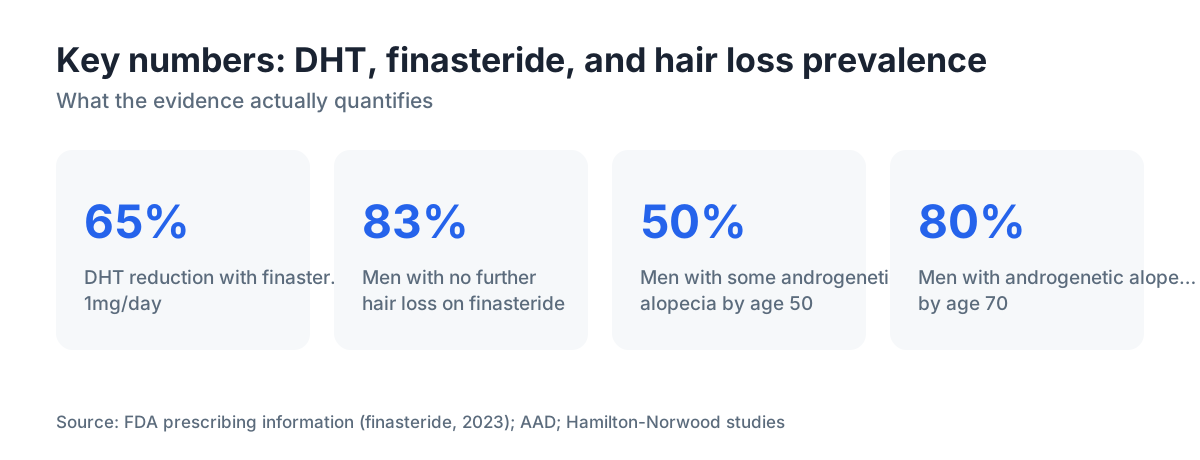
Men with 5-AR type 2 deficiency (who produce almost no DHT from testosterone) also do not develop androgenetic alopecia [2]. Finasteride works precisely by blocking 5-AR type 2, reducing scalp DHT by roughly 60-70% while leaving testosterone largely unchanged [6]. The FDA-approved labeling for finasteride describes this mechanism directly, and studies show it slows hair loss progression in roughly 83% of men who take it [6]. You can read more about how it works at finasteride.
The point is: normal testosterone variation, like what might occur after ejaculation, is not the rate-limiting step for hair loss. The rate-limiting step is your follicle's local sensitivity to DHT.
Could nofap or semen retention protect your hair?
"NoFap" and "semen retention" communities often claim that abstinence raises testosterone and DHT and is therefore either good for performance or, contradictorily, a hair-saving strategy. These claims pull in opposite directions because the community is not internally consistent about whether DHT is desirable or harmful.
From a hair standpoint: if abstinence temporarily raised DHT (which the data does not show), that would be bad for anyone with follicle sensitivity. If abstinence lowered DHT (also not shown), it might be marginally protective. Neither scenario has evidence behind it.
Surveys of self-reported NoFap users describe a grab-bag of perceived effects, but they lean entirely on self-report and carry heavy selection bias. No objective hormone panels get collected in that setting. "Perceived" changes in hair or energy tell you more about expectation than about DHT.
The honest answer is that your ejaculation frequency is almost certainly irrelevant to your hairline trajectory. If you have a genetic predisposition to androgenetic alopecia, the follicle miniaturization process is already in motion at your scalp's tissue level. Whether you ejaculate once a week or once a day will not meaningfully change that process.
What does change it: finasteride, minoxidil, and in later stages, surgical options. Nothing in the semen retention literature competes with those.
What else gets mistaken for a DHT cause?
The ejaculation claim is not the only thing people wrongly blame for elevated DHT. A few others worth knowing:
Creatine is the most prominent recent example. A 2009 study from South Africa found that rugby players supplementing with creatine showed a rise in the DHT-to-testosterone ratio, not in DHT itself [7]. Hair loss was not measured at all. Yet the finding spread as "creatine causes hair loss." For a full breakdown, see does creatine cause hair loss.
High-protein diets get blamed. Biotin deficiency gets blamed (usually incorrectly unless you actually have a deficiency). Stress is blamed and here, unlike the others, there is real mechanism: acute stress can trigger telogen effluvium, a temporary shedding event, though this is distinct from androgenetic alopecia and usually reverses.
The common thread is that hair loss is visible, distressing, and feels like it should have a controllable cause. People pattern-match lifestyle behaviors to their shedding timeline and draw causal conclusions from coincidence. Androgenetic alopecia develops over years and is mostly genetic. It was going to happen regardless of the supplement or behavior that gets blamed.
If you're tracking your own hairline changes and want an objective baseline, MyHairline's free AI hair scan can map your current pattern against the Norwood stages and flag whether what you're seeing looks like androgenetic alopecia or something else.
What does actually raise DHT levels?
Since the question is about DHT, it is worth knowing what does move the needle:
Exogenous androgens. Anabolic steroid use is the biggest driver of accelerated androgenetic alopecia in young men. Synthetic androgens (especially those that are potent DHT precursors or DHT analogs like trenbolone or oxandrolone) flood the 5-AR system and massively accelerate follicle miniaturization in genetically predisposed men [8]. This is a real, documented effect.
Obesity and insulin resistance. Higher body fat is associated with altered androgen metabolism, including increased conversion via aromatase and changes in sex hormone-binding globulin (SHBG), which affects how much testosterone is free and available for conversion to DHT [9].
Certain supplements. DHEA supplements raise downstream androgens including DHT. Some men who take testosterone therapy or testosterone boosters see scalp DHT rise as a consequence, though the degree depends on individual 5-AR activity.
Genetic variation in 5-AR. This is the biggest factor that doesn't get talked about enough. SRD5A2 gene variants (which encode 5-AR type 2) can raise or lower basal DHT production independent of testosterone. This is baked in from birth.
None of these involve ejaculation. Ejaculation is a physiological process that releases accumulated seminal fluid. It does not deplete testosterone stores, because testosterone is a hormone produced continuously by Leydig cells in the testes, not stockpiled with sperm.
What treatments actually reduce scalp DHT?
If your concern is DHT-driven hair loss, here is what the evidence supports.
Finasteride (oral, 1 mg/day). The FDA approved finasteride for male androgenetic alopecia in 1997. It inhibits 5-AR type 2, reducing serum and scalp DHT by approximately 60-70%. The main trials showed that 83% of men who took it experienced no further hair loss over 2 years, and 66% experienced measurable regrowth [6]. It requires a prescription.
Dutasteride. Inhibits both 5-AR type 1 and type 2, reducing DHT by over 90%. Approved in some countries for alopecia (not yet in the US for this indication, though used off-label). More potent DHT suppression but also a broader side-effect profile.
Topical finasteride. A 0.25% topical solution reduces scalp DHT with lower systemic absorption than oral finasteride. Some evidence it causes fewer sexual side effects, though the data is less mature.
DHT blocker supplements (saw palmetto, pumpkin seed oil). These show modest activity in small trials but nothing close to prescription-grade 5-AR inhibitors. Treat them as a very soft option, not a replacement.
Minoxidil. Does not block DHT but counteracts follicle miniaturization through a different mechanism (vasodilation and possible direct follicle stimulation). Minoxidil for men is still the most widely used first-line treatment, and combining it with finasteride is more effective than either alone. See finasteride and minoxidil for the combination evidence.
For later-stage loss, hair transplant remains the only way to restore density where follicles have already died.
Should I change my ejaculation habits to protect my hair?
No. There is no credible evidence that changing how often you ejaculate will slow, stop, or accelerate hair loss. The decision about ejaculation frequency is yours to make on grounds that matter to you, none of which have anything to do with your scalp.
If you're noticing a receding hairline or increased shedding, the productive steps are: get a realistic picture of your current Norwood stage, understand whether it's androgenetic alopecia or something like telogen effluvium or another cause, and then decide if you want to intervene with a treatment that has actual evidence behind it.
Androgenetic alopecia is one of the most studied conditions in dermatology. The American Academy of Dermatology (AAD) recommends minoxidil as a first-line over-the-counter option and notes that finasteride requires a prescription but has strong evidence for slowing progression in men [10]. Neither the AAD nor any peer-reviewed dermatology guideline mentions ejaculation frequency as a relevant factor.
If you want a second opinion on what your hairline looks like right now, MyHairline offers a free AI scan at /scan that can give you a Norwood stage estimate and flag whether what you're seeing is typical androgenetic progression.
Summary: what the evidence actually says
Here is the honest state of play.
One small study found a transient testosterone spike after 3 weeks of abstinence. DHT was never measured in that study. The spike reversed. No replication study has confirmed the finding at scale.
No study has found that ejaculation frequency changes scalp DHT levels. No study has found that ejaculation frequency changes the rate of androgenetic alopecia progression. The biological mechanism by which ejaculation would affect follicle miniaturization does not exist in the peer-reviewed literature.
Androgenetic alopecia is driven by genetic sensitivity of scalp follicles to DHT. The treatments that work do so by either reducing DHT (finasteride, dutasteride) or protecting follicles from miniaturization through other pathways (minoxidil). Ejaculation frequency belongs in neither category.
Spend your energy on what moves the needle: an honest assessment of your pattern, a conversation with a dermatologist or GP about finasteride if you're early-stage, and minoxidil if you want an OTC option you can start today.
Sources
- Jiang M et al., Journal of Endocrinology, 2003
- Kaufman KD, Journal of Investigative Dermatology Symposium Proceedings, 1996
- American Academy of Dermatology, Hair Loss Overview
- Andrology journal, review of ejaculation frequency and androgen levels, 2021
- Hughes IA et al., Lancet, Androgen Insensitivity Syndrome review
- FDA, Propecia (finasteride 1mg) prescribing information
- Shapiro J, New England Journal of Medicine, Hair Loss in Men, 2007
- Traish AM et al., Journal of Andrology, Obesity and testosterone metabolism, 2011
- American Academy of Dermatology, Hair Loss Treatment Recommendations
- Hamilton JB, American Journal of Anatomy, Male hormone stimulation as a prerequisite for hair loss, 1942 (Hamilton-Norwood classification basis)