

TL;DR: Telogen effluvium has no single confirmatory test. Dermatologists diagnose it by combining a detailed history of stressors 2-4 months before shedding, a scalp exam, the hair pull test, and targeted bloodwork to rule out thyroid disease, iron deficiency, or nutritional gaps. A scalp biopsy is used only when the diagnosis stays unclear after everything else.
What is telogen effluvium and why is it hard to pin down?
Telogen effluvium is diffuse, temporary shedding that happens when a physical or emotional stressor pushes an unusually large share of growing follicles into the resting (telogen) phase all at once. Normally about 10-15% of your scalp follicles sit in telogen at any given time. In telogen effluvium that share can climb to 30% or higher, which is why clumps suddenly show up on your pillow or clog the shower drain [1].
The hard part is timing. The shed doesn't happen when the stressor hits. Hair pushed into telogen stays anchored for roughly 2-3 months before it lets go, so by the time you notice the problem, the original cause may feel unrelated or already behind you [2]. That 2-4 month lag is the single biggest reason people dismiss the real culprit.
There's also no blood test that says "you have telogen effluvium." The diagnosis is clinical. A doctor builds a picture from your history, the exam, and labs that rule out other conditions rather than confirm this one. That distinction matters if you're trying to make sense of your own workup.
For a broader look at what sets off this and other forms of shedding, the telogen effluvium overview explains the mechanism in more depth.
What does a dermatologist actually do during the diagnostic visit?
The visit has three parts, and the first is almost entirely talking.
History. A good dermatologist asks about everything that happened 2-5 months before the shedding started, not the week before. They're hunting for major illness or fever, surgery or hospitalization, childbirth (postpartum telogen effluvium accounts for a large share of cases), crash diets or significant weight loss, starting or stopping hormonal contraceptives, new medications, thyroid or autoimmune diagnoses, and severe emotional stress. They'll ask how long you've been shedding, whether it's getting worse or better, and whether permanent hair loss runs in your family (which points toward androgenetic alopecia instead) [3].
Physical scalp exam. The doctor looks at where the hair is thinning. Telogen effluvium thins diffusely across the whole scalp. It doesn't recede at the temples or carve out bald patches. They also check for inflammation, scaling, or scarring, any of which suggests a different diagnosis entirely.
The pull test. This is the closest thing to a bedside diagnostic. The doctor grasps 40-60 hairs between thumb and forefinger, applies gentle traction, and counts what comes out. Pulling more than 6 hairs (some sources use a threshold of 3 or more) from a single grab is a positive test and suggests active shedding [3][4]. It's imperfect because recent washing skews it, but it tells the doctor in real time whether the effluvium is still going.
By the end of the history and exam, the dermatologist has a working diagnosis in most cases. Labs and other tests confirm or exclude. They don't build the diagnosis from scratch.
Which blood tests are ordered and what are they actually looking for?
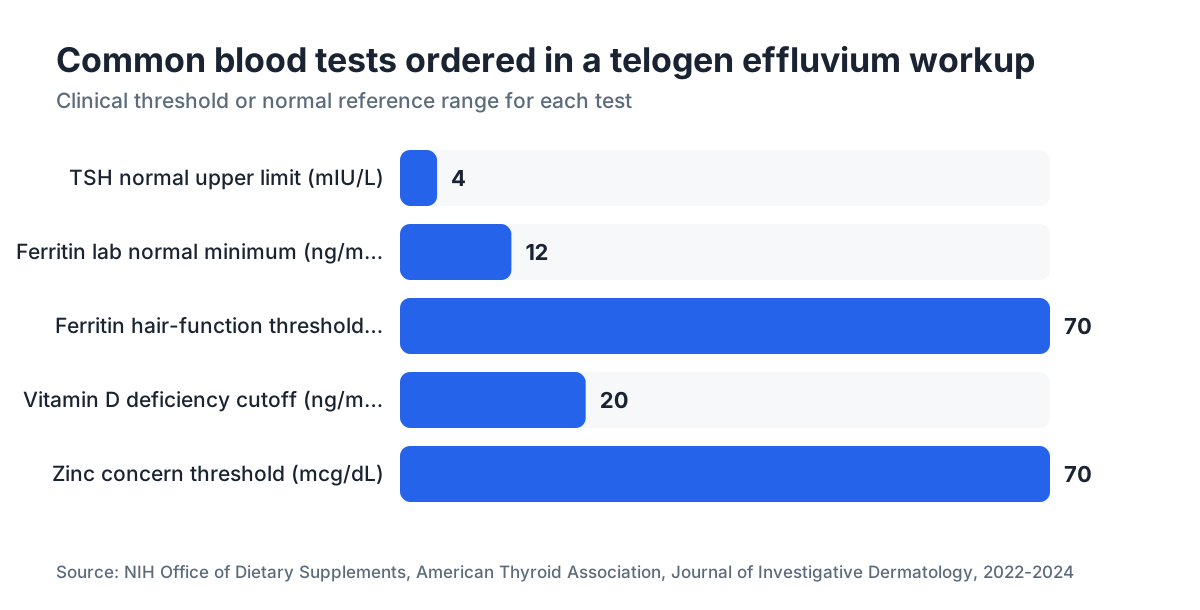
The American Academy of Dermatology notes that lab testing in diffuse hair loss is used to exclude treatable systemic causes, not to confirm telogen effluvium itself [3]. The standard panel most dermatologists order looks like this:
| Test | What it screens for | Key threshold |
|---|---|---|
| TSH (thyroid-stimulating hormone) | Hypothyroidism or hyperthyroidism | Normal range roughly 0.4-4.0 mIU/L [5] |
| Serum ferritin | Iron stores (depleted ferritin is common in TE) | Many hair experts use a threshold of >70 ng/mL for hair; lab "normal" can be as low as 12 ng/mL [6] |
| CBC (complete blood count) | Anemia | Hemoglobin and hematocrit |
| Serum zinc | Zinc deficiency | Below 70 mcg/dL raises concern |
| Vitamin D | Deficiency linked to hair cycling | Below 20 ng/mL is deficient per NIH [7] |
| ANA (antinuclear antibody) | Lupus and autoimmune alopecia | Positive prompts further workup |
| Free T4, free T3 | Deeper thyroid assessment if TSH is borderline | Varies by lab |
The ferritin threshold is genuinely contested. A lab report might flag your ferritin as "normal" at 15 ng/mL, but dermatology researchers have argued the functional threshold for hair growth sits higher, perhaps 40-70 ng/mL [6]. A "normal" result doesn't mean ferritin is off the hook. Ask your doctor for the actual number.
Hormonal panels (DHEA-S, free testosterone, SHBG, prolactin) get added when there are signs of androgen excess like irregular periods, acne, or hirsutism, or when androgenetic alopecia is also on the table.
A note on cost. A standard TE blood panel runs roughly $80 to $400 out of pocket without insurance, depending on which tests are included and whether your lab is in-network. Many are covered when ordered for a documented medical reason.
What is the hair pull test and how reliable is it?
The pull test (also called the tug test or manual hair pull) is simple to do and tricky to read. The examiner grasps a bundle of about 40-60 hairs near the scalp and pulls firmly from root to tip. Extracting 6 or more club hairs (hairs with a small, white, rounded bulb at the root) is positive [4]. Club hairs are telogen hairs, and a lot of them confirms active shedding.
The test has real limits. Wash your hair that morning and the loose telogen hairs are already gone, so the test can read falsely negative. Skip washing for several days and loose hairs pile up, so the test can read worse than the truth. Because of that swing, most dermatologists ask patients not to wash for at least 24 hours before the appointment.
A negative pull test doesn't rule out telogen effluvium. If the condition is in its late, resolving phase, the telogen proportion may already be dropping back to normal even though heavy shedding happened weeks ago.
Dermatoscopy (a handheld magnifier with polarized light) adds information by letting the doctor study individual hair shaft diameters and follicle density without touching the hair. This helps separate telogen effluvium from androgenetic alopecia, where miniaturized, thin hairs are the giveaway [8].
When does a doctor order a scalp biopsy for hair loss?
Most cases of telogen effluvium are diagnosed without a biopsy. A biopsy comes into play when the picture is mixed or when the condition won't resolve on schedule.
Specific situations that push a dermatologist toward biopsy:
- The hair loss has lasted more than 6 months (chronic telogen effluvium) and the cause stays unexplained
- Androgenetic alopecia and telogen effluvium can't be told apart clinically, which happens more often in women
- Scarring alopecia (lichen planopilaris, frontal fibrosing alopecia) needs to be excluded because it's permanent and treated differently
- The pull test is strongly positive but the bloodwork is all normal
The procedure is quick. The dermatologist numbs a small area (usually the top or back of the scalp), removes one or two skin punches 4mm across, and sends them to a dermatopathologist. Horizontal sectioning is preferred over vertical for hair loss biopsies because it captures more follicle cross-sections per specimen [9].
The pathologist reports back a terminal-to-vellus hair ratio and a telogen-to-anagen ratio. In active telogen effluvium, the telogen count is elevated (often above 25%) with no sign of follicular miniaturization. Miniaturization, when it's there, confirms androgenetic alopecia is either the main diagnosis or a second one riding along [9].
A biopsy won't tell you why the effluvium happened. It confirms the pattern. Finding the trigger still comes down to the history.
How do doctors tell telogen effluvium apart from androgenetic alopecia?
This is the most common mix-up, especially in women. Both conditions thin the top of the scalp. Both can run together in the same person. Getting it right matters a lot because the treatments have nothing in common.
The distinguishing features:
Pattern. Telogen effluvium thins diffusely and evenly. Androgenetic alopecia in women follows a central part widening pattern (Ludwig scale) or diffuse thinning worst at the crown, and in men it follows the Norwood scale with recession at the temples and crown [10]. A receding hairline in a young man alongside diffuse shedding should trigger evaluation for both.
Timeline. Telogen effluvium usually starts abruptly, often within 2-4 months of a stressor. Androgenetic alopecia creeps along over years.
Dermatoscopy findings. Miniaturized hairs, hair shaft diameter variability greater than 20%, and single-hair follicular unit prevalence above 65% all point toward androgenetic alopecia [8]. Telogen effluvium shows mostly equal-diameter hairs with no miniaturization.
Pull test distribution. In androgenetic alopecia, the pull test is more positive over the crown than the back. In telogen effluvium, it's roughly equal across the scalp.
Family history. Useful, not decisive. You can have androgenetic alopecia with no family history, and relatives with hair loss don't prove that's your diagnosis.
When both conditions are present at once, a biopsy (showing miniaturized follicles alongside an elevated telogen ratio) is often the only way to confirm it. This matters practically. Someone with pure telogen effluvium who gets put on finasteride for a misdiagnosis of androgenetic alopecia is taking on a drug's side effect profile for no reason.
For a fuller picture of the causes being ruled out here, the what causes hair loss article covers the whole differential.
Can you diagnose telogen effluvium at home before seeing a doctor?
Sort of, but with real limits.
You can run a rough pull test yourself. Grasp about 40 hairs between two fingers, pull gently but firmly from scalp to tip. Six or more club hairs (look for the small white or translucent bulb at the root) suggests active shedding. It's most reliable if you haven't washed in 24 hours.
You can also count hairs in your brush or on your pillow. The widely cited figure is that losing more than 100-150 hairs a day is outside normal variation, though the threshold is imprecise [2]. Collecting hairs in a bag for 3-5 days and counting gives a rough baseline.
What home assessment can't do is confirm the cause, measure your ferritin, check your thyroid, or separate telogen effluvium from early androgenetic alopecia. If you're shedding at a rate that worries you, the dermatologist visit is worth it.
MyHairline's free AI hair scan at myhairline.ai/scan gives you a starting read on your hairline and shedding pattern before you see a doctor, which helps you show up with sharper questions. It's a screening tool, not a diagnosis.
One practical tip. Photograph your scalp under consistent lighting (same spot, same time of day) every week starting now. Dermatologists constantly ask how your hair looked 6 months ago, and a visual record beats memory every time.
What triggers are doctors specifically trying to identify?
The history is doing most of the diagnostic work, and what the doctor wants to find is a significant physical or emotional stressor in the 2-4 months before shedding began. The common ones:
Postpartum hair loss. Estrogen surges during pregnancy keep hair in the anagen (growing) phase, so many women enjoy thicker hair while pregnant. After delivery, estrogen drops sharply and all that extra anagen hair shifts into telogen at once. Shedding usually peaks around 3-4 months postpartum and resolves by 12 months in most women [2].
Illness and fever. Any illness with a high fever (COVID-19, flu, severe infection) can set off telogen effluvium. A 2021 study in The Lancet found hair loss was among the persistent post-COVID symptoms reported by a significant minority of patients [11].
Surgery and hospitalization. General anesthesia and the physiological stress of major procedures are known triggers.
Crash diets and rapid weight loss. Very low calorie diets (below about 1,000-1,200 kcal/day) and rapid weight loss (more than 1-1.5 lbs per week sustained) create protein and micronutrient deficits that throw off the hair cycle.
Thyroid disease. Both hypothyroidism and hyperthyroidism cause diffuse shedding, which is why TSH gets ordered nearly every time. The shedding here isn't classic telogen effluvium, but the presentation overlaps heavily.
Iron deficiency. Low ferritin is one of the most consistently fixable causes of shedding in women. Correcting it doesn't always reverse hair loss right away, but it's a logical place to start.
Medications. A long list of drugs triggers telogen effluvium, including anticoagulants, retinoids, beta-blockers, ACE inhibitors, antidepressants, and some cholesterol medications. The FDA drug label for each one lists alopecia as a possible side effect when it applies [12]. Started a new medication 2-4 months before the shedding began? Bring it to the appointment.
Psychological stress. Bereavement, divorce, job loss, and other severe life events can trigger shedding. This gets dismissed too easily, but the mechanism (cortisol and stress hormones disrupting the hair cycle) is well-documented.
How long does the diagnostic process take?
The first visit, including history, exam, and pull test, takes 20 to 40 minutes. Blood results come back within 1 to 5 business days depending on the lab.
If a biopsy is ordered, results usually take 2 to 3 weeks because dermatopathology processing is slow.
The harder answer is that diagnosing telogen effluvium is iterative. You get an initial diagnosis, treat any identified causes (supplement iron, address thyroid, stop the offending drug), then wait 3 to 6 months to see whether shedding settles. If it doesn't, the diagnosis gets revisited.
Chronic telogen effluvium, defined as diffuse shedding lasting more than 6 months, needs more investigation because the triggering cause often isn't the same as in the acute form. In chronic cases, bloodwork is frequently repeated, a biopsy is more commonly ordered, and the possibility of two concurrent diagnoses (chronic TE plus early androgenetic alopecia) gets taken more seriously [9].
The waiting period is often the hardest part. Shedding peaks before it stops, so the first few months after finding a cause and starting treatment can look like things are getting worse before they get better. That's normal, and it's one reason dermatologists ask patients to reassess at 6-month intervals.
What does "ruling out other causes" actually mean in practice?
Dermatologists mention ruling out other diagnoses almost every time they explain telogen effluvium. Here's what they're actually excluding.
Alopecia areata shows up as patchy, sudden loss rather than diffuse thinning. The pull test around patch borders is strongly positive. Exclamation mark hairs (hairs that taper as they near the scalp) are a hallmark. A dermatoscope makes them easier to spot.
Androgenetic alopecia (covered above) is excluded by pattern, dermatoscopy, family history, and biopsy if needed.
Scalp disorders. Seborrheic dermatitis, psoriasis, and fungal infection (tinea capitis) all cause hair loss and get excluded by scalp exam. A KOH preparation (scraping some scale and dissolving it in potassium hydroxide to look for fungal elements under a microscope) can be done in-office.
Lupus. Discoid lupus causes scarring hair loss. Systemic lupus causes diffuse shedding. An ANA plus clinical exam separates these.
Trichotillomania. This is hair pulling, not shedding, and it leaves irregular patches with broken hairs of varying lengths. The history and scalp appearance usually give it away, but it gets missed.
Secondary syphilis. Known as "moth-eaten" alopecia in dermatology teaching. An RPR or VDRL test is ordered when it's on the differential.
None of these need extensive investigation when the history is clean (classic stressor, right timing, diffuse shedding, no other symptoms). When the history is murky, the exam is atypical, or the bloodwork is all normal, dermatologists widen the net.
If you're also weighing whether treatments like minoxidil for men fit alongside a TE diagnosis, the real question is whether androgenetic alopecia is running concurrently. Minoxidil may modestly speed regrowth in telogen effluvium, but the evidence is far stronger for androgenetic alopecia.
What happens after the diagnosis is confirmed?
Treating telogen effluvium means treating the cause. No drug is FDA-approved specifically for telogen effluvium. The evidence base for cause-specific interventions:
- Iron deficiency: Replenishing ferritin (typically oral iron, 150-200 mg elemental iron per day in divided doses) corrects the deficiency, but regrowth lags the correction by months [6].
- Thyroid disease: Treating hypothyroidism or hyperthyroidism usually resolves the shedding within 6-12 months of thyroid levels normalizing.
- Nutritional deficiency: Correcting zinc, vitamin D, or protein intake. The case for supplementing when there's no documented deficiency is much weaker, and the evidence for most hair loss supplements marketed for this is thin.
- Medication-induced TE: Switching to an alternative drug when possible. This takes a conversation with the prescribing physician.
- Postpartum TE: Usually resolves on its own. No intervention has been shown in controlled trials to speed recovery meaningfully.
Minoxidil is sometimes used off-label in stubborn cases. The published evidence for telogen effluvium specifically is limited, but it's FDA-approved for androgenetic alopecia and has a well-understood safety profile at 2% and 5% topical strengths and at low oral doses. If you're reading up on minoxidil side effects before deciding, the two most common issues are initial shedding (paradoxical, temporary, and often mistaken for worsening) and scalp irritation.
For most people with acute telogen effluvium where the cause has been found and corrected, hair density returns to baseline within 6-12 months with no hair-specific treatment at all. The prognosis is genuinely good.
MyHairline's free AI scan can track visible changes over time once you're in the recovery phase, giving you an objective baseline to compare against as the months pass.
What should you bring to your first dermatology appointment?
Walking in prepared makes the visit faster and the diagnosis sharper.
A timeline of events. Write out, month by month, everything significant in the 6 months before you noticed shedding: illnesses, surgeries, medication changes, dietary changes, pregnancy or delivery, major stressors. Don't edit for relevance. Let the doctor filter it.
A medication list. Every prescription, over-the-counter drug, supplement, and herbal product. Include start dates where you know them.
Photos. Before-and-after scalp photos if you have them. Even casual shots from 6-12 months ago help the doctor judge how much has changed.
A hair sample. Some dermatologists ask patients to collect all shed hairs from a 24-hour period and bring them in. Call ahead to check whether yours wants this.
Your menstrual history if you're a woman. Irregular cycles, recently stopping oral contraceptives, or perimenopausal symptoms all add hormonal context.
Questions. Ask directly: "Is this consistent with telogen effluvium, androgenetic alopecia, or possibly both?" and "What's the one most likely cause you'd address first?" Those two questions move the conversation toward a practical plan faster than anything else.
Sources
- American Academy of Dermatology, Hair Loss Overview
- StatPearls (NCBI Bookshelf), Telogen Effluvium
- American Academy of Dermatology, Diagnosis and Treatment of Hair Loss
- Journal of the American Academy of Dermatology, Tosti A et al., Hair pull test
- American Thyroid Association, Thyroid Function Tests
- Journal of Investigative Dermatology, Trost LB et al., The Role of Iron and Zinc in Hair Loss
- National Institutes of Health, Office of Dietary Supplements, Vitamin D Fact Sheet
- Journal of the American Academy of Dermatology, Olsen EA et al., Dermatoscopy in Hair Loss Diagnosis
- Journal of Cutaneous Pathology, Elston DM et al., Horizontal sectioning of scalp biopsies
- American Academy of Dermatology, Female Pattern Hair Loss
- The Lancet, Huang C et al., 6-month consequences of COVID-19 in patients discharged from hospital
- U.S. Food and Drug Administration, Drug Label Database