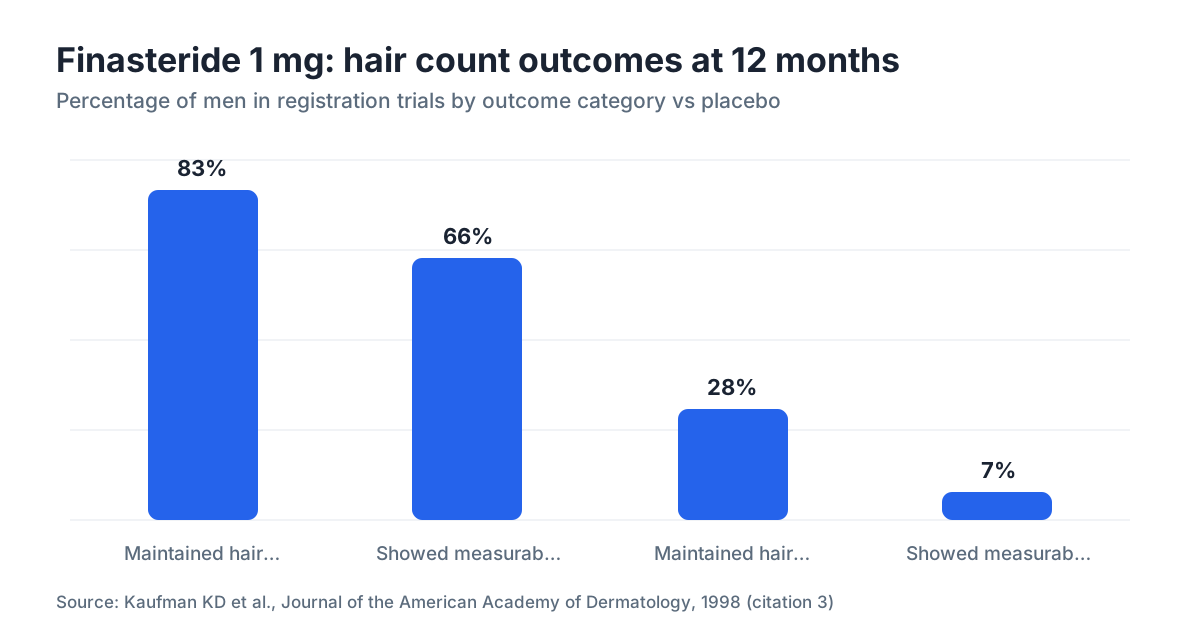
TL;DR: Finasteride starts blocking DHT within hours of your first dose, but you won't see visible results for 3 to 6 months. Shedding usually stabilizes first. Real regrowth, if it comes, shows up between months 6 and 12. Studies show about 83% of men keep their hair and roughly 66% see measurable regrowth after one year of daily 1 mg use.
What does finasteride actually do, and why does it take so long?
Finasteride is a 5-alpha reductase type II inhibitor. It blocks the enzyme that converts testosterone into dihydrotestosterone (DHT), the androgen that shrinks hair follicles in men with androgenetic alopecia. A single 1 mg oral dose cuts serum DHT by roughly 60 to 70% within 24 hours [1]. Scalp DHT drops even further, by around 60% after 42 days of continuous use [2].
The drug does its job almost immediately. The delay in visible results has nothing to do with finasteride being slow. It has everything to do with the hair follicle cycle.
Each follicle moves through three phases: anagen (active growth, lasting 2 to 6 years), catagen (a brief transition), and telogen (resting, about 3 months). When DHT has been damaging follicles for years, many are stuck cycling through shortened anagen phases, producing thinner and thinner hairs. Finasteride doesn't flip a switch. It removes the damaging signal, and then you wait for the follicle to recover, re-enter a longer anagen phase, and grow a visibly thicker hair shaft. That process, from follicle rescue to a hair you can see in the mirror, takes at least one full growth cycle. That's months, not weeks.
This is the one fact most prescribers don't explain clearly enough, and it's why so many men quit too early. Learn more about how DHT drives follicle miniaturization in our guide to dht blocker.
What is the month-by-month finasteride timeline?
Here is an honest, phase-by-phase breakdown of what the clinical evidence and dermatology practice actually show.
Weeks 1 to 4: Nothing visible, but DHT is already dropping
Your serum and scalp DHT levels fall a lot in the first few weeks [1]. You won't see any change in the mirror. Some men report no change at all in shedding during this period. A small number notice slightly increased shedding early on, which is covered below.
Months 1 to 3: Possible increase in shedding
This is where some men panic and stop. When DHT drops, follicles that were stuck in miniaturized cycles can be nudged into a new telogen phase before re-entering anagen. The result is a temporary, normal uptick in shedding. This phenomenon, sometimes called a medication-induced telogen effluvium, can last a few weeks to a couple of months. It is not a sign the drug is failing. It's often the opposite.
Months 3 to 6: Shedding stabilizes, early density changes
For most men, this is when shedding noticeably slows or returns to baseline. Some report the first signs of early regrowth: fine, vellus-like hairs along a hairline or on the crown. These are real but fragile. Don't get excited yet about final results.
Months 6 to 12: Visible regrowth appears
The finasteride 1 mg registration trials that supported FDA approval showed that at 12 months, roughly 66% of men had measurable hair count increases versus baseline [3]. The American Academy of Dermatology notes that finasteride's effects on hair growth are typically assessed at one year [4]. The vertex (crown) tends to respond better than the frontal hairline, though both can improve.
Month 12 and beyond: Peak results
The two-year data from the registration trials shows continued improvement in hair count between months 12 and 24 [3]. Men who are going to respond well generally know by month 12 whether the drug is working. If you've lost no additional ground after 12 months, finasteride is working, even if the regrowth is modest.
| Timeframe | What typically happens |
|---|---|
| Weeks 1 to 4 | DHT suppressed ~60 to 70%; no visible change |
| Months 1 to 3 | Possible increased shedding (temporary telogen effluvium) |
| Months 3 to 6 | Shedding stabilizes; faint early regrowth may appear |
| Months 6 to 12 | Visible regrowth in ~66% of men; density increases |
| Months 12 to 24 | Peak results; continued slow improvement |
| After stopping | DHT returns to baseline within ~2 weeks; losses resume within months |
How much hair can you realistically expect to regrow?
The Merck-sponsored trials that formed the basis of FDA approval for finasteride 1 mg used standardized 1 cm² scalp photographs and hair count assessments. At one year, men on finasteride 1 mg showed an average increase of about 107 hairs per cm² at the vertex compared to men on placebo, who lost hairs over the same period [3]. That's a meaningful difference, but it varies enormously by individual.
About 83% of men in the two-year trials kept their hair count, meaning they didn't lose more ground [3]. That's probably the most honest number to hold onto: the main job of finasteride is to stop further loss, and it does that for most men. Regrowth is real but variable.
Younger men, men earlier in their hair loss progression, and men with receding hairline patterns at Norwood II to III tend to respond better than men with advanced loss at Norwood V or VI. At those advanced stages, the follicles themselves may be too far gone to recover.
Want to speed results up? Combining finasteride with topical or oral minoxidil has stronger evidence than either drug alone. A network meta-analysis found combination therapy produced greater increases in hair count than either monotherapy [5]. See our comparison of finasteride and minoxidil for the full breakdown.
Why does finasteride work better for some men than others?
Genetics drives most of the variation. The androgen receptor gene on the X chromosome has variants that affect how sensitively follicles respond to DHT, and by extension how well they recover when DHT is removed. Men with certain SRD5A2 gene variants (which code for the type II 5-alpha reductase enzyme) may metabolize finasteride differently, changing how much DHT gets suppressed [6].
Age matters too. Finasteride can't regenerate follicles that are fully fibrosed, which tends to happen after decades of DHT exposure. A 25-year-old at Norwood II and a 55-year-old at Norwood V are taking the same drug from very different starting points.
Compliance is underrated. Finasteride needs to be taken daily. Missing doses regularly undermines DHT suppression, because the half-life of finasteride is only about 6 to 8 hours in younger men, though DHT suppression persists somewhat longer thanks to enzyme binding [2]. Men who take it inconsistently often report weaker results and then blame the drug.
Curious what's actually driving your own hair loss? A structured hair loss analysis can give you a clearer picture of your pattern and progression before you commit to treatment.
Is the early shedding on finasteride normal?
Yes, and it's probably the single most common reason men quit too soon. When finasteride clears DHT from the follicular environment, miniaturized follicles that were barely cycling can shift into telogen all at once. The result looks like accelerated shedding for a few weeks to a couple of months.
This is the same mechanism behind the shedding that happens at the start of minoxidil use, and dermatologists recognize it well. The American Academy of Dermatology's clinical guidelines describe this initial shedding phase as a known and expected response [4].
If the shedding started within the first 2 months, it's almost certainly this telogen shift. If heavy shedding is still happening at month 4 or 5, that's worth bringing up with a dermatologist, because something else may be going on. Read more about the condition in our guide to telogen effluvium.
The practical advice: take progress photos every 4 to 6 weeks under the same lighting. Shedding feels alarming but doesn't show up the same way in photos taken in consistent conditions. Photos keep you honest.
What happens if you stop taking finasteride?
DHT returns to pre-treatment levels within about 14 days of stopping finasteride [1]. Hair loss resumes, usually within 6 to 12 months of stopping, and the hair you gained or kept during treatment gradually falls out.
This is not a flaw in the drug. It's how it works: finasteride manages androgenetic alopecia, it doesn't cure it. The underlying genetic sensitivity to DHT stays unchanged.
Some men decide the side effect profile isn't worth it and stop. Others stop because they feel they've hit a satisfying result and want to see if they can hold it. Both are valid choices, but the data is clear that stopping leads to loss of benefit over the following year or two.
If you're thinking about stopping because of side effects, talk to a prescribing physician about the evidence, dose adjustments (some men use finasteride 5 times per week rather than daily as an off-label variation), or switching to topical finasteride, which some studies suggest may produce lower systemic DHT levels.
Does finasteride work for women?
This is complicated and off-label territory. Finasteride 1 mg is FDA-approved only for men with androgenetic alopecia [1]. It is not approved for women. The evidence in premenopausal women is weak because the trials were small and underpowered, and there is a serious teratogenicity concern: finasteride can cause genital abnormalities in a male fetus, so it is absolutely contraindicated in pregnancy.
That said, some dermatologists prescribe finasteride off-label to postmenopausal women with female-pattern hair loss at higher doses (2.5 mg or 5 mg). A 2020 review in the Journal of the American Academy of Dermatology noted evidence of benefit in postmenopausal women but called for larger randomized trials [7]. Any woman considering this should be under the care of a dermatologist who understands the risks.
For women, the AAD's primary recommended treatments for androgenetic alopecia are topical minoxidil 2% or 5% [4]. See our guide to what causes hair loss for more on how female-pattern loss differs mechanically.
How does finasteride compare to other hair loss treatments?
Fair question, and one worth answering with real numbers rather than marketing.
| Treatment | Mechanism | Approval status | Evidence of regrowth | Typical time to results |
|---|---|---|---|---|
| Finasteride 1 mg | DHT blocker (oral) | FDA-approved (men) | ~66% at 12 months [3] | 6 to 12 months |
| Minoxidil 5% topical | Vasodilator, prolongs anagen | FDA-approved (men + women) | ~40% at 12 months [4] | 4 to 6 months |
| Oral minoxidil (low-dose) | Same as topical, systemic | Off-label | Similar or better than topical [5] | 3 to 6 months |
| Ketoconazole 2% shampoo | Anti-androgen, anti-fungal | OTC / Rx | Limited; adjunct use [8] | Unclear |
| Hair transplant | Surgical redistribution | N/A | Permanent for transplanted hairs | 9 to 18 months for full growth |
| PRP injections | Growth factor stimulation | Off-label | Mixed; small studies only | 3 to 6 months |
Finasteride has the best oral medication evidence base for men with androgenetic alopecia, period. Its advantage over minoxidil alone is that it addresses the root hormonal cause rather than just extending the growth phase of existing hairs.
Combining finasteride with minoxidil for men is what most dermatologists recommend for anyone serious about results. That combination beats either drug alone in head-to-head and network meta-analyses [5]. If medications aren't producing enough results after 12 to 18 months, a hair transplant consultation starts to make sense, though finasteride should continue afterward to protect non-transplanted hairs.
What side effects should you watch for, and how common are they?
The FDA-approved label for finasteride 1 mg lists sexual side effects as the main concern. In the two placebo-controlled trials supporting approval, sexual adverse events occurred in roughly 3.8% of men on finasteride versus 2.1% on placebo [1]. The events reported included decreased libido, erectile dysfunction, and decreased ejaculate volume. In most men who had them, the effects resolved after stopping.
Post-market reports introduced the idea of post-finasteride syndrome (PFS), a claimed persistent sexual, neurological, and psychological dysfunction after stopping finasteride. The FDA added a label update in 2012 noting reports of persistent sexual side effects after discontinuation [1]. The scientific evidence on PFS as a defined syndrome remains contested. A 2021 review in JAMA Dermatology noted the absence of high-quality controlled studies confirming persistent effects beyond what would be expected in a general population [9].
Other side effects in the clinical trials included breast tenderness or enlargement (gynecomastia) in less than 1% of men, and hypersensitivity reactions in rare cases [1].
Depression and mood changes have been raised in post-market reporting but are not well-established in controlled trial data. If you notice mood changes after starting finasteride, take it seriously and talk to a doctor.
The practical takeaway: most men tolerate finasteride without noticeable side effects. The sexual side effects that do occur are usually reversible. The risk is real but statistically modest for the average man starting the drug in his 20s or 30s. Read the full overview of finasteride at finasteride for a deeper look at the evidence.
How do you track progress on finasteride so you know if it's working?
Most men make the mistake of checking the mirror daily, which is useless. Hair growth is slow enough that day-to-day changes in lighting and styling make it impossible to spot real trends.
What actually works:
Take standardized photos every 4 to 6 weeks. Same location, same light source (natural indirect daylight is best), hair damp and combed back the same way. The vertex (crown), the hairline, and the temples are the three spots worth photographing separately. A photo taken by someone else is often more accurate than a selfie because the angle stays more consistent.
Track shedding roughly. Count hairs in the shower drain or on a white pillowcase for a week each month. This is imprecise, but a clear downward trend between months 2 and 5 tells you the drug is reducing active fallout.
See a dermatologist at 6 and 12 months. Dermoscopy (trichoscopy) can pick up miniaturization patterns and hair shaft diameter changes that are invisible to the naked eye. This is how you get objective data instead of subjective impressions.
Want a structured starting point before you begin tracking? The free AI hair analysis at MyHairline can document your baseline hairline and density, which gives you something concrete to measure against as the months pass.
The goal of tracking is to avoid two failure modes: quitting at month 4 because you don't see results yet (too early) or staying on a drug for 18 months that genuinely isn't helping (too long without a reassessment).
Is 12 months really long enough to judge whether finasteride is working?
Twelve months is the standard clinical assessment point used in FDA approval trials and referenced in AAD guidelines [4]. It's a reasonable minimum. Most men who will respond have shown a meaningful signal by then.
But there are edge cases. Some men with significant miniaturization see continued, slow improvement between months 12 and 24 as more follicles recover. The two-year data from the registration trials showed ongoing improvement in hair count from year one to year two [3].
If at 12 months you've maintained your hair count (not lost more ground) but haven't seen regrowth, that's still a positive outcome. Stabilization is the drug doing its job. If you've kept losing hair at the same rate as before starting, that's either a genuine non-responder situation or a compliance problem worth investigating.
One variable to watch: if you added finasteride after already being on minoxidil for a year, your timeline resets somewhat. The two drugs together can produce regrowth over 18 to 24 months that wouldn't have appeared with either alone.
Sources
- FDA, Propecia (finasteride 1 mg) prescribing information
- Merck & Co., Propecia clinical pharmacology data (FDA submission)
- Kaufman KD et al., Journal of the American Academy of Dermatology, 1998 - finasteride 1 mg registration trial data
- American Academy of Dermatology, Clinical Guidelines: Alopecia
- Gupta AK et al., Journal of the American Academy of Dermatology, 2022 - network meta-analysis of hair loss treatments
- Zhu YI, Stiller MJ, American Journal of Clinical Dermatology, 2001 - genetics of androgenetic alopecia and 5-alpha reductase
- Starace M et al., Journal of the American Academy of Dermatology, 2020 - finasteride in postmenopausal women with androgenetic alopecia
- Piérard GE et al., European Journal of Dermatology, 2002 - ketoconazole shampoo in androgenetic alopecia
- Fertig R et al., JAMA Dermatology, 2021 - review of post-finasteride syndrome evidence
- van Neste D et al., British Journal of Dermatology, 2000 - finasteride hair cycle effects