
TL;DR: A Norwood 3 hairline usually needs 1,500 to 2,500 grafts. The exact number depends on how deep the recession is, how dense you want the result, and whether you have crown thinning (Norwood 3 vertex). That range covers the temples and frontal zone. Cost runs roughly $4,500 to $12,000 in the US at current per-graft rates.
What exactly is a Norwood 3, and why does it matter for graft counts?
Norwood 3 is the first stage the standard scale calls significant recession. The temples have pulled back to or beyond a line drawn between the ears, and the recession forms two deep triangular zones on either side of the frontal hairline. O'Tar Norwood published the classification in 1975, and it's still the language every surgeon uses [1].
There's also a Norwood 3 Vertex variant. The temple recession looks similar, but a separate thinning patch opens at the crown. That version needs more grafts. Settle which subtype you actually have before anyone quotes you a number.
Why does the classification matter this much? Every graft count you're quoted is really an estimate of how many follicular units it takes to cover a measured area of bald or thinning scalp at a density that reads as natural. Misclassify a Norwood 3 vertex as a plain Norwood 2 and the whole plan is wrong from the first cut.
The recession in a typical non-vertex Norwood 3 covers roughly 40 to 60 square centimeters total across both temples and the frontal zone [2]. That area, multiplied by your target density, is the engine behind every estimate you'll get.
How is the actual graft number calculated?
Surgeons measure the recipient area and multiply by desired density. That's the whole method. Published density targets for the hairline zone run 45 to 55 follicular unit grafts per square centimeter, though many surgeons use 40 to 50 in the frontal third and accept slightly lower density mid-scalp [2].
The math is simple. Take a 50 cm² recipient area, a fair midpoint for Norwood 3, and multiply by 40 grafts/cm². That's 2,000 grafts. Push density to 50 and you need 2,500. Drop to 35 and you're at 1,750. Almost all the variation in published Norwood 3 ranges traces back to those two variables: measured area and target density.
A few other things nudge the number:
- Hairline design. A lower, more aggressive hairline covers more area, so it costs more grafts.
- Native density. If fine vellus hairs still live in the recession zone, you may need fewer grafts to hit the visual threshold for fullness.
- Hair caliber. Coarse dark hair covers more visual surface per graft than fine light hair. A man with thick black hair might get the same apparent fullness from 1,800 grafts that a man with fine blond hair needs 2,400 to match.
- Graft composition. Follicular units carry 1 to 4 hairs. A plan built on multi-hair grafts reaches target density faster than one leaning on singles.
Good surgeons show you a diagram with real measurements before naming a number. Be skeptical of any quote handed to you over email, with no physical or video exam behind it.
What is the typical graft range for Norwood 3, broken down by subtype?
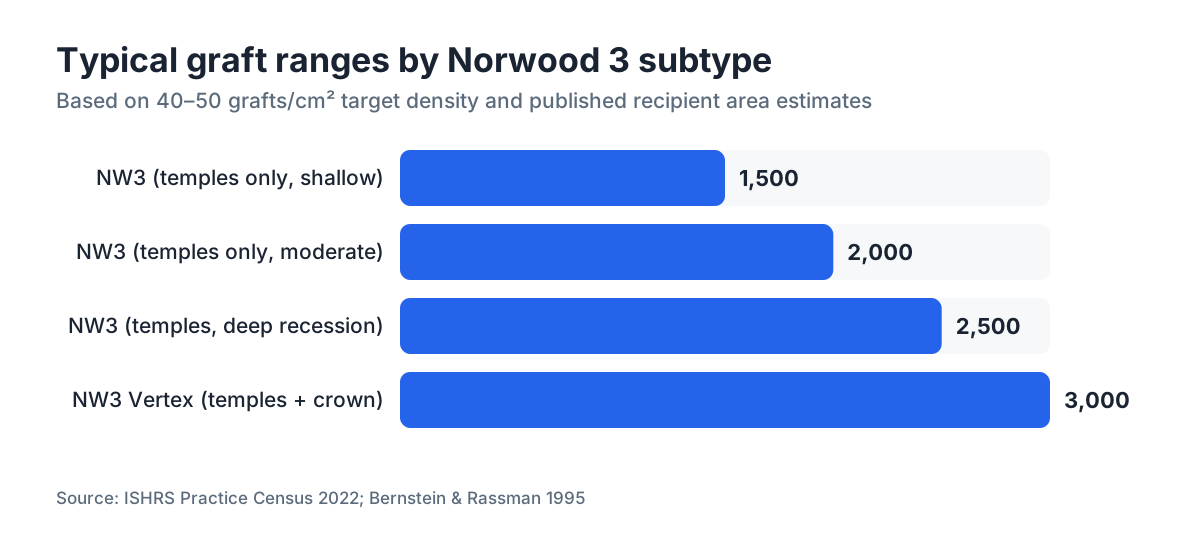
Here's how the numbers split across the common Norwood 3 presentations:
| Subtype | Typical recipient area | Graft range (40-50/cm²) | Notes |
|---|---|---|---|
| NW3 (temples only) | 40 to 55 cm² | 1,500 to 2,500 | Most common case |
| NW3 with wide recession | 55 to 70 cm² | 2,000 to 3,000 | Deeper bitemporal recession |
| NW3 Vertex | 50 to 80 cm² | 2,000 to 3,500 | Adds crown coverage |
These ranges line up with the session sizes the International Society of Hair Restoration Surgery (ISHRS) reports for early-to-mid pattern loss in its practice census [3].
One thing worth burning into memory: good surgeons stay conservative on the first pass and leave donor reserve for later. Male pattern baldness moves. A man at Norwood 3 at age 28 may reach Norwood 5 or 6 by 50 [1]. Spend 3,500 grafts on a Norwood 3 hairline and you can find yourself short on supply when the crown needs work a decade later. A thoughtful surgeon plans the session around your likely future loss, more than the scalp in front of them today.
How much does a Norwood 3 hair transplant cost in the US?
US clinics price transplants per graft almost across the board, with the 2024 market rate running $3 to $8 per graft depending on the clinic, the technique, and the city [3].
At 1,500 to 2,500 grafts:
- Low end ($3/graft): $4,500 to $7,500
- Mid range ($5/graft): $7,500 to $12,500
- High end ($8/graft): $12,000 to $20,000
Most of the spread between $3 and $8 comes from overhead (Manhattan vs. rural Texas), surgeon reputation, and whether a physician does the extraction or hands it to technicians. Turkey and Eastern Europe run the same procedure at $1,500 to $4,000 all-in, which is why medical tourism for hair transplants keeps climbing. The ISHRS 2022 practice census counted roughly 703,000 hair restoration procedures performed worldwide that year [3].
Insurance won't touch a hair transplant. It's cosmetic surgery. Health savings accounts (HSAs) and flexible spending accounts (FSAs) can sometimes cover it, but that hinges on your plan administrator's read, not a federal rule.
Nobody should quote you a final price without an in-person or detailed video consultation that includes a scalp exam. Anyone who fires off a firm number from a single photo is guessing.
FUE vs. FUT: does the technique change the graft count?
No. FUE or FUT doesn't change how many grafts you need. It only changes how those grafts come out of the donor area.
FUT (follicular unit transplantation, the strip method) removes a horizontal strip of scalp from the back of the head, then dissects it under microscopes into individual units. FUE (follicular unit excision) pulls units out one at a time with a small punch, leaving tiny circular scars instead of one line.
For a Norwood 3 case at 1,500 to 2,500 grafts, both methods work fine. FUT tends to yield slightly higher counts in a single session, which helps when you need a big number in one day, and some surgeons argue transection rates run lower with strip [10]. FUE skips the linear scar, which matters if you ever want to buzz your hair short.
The American Academy of Dermatology (AAD) notes that hair transplant results ride heavily on surgeon skill, and that both techniques can look natural in the right candidate [4]. The AAD also warns that not everyone qualifies, especially people with diffuse unpatterned alopecia or expectations no surgery can meet.
For most Norwood 3 patients, 2,000 grafts is easy in one FUE session. You rarely have to choose FUT just for capacity at this stage.
Does donor supply limit what's possible at Norwood 3?
Donor supply almost never caps a Norwood 3 procedure. The donor zone, that permanent fringe at the back and sides, yields roughly 4,000 to 8,000 safe grafts over a lifetime, depending on scalp laxity, hair density, and how far the surgeon will harvest before the back of your head starts to look thin [2].
A 2,000-graft session for a Norwood 3 hairline spends roughly 25 to 50 percent of a conservative lifetime budget. Fine, if your future loss cooperates. It's still a real number worth knowing. If you're 25 and your father went to Norwood 6, treat your donor supply as a finite account to be managed across decades and several procedures, not drained in one afternoon.
Body hair (beard and chest) can stretch scalp donor supply in people who run out of scalp sources. Beard grafts have caliber close to scalp hair and show up often at experienced FUE clinics. For a straightforward Norwood 3, though, you won't get near that ceiling.
Curious what's driving your loss? The what causes hair loss explainer covers the androgen mechanism, including how DHT miniaturizes follicles over time.
Should you be on finasteride or minoxidil before getting a transplant?
Most hair restoration surgeons want your loss stabilized before they transplant. Operating on an actively receding hairline is like painting a wall while someone chips at the plaster behind it.
Finasteride (oral, 1mg daily) is the only oral drug the FDA has approved for male pattern hair loss [5]. It blocks 5-alpha reductase type 2, the enzyme that turns testosterone into dihydrotestosterone (DHT). Trials show it stops progression in roughly 83% of men and produces visible regrowth in about 66% after two years [5]. Finasteride doesn't make you a worse transplant candidate. It makes you a better one, because it protects the native hairs framing the transplanted zone.
The FDA label for finasteride 1mg (Propecia) states: "treatment with Propecia for 5 years was associated with a mean increase of 277 hairs versus a mean decrease of 100 hairs in the placebo group in a representative 1-inch diameter circle" [5]. A real number, if a modest one.
Minoxidil (topical or oral) is the other FDA-approved option. Topical 2% and 5% are approved for men [6]. It stretches the anagen (growth) phase and enlarges follicles. It doesn't touch the androgen cause the way finasteride does, but it can thicken miniaturized hairs in a way you can see. Minoxidil for men breaks down the evidence in full.
Running finasteride and minoxidil together before and after a transplant is standard practice. The combination protects your investment. A transplanted hairline ringed by native hair that keeps thinning starts to look wrong within five years if nothing slows the loss.
Want to understand your DHT sensitivity before you commit to surgery? The DHT blocker article walks through the options.
What results can you realistically expect from a Norwood 3 transplant?
Norwood 3 is one of the best stages to transplant. The area is small, the donor supply is deep, and the surrounding native hair is still thick enough to blend the transplanted zone.
A well-executed 1,800 to 2,200 graft procedure at this stage, done by a skilled surgeon at solid density, usually looks completely undetectable. A 2020 review in the Journal of Plastic, Reconstructive and Aesthetic Surgery found satisfaction rates above 80% in properly selected candidates with realistic expectations [7].
Growth after a transplant follows a predictable clock:
- Weeks 2 to 4: transplanted hairs shed (normal, called shock loss)
- Months 3 to 4: new hairs start pushing out of the transplanted follicles
- Months 6 to 9: roughly 60 to 80% of final density visible
- Months 12 to 18: full result
The transplanted hairs come from the DHT-resistant donor zone and keep that resistance in their new home. They should be permanent. The hairs around them are still fair game for miniaturization if you haven't dealt with the underlying androgenic process.
Want to check where your hairline sits before booking a consultation? MyHairline's free AI scan reads photos to estimate your Norwood stage and flag problem areas.
Are there risks specific to Norwood 3 procedures that lower stages don't have?
Norwood 3 sits on an odd risk threshold. You have enough recession that a transplant clearly makes sense, but plenty of native hair still stands at risk of future loss. That combination creates a few specific problems.
The big one is "islanding." If the transplanted hairline turns out dense but the native hair behind it keeps thinning, you end up with a thick frontal strip stranded ahead of a sparse mid-scalp. Preventing it means committing to finasteride long-term, accepting future touch-up sessions, or both.
The general risks apply to any transplant: infection (rare, under 1% in most published series), folliculitis in the recipient area during healing, temporary shock loss of surrounding native hairs, and scarring in the donor zone (a line with FUT, scattered dots with FUE) [10][4].
Numbness in the donor strip is a known FUT complication, usually temporary but sometimes lasting. The AAD lists these among recognized risks that patients should raise with their surgeon before consenting [4].
Finasteride carries its own side effect profile. The FDA label reports sexual side effects in roughly 3.8% of men, most of which resolve after stopping the drug [5]. The finasteride article digs into that evidence.
For women, the picture changes. Female pattern loss rarely looks like Norwood 3; the Ludwig scale fits better. Finasteride isn't FDA-approved for women and carries a pregnancy contraindication [5].
How do you find a qualified surgeon for a Norwood 3 transplant?
Start with the ISHRS, the main professional body for hair restoration surgeons worldwide. Its Find a Physician directory at ishrs.org lists members by location and subspecialty [3]. Board certification from the American Board of Hair Restoration Surgery (ABHRS) is a tighter credential worth checking [9].
Four things to watch for in a consultation.
First, the surgeon should examine your scalp in person, more than study photos. They should measure the recipient area explicitly instead of eyeballing it, and talk through your likely future loss based on age, family history, and current trajectory.
Second, ask to see result photos from patients with Norwood staging and hair characteristics close to yours, with at least 12-month follow-up. A clinic that can only show 6-month photos is showing you an unfinished result.
Third, ask who actually performs the extraction and implantation. In high-volume clinics, technicians handle much of the work. That isn't automatically a red flag, since experienced techs can be excellent, but you should know before you sit down.
Fourth, get at least two consultations at different clinics before you commit. Graft-count quotes for the same patient can swing 20 to 30% between clinics, and asking why tells you a lot about each one's philosophy.
The receding hairline article covers what to track between consultations so you walk in informed.
What if surgery isn't the right move yet?
Surgery at Norwood 3 is reasonable. It isn't mandatory. A 22-year-old with fast progression and no family stabilization point is often better off spending two or three years on finasteride before a scalpel comes near his scalp.
The non-surgical options with real clinical evidence are finasteride, minoxidil, low-level laser therapy (LLLT), and platelet-rich plasma (PRP). Finasteride and minoxidil have the strongest evidence and FDA approval [5][6]. LLLT holds FDA clearance for marketing (a 510(k) clearance, which isn't the same as approval for efficacy) [8]. PRP has some promising small-study data but no FDA approval and no large randomized controlled trial to anchor the claims.
For someone at early Norwood 3 who's uncertain, starting finasteride and topical minoxidil together for 12 to 18 months and then reassessing is a defensible path. Some men stabilize well enough to push the transplant decision years further out. Others find the drugs come up short and move to surgery from a stable baseline, which makes the planning more reliable anyway.
The hair loss supplements article covers what the evidence does and doesn't say about biotin, saw palmetto, and the rest, if you want to know which are worth your money.
Not sure whether your shedding is androgenic or something else? Telogen effluvium describes the temporary shedding that can mimic or overlap with pattern loss and skew how you read your current stage.
Sources
- Norwood OT, 'Male pattern baldness: classification and incidence', Southern Medical Journal, 1975
- Bernstein RM, Rassman WR, 'Follicular transplantation', International Journal of Aesthetic and Restorative Surgery, 1995; plus ISHRS graft density guidelines
- International Society of Hair Restoration Surgery (ISHRS), 2022 Practice Census
- American Academy of Dermatology (AAD), Hair loss: Diagnosis and treatment
- FDA, Propecia (finasteride 1mg) prescribing information
- FDA, minoxidil topical solution 2% and 5% labeling
- Perez-Meza D et al., 'Patient satisfaction in hair restoration surgery', Journal of Plastic, Reconstructive and Aesthetic Surgery, 2020
- FDA, 510(k) Premarket Notification Database: low-level laser therapy devices for hair loss
- American Board of Hair Restoration Surgery (ABHRS), Diplomate Certification
- Jimenez F et al., 'Hair transplantation techniques and outcomes: an updated review', Dermatologic Surgery, 2021