

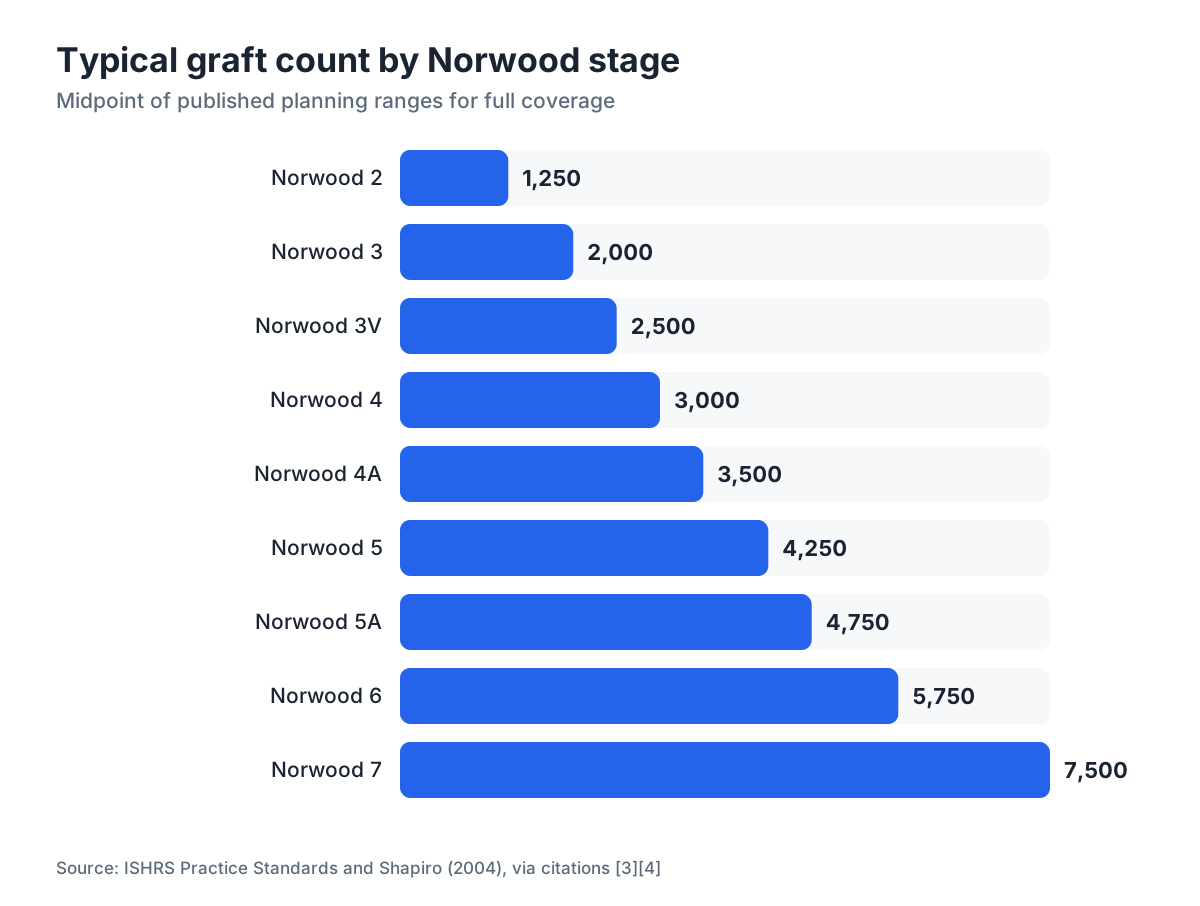
TL;DR: Total grafts needed depends on your Norwood stage, scalp laxity, and target density. A rough guide: Norwood 2 needs 1,000-1,500 grafts; Norwood 3-4 needs 2,000-3,500; Norwood 5-6 needs 4,500-6,500; Norwood 7 can top 8,000. Donor supply is usually the hard ceiling, not the size of the bald area.
What does 'total grafts needed' actually mean?
A graft is a natural bundle of skin holding one to four hair follicles. When a surgeon quotes you 3,000 grafts, they mean 3,000 of those bundles, which might carry anywhere from 4,500 to 8,000 individual hairs depending on how many hairs sit in each follicular unit. That distinction is where quotes get confusing. Two surgeons can quote wildly different numbers for the same head and both be right, if one is counting hairs and the other is counting grafts.
So before you compare quotes, confirm the unit. Grafts or hairs. Most reputable clinics quote grafts. If a clinic only gives you a hair count, divide by roughly 2.2 to approximate the graft count, because the average follicular unit on the scalp holds about 2.2 hairs [1].
Calculating 'total grafts needed for full coverage' means estimating how many follicular units it would take to bring a given area to a density that reads as full. That number comes from three inputs: the area to be covered in square centimeters, the target density in grafts per square centimeter, and an adjustment for your specific hair.
How does Norwood stage determine the area you need to cover?
The Norwood-Hamilton scale sorts male pattern hair loss into seven stages, each with a defined pattern of recession and thinning [2]. Each stage maps to a rough recipient area in square centimeters, and that area is the single biggest driver of your graft count.
Here is how area scales by stage based on published surgical planning references:
| Norwood Stage | Typical recipient area (cm²) | Common graft range |
|---|---|---|
| NW 2 | 20-40 | 1,000-1,500 |
| NW 3 | 40-60 | 1,500-2,500 |
| NW 3V (vertex) | 50-70 | 2,000-3,000 |
| NW 4 | 70-100 | 2,500-3,500 |
| NW 4A | 80-110 | 3,000-4,000 |
| NW 5 | 100-140 | 3,500-5,000 |
| NW 5A | 110-150 | 4,000-5,500 |
| NW 6 | 150-190 | 5,000-6,500 |
| NW 7 | 185-225+ | 6,500-8,500+ |
The ranges are wide because Norwood describes a pattern, not a measurement. Two men at Norwood 5 can have recipient areas 30 cm² apart based on hairline position, temporal recession depth, and how far the vertex has spread. The only number you can plan real surgery around is one taken from a physical measurement at a consultation [3].
The vertex adds area fast. A Norwood 3V patient who looks fine from the front can carry a 4-5 cm bald patch on the crown that adds 12-20 cm² before you count a single graft of frontal recession.
What density do you actually need per square centimeter?
Native scalp density in people who have never lost hair runs roughly 65-85 follicular units per cm² [1]. You do not need to match that to look full. Coverage is an optical trick driven by hair shaft diameter and curl as much as raw follicle count. Most surgeons target 35-45 grafts per cm² in the hairline zone, where it has to hold up under close inspection, and 25-35 grafts per cm² across mid-scalp and crown, where slightly thinner coverage hides well [4].
Coarse, wavy, or dark hair on a light scalp can look full at 25-30 grafts per cm². Fine, straight, light hair on a light scalp may need 40-45 in the hairline to avoid a see-through look. This is not cosmetic trivia. For a 120 cm² recipient area, the gap between a 30 and a 45 grafts-per-cm² target is 1,800 grafts. That is thousands of dollars of difference, and it may be more than your donor area can supply.
Realistic targets beat maximum targets. Any surgeon promising native density (65-85 grafts per cm²) across a very large area is either planning several sessions or overpromising. A single session reliably delivers about 35-45 grafts per cm² without hurting graft survival or over-thinning the donor [4].
How do you calculate the actual graft number step by step?
The math is simple once you have the inputs.
Step 1: Measure the recipient area. At a consultation, the surgeon or technician measures the balding and thinning zones in square centimeters. For a rough self-estimate at home, use a soft tape measure: get the front-to-back length of the thinning zone and the widest side-to-side span, multiply them, then apply a shape correction factor (roughly 0.78 for an oval, 0.64 for a triangle). That gives you a ballpark cm².
Step 2: Pick a target density. Use 40 grafts/cm² for the hairline zone and 30 grafts/cm² for mid-scalp and crown. If you want one blended number for the whole area, 32-38 grafts/cm² is defensible for most Norwood stages.
Step 3: Multiply. Total grafts = recipient area (cm²) × target density (grafts/cm²). A Norwood 5 with a 120 cm² area at 35 grafts/cm² comes to 4,200 grafts.
Step 4: Adjust for hair characteristics. Multiply the raw count by a correction factor: coarse wavy hair gets a 0.85 multiplier (fewer grafts needed), fine straight hair gets a 1.1-1.15 multiplier (more needed). These are planning rules of thumb, not settled science.
Step 5: Check against donor supply. This is where large cases fall apart. A healthy donor area typically holds 6,000-8,000 grafts available for lifetime extraction [5]. If your calculated need is 6,500 grafts and you are 32 with probable progression to Norwood 6, you are planning across multiple sessions, not one.
Step 6: Compare to one-session extraction limits. FUE (follicular unit extraction) reliably yields about 2,000-3,500 grafts per session before survival rates slip from time-out-of-body stress. FUT (strip) can pull 3,000-4,500 grafts per session from a single strip in a lax scalp [6]. If the math says 5,000 grafts, that usually means two sessions.
How does donor supply limit what is actually achievable?
Donor supply is the real constraint at high Norwood stages, not surgical skill. The safe donor zone sits on the back and sides of the scalp in a band roughly 6-8 cm tall that is genetically resistant to DHT-driven miniaturization [7]. Move outside that band and the transplanted hairs eventually fall out for the same reason your original ones did.
Lifetime donor capacity swings widely. Thick, dense donor hair might yield 8,000-9,000 extractable grafts. Fine, sparse donor hair might yield 4,000-5,500. Body hair from the chest or beard can pad the supply, but graft quality and survival differ, and most surgeons treat it as a backup.
For a Norwood 7 patient needing 7,000-8,500 grafts across the whole scalp, full density from scalp donor alone may simply not be possible. The goal shifts from full density to strategic density: load the frontal zone at higher density, accept less toward the crown. Some surgeons call it a veil of density.
If you are early (Norwood 2-3) and eyeing a transplant, spending a big chunk of donor supply now is a real gamble. Progress to Norwood 5-6 later and you may not have enough grafts left for a second procedure. Hair loss treatments like finasteride that slow or stop progression are part of the surgical planning conversation for exactly this reason. Many surgeons will not operate on younger patients without confirmed medical management of ongoing loss.
Does your projected future Norwood stage change the calculation?
It should. This is one of the most ignored parts of graft planning.
Say you are 28, currently Norwood 3, and your father and maternal grandfather both hit Norwood 6 by 50. Designing a 3,000-graft plan today without reserving donor hair for that future is a mistake plenty of patients live to regret. You would be spending grafts from a finite supply on a problem that is about to get much bigger.
Good planning accounts for the worst-case progression in your family history. The surgeon should walk you through three numbers: how many grafts you need now, how many you have in reserve, and how many you would need if you advance the next two stages. If that total exceeds your donor supply, the plan has to address the gap, through staged sessions, medical management, or an honest conversation about what is actually possible.
Family pattern is the best predictor available, and it is still imperfect. Genetic panels that claim to forecast your hair loss trajectory exist but have limited clinical validation as of 2024 [8]. The most reliable predictor is still family history plus your own documented rate of change over 6-12 months.
Pairing a transplant with ongoing minoxidil for men or a DHT blocker is standard for this reason. Slowing native loss after surgery protects both your result and your donor reserve.
What do surgeons actually measure at a consultation?
A thorough consultation runs several measurements that feed the final graft estimate.
Scalp laxity is gauged by how far the scalp skin slides when pinched. High laxity means a longer FUT strip is possible without a tight scar, which raises per-session yield. Low laxity caps strip width and therefore graft count per session.
Donor density is measured with a densitometer, a handheld device with a magnifying camera that counts follicular units in a sampled patch, usually reported as follicular units per cm². Normal donor density runs 70-90 FU/cm² [1]. Multiply that by the accessible donor area (roughly 80-120 cm² in a typical safe zone) and you get a rough lifetime yield.
Miniaturization percentage is the share of existing hairs already showing DHT-driven thinning. Heavy miniaturization in the donor zone is a red flag, because those hairs may not stay stable enough to transplant reliably [7].
Hair caliber matters because thick shafts cover more surface per graft. A patient with 80-micron hair needs fewer grafts per cm² than one with 55-micron hair for the same look. Caliber comes off the same trichoscopic device used for donor density.
Want a preliminary read before booking? A digital photo analysis can rough out your zone size and visible miniaturization. The free AI scan at MyHairline maps your current pattern against Norwood stages and gives you a baseline before you walk into a clinic.
How much does each Norwood stage cost in grafts and dollars?
Graft counts translate straight into cost. In the US, pricing typically runs $3-8 per graft for FUE and $2-5 per graft for FUT as of 2024-2025, though clinics exist at both extremes [9]. Location, surgeon experience, and technique all move the number.
| Norwood Stage | Typical graft count | Estimated US cost (FUE) | Estimated US cost (FUT) |
|---|---|---|---|
| NW 2 | 1,000-1,500 | $4,000-$10,500 | $2,500-$6,500 |
| NW 3 | 1,500-2,500 | $6,000-$17,500 | $4,000-$11,000 |
| NW 4 | 2,500-3,500 | $10,000-$24,500 | $6,000-$15,500 |
| NW 5 | 3,500-5,000 | $14,000-$35,000 | $8,000-$22,000 |
| NW 6 | 5,000-6,500 | $20,000-$45,500 | $11,000-$29,000 |
| NW 7 | 6,500-8,500+ | $26,000-$60,000+ | $15,000-$40,000+ |
These are ranges, not quotes. The per-graft rate often drops for large sessions because of clinic economics, so a 5,000-graft case can cost less per graft than a 1,500-graft case at the same clinic. Always ask for both a per-graft price and a total, and confirm what is included: anesthesia, post-op medications, follow-up visits.
Flying to Turkey, Thailand, or Eastern Europe can cut the procedure cost by 50-75%. The tradeoff is follow-up logistics, uneven quality control, and travel recovery. Some patients find the value strong. Others have had poor outcomes that cost more to revise than a domestic surgery would have cost in the first place [9].
Hair transplant surgery is not covered by most health insurance because it is classified as cosmetic. Some FSA and HSA accounts may work depending on plan rules, but confirm with your administrator before counting on it.
Can you cover a Norwood 6 or 7 in a single session?
Rarely, and rarely well. A Norwood 6-7 recipient area runs 150-225+ cm². At 30 grafts/cm², a modest target, that is 4,500-6,750 grafts. At 35 grafts/cm², it is 5,250-7,875 grafts.
Reliably extracting more than 3,000-3,500 FUE grafts in one session without hurting graft viability or over-depleting the donor is genuinely hard. The International Society of Hair Restoration Surgery (ISHRS) notes that graft survival drops when grafts spend extended time outside the body, and very large FUE sessions often run 8-10 hours, wearing on both graft and patient [6].
FUT can harvest more per session (3,500-4,500 from a single strip) but still comes up short of the 6,000-7,000+ grafts a full Norwood 7 needs. The realistic path for high-stage patients is two sessions, 12-18 months apart, sometimes topped up with body or beard donor hair.
Some clinics advertise mega sessions of 5,000+ grafts in a single day. Those exist and a few surgeons run them well, but the evidence on graft survival at that size is thin, and results depend heavily on technique. If a clinic quotes you a 5,000+ graft single-session FUE at a bargain price, ask specifically about their documented survival rates at that volume.
A candid hair transplant consultation at a reputable clinic gives you a staged plan with lifetime graft allocation mapped out, more than a price for today.
What variables make your personal calculation different from the average?
Race and ethnicity change both hair characteristics and how the recipient area reads. Afro-textured hair has a high curl coefficient, so each hair covers more lateral surface. Black patients often reach good coverage at 20-25 grafts/cm² where a straight-haired Asian patient might need 40-45. Asian hair, on the other hand, carries a high shaft diameter (often 80-100 microns) that covers well per graft. Caucasian hair varies widely, typically 55-80 microns [4].
Hair-to-skin color contrast matters as much as density. Very dark hair on very light skin shows scalp through even moderately dense coverage. Hair that closely matches skin tone looks fuller at the same graft count.
Past treatments shift the math. If you have run finasteride and minoxidil for three years, some thinning zones may have recovered native density on their own. Those zones need fewer transplanted grafts, or none.
Scar tissue from prior procedures changes graft placement. A revision on a patient with an old FUT scar or a botched FUE has a tougher recipient bed, and graft survival in scar tissue tends to be lower than in virgin scalp.
Chronic conditions count too. Poorly controlled diabetes slows wound healing and hurts graft survival. Scalp conditions like seborrheic dermatitis or telogen effluvium active on surgery day can drag down outcomes. A good surgeon defers until those are handled.
Age changes the strategy more than the arithmetic. A 50-year-old Norwood 5 stable for a decade needs fewer reserves than a 28-year-old Norwood 3 still actively shedding. If you want to understand your own picture before chasing a graft estimate, reading about what causes hair loss and receding hairline patterns is a fair place to start.
How do you know if a surgeon's graft quote is realistic?
Make them show the math. A reputable surgeon can hand you the measured recipient area in cm², their target density per zone, the resulting graft total, and their estimate of your donor yield. A quote delivered as a single naked number is one you cannot evaluate.
The American Academy of Dermatology recommends consulting board-certified dermatologists or plastic surgeons with specific hair restoration training for surgical procedures [10]. The ISHRS keeps a public member directory you can use to check credentials.
Red flags: any single-session quote above 5,000 FUE grafts from a clinic you cannot verify, a promise of full native density, a price below $1.50 per FUE graft (often a sign of technician-run rather than surgeon-run extraction), and any clinic that never mentions future loss or staged planning.
A second opinion is standard, and any surgeon worth working with will not talk you out of one. Two qualified surgeons often land 10-20% apart on the same patient because of honest differences in density targets and zone definitions. A gap over 30% is your cue to ask both to walk through their numbers.
Want a baseline to bring to that first consultation? The free AI-assisted scan at MyHairline can identify your Norwood stage from photos before you step into a clinic.
The most honest sentence about graft estimates: they are planning tools, not guarantees. Real results ride on graft survival, post-operative care, and continued native loss, none of which any calculation can fully predict.
Sources
- Bernstein RM, Rassman WR. Follicular transplantation. International Journal of Aesthetic and Restorative Surgery, 1995. Foundational graft density reference.
- Norwood OT. Male pattern baldness: classification and incidence. Southern Medical Journal, 1975.
- International Society of Hair Restoration Surgery (ISHRS). Practice Standards.
- Shapiro R. Principles and Techniques Used to Create a Natural Hairline in Surgical Hair Restoration. Facial Plastic Surgery Clinics of North America, 2004.
- Unger WP. Hair Transplantation, 4th edition. Marcel Dekker, 2004. Standard surgical reference.
- International Society of Hair Restoration Surgery (ISHRS). ISHRS Practice Census 2022.
- Rassman WR, Bernstein RM et al. Follicular Unit Extraction: Minimally Invasive Surgery for Hair Transplantation. Dermatologic Surgery, 2002.
- Pirastu N et al. Genetic prediction of male pattern baldness. PLOS Genetics, 2017.
- American Society of Plastic Surgeons. Plastic Surgery Statistics Report 2023.
- American Academy of Dermatology (AAD). Hair loss: Diagnosis and treatment.
- U.S. Food and Drug Administration (FDA). Propecia (finasteride) prescribing information.
- U.S. FDA. Rogaine (minoxidil topical) OTC labeling.