

TL;DR: Genetic hair loss (androgenetic alopecia) follows a predictable pattern, thins at the crown or temples, and is permanent without treatment. Stress hair loss (telogen effluvium) sheds diffusely all over, usually peaks 2-4 months after the stressor, and most people regrow it fully within 6-12 months. A dermatologist can confirm which one you have with a pull test, scalp exam, and sometimes bloodwork.
What's the fastest way to tell if hair loss is genetic or from stress?
Look at the pattern and the timeline. Those two things rule out most of the guessing.
Genetic hair loss, clinically called androgenetic alopecia (AGA), concentrates where DHT-sensitive follicles live: the hairline above the temples, the crown, and the top of the scalp. The sides and back stay thick, because those follicles genetically resist DHT. The thinning is gradual, measured in years, and you won't suddenly shed clumps in the shower. You'll look at photos from two years ago and notice the difference.
Stress-related hair loss, called telogen effluvium, works completely differently. It doesn't care about pattern. You lose hair evenly across the whole scalp, sometimes including the sides and back. Shedding is the main event, not thinning in a zone. And there's almost always a trigger you can point to: a surgery, a high fever, childbirth, a brutal diet, a death in the family, or months of chronic stress. The shed typically starts 6-12 weeks after that trigger, not during it [1].
If you're losing hair in a defined zone (temples, crown) and there's a family history, lean genetic. If you're shedding heavily all over and something hard happened 2-4 months ago, lean stress.
Neither self-diagnosis is reliable on its own. But the combination of pattern plus timeline gets you close enough to know which specialist conversation to have next.
What does genetic hair loss actually look like in men and women?
In men, genetic hair loss follows the Norwood-Hamilton scale [2]. Stage 1 is a normal adult hairline. By Stage 3 you have visible recession at the temples forming an M-shape. Stage 5 is when the temple and crown loss merge into one large area. The pattern is reliable enough that dermatologists can often diagnose AGA by visual inspection alone.
In women the pattern is different and often missed early. Women with AGA typically thin at the central part, which widens over time, while the frontal hairline stays relatively intact. The Ludwig scale grades this from I (mild widening) to III (extensive thinning at the crown) [2]. Women rarely go fully bald from AGA, but density loss can be significant. A receding hairline in a woman is less common with AGA than in men and might signal something else, like traction alopecia or another hormonal issue.
Both sexes tend to see miniaturization: the hairs in affected zones become finer and shorter with each growth cycle, because DHT is shrinking the follicle. That's a key difference from stress shedding, where the follicles themselves are healthy and the hairs that regrow are normal thickness.
Family history matters but doesn't determine everything. The genetics of AGA are polygenic (many genes contribute) and can come from either parent's side [3]. Having a bald father raises your risk, but so does a maternal grandfather with hair loss. No single gene predicts it reliably yet.
What does stress-related hair loss look like?
The main sign is a jump in daily shedding. Normal loss runs roughly 50-100 hairs per day [4]. In an active telogen effluvium, people report clumps in the shower drain, hair on the pillow, and handfuls when they run fingers through wet hair. Counts above 200-300 hairs a day are not unusual during a peak shed.
The shed is diffuse. Run your hands through the hair over your temples, over the crown, over the back of your head: loss is roughly equal everywhere. That's the opposite of AGA, where the back stays dense.
The trigger-to-shed delay trips people up badly. Most people who experience telogen effluvium start losing hair 2-4 months after the actual stressor, not at the time of the stress [1]. Someone who had COVID in January might not start shedding until March or April. By the time the shedding is obvious, they've often forgotten or minimized the original event, which leads them to conclude there's no reason for the loss.
Chronic telogen effluvium, which lasts longer than 6 months, is real but less common. It tends to have ongoing triggers: a thyroid condition that hasn't been treated, ongoing iron deficiency, or persistent severe stress. The American Academy of Dermatology notes that most telogen effluvium resolves once the underlying cause is addressed [4].
One honest caveat: both conditions can coexist. Someone genetically predisposed to AGA can also have a telogen effluvium on top of it, which makes the thinning look worse and faster than either condition alone would cause. A dermatologist can separate these.
Can bloodwork or a scalp test tell the difference?
Yes, and it's worth doing if you're not sure.
A dermatologist doing a clinical evaluation for hair loss will typically start with a pull test: grasping 40-60 hairs between two fingers, close to the scalp, and pulling gently along the hair shaft. Extracting more than 10% of the grabbed hairs (roughly 6 or more) is a positive result suggesting active shedding, which points toward telogen effluvium over AGA [5]. In AGA, most hairs are anchored; in an active effluvium, telogen-phase hairs release easily.
Bloodwork rules out medical causes that mimic or worsen hair loss. A standard hair loss panel usually includes: TSH (thyroid), ferritin (iron stores), CBC, and sometimes vitamin D, zinc, and sex hormone levels [4]. Iron deficiency is probably the most commonly missed contributor to persistent shedding in women. Low ferritin, even without frank anemia, can perpetuate a telogen effluvium.
Dermoscopy (a handheld polarized light magnifier) lets a dermatologist look at the scalp and hair follicles directly. In AGA, you see variability in hair shaft diameter (some thick, some miniaturized) and peripilar signs. In telogen effluvium, shafts are more uniform in width but there are more empty follicles.
A scalp biopsy is the gold-standard confirmation but is usually reserved for ambiguous cases. It's a small punch biopsy, typically 4mm, and can definitively show miniaturization (AGA) versus a high telogen-to-anagen follicle ratio (effluvium).
If you want an accessible first look before booking a dermatologist appointment, the free AI scan at MyHairline analyzes your hairline pattern and can help you understand what type of hair loss you might be dealing with. It's not a diagnosis, but it gives you something concrete to bring to a doctor.
How does the timing of shedding help you figure out the cause?
Timing is one of the most useful diagnostic clues, and most people underuse it.
With genetic hair loss, you probably won't be able to name a month when it started. It's been happening slowly. Your ponytail got thinner. Your part got wider. You're using more product to cover the crown. When you look back, the process started years ago.
With telogen effluvium, the opposite is true. Most people can describe exactly when the shedding exploded. "I started losing it in March." That specificity matters, because you can then count back 6-12 weeks and almost always land on the stressor: the flu, the breakup, the brutal calorie restriction, the hospitalization.
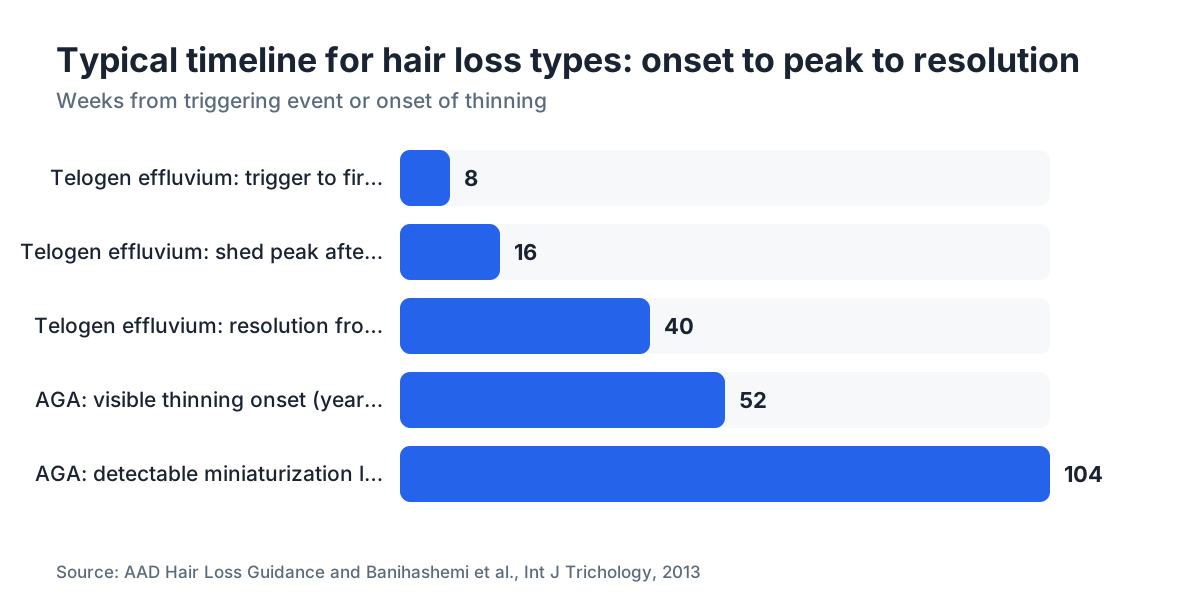
The chart below shows how quickly each condition develops versus resolves, which also helps with timeline reasoning.
Acute telogen effluvium typically peaks around 3-4 months after the trigger and then gradually resolves over the following 3-6 months as new anagen hairs regrow [1]. By 9-12 months post-trigger, most people are back to their baseline density. If shedding continues past 6 months with no sign of slowing, that's chronic telogen effluvium and something ongoing is driving it.
Genetic hair loss has no natural resolution. Without treatment it continues and usually progresses. That's the fundamental difference in prognosis, and it's a big reason what causes hair loss matters so much before you commit to any treatment.
Does a family history of baldness mean your hair loss is definitely genetic?
Not definitively, but it raises the probability significantly.
AGA is polygenic and heritable. Having a first-degree relative (father, maternal grandfather) with pattern baldness is one of the strongest individual risk factors [3]. One large genome-wide association study published in PLOS Genetics identified over 250 independent genetic signals associated with male pattern baldness, which tells you this is not a simple one-gene situation [3].
So family history is a clue, not a verdict. Someone with a bald father can absolutely develop a telogen effluvium from stress, and the shedding will look alarming against their already-thin baseline. Meanwhile, someone with no family history of hair loss can still develop AGA, especially women, where the genetic contribution can be subtler.
The safest framing: if you have a strong family history and you're seeing a pattern-consistent change (temples, crown, widening part), the probability is high that AGA is at least contributing. If your family has great hair into old age and you're shedding diffusely after a stressful event, stress is the much more likely explanation. But neither case rules out the other cause entirely.
What treatments work for genetic hair loss but not stress-related shedding?
This is where the distinction really pays off, financially and medically.
Genetic hair loss (AGA) responds to treatments that either block DHT or stimulate the follicle directly. Finasteride is an oral 5-alpha-reductase inhibitor approved by the FDA for male pattern hair loss that reduces scalp DHT by roughly 60-70% [6]. Minoxidil for men is the other main tool, a topical (or oral) vasodilator that prolongs the anagen phase. The combination of finasteride and minoxidil is more effective than either alone for AGA. DHT blockers work because AGA is DHT-driven. None of these do much for telogen effluvium, because the follicles in an effluvium are healthy and not DHT-miniaturized.
Stress-related shedding is fixed by fixing the cause: treat the iron deficiency, stabilize the thyroid, stop the crash diet, manage the chronic stress. Hair regrowth follows naturally once the trigger is gone. Minoxidil might slightly speed up the regrowth cycle if applied topically, but it's not correcting the underlying biology the way it does in AGA.
Platelet-rich plasma (PRP) and hair transplants are AGA treatments. A transplant makes no sense for telogen effluvium, where you'll regrow the hair anyway and the donor area is also affected by the diffuse shed.
Hair loss supplements are a murkier area. Biotin deficiency is rare but real; if you're genuinely deficient, supplementing helps. But for AGA, no supplement matches minoxidil or finasteride in evidence weight. For effluvium caused by nutritional deficit, correcting the deficit (iron, vitamin D, protein) is the actual fix.
Oral minoxidil is gaining traction for both conditions but has stronger evidence in AGA. The side effects of minoxidil differ somewhat between topical and oral formulations, which matters if you're choosing a route.
Can stress hair loss turn into permanent genetic hair loss?
This question comes up a lot and the honest answer is: stress shedding itself doesn't cause permanent follicle damage, but it can unmask or accelerate genetic hair loss that was already happening quietly.
Here's what that means in practice. If you're genetically predisposed to AGA and you have a major telogen effluvium, the effluvium sheds telogen hairs from all follicles, including the already-miniaturized ones at your temples and crown. When those miniaturized follicles regrow, they come back thinner than before. The person then perceives that the stress "made them go bald," when what actually happened is the stress revealed AGA that was progressing slowly in the background.
Pure telogen effluvium, in someone with no AGA predisposition, fully reverses. The follicles are healthy. There's no miniaturization. Give the trigger time to resolve, give the body time to cycle, and the hair comes back at normal caliber.
If 12 months after a stressor resolves your density still hasn't returned, and especially if the distribution of thinning is now concentrated at the crown or temples, that's a signal that AGA is in play and deserves a formal evaluation.
How does a dermatologist officially diagnose which type of hair loss you have?
A thorough evaluation typically combines history, physical examination, and targeted testing. No single test is mandatory; the approach is tailored to what the pattern and history suggest.
The clinical history asks about: onset and pattern of shedding, triggers in the preceding 3-6 months, medications, diet, thyroid symptoms, menstrual irregularities (in women), and family history.
The physical examination maps the pattern. Is it diffuse? Patterned? Is the frontal hairline preserved? Are there any areas of scalp inflammation, scaling, or scarring? Scarring alopecias (like lichen planopilaris) are a separate category entirely and require different treatment.
The pull test as described above gives a quick read on whether active shedding is occurring [5].
Dermoscopy can show: miniaturized hairs (AGA), yellow dots or empty follicles (alopecia areata or chronic effluvium), or peripilar casts.
Bloodwork targets reversible causes: ferritin, TSH, free T4, CBC, TIBC, sometimes a hormonal panel in women (DHEA-S, free testosterone, prolactin) to evaluate for PCOS or adrenal causes [4].
The JAAD (Journal of the American Academy of Dermatology) guidelines for diagnosing androgenetic alopecia note that "diagnosis is usually made clinically based on the history and examination" and that "laboratory tests are useful primarily to exclude other causes" [5]. Biopsy is confirmatory when the diagnosis is uncertain after clinical evaluation.
Bring photos: old photos of your hairline and density are genuinely useful clinical data and most people don't think to bring them.
Are there differences between how genetic and stress hair loss affect men vs. women?
Yes, and the differences matter for both diagnosis and treatment.
In men, AGA is more common and usually more severe. About 50% of men show signs of AGA by age 50 [2]. The Norwood scale stages are well-recognized and dermatologists apply them routinely. Men also tend to have higher baseline DHT activity, which is why AGA progresses more aggressively in men than women.
In women, AGA often presents more diffusely, which can be mistaken for telogen effluvium. The frontal hairline is often preserved in female AGA, making it look less like "male pattern baldness" and more like general thinning. Women are also more frequently affected by telogen effluvium, partly because they're more likely to experience triggers like pregnancy, postpartum hormone shifts, iron deficiency, and significant dieting.
Postpartum hair loss is a specific and very common form of telogen effluvium. Pregnancy keeps hairs in anagen; after delivery, estrogen drops sharply and many of those hairs enter telogen simultaneously, producing a massive shed around 3-4 months postpartum [1]. It almost always resolves completely and doesn't indicate AGA unless it was already present.
For women with AGA, finasteride is not FDA-approved for premenopausal women (due to teratogenicity risk) and requires careful consideration with a physician. Minoxidil 2% topical is FDA-approved for women with AGA; the 5% formulation is used off-label [6]. The evaluation in women also needs to rule out hormonal drivers more carefully than in men.
What should you do first if you're not sure which type you have?
Start with two things you can do today without spending money: photos and a timeline.
Take close-up, consistent photos of your hairline, temples, crown, and part (if applicable). Good lighting, same angle each time. These will be your baseline for tracking change and they're genuinely useful to a dermatologist.
Write down a timeline. When did you first notice the change? What happened in the 2-4 months before the shedding started? Any illness, surgery, major stress, big dietary change, new medication? What does the pattern look like (all over, or specific zones)?
Then book a dermatologist. Not a GP, a dermatologist or a trichologist if one is accessible in your area. The earlier you go, the more options you have, especially if it turns out to be AGA where earlier treatment preserves more follicles.
If you want a data point before that appointment, the free AI scan at MyHairline can analyze your hairline pattern from a photo and flag whether the distribution looks more like pattern loss or diffuse shedding. It's a tool, not a diagnosis, but it takes 90 seconds and gives you a clearer picture to discuss with your doctor.
Don't start buying finasteride or transplant consultations before you know which type you're dealing with. DHT-blocking drugs do nothing useful for telogen effluvium and carry real side effect considerations. Knowing your actual diagnosis first saves money and avoids unnecessary risk.
Sources
- American Academy of Dermatology Association, Hair Loss: Diagnosis and Treatment
- Heilmann-Heimbach S et al., PLOS Genetics, 2017: Meta-analysis identifies novel risk loci and yields systematic insights into the biology of male-pattern baldness
- American Academy of Dermatology Association, Hair Loss: Causes and Overview
- Mubki T et al., Journal of the American Academy of Dermatology, 2014: Evaluation and diagnosis of the hair loss patient
- U.S. Food and Drug Administration, Minoxidil Label and Approval
- National Institutes of Health MedlinePlus, Telogen Effluvium
- Trüeb RM, International Journal of Trichology, 2009: Oxidative Stress in Ageing of Hair
- van der Donk J et al., Clinical and Experimental Dermatology, 1994: Finasteride in male pattern baldness
- Banihashemi M et al., International Journal of Trichology, 2013: Telogen Effluvium: A Review
- Rasheed H et al., International Journal of Dermatology, 2013: Serum ferritin and vitamin D in female hair loss
- Goren A et al., Journal of Cosmetic Dermatology, 2018: Androgenetic alopecia prevalence by age in men