

TL;DR: Most hair loss treatments take 6 to 12 months before you see meaningful regrowth, and the first few months often look worse before they look better. Minoxidil and finasteride work, but they slow or stop loss more reliably than they reverse it. Understanding the actual timeline, what counts as success, and when to reassess is what separates people who stick with treatment from those who quit too early.
Why is managing expectations so important before you start treatment?
People quit effective treatments every day because they expected the wrong thing at the wrong time. That's the whole problem. Someone starts minoxidil, loses more hair in week six, panics, and stops. Two months later they're right back where they started, or worse, because they interrupted a treatment that was actually working.
The hair follicle cycle runs on its own clock, completely indifferent to your impatience. Anagen (growth), catagen (transition), and telogen (shedding) phases each take months to complete [1]. No topical, pill, or procedure bypasses that biology. If you go in expecting a before-and-after photo result in eight weeks, you will be disappointed by every legitimate treatment that exists.
There's also a subtler problem. Without a realistic baseline, you can't tell whether a treatment is failing or just taking its normal time. That uncertainty drives abandonment. Setting honest expectations before day one isn't pessimism. It's the thing that keeps you in the game long enough to actually see results.
What does a realistic timeline look like for minoxidil and finasteride?
Here's what the clinical data actually shows, broken out by treatment.
Minoxidil (topical) The FDA-approved label for 5% topical minoxidil says to use the product for at least four months before you judge whether it works, and clinical studies show meaningful hair count changes at the 16 to 48 week mark [2]. In the 48-week trial, men using 5% minoxidil foam saw a mean increase of about 18.6 non-vellus hairs per cm2 compared to placebo. Regrowth, when it happens, usually peaks somewhere between months 6 and 12 and then plateaus.
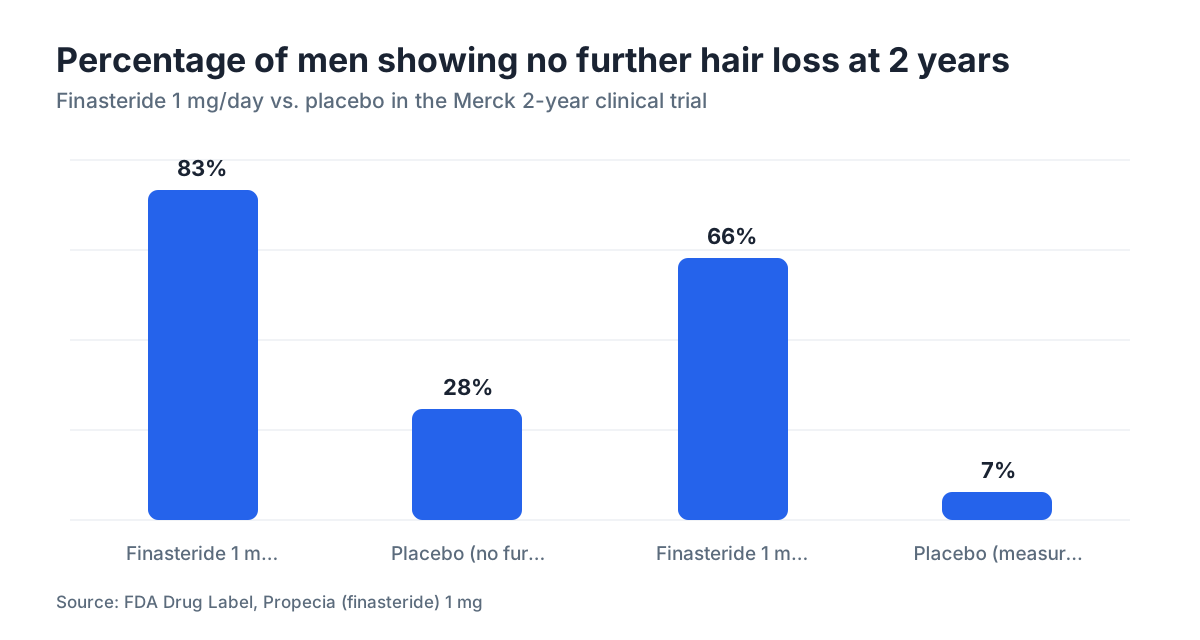
Finasteride (oral) Finasteride's FDA label states that 3 months of daily use is the minimum before you'd expect any effect, with studies running 12 to 24 months to capture full benefit [3]. The 2-year Merck trial found that 83% of men on 1 mg finasteride had no further hair loss (vs. 28% on placebo), and about 66% showed measurable improvement in hair count [3]. That's a strong result, but it came at the 2-year mark, not week eight.
Combination therapy Using finasteride and minoxidil together is where the better regrowth numbers tend to live. A 2021 Journal of the American Academy of Dermatology study found combination oral minoxidil plus finasteride beat either drug alone on hair counts and subject self-assessment at 24 weeks [4].
| Treatment | Minimum eval period | When regrowth peaks | Main benefit |
|---|---|---|---|
| Topical minoxidil 5% | 4 months | 6-12 months | Slows loss, modest regrowth |
| Finasteride 1 mg | 3 months | 12-24 months | Slows/stops loss strongly |
| Combination (both) | 3-6 months | 12-18 months | Best regrowth data overall |
| Hair transplant | N/A (surgical) | 12-18 months post-op | Permanent redistribution |
The honest summary: if you're not giving any of these 12 full months, you're not giving them a fair trial.
Why do I seem to be losing more hair after starting treatment?
This is probably the most common reason people quit, and it's also the most misunderstood part of the whole process.
Minoxidil triggers what's called a telogen effluvium shed in a lot of users. The drug shifts resting follicles back into active growth, but before the new anagen hair pushes through, the old telogen hair has to leave [5]. So you see increased shedding, sometimes dramatically so, for weeks four through twelve. It feels like the treatment is destroying your hair. It is, in fact, working.
This initial shed is temporary. It usually peaks around weeks 6 to 8 and resolves by month three to four. The American Academy of Dermatology notes that shedding after starting treatment is expected and not a sign that you should stop [6].
Finasteride doesn't cause the same pronounced shed. But some people on finasteride do report a short increase in shedding in the first 2 to 3 months as the DHT-dependent follicle environment shifts. The mechanism is less well characterized than minoxidil's, and it typically resolves on its own.
If heavy shedding continues past month four, that's worth a conversation with a dermatologist. It may point to a separate issue like true telogen effluvium triggered by stress, diet, or another cause entirely.
What counts as treatment success, and what's wishful thinking?
This question deserves a blunt answer because the marketing around hair loss products is aggressively misleading.
A realistic success for minoxidil and finasteride is stopping or meaningfully slowing further loss, and possibly seeing some regrowth in areas with miniaturized (thin, fine) follicles that haven't fully died. The treatments work on follicles that are alive but struggling. They cannot resurrect completely dead follicles.
If you started treatment at a Norwood 2 and you're holding at Norwood 2 after two years, that is a genuine win. Most untreated men with androgenetic alopecia (the most common cause of male pattern hair loss) progress noticeably over that same period [7]. Stabilization is success.
Wishful thinking is expecting to go from a receding hairline to your 20-year-old density. That doesn't happen with medication for most people. Hair transplants can address density in specific areas, but they redistribute existing hair rather than creating new follicles. Even transplants don't restore what you had at 18.
What the dermatology literature calls "significant" regrowth is usually a 10 to 20% increase in hair count. That sounds small. On your head, it can look meaningful. But it's not the full reversal social media before-and-afters suggest.
If you want a concrete baseline before you start, tracking progress with standardized photos under the same lighting every 3 months gives you real data. Some people find that a free AI hair scan (like the one at MyHairline) helps establish a starting point to compare against later.
How do I know if a treatment is actually working or not?
The biggest mistake is evaluating by feel instead of evidence. Hair feels thinner or thicker based on dozens of variables: humidity, product buildup, how you slept. Feelings are not data.
The most reliable way to track response is standardized photography. Same lighting, same angle, same hair state (dry, unstyled) every 8 to 12 weeks. Three reference angles matter most: top-down, frontal, and the crown. Over 12 months this gives you actual visual evidence instead of bathroom mirror anxiety.
Another useful marker is the shed rate. If you were losing 150 hairs a day at baseline and you're losing 80 at month six, that's a signal the treatment is working even if density doesn't look obviously different yet. Normal daily hair loss is roughly 50 to 100 hairs [6].
Dermatologists can also use dermoscopy or trichoscopy to assess follicle miniaturization and telogen-to-anagen ratios in ways that aren't visible to the naked eye. If you have access to a dermatologist who does hair loss assessment, a baseline trichoscopy before starting treatment gives you an objective comparison point for a later visit.
Don't evaluate at 8 weeks. Don't evaluate at 12 weeks. Set a 12-month milestone and commit to getting there.
Are there things that make treatment less likely to work?
Yes, and knowing them upfront matters.
Starting too late. Both minoxidil and finasteride work on miniaturized follicles, not completely lost ones. If a scalp area has been bald for years with no follicular activity visible, medication won't bring it back. Earlier in the hair loss progression generally means better treatment response [7].
Inconsistency. Finasteride has a half-life of 5 to 6 hours but its 5-alpha reductase inhibition lasts roughly 24 hours per dose, so daily consistency matters [3]. Missing doses often undermines the sustained DHT suppression the drug depends on. Minoxidil applied erratically gives erratic results.
Unaddressed underlying causes. If hair loss has a non-genetic driver like thyroid dysfunction, iron deficiency, or high chronic stress, medication aimed at androgenetic alopecia won't fix it. Understanding what causes hair loss for your specific situation first can save you months of chasing the wrong solution.
Scalp health issues. Severe seborrheic dermatitis or scalp inflammation can interfere with follicle function and topical absorption. Treating those conditions alongside medication improves the environment for hair growth.
For men specifically, DHT is the main driver of pattern hair loss, which is why DHT blockers like finasteride address the root cause rather than just the symptom. But they won't work if a secondary cause is doing most of the damage.
What side effects should I expect, and how do they affect the decision to continue?
Side effects are real and they deserve honest treatment, because ignoring them sets up a different kind of failed expectation.
Minoxidil most commonly causes scalp irritation or dryness (especially with the propylene glycol-containing liquid formula), the initial shedding phase described above, and, rarely, unwanted facial hair growth from topical application. Systemic side effects from topical minoxidil are uncommon at standard doses, but the oral form carries more cardiovascular considerations. You can read the detailed breakdown in the minoxidil side effects guide.
Finasteride carries a post-market safety profile that includes sexual side effects (decreased libido, erectile dysfunction) in roughly 2 to 3% of users in clinical trials, with some post-marketing reports of persistent symptoms after discontinuation [3]. The FDA updated the finasteride label in 2012 to include post-marketing reports of these effects [8]. Whether the absolute risk is small or meaningful is a genuinely personal calculation that depends on your risk tolerance. A GP or dermatologist can help you weigh it.
The point here isn't to scare you off treatment. If you know a side effect profile going in, you can tell normal early-treatment weirdness apart from something that actually needs attention, and you won't misattribute coincidental symptoms to the medication.
How is hair transplant success different from medication success?
This is worth its own section because transplants get lumped in with medications as though the expectations framework is the same. It isn't.
A hair transplant moves living DHT-resistant follicles from the back and sides of the scalp (the donor area) to thinning or bald areas. The transplanted hairs will almost certainly grow, assuming a skilled surgeon and adequate donor supply. The variable isn't "will it work" the same way it is with medication. The variable is "how natural will it look" and "how much donor hair do I have to work with."
Post-transplant, the transplanted grafts shed in weeks 2 to 4 and then go dormant. Regrowth starts around month 3 to 4. Full cosmetic results usually aren't visible until month 12 to 18. Patients who evaluate at month 4 and panic are making the same timeline mistake as the person who quits minoxidil at week 8.
The other expectation trap with transplants: they don't stop the underlying hair loss. If you have active androgenetic alopecia and you don't use medication post-transplant, the native (non-transplanted) hairs around the grafts can keep thinning, creating a patchy look years later. Most surgeons recommend continued finasteride or minoxidil after transplant for exactly this reason.
Cost is also a legitimate expectations issue. Transplants in the US typically run $4,000 to $15,000 depending on graft count, technique (FUT vs. FUE), and geography. There is no insurance coverage for cosmetic hair restoration.
What should I track and when should I reassess my treatment plan?
Build in formal reassessment points rather than making decisions reactively.
Month 3: Check for tolerability. Are you having side effects that are impacting quality of life? Is the minoxidil shed resolving? This is not a useful time to assess efficacy, only tolerability.
Month 6: A reasonable midpoint photo comparison. Some people see early improvement here, especially with combination therapy. Many don't. Absence of obvious improvement at month 6 is not a reason to quit, but significant ongoing loss acceleration would be worth discussing with a dermatologist.
Month 12: Your primary efficacy checkpoint. Compare standardized photos to your baseline. Has loss stabilized? Is there any visible regrowth? If you've seen neither stabilization nor regrowth after 12 months of consistent use, it's worth revisiting the diagnosis and whether a different approach fits better.
Month 24: The point where finasteride's benefit is most fully expressed. If you're doing well at 12 months, commit to month 24 before making any major changes.
If you're unsure what stage your hair loss is at or whether you've actually made progress, a baseline assessment with photos or a tool like the free AI scan at MyHairline can help you establish a reference point objectively.
Do women have different expectations to manage than men?
Women do, and the treatments are different enough that it matters.
For women, the most common diagnosis is female pattern hair loss (FPHL), also called androgenetic alopecia, though the distribution and mechanism differ from men's pattern loss [1]. Women typically see diffuse thinning across the crown rather than a frontal recession, and the Ludwig scale (I through III) is used instead of Norwood.
Minoxidil 2% is FDA-approved for women; 5% is also used off-label and some evidence suggests it's more effective [2]. Women are generally counseled that stabilization is the primary goal and regrowth, when it occurs, tends to be modest. The initial shed is just as real for women as for men, and just as misunderstood.
Finasteride is not FDA-approved for women with FPHL, and it is absolutely contraindicated in women who are pregnant or may become pregnant due to risk of fetal harm [3]. Spironolactone (an off-label option) and low-level laser therapy are more commonly used second-line options for women.
The timelines are broadly similar to men's: 6 months minimum, 12 months to proper evaluation. Women who are losing hair due to hormonal shifts (postpartum, perimenopause, thyroid) need those underlying factors addressed, more than topical minoxidil applied over an uncorrected hormonal problem.
Oral minoxidil has growing evidence in women at low doses (0.25 mg to 1 mg daily) with a favorable side effect profile compared to higher doses used in men [10].
What are the most common psychological traps people fall into during treatment?
This section matters as much as the clinical stuff. The mental game is where most treatments fail.
The comparison trap. Looking at before-and-after photos posted online selects for the best responders. The person who got great results posts. The person who had average results usually doesn't. You're calibrating against a biased sample.
The daily mirror trap. Checking your hair every day is roughly as useful as stepping on the scale every hour while dieting. Day-to-day variation in hair appearance is enormous. Weekly or monthly photo comparisons are the only useful signal.
The "natural alternative" pivot. When people get frustrated with slow progress, they often switch to supplements, special shampoos, or other products that have much weaker evidence. The data on hair loss supplements is generally thin. Some (biotin, iron correction in deficient people) have legitimate uses. Most are not going to substitute for treatments with clinical trial data. It's fine to use a good shampoo. Just don't trade finasteride for rosemary oil and expect equivalent results.
The quitting loop. Stop, restart, stop, restart. This is probably the most damaging pattern. Each restart resets the clock and may trigger a new shed. The evidence base for these treatments is built on consistent, continuous use. Inconsistency doesn't get a fair trial.
Sources
- National Institutes of Health, MedlinePlus: Hair Loss
- FDA, Drugs@FDA database, Rogaine (minoxidil) 5% topical labeling
- FDA, Drugs@FDA database, Propecia (finasteride) 1 mg labeling
- Journal of the American Academy of Dermatology: Oral minoxidil and finasteride combination study, 2021
- National Library of Medicine, StatPearls: Minoxidil
- American Academy of Dermatology: Hair Loss Overview
- National Library of Medicine: Androgenetic Alopecia (StatPearls)
- FDA: Drug Safety and Availability
- National Institute of Arthritis and Musculoskeletal and Skin Diseases (NIAMS): Alopecia Areata
- Journal of Dermatological Treatment: Low-dose oral minoxidil in women, systematic review