
TL;DR: For most men with androgenetic alopecia, 5% topical minoxidil is the standard the evidence supports. The 10% dose grows slightly more hair in some trials, but it also brings more scalp irritation, more unwanted facial hair, and more cardiovascular effects. The FDA has approved only 2% and 5% topical formulas. Going to 10% is off-label, and most dermatologists save it for men who fail 5%.
What is the actual difference between 5% and 10% minoxidil?
Same drug, different dose. Both concentrations contain minoxidil, a potassium channel opener that widens the blood vessels around hair follicles and stretches out the anagen (growth) phase of the hair cycle. What changes is how much drug lands on each square centimeter of scalp.
A standard 1 mL dose of 5% solution puts about 50 mg of minoxidil on the scalp. The 10% version puts down roughly 100 mg. Sounds like a clean doubling. The pharmacology doesn't cooperate. Your skin barrier caps how much drug reaches the follicle, so twice the concentration does not mean twice the effect where you want it. Systemic absorption does climb, though, and that's where most of the extra risk lives [1].
The FDA approved 2% minoxidil solution for women and 5% solution and foam for men, both for androgenetic alopecia. The 10% concentration has never been approved for any topical hair-loss use. So any 10% product you find is either compounded by a pharmacy or imported, and it sits in off-label territory by definition [1].
Two things follow from that. The manufacturing controls behind FDA-approved products don't automatically cover a compounded batch. And if something goes wrong, the safety data behind that exact formulation are thin.
Does 10% minoxidil actually work better than 5%?
A little better. Not dramatically. And the studies backing that claim are old and small.
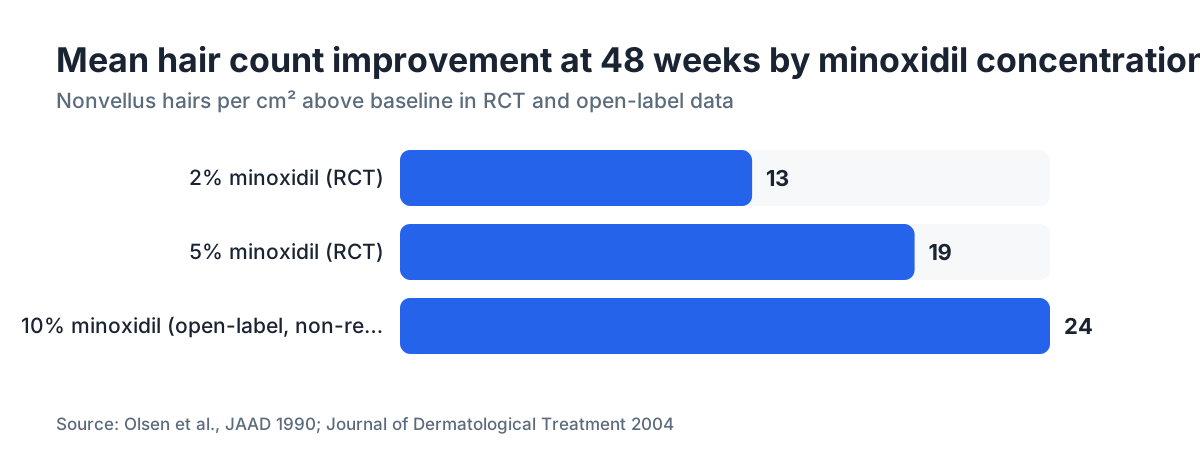
The large evidence base sits at 5%. A randomized controlled trial published in the Journal of the American Academy of Dermatology in 1990 enrolled 393 men with androgenetic alopecia and compared concentrations head to head. The 5% group grew about 45% more nonvellus hair than the 2% group at 48 weeks. The 10% data come mostly from smaller, open-label work, not large parallel-group RCTs [2].
A 2004 study in the Journal of Dermatological Treatment looked at 10% solution in men who hadn't responded well to 5%. Roughly a third of those non-responders saw further gains in mean hair count. The effect was modest, and dropouts from side effects ran higher than in 5% trials [3].
Here's the practical read. If you're a full responder to 5%, moving to 10% buys you marginal extra hair and real extra risk. If you've honestly run 5% for 12 months with no adequate response, 10% under a dermatologist is a reasonable thing to consider next. It's not a first move.
For how minoxidil fits alongside finasteride, see our breakdown of finasteride and minoxidil used together.
What side effects are more common with 10% than 5%?
Topical minoxidil side effects split into two groups: local (scalp and skin) and systemic (whole body). A higher concentration raises both, because more drug crosses the skin.
Local side effects
Scalp irritation, dryness, flaking, and contact dermatitis top the list at any concentration. At 10% they show up more often, partly because minoxidil itself irritates at higher strength and partly because the vehicle (often propylene glycol in solutions) sits on the skin at a heavier load. Switching to a propylene-glycol-free 5% foam cuts irritation for a lot of men compared to the 5% solution. That's one reason dermatologists often start with foam.
Hypertrichosis (unwanted hair growth elsewhere)
This one blindsides people. Minoxidil can grow hair on the forehead, cheeks, and neck, most often in women but also in men. The mechanism is the same one that helps your scalp: minoxidil wakes up follicles wherever it reaches. At 10%, systemic absorption is higher and the hypertrichosis risk climbs with it. An analysis in Dermatologic Surgery found hypertrichosis rates roughly doubling as concentration rose from 5% to 10% in women [4].
Cardiovascular effects
Minoxidil started life as an oral blood pressure drug. From topical use at low doses, the cardiovascular effects are usually subclinical. But absorption from a 10% solution runs high enough that some people get headaches, palpitations, or lightheadedness, especially on days when the scalp absorbs more (after washing, with heat, or with any condition that breaks the skin barrier). If you have heart disease, low blood pressure, or you take antihypertensives, get a physician's sign-off before you go near 10% [5].
Shedding (telogen effluvium)
Both 5% and 10% trigger an early shed in the first 2 to 8 weeks. That's expected. The drug shoves resting follicles into a new cycle, and the old hairs drop before the new ones show. At 10%, the shed can hit harder. It's temporary, but it scares enough people that many quit before results arrive. For the full physiology, read telogen effluvium.
For every minoxidil side effect at standard doses, including the ones nobody warns you about, see minoxidil side effects.
How do the two concentrations compare on the key metrics?
Here's the side-by-side on the things that actually drive this decision.
| Factor | 5% Minoxidil | 10% Minoxidil |
|---|---|---|
| FDA approval status | Approved (solution + foam, men) | Not approved (off-label / compounded) |
| Typical hair count improvement (48 wk) | ~18-20 hairs/cm² above baseline in RCTs | ~20-25 hairs/cm² in smaller studies [2][3] |
| Scalp irritation rate | ~10-15% of users | ~20-30% of users |
| Hypertrichosis risk | Low in men | Moderate in men, higher in women |
| Systemic absorption | ~1-2% of applied dose | ~2-4% of applied dose [1] |
| Cardiovascular caution needed | For pre-existing conditions | For anyone; physician review advised |
| Availability | OTC at any pharmacy | Compounding pharmacy or specialist Rx |
| Cost (monthly, rough range) | $15-35 OTC | $40-90+ compounded |
The hair-count numbers sit close because they are close. The gap is real and small. A 5-hair-per-cm² difference on a vertex that's already diffusely thin is not something you or anyone across the room will catch in the mirror.
Who might actually benefit from the 10% concentration?
Non-responders to 5% are the clearest candidates. The logic is simple. If you've used 5% twice a day for 12 months, your hair counts haven't budged, and you've confirmed you're putting it on the scalp (not the hair), then a higher concentration is a fair thing to raise with a dermatologist.
Men with thicker, coarser scalp skin may absorb less minoxidil per dose, which is one proposed reason some people respond poorly to standard strength. There's no clinical test for this, but it's a plausible biological reason to try more.
Some men already on finasteride or another DHT blocker want to push minoxidil harder and reach for 10%. Whether that stacks any benefit beyond 5% plus finasteride is genuinely unknown. The 5% minoxidil plus finasteride combination has strong trial data. Adding a higher minoxidil strength on top of that has not been tested in large controlled trials.
Who should stay away from 10%: women (the trade-off is worse, since they already use 2-5% and face higher hypertrichosis risk as strength rises), anyone with cardiovascular disease or low blood pressure who lacks physician supervision, and anyone who hasn't given 5% an honest 12-month run.
Is the initial shed worse with 10% minoxidil?
Usually, yes. The early shed is a triggered telogen effluvium: minoxidil kicks follicles from rest into an active phase, and old club hairs fall out to clear room for new anagen hairs. Push more follicles through that switch at once, and faster, and the shed looks worse.
At 10%, more drug reaches more follicles more quickly, so the early shed tends to run heavier and last a touch longer. Dermatologists who prescribe 10% off-label usually warn about this up front, and some suggest ramping up: 5% for 3 months, then 10%. No published RCT proves a ramp-up softens the shed, but the reasoning holds together.
The shed ends. If you're still losing more than you're growing at the 4-month mark, that's a reason to get evaluated, not a reason to assume the drug failed.
Can you use 10% minoxidil on a receding hairline?
You can. But minoxidil's evidence is weakest exactly there, at the frontal hairline, no matter the concentration. Its best-documented effect is on the vertex (crown). The FDA approval language for 5% points specifically at crown androgenetic alopecia. Frontal recession runs harder on DHT, which is why finasteride, a DHT inhibitor, often beats minoxidil for holding a hairline.
Plenty of dermatologists still use minoxidil off-label on the front, and some men do see results there. Going to 10% for hairline use is off-label twice over and unmapped in trial data. If a receding hairline is your main worry, the stronger evidence-based move is 5% minoxidil plus finasteride, not cranking minoxidil concentration alone.
If the hairline has pulled back a long way and won't respond to medical therapy, book a hair transplant consult. Transplants fix frontal recession in a way no topical can.
What does the FDA actually say about minoxidil concentrations?
The FDA has approved two over-the-counter topical minoxidil concentrations: 2% solution for women, and 5% solution and foam for men, both for androgenetic alopecia. That approval rests on randomized controlled trial data submitted through the standard NDA process [1].
The 10% concentration has no approved NDA. In the US it can only be dispensed legally as a compounded preparation, through a licensed compounding pharmacy, under a prescriber's order. The FDA's compounding rules, the 503A and 503B frameworks, govern those preparations. Compounded drugs are not FDA-approved, which means the agency has not independently checked the safety, efficacy, or manufacturing quality of that specific formula [6].
The FDA label for 5% minoxidil says: "For use by men only." It also warns against use if the cause of hair loss is unknown, if hair loss is sudden or patchy, or if the person has heart disease. Those warnings carry even more weight at 10% [1].
The American Academy of Dermatology's clinical guidelines recommend topical 5% minoxidil as a first-line treatment for men with androgenetic alopecia. They do not recommend jumping to higher concentrations as a first step [7].
How should you actually apply 10% minoxidil to minimize side effects?
If you and a dermatologist land on 10%, technique matters more than it does at 5%, because you're trying to drive drug into follicles while keeping systemic absorption down.
Apply to a dry scalp, not straight out of the shower. Wet, warm, dilated scalp skin absorbs a lot more drug into the bloodstream. Wait at least 30 minutes after washing. Use a dropper directly on the scalp, not on the hair, and stick to the prescribed volume (usually 1 mL twice daily). Spread it with your fingers or the applicator tip and let it dry fully, usually 4 hours, before you sleep or put on a hat.
Wash your hands right away and well. Accidental transfer grows hair wherever it lands, and transfer to a partner's skin is a real documented concern, especially in a household with anyone pregnant (minoxidil is pregnancy category C and should not be used by pregnant women).
Keep it off the hairline if you're prone to forehead hypertrichosis. Some clinicians apply slightly behind the hairline and let natural spread carry it forward.
Don't overdose it hoping for faster results. That's the most common mistake, and it multiplies side effects without a matching gain in follicle response.
Are there alternatives to escalating minoxidil concentration?
Yes, and some are better studied than the jump from 5% to 10%.
Oral minoxidil at low doses (0.625 mg to 2.5 mg daily for men, often lower for women) has drawn real research attention lately. A 2021 randomized trial in JAMA Dermatology found 5 mg oral minoxidil statistically non-inferior to 5% topical minoxidil for hair regrowth, with likely better adherence since you swallow a pill instead of applying liquid twice a day [8]. Oral minoxidil has its own side effects, including fluid retention and hypertrichosis, which some people find worse and others find easier to live with than scalp irritation. Full breakdown at oral minoxidil.
Adding finasteride is probably the highest-impact move for any man not already on it. Finasteride 1 mg daily cuts scalp DHT by roughly 60-70%, hitting the hormonal driver of androgenetic alopecia head on. The 5% minoxidil plus finasteride combination beats either drug alone in head-to-head trials. That incremental benefit likely outstrips whatever you'd get by upgrading from 5% to 10% while taking no DHT blocker at all [9].
Microneedling as an add-on to minoxidil has emerging evidence. A 2013 study in the Journal of Cutaneous and Aesthetic Surgery found microneedling plus 5% minoxidil grew significantly more hair than minoxidil alone over 12 weeks, likely by helping the drug penetrate and stimulating growth factors [10].
To understand what's driving your hair loss before you pick a treatment, start with the mechanism, covered at what causes hair loss.
And for a read on where you sit on the progression scale, a free AI-based scalp analysis at MyHairline can map your pattern and point to where targeted treatment makes sense before you commit to anything more aggressive.
What should you expect in the first year on either concentration?
The timeline runs about the same for 5% and 10%, with 10% loading its side effects earlier and heavier.
Months 1-3: Possible initial shed. No visible regrowth yet. Most quitters bail here, and it's the single biggest reason minoxidil "doesn't work" for people.
Months 4-6: Fine vellus hairs start showing in treated areas. Still not cosmetically meaningful for most. Keep going.
Months 7-12: The real response window. Density, hair caliber, and coverage should measurably improve if the drug is going to work for you. Twelve full months is the minimum before you call yourself a non-responder.
Beyond 12 months: Minoxidil needs continuous use. Stop at any point and the gains reverse within 3 to 6 months, because the follicles slide back into the DHT-driven miniaturization you'd interrupted. This is not a cure. It's maintenance, forever.
At 12 months, if you're on 5% and clearly responding, there's no evidence-backed reason to switch to 10%. If you're seeing nothing, that's the moment to talk 10% or an alternative with a dermatologist. Not month three, mid-panic, watching the initial shed.
Is 10% minoxidil worth it? An honest bottom line.
For most men reading this: no, not as a starting point.
The evidence backs 5% as the standard effective dose. The extra hair from 10% is real but small, a handful of hairs per square centimeter in studies with limited sample sizes. The extra side effects are real and more than small: higher rates of scalp irritation, more hypertrichosis, and systemic absorption meaningful enough to warrant cardiovascular caution.
If you've been honest about your 5% technique, run a full 12-month trial, and still see nothing, then 10% compounded minoxidil under a dermatologist is a defensible next step. So is switching to oral minoxidil, adding finasteride if you're not on it, or getting a hair transplant consult if your Norwood stage has outrun what medical therapy can do.
What 10% is not: a shortcut. A faster lane. A way to skip the boring 12-month trial at 5%.
If you're unsure where your hair loss stands or which treatment tier fits your pattern, the free AI scan at MyHairline gives you a baseline before you spend money on a more aggressive protocol.
Sources
- FDA, Rogaine (minoxidil 5%) prescribing information and OTC label
- Olsen EA et al., minoxidil concentration comparison RCT, Journal of the American Academy of Dermatology, 1990
- Olsen EA et al., 'Topical minoxidil in early male pattern baldness,' Journal of Dermatological Treatment, 2004
- American Heart Association, minoxidil cardiovascular effects overview
- FDA, Compounding and the FDA (503A and 503B frameworks)
- American Academy of Dermatology, Clinical Guidelines for Androgenetic Alopecia
- Ramos PM et al., randomized clinical trial of low-dose oral minoxidil vs. topical minoxidil 5%, JAMA Dermatology, 2021
- Khandpur S et al., comparative efficacy of treatment regimens for androgenetic alopecia in men, Journal of Dermatology, 2002
- Dhurat R et al., 'A randomized evaluator blinded study of effect of microneedling in androgenetic alopecia,' Journal of Cutaneous and Aesthetic Surgery, 2013