

TL;DR: Minoxidil is FDA-approved for women at 2% topical concentration, and most women tolerate it well. The most common side effect is scalp irritation or dryness, affecting roughly 7% of users in clinical trials. Unwanted facial hair growth affects a smaller subset. Serious cardiovascular effects are rare with topical use but more relevant with oral minoxidil. Initial shedding in weeks 2-8 is normal and almost always temporary.
What is minoxidil and why do women use it?
Minoxidil started life as an oral blood pressure drug in the 1960s. Doctors noticed patients growing hair in unexpected places, and that observation eventually became Rogaine. The FDA approved a 2% topical minoxidil solution specifically for women with androgenetic alopecia (female-pattern hair loss) in 1991 [1]. A 5% topical foam followed years later, though that label is technically for men. Many dermatologists prescribe the 5% concentration off-label for women when 2% isn't cutting it.
Female-pattern hair loss affects an estimated 21 million women in the United States, according to the American Academy of Dermatology [2]. It usually shows up as diffuse thinning at the crown and part line, not the hairline recession men see. Minoxidil is one of only two treatments the FDA has specifically approved for it.
The side effects matter because you'll likely be using this for years, not weeks. Minoxidil doesn't cure hair loss. It slows it and, in good responders, regrows some of what you've lost. Stop using it and the gains reverse within about 3 to 6 months. That long commitment is exactly why knowing what to watch for pays off.
Want to see how minoxidil side effects differ between formulations, or how women's experience compares to minoxidil for men? Those are good places to start.
What are the most common side effects of minoxidil in women?
The FDA-approved labeling for 2% topical minoxidil lists these as the most frequently reported side effects in women:
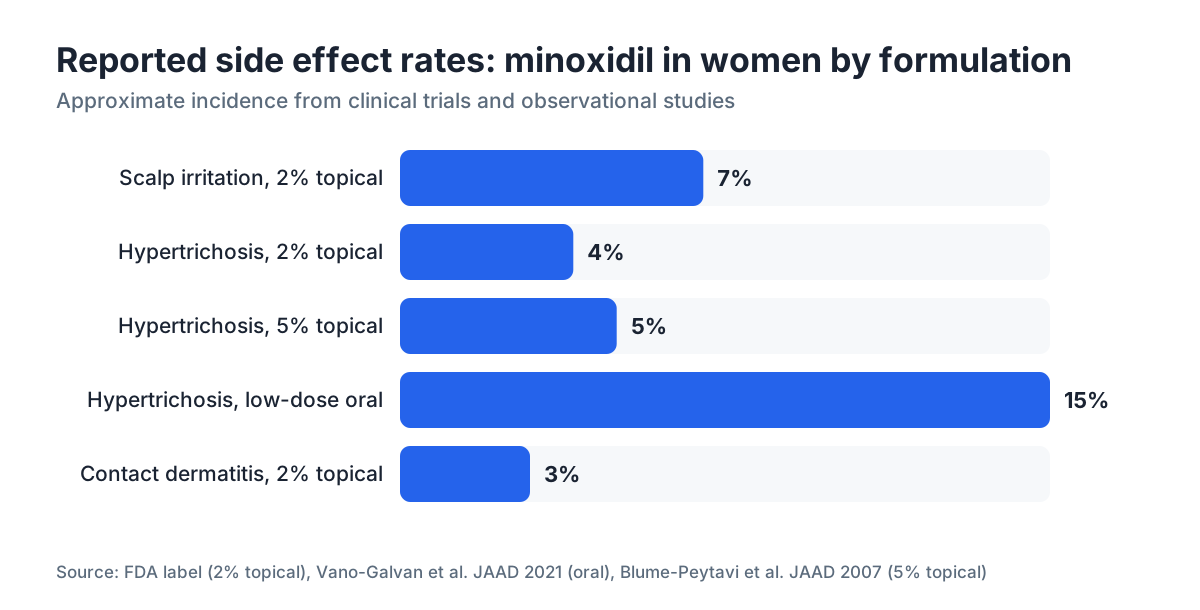
Scalp irritation, itching, and dryness. This is the number one complaint. In the trials supporting FDA approval, scalp dermatitis occurred in roughly 7% of women using the 2% solution versus about 3% on placebo [1]. A lot of that is the propylene glycol carrier in liquid formulations, not the minoxidil itself. Switching to a foam version (which uses alcohol and butane rather than propylene glycol) often fixes it.
Contact dermatitis. A true allergic reaction to minoxidil itself is less common but real. You'd see redness, swelling, and itching that spreads beyond the scalp. If that happens, stop and see a doctor. A patch test before starting is a sensible precaution if you have sensitive skin.
Unwanted facial hair (hypertrichosis). This is the side effect women fear most, and it gets its own section below. It's real, though less common than scalp irritation.
Initial shedding (telogen effluvium). Somewhere between weeks 2 and 8 of starting minoxidil, many women notice more hair coming out than usual. This scares people into quitting, which is a shame, because it's almost always a sign the treatment is working. Minoxidil pushes resting hairs into an active growth phase, kicking out old club hairs in the process. It typically resolves on its own by month 3 or 4. See telogen effluvium for a fuller explanation of what's happening biologically.
Scalp flaking or seborrheic-dermatitis-like symptoms. Less common, and again often tied to the propylene glycol carrier.
Here's a quick reference pulled from the FDA label and supporting trial data:
| Side Effect | Approximate Incidence (2% topical, women) | Notes |
|---|---|---|
| Scalp irritation / pruritus | ~7% | Often propylene glycol, not minoxidil |
| Contact dermatitis | <3% | True allergy to minoxidil itself |
| Facial hypertrichosis | Reported; estimated 3-5% in observational data | Dose and application-method dependent |
| Initial shedding (weeks 2-8) | Very common, exact % not well-quantified | Almost always transient |
| Systemic cardiovascular effects | Rare with topical at labeled doses | More relevant with oral minoxidil |
Does minoxidil cause unwanted facial hair growth in women?
Yes, it can. This is called hypertrichosis, and it's the side effect that makes many women hesitate. The mechanism is simple: minoxidil is a potassium channel opener that increases blood flow and stimulates hair follicles. It doesn't know the difference between your scalp and your forehead.
The risk depends heavily on how you apply it. Apply topical liquid with your hands and then touch your face, or apply it near the hairline where it drips, and you've created the conditions for facial hair growth. Foam applied directly to the scalp with fingertips, then washing your hands right away, cuts transfer sharply.
The good news: for most women who do get facial hypertrichosis from topical minoxidil, it's mild and reversible. Stop the drug and those extra hairs usually shed within 1 to 3 months. The bad news: if you stop minoxidil to lose the facial hair, your scalp hair loss comes right back.
Oral minoxidil at the low doses used for hair loss (0.25 mg to 2.5 mg daily for women) carries a higher rate of hypertrichosis because the drug circulates systemically rather than sitting where you put it. A 2021 study in the Journal of the American Academy of Dermatology found hypertrichosis in 14 to 17% of women taking low-dose oral minoxidil [3], well above the rates seen with topical use.
Practical tips if you're worried: use the foam, not the liquid. Apply at night after your skin's natural oils have settled. Wash hands right after. Avoid applying within an inch of your hairline if you can.
Can minoxidil affect sexual function or hormones in women?
This comes up often when women search for minoxidil side effects sexually, and the honest answer is short: minoxidil is not a hormonal drug and has no known direct mechanism for affecting libido, menstrual cycles, or sexual function at the doses used for hair loss.
Minoxidil is a vasodilator. It works on potassium channels and blood vessels, not on androgen receptors or estrogen pathways. That's actually one of its advantages over finasteride for women, since finasteride and dutasteride carry more complicated hormonal considerations (see finasteride for that picture).
A few things are still worth knowing. Some women report reduced libido anecdotally, but these reports haven't held up in controlled trials and could easily reflect the psychological weight of hair loss itself rather than any drug effect. And oral minoxidil at high doses (far above what's used for hair loss) drops blood pressure significantly, which can indirectly affect sexual function. At the 0.5 to 2.5 mg oral doses used for hair, clinically meaningful blood pressure drops are uncommon but not impossible, especially in women who already run low.
Notice changes in your period, libido, or sexual function after starting minoxidil? Talk to your prescribing physician. Not because minoxidil is the likely cause, but because ruling out other causes is the right move.
What are the serious side effects women should know about?
Most women tolerate topical minoxidil without serious problems. A few situations deserve real attention.
Cardiovascular effects. Minoxidil was originally a blood pressure medication, and at high doses it causes fluid retention, rapid heart rate (tachycardia), and chest pain. At labeled topical doses, systemic absorption is low, roughly 1 to 2% of the applied dose reaches the bloodstream according to the FDA label [1]. Still, if you have existing heart disease, kidney disease, or you're on other blood pressure medications, talk to your cardiologist before starting topical minoxidil.
With oral minoxidil, systemic absorption is complete. The doses used for hair loss (typically 0.25 to 2.5 mg in women) sit far below the 10 to 40 mg doses historically used for hypertension, but some blood pressure effect is possible. Palpitations, lightheadedness when standing (orthostatic hypotension), and swelling in the ankles or feet have all shown up in low-dose oral minoxidil studies [3].
Pregnancy and breastfeeding. The FDA categorizes minoxidil as Category C for pregnancy, meaning animal studies have shown adverse effects and there are no adequate human studies. The label states plainly that minoxidil should not be used by pregnant women [1]. If you're trying to conceive or are pregnant, don't use it. Breastfeeding is also a contraindication because minoxidil passes into breast milk.
Scalp wounds or irritated skin. Applying minoxidil to broken or inflamed skin sharply increases systemic absorption. If you have psoriasis, eczema, or a sunburn on your scalp, wait until the skin barrier is intact.
Interaction with other topical medications. Using minoxidil alongside other scalp products (especially anything that boosts absorption, like retinoids) can raise how much gets into your bloodstream. Keep that in mind if you're using tretinoin or other actives on your scalp.
How does the 5% formula compare to 2% for side effects in women?
The 2% solution is FDA-approved specifically for women. The 5% foam is labeled for men, but many dermatologists use it off-label for women who don't respond to 2%, and there's good evidence it works better.
A randomized trial in the Journal of the American Academy of Dermatology compared 5% minoxidil solution, 2% solution, and placebo in women with androgenetic alopecia. The 5% group showed meaningfully more regrowth at 48 weeks, but also a higher rate of hypertrichosis: 5.1% in the 5% group versus 3.9% in the 2% group [4]. Scalp irritation rates were similar between concentrations, though the 5% liquid carries more propylene glycol in absolute terms.
The 5% foam tends to irritate less than the 5% liquid because foam formulations drop propylene glycol entirely. That makes the foam a reasonable middle ground: better efficacy than 2%, less irritation than 5% liquid, though the hypertrichosis risk stays higher than 2%.
For women who want maximum efficacy and can handle the side effect profile, low-dose oral minoxidil has become a popular alternative. You skip scalp application entirely, which sidesteps contact dermatitis and application-related facial transfer. The trade-off is fully systemic exposure. See oral minoxidil for a proper breakdown of that option.
What causes the initial shedding and how long does it last?
The initial shed after starting minoxidil is one of the most misunderstood parts of hair loss treatment. It's backwards on its face: you start something to grow hair and you lose more hair. So most people assume the drug isn't working.
Here's what's actually happening. Minoxidil shifts hair follicles from the resting phase (telogen) into the active growth phase (anagen). Follicles sitting in telogen have to shed their club hairs before they can start a new cycle. The drug speeds up the turnover. More follicles kicked into anagen at once means more old hairs falling out at once.
This shed typically starts between weeks 2 and 8 and resolves on its own by months 3 to 4. It is not damage. The evidence for it is mostly mechanistic and observational rather than a clean randomized trial, but it's a consistent clinical finding dermatologists see all the time.
If shedding is extreme, drags past month 4, or comes with burning or pain, get it looked at by a dermatologist. You could have a different underlying cause entirely, like iron deficiency anemia or thyroid dysfunction, that looks like a minoxidil shed. Reading up on what causes hair loss can help you rule out confounders before you pin everything on the minoxidil.
Who should not use minoxidil, and are there women at higher risk?
The FDA label lists these contraindications and cautions specifically [1]:
- Pregnant women (Category C)
- Women who are breastfeeding
- Anyone with a known allergy to minoxidil or any component of the formulation
- Anyone with alopecia areata, traction alopecia, or other causes of hair loss where minoxidil has no established benefit
Higher-risk groups who should have a specific conversation with their doctor before starting:
Women with cardiovascular disease. Even topical minoxidil has measurable systemic absorption. If you have heart failure, coronary artery disease, or you're on multiple antihypertensives, the extra vasodilator load matters.
Women with kidney disease. Minoxidil is renally cleared. Impaired kidneys mean higher and longer systemic exposure from topical use.
Women already at low blood pressure. Orthostatic hypotension (dizziness on standing) is the most practically relevant cardiovascular effect at the doses used for hair loss, and it's more likely if your baseline pressure already runs low.
Women with scalp conditions that break the skin barrier. Active seborrheic dermatitis, psoriasis, or eczema raises absorption unpredictably.
One group that gets overlooked: women taking oral minoxidil for hair loss who are also on other vasodilators or antihypertensives. The combination can add up to real blood pressure lowering. If you're on any blood pressure medications, run the interaction by your prescriber before adding oral minoxidil, even at the low doses used for hair.
How do I manage or reduce minoxidil side effects?
A few things actually move the needle.
Scalp irritation: Switch from liquid to foam. The foam drops propylene glycol, the main culprit in most irritation cases. If irritation continues with foam, you may have a true sensitivity to minoxidil itself, which means stopping.
Facial hair: Apply only at the scalp with your fingertips or a dropper. Never with your palms. Wash hands right after. Apply at night so the product dries before you sleep and won't transfer to pillowcases and then your face. If your hairline is the target, foam drips less than liquid.
Initial shedding: Patience is the only real strategy. Some dermatologists suggest starting with 2% to keep the shed milder, since a lower concentration triggers a less intense initial response. Don't stop during the shed.
Cardiovascular effects: Ankle swelling, palpitations, or steady lightheadedness all mean see your doctor. Ankle swelling in particular can signal fluid retention and warrants a clinical look rather than waiting it out.
Dryness and breakage: Minoxidil in either formulation can dry hair temporarily. A good conditioner used away from the scalp treatment area helps.
Trying to figure out whether what you're seeing is a normal side effect or something that needs evaluation? Tools like the free AI scan at MyHairline can help you document changes in your hair over time and bring a clearer picture to a dermatologist.
How do minoxidil side effects in women compare to other hair loss treatments?
For women specifically, the treatment options are narrower than they are for men, which makes side effect comparisons matter more.
Finasteride and dutasteride: These 5-alpha reductase inhibitors are used off-label for women with pattern hair loss, particularly post-menopausal women. They work on DHT and can be quite effective, but they carry teratogenicity risk (they can cause birth defects in male fetuses) and are flatly contraindicated in women of childbearing age who aren't using reliable contraception [9]. Side effects can include reduced libido, though the evidence in women is weaker than in men. See finasteride for the full picture.
Spironolactone: An anti-androgen commonly used off-label for female-pattern hair loss in the US. Side effects include frequent urination, breast tenderness, menstrual irregularities, and (like finasteride) teratogenicity. It's a DHT blocker by mechanism.
Hair transplant: No systemic side effects, but real cost (typically $4,000 to $15,000 per procedure), recovery time, and the fact that the underlying loss continues if you don't treat the cause. See hair transplant for what that involves.
Low-level laser therapy (LLLT): Considered quite safe, minimal side effects. The efficacy evidence is weaker than minoxidil. Devices range from cheap caps to $600-plus helmets.
For most women with androgenetic alopecia, topical minoxidil still has the best risk-to-benefit ratio as a starting point: FDA-approved at 2%, solid evidence for efficacy, and a side effect profile that's real but manageable for most. The main reasons a dermatologist might skip straight to something else are patient preference, skin sensitivity, or wanting to treat an androgen-excess problem directly.
| Treatment | FDA Approval for Women | Main Side Effects | Teratogenic? |
|---|---|---|---|
| Minoxidil 2% topical | Yes | Scalp irritation, hypertrichosis, initial shed | No (Category C, avoid use) |
| Minoxidil 5% foam | Off-label | Same, higher hypertrichosis rate | No |
| Oral minoxidil | Off-label | Hypertrichosis, BP effects, fluid retention | No (avoid use) |
| Finasteride | Off-label | Libido changes, menstrual changes | Yes (Category X in pregnancy) |
| Spironolactone | Off-label | Urination, menstrual changes, breast tenderness | Yes |
| Hair transplant | N/A (surgical) | Scarring, shock loss, cost | No |
When should a woman stop using minoxidil?
Stop and contact a doctor if you get any of these:
- Chest pain, rapid or irregular heartbeat
- Sudden weight gain or ankle swelling (signs of fluid retention)
- Severe scalp reaction: oozing, significant swelling, or spreading redness
- Dizziness or fainting, especially when standing
- Signs of a systemic allergic reaction: rash beyond the scalp, difficulty breathing, facial swelling
You do not need to stop for:
- Initial shedding in the first 8 weeks
- Mild scalp dryness or itching that clears up when you switch formulations
- Small amounts of downy facial hair you can manage
One practical note. If you stop minoxidil for any reason, the hair you've kept or regrown will shed over the following 3 to 6 months. That's not a reason to stay on it if you have a real adverse reaction, but it's worth factoring into the timing if you're pausing for something elective like pregnancy planning. Talk to your dermatologist about that transition well ahead of time.
Not sure whether your hair changes are minoxidil side effects or a different kind of shedding? Reading about telogen effluvium and what causes hair loss can help you walk into that appointment with better questions.
Sources
- FDA, Rogaine (minoxidil) 2% topical solution prescribing information
- American Academy of Dermatology, Hair Loss in Women
- Vano-Galvan S et al., Journal of the American Academy of Dermatology, 2021, Low-dose oral minoxidil for hair loss
- Blume-Peytavi U et al., Journal of the American Academy of Dermatology, 2007, randomized trial comparing 5% vs 2% minoxidil in women
- National Library of Medicine, MedlinePlus, Minoxidil Topical
- FDA, Drug Approval Package for Rogaine for Women
- American Academy of Dermatology, Hair Loss: Who Gets It and Causes
- NIH National Institute of Arthritis and Musculoskeletal and Skin Diseases, Alopecia Areata
- Mella JM et al., Journal of the American Academy of Dermatology, 2010, efficacy and safety of finasteride in female-pattern hair loss
- FDA, MedWatch Drug Safety Communication, Minoxidil