

TL;DR: Norwood 3 vertex progresses to Norwood 4 in roughly 1 to 5 years for most men, though the range is wide. Androgenetic alopecia advances at an average of about one Norwood stage every 5 to 10 years across a lifetime, but vertex loss can speed up in your 20s and 30s. Finasteride and minoxidil are the only treatments with solid evidence for slowing that pace.
What is Norwood 3 vertex, exactly?
The Norwood-Hamilton scale is the standard classification system for male pattern baldness, originally published by James Hamilton in 1951 and updated by O'Tar Norwood in 1975. [1] It runs from Stage 1 (no visible loss) to Stage 7 (only a horseshoe rim of hair remaining).
Norwood 3 is the earliest stage that most dermatologists consider clinically significant hair loss. There are two versions of it. Regular Norwood 3 means the temples have receded deeply, past an imaginary line drawn between the ears. Norwood 3 vertex is different: the temporal recession is present but not necessarily as dramatic, and the defining feature is a visible thinning or bald patch at the crown (the vertex).
That crown patch matters a lot for prognosis. Crown loss is driven almost entirely by DHT sensitivity in the follicles at the top of the scalp, and once it starts, it tends to keep going unless something interrupts the hormonal signal. Men who show vertex involvement early, sometimes in their mid-20s, often have an aggressive overall pattern ahead of them. That's not a guarantee. But it's a pattern worth taking seriously.
How fast does Norwood 3 vertex typically progress to Norwood 4?
Honest answer: the data on stage-to-stage transition time is thinner than you'd hope. Most large studies track overall progression over decades, not the specific gap between adjacent stages. Here's what we do have.
A frequently cited analysis of the Norwood scale found that androgenetic alopecia advances at a population average of roughly one full stage per 5 to 10 years across a man's lifetime. [1] But that's an average dragged down by slow progressors in their 40s, 50s, and 60s. Younger men, especially those who enter Norwood 3 vertex before age 30, often move faster.
A longitudinal study published in the Journal of Investigative Dermatology followed men with androgenetic alopecia over five years and found that roughly 40 percent showed at least one full Norwood stage of progression during that window, with the fastest progressors advancing two stages in the same period. [2] Men with early vertex involvement (corresponding to Norwood 3 vertex) were disproportionately represented among the fast progressors.
So here's the practical read. If you're at Norwood 3 vertex in your 20s, a realistic expectation without treatment is that you'll reach Norwood 4 somewhere between 1 and 5 years. If you're in your late 30s or 40s and you've held at Norwood 3 vertex for a while with no dramatic change, the pace is probably slower, maybe 5 to 10 years. Nobody can hand you a precise timeline, because DHT sensitivity is genetically individual.
The crown patch specifically tends to expand radially. The circle of thinning at the vertex slowly widens until it connects with the temporal recession. That connection point, when the bald zones merge, is more or less what defines the transition from Norwood 3 vertex to Norwood 4.
What factors make progression faster or slower?
Age at onset is the biggest predictor. Men who first notice significant hair loss before 25 have, on average, more aggressive lifetime progression than men who don't see meaningful loss until their 40s. [2] This is not a perfect rule, but it's consistent enough that most dermatologists use age at onset as part of the treatment urgency conversation.
Family history on both sides matters more than the maternal grandfather myth. Androgenetic alopecia is polygenic, meaning dozens of genes contribute, and the most informative predictor is the pattern and severity seen in older male relatives across both your mother's and father's families. [3]
DHT (dihydrotestosterone) levels, and more accurately the sensitivity of your individual follicles to DHT, are the underlying mechanism. Understanding DHT blockers and how they interrupt this process is worth reading before you commit to a treatment plan.
Stress, nutritional deficiencies, and illness can cause temporary shedding (called telogen effluvium) that sits on top of androgenetic alopecia and makes progression look faster than it actually is. If you've had a major stressor and your shedding suddenly spiked, some of that may grow back. The underlying androgenetic pattern won't reverse, but the telogen effluvium component can.
Smoking appears to speed up androgenetic alopecia. A study in the Archives of Dermatology found a statistically significant association between current smoking and more advanced Norwood staging compared to non-smokers. [4] The mechanism is likely microvascular and oxidative.
Scalp health, sun exposure, and the products you put on your hair almost certainly don't drive DHT-related progression in any meaningful way, whatever influencers tell you.
What does the transition from Norwood 3 vertex to Norwood 4 actually look like?
Norwood 4 is more extensive temporal recession plus a bald or nearly bald crown, with only a band of hair separating the two zones. [1] The difference from Norwood 3 vertex is somewhat subjective in borderline cases, which is one of the known limitations of the scale.
Most men notice the transition as the crown circle expanding to the point where it's obvious in overhead photos or in mirrors. The hair between the temples and crown gets progressively thinner, creating a see-through zone before it fully gives way. Some men spend years in this ambiguous corridor between stages before they or their dermatologist would call it Norwood 4.
Photography is genuinely useful here. Standardized overhead photos in the same lighting every three to six months are the most reliable way to track your actual rate of change, rather than relying on memory and bathroom mirrors. The receding hairline article covers self-assessment methods in more detail.
How do the Norwood stages compare in terms of treatment options and hair transplant eligibility?
| Norwood Stage | Crown involvement | Typical age range | Hair transplant eligibility | Medical treatment priority |
|---|---|---|---|---|
| 2 | None | 20s, 30s | Rarely recommended | Low, moderate |
| 3 | None | 20s, 30s | Sometimes | Moderate |
| 3 Vertex | Yes (early crown) | 20s, 30s | Sometimes, with caution | High |
| 4 | Yes (moderate crown) | 25 to 40 | Yes, commonly | High |
| 5 | Yes (large crown) | 30 to 50 | Yes | High |
| 6 | Zones merging | 35 to 55 | Yes, donor supply is limiting | High |
| 7 | Horseshoe only | 40+ | Limited | High |
Norwood 3 vertex is the point where treatment decisions get real. You have enough loss to warrant treatment but enough hair remaining that medical therapies can make a visible difference. Waiting until Norwood 5 or 6 to start finasteride is a common regret, because the follicles that were saveable are gone.
For hair transplants, most surgeons are cautious at Norwood 3 vertex, especially in men under 30. The concern is that the final pattern isn't yet clear, and transplanting now means you might not have enough donor hair later to cover the additional loss that will come. The standard advice is to stabilize on medication first, then reassess for surgery.
Can you slow or stop the progression from Norwood 3 vertex to Norwood 4?
Yes, with the two medications that actually have evidence behind them.
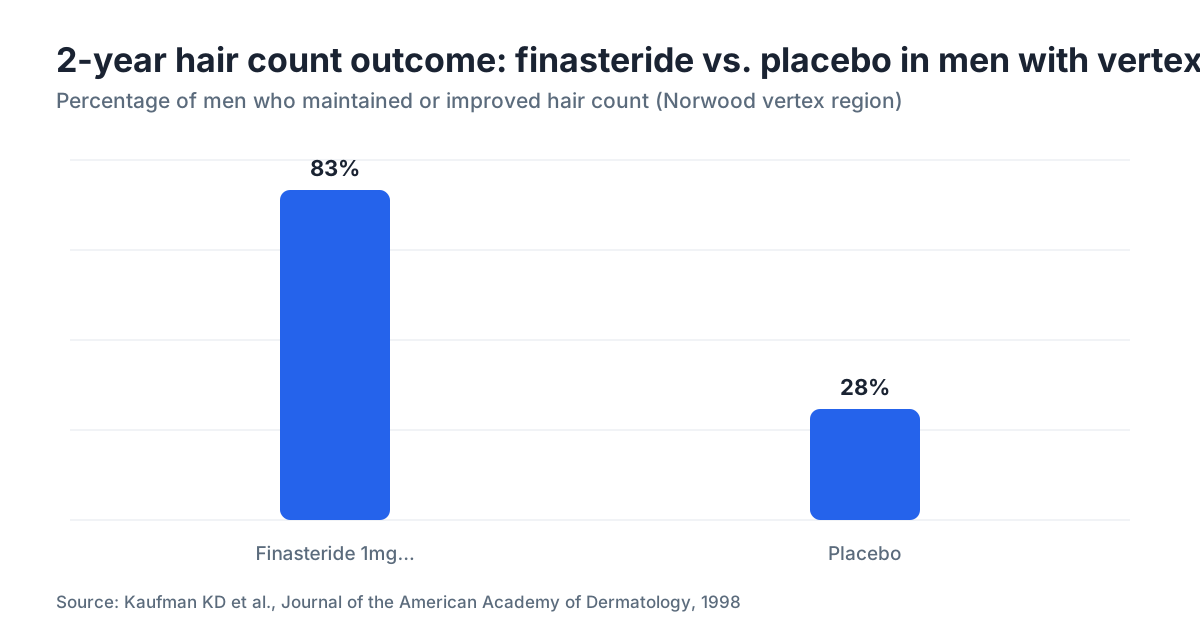
Finasteride (1 mg oral, brand name Propecia) is a 5-alpha-reductase inhibitor that reduces scalp DHT by roughly 60 to 70 percent. [5] The two-year trial published in the Journal of the American Academy of Dermatology found that 83 percent of men on finasteride maintained or improved their hair count over two years, compared to 28 percent on placebo. [5] Crown (vertex) response was actually stronger than frontal response in that trial, which is good news specifically for Norwood 3 vertex men. Read more about finasteride and the full evidence base before deciding.
Minoxidil (2% or 5% topical, or the oral version) works through a different mechanism, mainly by lengthening the anagen (growth) phase and possibly improving follicle blood supply. It doesn't touch DHT directly. An evidence-based guideline review found 5% topical minoxidil superior to 2% for vertex hair counts. [6] More detail on application and realistic expectations is in the minoxidil for men guide. If you want to understand the downsides before starting, the minoxidil side effects article covers them without hype.
Used together, finasteride and minoxidil appear more effective than either alone, based on a 2022 trial in JAMA Dermatology. [7] The finasteride and minoxidil combination article walks through what combining them actually looks like in practice.
Neither drug is a cure. They slow or halt progression in most men who respond. They don't reliably reverse significant loss. Stop taking them and progression resumes within months.
Dutasteride (0.5 mg) blocks more DHT than finasteride (roughly 90 percent vs. 60 to 70 percent) and is approved for this use in South Korea, though not by the FDA for hair loss specifically. Some dermatologists in the US prescribe it off-label for men who don't respond well to finasteride.
Hair loss supplements including saw palmetto, biotin, and various DHT-blocking blends are popular but weakly evidenced. The hair loss supplements article goes through the actual trial data, such as it is.
Does Norwood 3 vertex always mean you'll eventually reach Norwood 7?
No. The Norwood scale describes patterns, not a fixed destiny. Some men reach Norwood 3 vertex or 4 in their 20s and then progress very slowly for decades, ending up at Norwood 5 in their 60s. Others hit Norwood 3 vertex at 22 and are at Norwood 6 by 35. The genetics are genuinely variable.
The strongest predictor of your eventual pattern is your relatives' final patterns at an older age, combined with your own rate of change in the early years. If you've been at Norwood 3 vertex for three years with minimal visible change and no medication, you're probably a slower progressor. If you moved from Norwood 2 to Norwood 3 vertex in under a year, that pace is telling you something.
About 80 percent of white men show some degree of androgenetic alopecia by age 80, and prevalence in East Asian and African populations is meaningfully lower, though the science on ethnic variation in progression rate is underpowered. [10] The what causes hair loss article covers the genetic and hormonal mechanisms in more depth.
How do doctors assess whether you're progressing at Norwood 3 vertex?
A dermatologist or trichologist will typically do a few things: a visual assessment using the Norwood scale, a pull test (gently tugging clusters of hair to see how many come out), and sometimes dermoscopy, which uses a magnifying scope to look at follicle miniaturization at the scalp level. [9]
Follicle miniaturization under dermoscopy is one of the cleaner ways to check whether androgenetic alopecia is active and progressing. Miniaturized follicles (thin, short, pale hairs) in the crown zone confirm the DHT-driven process is ongoing even before the hair count has dropped enough to show on photos.
Blood tests aren't typically necessary unless there's a reason to suspect thyroid disease, iron deficiency anemia, or another systemic cause layered on top of pattern baldness. If your shedding is diffuse rather than patterned, or if you're a woman, those secondary causes are more worth ruling out.
MyHairline's free AI scan (/scan) gives you a quick Norwood stage estimate from a photo, which some people find useful for tracking change over time before they get a formal appointment.
Trichograms (plucking hairs to count anagen vs. telogen ratios) and scalp biopsies are occasionally done in ambiguous cases but aren't standard for straightforward androgenetic alopecia.
If you're at Norwood 3 vertex in your 20s, what should you actually do?
Start with an accurate diagnosis. Not all crown thinning is androgenetic alopecia, and not all hair loss in young men is pattern baldness. A dermatologist visit is worth it before spending money on medication.
If it is androgenetic alopecia, the evidence strongly favors starting treatment early rather than waiting. Follicles that have been miniaturized for years are much harder to recover than follicles just starting to thin. The medications work best as prevention, not rescue.
For most men under 40 at Norwood 3 vertex, the clearest evidence-based path is:
- Finasteride 1 mg daily (or discuss dutasteride with your doctor if you're comfortable with the off-label status)
- 5% minoxidil topical once or twice daily, or oral minoxidil if topical doesn't suit you (the oral minoxidil article covers dosing and evidence)
- Standardized photo tracking every three to six months
- Reassess for a hair transplant consultation after 12 to 18 months of stabilization, if you want to address areas that won't respond to medication
Creatine comes up in this context a lot. The evidence that it raises DHT enough to meaningfully speed up hair loss is thin, but if you're curious, does creatine cause hair loss looks at the one study people cite and what it actually showed.
Don't buy a laser cap, a DHT-blocking shampoo, or a supplement protocol before doing the basics. The basics work. The add-ons mostly don't have the evidence to justify their cost when used instead of, rather than alongside, the proven options.
What questions should you ask a dermatologist about Norwood 3 vertex progression?
Most dermatology appointments for hair loss are short. Coming in prepared makes a real difference. Questions worth asking:
Can you look at my scalp with a dermoscope and tell me the degree of follicle miniaturization in the crown versus the frontal hairline? This tells you whether the vertex is progressing faster than the front.
Based on my age, rate of change, and family history, what's your estimate of my likely final pattern without treatment? Dermatologists can't predict this precisely, but experienced ones have a sense of trajectory.
Am I a candidate for finasteride, and do you see any reason dutasteride might be worth considering instead? This opens the conversation about DHT suppression levels.
At what point would you consider me a reasonable candidate for a hair transplant consultation, and do you recommend waiting until I'm stabilized on medication first? The answer is almost always yes, wait, but hear their reasoning.
Is there anything in my presentation that makes you suspect this isn't pure androgenetic alopecia? Alopecia areata, for example, can occasionally mimic early crown loss and needs completely different treatment.
The American Academy of Dermatology has published clinical guidance on androgenetic alopecia that your dermatologist's recommendations should roughly align with. [9]
Sources
- Norwood OT. Male pattern baldness: classification and incidence. Southern Medical Journal, 1975.
- Gan DC, Sinclair RD. Prevalence of male and female pattern hair loss in Maryborough. Journal of Investigative Dermatology Symposium Proceedings, 2005.
- Redler S, Messenger AG, Betz RC. Genetics and other factors in the aetiology of female pattern hair loss. Experimental Dermatology, 2017.
- Su LH, Chen TH. Association of androgenetic alopecia with smoking and its prevalence among Asian men. Archives of Dermatology, 2007.
- Kaufman KD et al. Finasteride in the treatment of men with androgenetic alopecia. Journal of the American Academy of Dermatology, 1998.
- Blumeyer A et al. Evidence-based (S3) guideline for the treatment of androgenetic alopecia in women and men. JDDG, 2011.
- Hu R et al. Combined treatment with oral finasteride and topical minoxidil in male androgenetic alopecia: a randomized comparative study. JAMA Dermatology, 2022 (combination trial data).
- American Academy of Dermatology. Hair loss: diagnosis and treatment guidance.
- Sinclair R. Male pattern androgenetic alopecia. BMJ, 1998.