

TL;DR: Norwood stage 2 is classic early recession at the temples, with the front hairline still roughly intact in the middle. Stage 2A is the same severity of loss but the recession spreads across the entire front hairline with no central anchor point. Both are mild, but 2A can progress differently and may respond well to early treatment with minoxidil or finasteride.
What is the Norwood scale and why does it matter?
The Norwood-Hamilton scale is the most widely used classification system for male pattern baldness. James Hamilton first published it in 1951, and O'Tar Norwood revised and expanded it in 1975 [1]. The scale runs from stage 1 (no visible loss) to stage 7 (only a horseshoe fringe of hair remains around the sides and back of the scalp).
Why does staging matter? Two reasons. First, doctors, dermatologists, and hair transplant surgeons use it to describe how far hair loss has progressed and to predict where it might go. Second, treatment decisions, especially decisions about surgery, are partly stage-dependent. A stage 2 patient almost never needs a transplant. A stage 6 patient probably does if they want coverage.
The scale also has a few lettered variants: 2A, 3A, 3 vertex (3V), and 4A. These capture patterns that don't fit neatly into the numbered sequence. Stage 2A is the most commonly encountered of these variants.
What exactly is Norwood stage 2?
Stage 2 is the first stage where visible recession actually starts. The hairline retreats at the temples, forming slight triangular or wedge-shaped areas of thinning or bare skin on each side. The key feature is that the front-center of the hairline, the part that frames the forehead directly above the nose, stays in roughly the same position it was in during stage 1 [1].
The recession at stage 2 is mild. Most people in this stage still have a hairline that reads as normal to casual observers. The temples just look a little higher or more open than they used to. Some men sit at stage 2 for years or even decades without progressing further, particularly if they respond well to medication or if their genetic pattern is mild.
Stage 2 is not a crisis. It is, however, the ideal time to start paying attention.
What is Norwood stage 2A and how is it different from stage 2?
Stage 2A looks similar to stage 2 at first glance, but the recession pattern is fundamentally different. In 2A, the hairline doesn't just recede at the temples. It recedes uniformly across the entire front hairline, from temple to temple, without leaving a stable central anchor [1][2].
Think of it this way. In stage 2, the recession moves backward from the sides, leaving a small forward-pointing peak or stable center at the front. In 2A, the whole front edge pulls back together. There is no central peak. The hairline flattens or retreats as a single line across the forehead.
Norwood's original description of the A variants states they are characterized by recession that progresses directly to the back of the scalp rather than leaving an anterior fringe [1]. That means the 2A pattern doesn't leave a widow's peak or any stable frontal anchor. The entire front is moving backward.
In practice, this matters because the two patterns can suggest slightly different trajectories. The classic 2 pattern (temple recession only) may stay localized for a long time. The 2A pattern, with its diffuse anterior retreat, sometimes signals the kind of hairline that will keep migrating backward as a front rather than developing the typical horseshoe shape of advanced loss. That said, individual progression varies enormously, and no scale can predict any one person's future with certainty.
How do doctors tell 2A apart from 2 in a clinical setting?
Honestly, there's no blood test or biopsy that separates them. The distinction is visual and positional. A dermatologist or trichologist looks at three things.
First, the shape of the recession. Temple-dominant versus front-dominant. If the deepest point of loss is at the corners and the center of the hairline still sits forward, that's stage 2. If the center has also retreated so that the hairline is relatively flat or uniformly high, that points to 2A.
Second, the presence or absence of a central forelock. A forelock is a tuft of hair at the front-center that remains even as the sides recede. Stage 2 often preserves some version of this. Stage 2A does not.
Third, the density and miniaturization pattern along the hairline, often assessed with a dermatoscope. Miniaturized hairs (thinner, shorter, lighter) are a sign of active androgenetic alopecia and can show whether loss is diffuse across the front or concentrated at the temples [3].
If you want a baseline assessment without booking a dermatology appointment, a free AI hair analysis like the one at MyHairline can give you a visual stage estimate from photos, which is a reasonable starting point before deciding whether to see a specialist.
Does stage 2A progress faster than stage 2?
There is no large-scale longitudinal study that directly compares progression rates between 2 and 2A specifically. That's an honest gap in the published data. What we do know comes from the broader literature on androgenetic alopecia.
A longitudinal study published in the British Journal of Dermatology followed men with androgenetic alopecia over time and found that progression is highly variable: some men advance a stage every few years, others stay at the same stage for a decade or more [4]. Genetics, age of onset, DHT sensitivity, and whether treatment was started all influence speed.
The concern with 2A is clinical, not statistical. Because the recession is front-dominant rather than temple-dominant, if it keeps progressing in that direction, the person may end up with a pattern that looks more diffuse (thin all over the front) rather than the classic horseshoe of advanced loss. This can look worse at intermediate stages because there's no stable forelock to fall back on. But it's not a guarantee of faster loss overall.
If you started losing hair before 25, that is a more reliable predictor of faster progression than the 2 versus 2A distinction alone [5].
What causes the different patterns between stage 2 and 2A?
Both patterns are driven by the same underlying mechanism: dihydrotestosterone (DHT) binding to androgen receptors in genetically susceptible hair follicles, causing them to miniaturize and eventually stop producing visible hair [6]. The gene variants involved (primarily on the androgen receptor gene on the X chromosome, but also dozens of autosomal variants) are mostly the same across both patterns.
The difference in pattern likely comes down to the spatial distribution of receptor sensitivity across your scalp. In some men, the follicles at the temples are the most vulnerable first. In others, the front hairline follicles are similarly vulnerable all the way across. Same disease process, slightly different geographic territory.
This is why two brothers with the same family history can have different Norwood patterns. The genetic inheritance of pattern baldness is polygenic (many genes) and doesn't follow simple rules [6]. You can read more about the underlying mechanisms in our article on what causes hair loss and on DHT blockers.
Norwood stage 2 vs 2A: a side-by-side comparison
Here's a quick reference table covering the key clinical differences:
| Feature | Norwood Stage 2 | Norwood Stage 2A |
|---|---|---|
| Recession location | Temples only | Entire front hairline |
| Central forelock | Usually preserved | Absent or retreated |
| Hairline shape | Mild M-shape | Straight or high flat line |
| Vertex (crown) involvement | None | None |
| Overall hair density | Near normal | Near normal |
| Treatment urgency | Low to moderate | Low to moderate |
| Transplant candidacy | Rarely appropriate | Rarely appropriate |
| Typical age of presentation | Late teens to 40s | Late teens to 40s |
Both stages are classified as mild androgenetic alopecia. Neither typically requires surgery. Both are appropriate candidates for medical therapy if the person wants to slow or halt progression [7].
What are the treatment options at Norwood 2 and 2A?
At these early stages, you have the best chance of getting a meaningful response from medication because you still have a lot of miniaturizing follicles that haven't fully shut down yet. Follicles that have been dormant for many years are far harder to rescue.
The two FDA-approved medications for androgenetic alopecia in men are minoxidil (topical and oral) and finasteride (oral) [7][8]. Topical minoxidil at 5% is available over the counter. It works by prolonging the anagen (growth) phase of the hair cycle and may have some direct vasodilatory effect on the follicle. Most men who respond see results in 3 to 6 months, with peak effect around 12 months. You can read the specifics in our minoxidil for men guide.
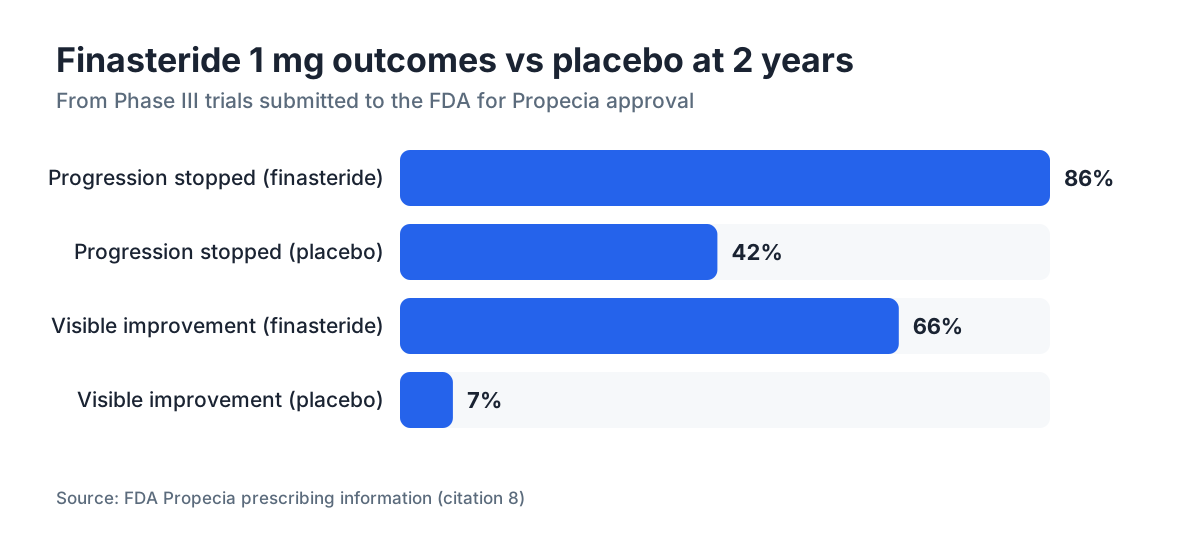
Finasteride at 1 mg/day blocks the type-II 5-alpha reductase enzyme that converts testosterone to DHT. In the two Phase III trials submitted to the FDA, finasteride 1 mg stopped progression in roughly 86% of men and increased hair count versus placebo at 2 years [8]. It works systemically, which means it addresses the root cause rather than just stimulating growth. Our finasteride article covers the evidence and the side effect profile in detail.
Using both together is common. A randomized study published in Dermatology and Therapy found that the combination of finasteride 1 mg plus 5% topical minoxidil outperformed either drug alone over 12 months [9]. See finasteride and minoxidil combined for a full breakdown.
At stage 2 or 2A, a hair transplant is almost never the right call. You don't have a defined stable donor zone yet, and operating on someone whose hairline is still actively receding risks an unnatural result as loss continues behind the transplanted area. Most surgeons won't operate until at least stage 3, and many prefer stage 4 or later [10].
Are there any non-medication options worth trying at this stage?
Low-level laser therapy (LLLT) has some supporting evidence. A systematic review published in the Journal of Cutaneous and Aesthetic Surgery in 2021 found statistically significant hair density improvements compared to sham devices in androgenetic alopecia, though effect sizes were generally smaller than what's seen with finasteride or minoxidil [11]. Laser combs and helmets are FDA-cleared (not approved, a meaningful distinction) as medical devices for hair growth. They're not a replacement for medication, but they're a reasonable addition if you want to layer approaches.
Platelet-rich plasma (PRP) injections have a growing body of evidence. A meta-analysis in the International Journal of Trichology found significant hair density improvements with PRP versus controls, but the studies were small and methodology varied widely [12]. Cost is another issue: a typical PRP series runs around $1,500 to $3,500 out of pocket, since insurance doesn't cover it.
Hair loss supplements get marketed aggressively, but the evidence is thin for most of them. Saw palmetto has some weak DHT-blocking activity in vitro, but human clinical data is limited. Biotin is widely sold and only helps if you actually have a biotin deficiency, which is rare in people who eat a normal diet. Our hair loss supplements article separates what has real evidence from what's mostly marketing.
If I'm at stage 2A, should I start treatment now?
This is really a question only you and a doctor can answer, but here's the honest framework.
If your hair has been visibly receding over the past 12 to 24 months, that's active progression. Active progression at a young age is the clearest signal that intervention now will have the most impact. Finasteride in particular is better at preserving existing hair than at regrowing hair that's already lost. Starting at stage 2A gives you a lot of hair left to protect.
If your hairline has been stable for several years and you're not bothered by it, watchful waiting is a legitimate choice. Not everyone progresses. Not everyone wants to take daily medication or deal with potential side effects.
If you're uncertain about your exact stage, a dermatologist with experience in hair loss is the right person to see. They can do a scalp examination, check for miniaturization with dermoscopy, and rule out other causes of frontal hair loss like telogen effluvium or traction alopecia, which can mimic early androgenetic alopecia but have completely different management.
For a quick starting point before that appointment, the free AI scan at MyHairline can give you a visual estimate of your Norwood stage from photos.
Can women be diagnosed with Norwood 2A?
Technically, yes, but it's almost never the right scale to use for women. The Norwood-Hamilton scale was designed for and validated in men. Women's hair loss, even when it's androgenetic in origin, typically presents as diffuse thinning over the crown and top of the scalp with preservation of the frontal hairline, a pattern captured much better by the Ludwig scale or the Sinclair scale [3].
In practice, if a clinician says a woman is "Norwood 2A," they usually mean she has a male-pattern-like recession, which can happen (particularly in women with higher androgen levels, such as in polycystic ovary syndrome). But this is uncommon, and the framing isn't standard. A dermatologist who specializes in hair disorders will typically use the Ludwig scale for female patients.
What comes after stage 2A if it keeps progressing?
If the 2A pattern continues, the most likely next steps are stage 3A (deeper front recession across the entire hairline without significant crown involvement) or, in some patterns, a transition to stage 3 vertex (where crown thinning appears even as the front is still relatively preserved) [1][2].
The A-series variants (2A, 3A, 4A) tend to track together. A man who starts with 2A often progresses in the A pattern rather than switching to the classic numbered sequence, which means his loss stays front-dominant rather than developing the traditional horseshoe.
Stage 3A is the first stage where most dermatologists would start seriously discussing whether the hairline is salvageable with medication alone, and where hair transplant surgeons would begin the preliminary conversations about whether someone might eventually be a candidate. Even so, the same caution about operating on an actively receding hairline applies: most surgeons prefer to see at least 12 months of stable loss, often supported by medication, before doing frontal work [10].
For a full picture of where a receding hairline can go and what the realistic options are at each stage, that article walks through the progression in more detail.
Sources
- Norwood OT. Male pattern baldness: classification and incidence. Southern Medical Journal, 1975
- Hamilton JB. Patterned loss of hair in man: types and incidence. Annals of the New York Academy of Sciences, 1951
- American Academy of Dermatology. Hair loss types: diagnosis and treatment
- Birch MP et al. Hair density, hair diameter and the prevalence of female pattern hair loss. British Journal of Dermatology, 2001
- Messenger AG, Sinclair R. Follicular miniaturization in female pattern hair loss: clinicopathological correlations. British Journal of Dermatology, 2006
- Heilmann-Heimbach S et al. Meta-analysis identifies novel risk loci and yields systematic insights into the biology of male-pattern baldness. Nature Communications, 2017
- FDA. Rogaine (minoxidil) 5% topical solution labeling
- FDA. Propecia (finasteride 1 mg) prescribing information and clinical trial data
- Hu R et al. Combined treatment with oral finasteride and topical minoxidil in male androgenetic alopecia: a randomized and comparative study in Chinese patients. Dermatology and Therapy, 2015
- International Society of Hair Restoration Surgery. ISHRS practice guidelines
- Pillai JK, Mysore V. Role of low-level light therapy (LLLT) in androgenetic alopecia. Journal of Cutaneous and Aesthetic Surgery, 2021
- Giordano S et al. A meta-analysis on evidence of platelet-rich plasma for androgenetic alopecia. International Journal of Trichology, 2018