
TL;DR: Finasteride (1 mg/day) blocks DHT, the hormone that shrinks hair follicles. Trials show it stops shedding in about 83% of men and produces visible regrowth in roughly 66% after two years. Results start around month 3 to 6, peak near year 2, and reverse within 12 months of stopping. It does not work the same way for women.
How does finasteride actually cause hair to regrow?
Finasteride doesn't grow hair out of nowhere. It removes a brake. The drug is a 5-alpha reductase type II inhibitor, meaning it blocks the enzyme that converts testosterone into dihydrotestosterone (DHT) [1]. DHT is the androgen behind androgenetic alopecia, the hair loss that follows a pattern: a receding hairline and thinning at the crown, the classic receding hairline picture. DHT binds to receptors in genetically sensitive follicles and miniaturizes them over years, turning thick terminal hairs into thin, unpigmented vellus hairs and eventually shutting the follicle down.
Finasteride at 1 mg/day lowers serum DHT by about 70% [1]. That drop gives follicles that are shrinking but still alive a chance to recover. The hair cycle has three phases: anagen (growth), catagen (transition), and telogen (rest). DHT shortens anagen. Remove enough DHT and those shortened cycles can lengthen again, follicles can thicken, and hairs that were barely visible can return to normal caliber.
The key phrase is "still alive." Follicles dormant so long they've been replaced by scar tissue won't come back. That's why finasteride works far better on thinning hair than on bare scalp. If you want the follicle-level biology, the guide on DHT blockers goes deeper.
What finasteride does not do: it doesn't block testosterone itself, and it doesn't touch type I 5-alpha reductase (mostly in skin and liver). So the systemic androgen disruption is narrower than people sometimes fear.
What do clinical trials say about regrowth rates?
Two large randomized controlled trials from the late 1990s form the base of the evidence, and they're summarized in the FDA-approved prescribing information. In the first (a study of men with mild-to-moderate vertex thinning), 48% of men on finasteride 1 mg showed increased hair count at year 1, rising to 66% showing improvement by year 2 [2]. Among men on placebo, 58% had worsened by year 2.
The second trial looked at the anterior scalp, which is harder to treat. Results there were less dramatic but still real: hair count rose from baseline in finasteride-treated men and fell in the placebo group [2].
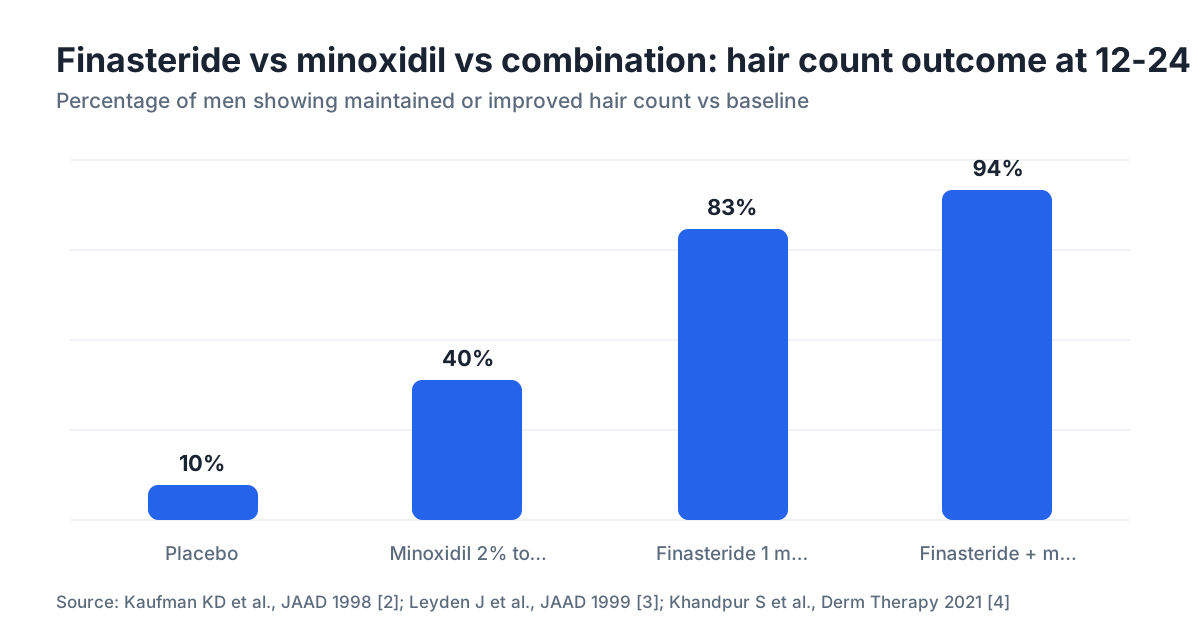
Here's the stat you'll see quoted everywhere. Finasteride "maintained or increased hair count relative to baseline in 83% of men after 2 years" [2]. That 83% figure includes men who didn't regrow but also didn't lose more ground. Pure regrowth was the 66% number. Holding the line is itself a win, because untreated androgenetic alopecia only moves one direction.
One honest caveat. These trials enrolled men aged 18 to 41 with Norwood II to IV patterns. Men with advanced loss (Norwood V to VII), older men, and men with long-standing baldness weren't well represented. Real-world results in those groups run worse.
For how these numbers change when you add the other first-line drug, the article on finasteride and minoxidil covers the combination.
When do you actually see results from finasteride?
Month 1 to 3: probably nothing visible. Some men notice a temporary bump in shedding. This gets called a "shedding phase" and happens as follicles move out of a stalled telogen into a new anagen cycle. It looks alarming. It's usually a sign the drug is working, not failing. That said, the evidence for a distinct finasteride shed is mostly anecdotal, and telogen effluvium from other causes looks identical at this stage.
Month 3 to 6: the first sign of stability. Most men stop noticing new thinning. Some see a slight density gain in photos taken under consistent light.
Month 6 to 12: visible regrowth usually starts here. Hair in miniaturized follicles comes back thicker and longer. It won't look like a transplant. It's gradual densification.
Year 1 to 2: the peak window. The trials show the largest hair count gains between baseline and the 12 to 24 month marks [2]. Gains after year 2 are possible but slower.
Year 2 onward: maintenance. Finasteride doesn't cure the genetic susceptibility. It suppresses DHT for as long as you take it. If results flatten at year 2, that plateau is the drug doing its job.
One practical rule. Take photos every 8 weeks, same lighting, same angle. Hair change is too slow to see day to day, and confirmation bias cuts both ways.
Which areas of the scalp respond best to finasteride?
The vertex (crown) beats the front. The trials showed statistically significant regrowth at the vertex as the primary endpoint [2]. Anterior scalp results were a secondary endpoint and improved too, just less.
This isn't a trial quirk. The biology lines up. Frontal hairline follicles tend to be more sensitive to androgens and are often further down the miniaturization road by the time most men start treatment. Finasteride can slow frontal recession and sometimes bring back some density, but the dramatic hairline before-and-afters you see usually involve men who started early or stacked finasteride with minoxidil or a procedure.
Norwood stage matters a lot. A Norwood II to III who starts within a year or two of noticing recession has a far better shot at meaningful regrowth than a Norwood V who's been bald at the crown for a decade. Early treatment is the single biggest predictor of outcome, more than dosage, more than brand, more than any add-on supplement.
If the hairline is your main concern, a hair transplant is often the more realistic fix for the front, with finasteride protecting the existing hair behind it.
How does finasteride compare to minoxidil for regrowth?
Different mechanisms, different strengths, and they pair well. Finasteride blocks DHT. Minoxidil stimulates the follicle. Together they cover more ground than either alone.
Minoxidil is a vasodilator applied to the scalp (or taken orally). It lengthens the anagen phase and boosts blood flow to follicles. It doesn't block DHT at all. Finasteride blocks DHT but doesn't push the follicle the way minoxidil does.
In head-to-head data, finasteride generally beats topical minoxidil 2% for vertex regrowth. A randomized trial in the Journal of the American Academy of Dermatology found finasteride 1 mg superior to topical minoxidil 2% at 12 months for both hair count and patient satisfaction [3]. Minoxidil 5% narrows that gap.
Most dermatologists give the same practical answer. If you can pick only one, finasteride wins for male androgenetic alopecia. If you want maximum regrowth, the combination beats either alone. The minoxidil for men article covers dosing and formulation.
| Treatment | Mechanism | Vertex regrowth at 2 yrs | Works without DHT sensitivity? |
|---|---|---|---|
| Finasteride 1 mg | DHT blocker | ~66% show improvement [2] | No |
| Minoxidil 2% topical | Vasodilator | ~40% show improvement [3] | Yes |
| Combination | Both | Higher than either alone [4] | Partially |
| Placebo | None | <10% maintain hair [2] | N/A |
Note: percentages across these studies use different outcome measures. Treat them as directional, not directly arithmetic.
Does finasteride work for women?
The evidence here is genuinely complicated. Finasteride is FDA-approved only for men [1]. The label carries a specific contraindication for women who are or may become pregnant, because blocking 5-alpha reductase during fetal development can cause abnormalities of the external genitalia in male fetuses [1].
Still, dermatologists do prescribe it off-label to postmenopausal women with female pattern hair loss, and there's a reasonable evidence base. A meta-analysis in the Journal of the American Academy of Dermatology found modest benefit in women, mostly at doses of 2.5 to 5 mg/day rather than the 1 mg used in men [5]. Response rates and regrowth were generally lower than in men.
For premenopausal women, the pregnancy risk makes most physicians cautious. When finasteride is prescribed to premenopausal women, reliable contraception is standard practice.
Women with pattern hair loss also have more options than men, including spironolactone, which blocks androgens through a different pathway. The broader picture of what causes hair loss in women involves hormonal factors that finasteride may not touch at all.
What happens if you stop taking finasteride?
The hair you kept or regrew starts to go. DHT levels return to baseline within roughly 2 weeks of stopping [1]. The follicles that lower DHT was protecting start miniaturizing again. Most men who stop after years of use report visible shedding within 3 to 6 months, and within 12 months many are back to the hair state they'd have reached had they never taken the drug.
This isn't a rebound in any pharmacological sense. It's the underlying genetic condition resuming its course. You haven't made anything worse. The drug stopped working because you stopped taking it.
Here's the thing people underestimate before starting. Finasteride is a long-term commitment. If a side effect makes you quit, or you just decide to quit, the results don't bank. The trials showing 5-year maintenance required 5 years of daily use [2].
If you travel a lot or have stretches where a daily pill is hard to keep up, think that through before you start, not after.
What are the real risks and side effects?
The trials reported sexual side effects (decreased libido, erectile dysfunction, decreased ejaculate volume) in about 3.8% of finasteride-treated men versus 2.1% on placebo in the first year [1]. A real difference, but a small one in absolute terms.
The contested issue is post-finasteride syndrome (PFS), a reported condition where sexual and cognitive side effects persist after stopping. The FDA updated finasteride labeling in 2012 to include persistent sexual dysfunction as a possible adverse effect [9]. The mechanism and true prevalence of PFS are still debated in the literature [10]. Case reports exist. Population-level incidence in a form that yields a reliable percentage does not.
What I'd tell a friend: the 3.8% trial rate is the most solid number we have. Most of those cases resolved after stopping the drug in the trial population. Persistent cases are real but probably rare. If side effects show up, stop early rather than pushing through. There's no evidence that continuing through them leads to resolution.
Other risks: breast tenderness or gynecomastia (rare, under 1% in trials), and a drop in PSA of about 50% that doctors have to account for in prostate cancer screening [1]. Tell your doctor you take finasteride before any PSA test.
Finasteride has no meaningful interaction with most common medications, but the full picture is in the prescribing information [1]. The standalone finasteride article covers safety in more depth.
Can you improve results by combining finasteride with other treatments?
Yes. The combination with the most evidence behind it is finasteride plus minoxidil. A randomized controlled trial in Dermatologic Therapy found the pair produced significantly greater hair count increases than either treatment alone at 12 months [4]. The mechanisms complement each other cleanly: finasteride removes the hormonal driver of miniaturization, minoxidil stimulates the follicle directly and extends growth cycles.
Platelet-rich plasma (PRP) gets added sometimes, and a few small studies show additive benefit, but the evidence is inconsistent and the cost is high. Microneedling (dermarolling) at 0.5 to 1.5 mm has some trial support as a minoxidil adjunct and may help topical finasteride penetrate if you use the topical form rather than the pill.
Topical finasteride is a real option now. Formulations pairing topical finasteride 0.25% with topical minoxidil 5% are on the market, and some studies suggest topical finasteride cuts scalp DHT about as much as oral while dropping serum DHT less, which may lower systemic side effect risk [6]. The topical data is newer and thinner than the oral data, but it looks promising.
Ketoconazole shampoo has weak evidence as an adjunct. Hair loss supplements like biotin or saw palmetto have minimal evidence for androgenetic alopecia specifically.
If you want a personalized read on which combination fits your pattern, a free AI hair analysis like the one at MyHairline gives you a starting point before your dermatology appointment.
How long should you give finasteride before deciding it isn't working?
Twelve months minimum. Eighteen is more honest.
Hair grows about 1 cm per month on average [11]. A follicle has to finish a full anagen cycle to produce a hair you can see and measure. Kicking off a new anagen cycle after suppressing DHT takes months, and then the hair has to grow to a visible length. Judging finasteride at 3 or 6 months is like grading a house before the walls go up.
The standard clinical benchmark is 12 months, which is why most trials report 1-year data as a primary endpoint. But the 2-year data consistently shows gains beyond the 12-month snapshot [2]. Plenty of men who saw only modest improvement at 12 months had clear regrowth by 24.
If at 12 months your photos show ongoing loss with no stabilization at all, that's a fair point to ask a dermatologist whether finasteride is working for you specifically. A minority of men are non-responders, and no reliable genetic test predicts this in advance.
Stopping at 3 months because you see nothing is the most common mistake. Stopping at 6 is the second most common.
Does finasteride prevent future hair loss or just treat current thinning?
Both, and the prevention angle is underrated.
Androgenetic alopecia is progressive. Without treatment, men with genetic susceptibility keep losing hair over decades. Finasteride lowers DHT enough that follicles which haven't yet miniaturized are less likely to while you're on it. The 5-year trial data showed men on finasteride held hair counts steady or better, while placebo-treated men lost significant density over the same period [12].
Here's the practical implication. Starting early (Norwood II to III) and staying on finasteride can mean arriving at 50 with a lot more hair than you'd otherwise have. Not because you regrew a ton, but because you interrupted a decade of loss. That outcome gets far too little attention.
The drug is not a ceiling-raiser for someone already at Norwood VI. It's a brake. The sooner you apply it, the more hair you keep.
For younger men noticing early hairline changes, the receding hairline guide explains which patterns to watch and when intervention usually matters most.
Is generic finasteride as effective as Propecia?
Yes. Generic finasteride 1 mg has the same active ingredient at the same dose as brand-name Propecia, made under the same FDA bioequivalence standards [1]. Merck no longer markets Propecia as a branded product in the US. What exists now is the generic market.
The cost difference is real and large. When Propecia was on the market it ran roughly $70 to $80 a month. Generic finasteride through most pharmacies or telehealth platforms now runs $15 to $30 a month, and some online prescribers offer it under $10. The molecule in both is identical.
The 5 mg finasteride tablet (Proscar, originally for benign prostatic hyperplasia) sometimes gets prescribed and split to yield four 1.25 mg doses. That's off-label but pharmacologically sound and can be even cheaper. Some physicians are comfortable with it. Others prefer to prescribe 1 mg tablets. Either works.
There's no evidence any specific brand of generic finasteride performs meaningfully differently from another. FDA bioequivalence testing requires blood level performance within a narrow window of the reference drug [1].
Sources
- FDA, Propecia (finasteride 1 mg) prescribing information
- Kaufman KD et al., Journal of the American Academy of Dermatology, 1998 (Finasteride in the treatment of men with androgenetic alopecia)
- Leyden J et al., Journal of the American Academy of Dermatology, 1999 (Finasteride vs minoxidil 2%)
- Khandpur S et al., Dermatologic Therapy, 2021 (combination finasteride and minoxidil)
- Mella JM et al., Journal of the American Academy of Dermatology, 2010 (meta-analysis: finasteride in women)
- Piraccini BM et al., Journal of the European Academy of Dermatology and Venereology, 2022 (topical finasteride)
- American Academy of Dermatology, Hair loss: diagnosis and treatment guidelines
- van Neste D et al., British Journal of Dermatology, 2000 (finasteride anterior scalp)
- FDA, MedWatch: finasteride label update 2012
- Traish AM et al., Korean Journal of Urology, 2015 (post-finasteride syndrome review)
- van der Donk J et al., Clinical & Experimental Dermatology, 1994 (hair growth rate)
- Olsen EA et al., Journal of the American Academy of Dermatology, 2006 (finasteride 5-year data)