
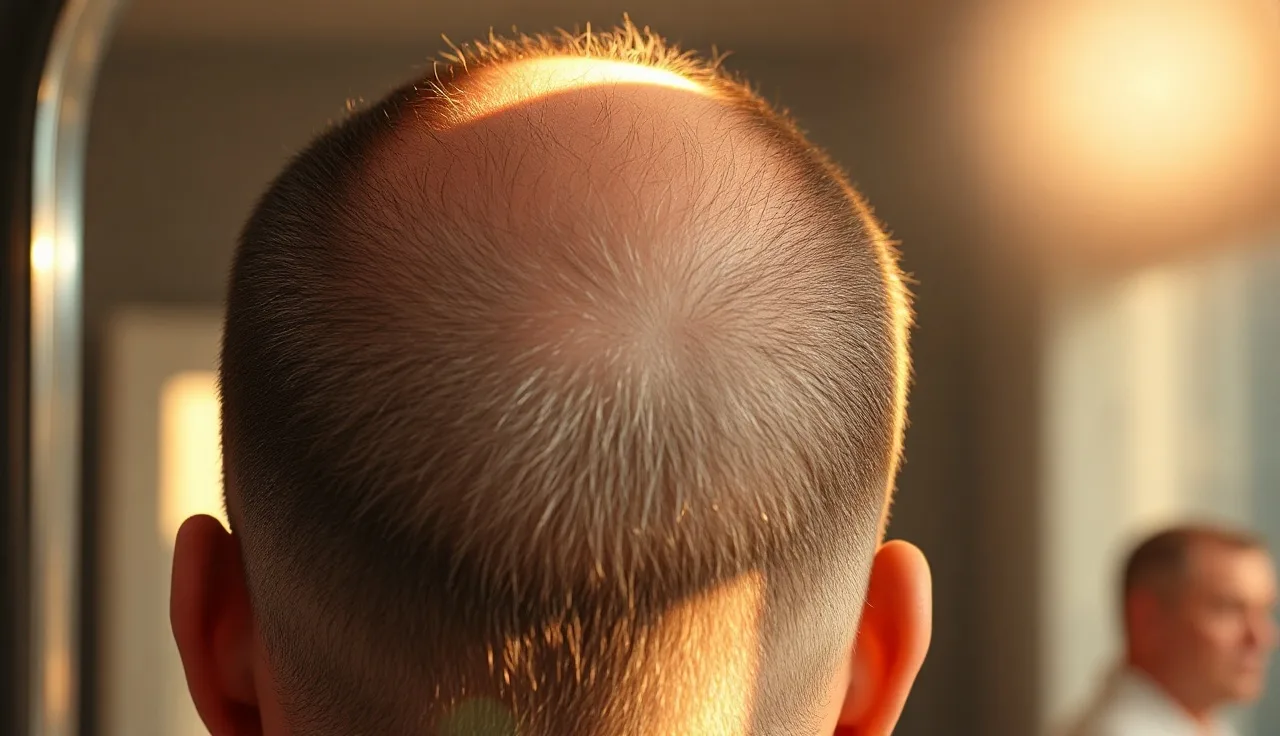
TL;DR: Non-surgical options like finasteride and minoxidil slow or partially reverse male pattern alopecia in most men who start early; finasteride stops progression in roughly 87% of users. Hair transplant surgery is the only option that permanently restores coverage, but it costs $4,000 to $15,000+ and works best after medication has already stabilized the remaining hair.
What actually causes male pattern alopecia, and why does it matter for treatment?
Male pattern alopecia (androgenetic alopecia) follows a predictable path driven by dihydrotestosterone (DHT) binding to androgen receptors in genetically susceptible hair follicles. Over years, DHT shrinks the follicle, shortens the growth cycle, and eventually stops producing visible hair. [1]
This matters for treatment because the mechanism is the target. Block DHT and you slow or stop the miniaturization process. Physically move DHT-resistant follicles from the back of the scalp to the thinning areas and you get permanent hair that doesn't respond to DHT. Do neither, and no amount of shampoo or laser cap changes the biology.
Understanding the cause also tells you what order to act in. If you transplant before stabilizing with medication, the non-transplanted native hair around the grafts keeps falling out, leaving you with an island of transplanted hair surrounded by a sea of thinning scalp. Surgeons and dermatologists who specialize in this almost universally recommend medical therapy first or alongside surgery.
If you want the full upstream picture, see what causes hair loss and DHT blockers for the mechanism in detail.
What are the main non-surgical treatments for male pattern alopecia?
Three non-surgical options have real evidence behind them. Everything else ranges from plausible-but-weak to pure marketing.
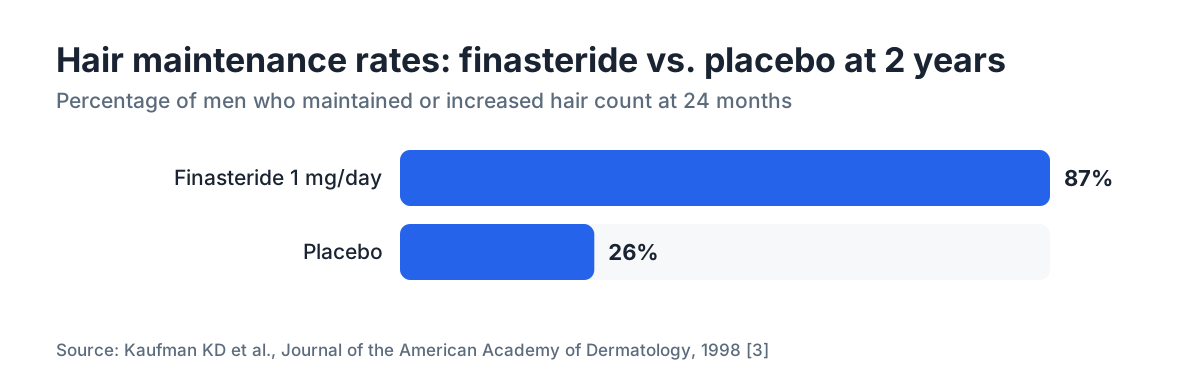
Finasteride (oral, 1 mg daily) is a 5-alpha reductase inhibitor that blocks the conversion of testosterone to DHT. The FDA approved it for male androgenetic alopecia in 1997. [2] The main two-year trial found 87% of men maintained or increased hair count versus 26% on placebo, and the average hair count increase was 107 hairs per inch-squared at the vertex. [3] It needs a prescription and works best if you start before you've lost a lot.
Minoxidil (topical, 2% or 5%; oral, 0.625 to 1.25 mg daily) is the other FDA-approved option. It prolongs the anagen (growth) phase and possibly increases follicle size. Topical 5% outperforms 2% in men. [4] Oral minoxidil is increasingly used off-label at low doses with good tolerability data. Read the full breakdown in minoxidil for men. Side effects are real, so minoxidil side effects is worth reading before you start.
Low-level laser therapy (LLLT) has FDA 510(k) clearance for marketing, which is not the same as approval for efficacy. Some randomized controlled trials show modest improvement in hair density, but effect sizes are smaller than either drug, and long-term data are thin. [5]
Combination finasteride plus minoxidil is where most dermatologists start men who have real loss. A 2021 randomized trial found the combination significantly outperformed either agent alone. [6] See finasteride and minoxidil for the combined protocol details.
Supplements (biotin, saw palmetto, vitamins) get a lot of airtime and almost no rigorous evidence for androgenetic alopecia specifically. Read hair loss supplements before spending money there.
What surgical treatments exist for male pattern alopecia?
Hair transplant surgery is the primary surgical male pattern alopecia treatment. Everything else marketed as "surgical" is either minimally invasive (PRP injections, scalp micropigmentation) or experimental. See surgical male pattern alopecia treatments.
Two techniques dominate modern practice:
Follicular Unit Transplantation (FUT): A strip of scalp is removed from the donor area (usually the back and sides), dissected into individual follicular units, and implanted into recipient sites. It leaves a linear scar but typically yields the highest graft counts per session.
Follicular Unit Extraction (FUE): Individual follicular units are extracted one by one with a punch tool, leaving tiny round scars that are less visible with short hair. Recovery is faster, but the procedure takes longer and costs more per graft.
Robotic FUE (ARTAS system): An FDA-cleared device that automates the extraction step of FUE. [12] Outcomes are similar to skilled manual FUE. The main argument for it is consistency, not better results.
Graft survival rates of 90 to 95% are commonly cited by experienced surgeons, though published peer-reviewed data on this figure vary by clinic and technique. The key variable is surgeon skill, not the machine.
Scalp micropigmentation (SMP) is worth naming separately. It's tattooing the scalp to simulate a shaved-head look. It doesn't regrow hair, but for men who prefer a close-cropped aesthetic, it's a lower-cost, non-surgical option that can look convincing. It fades over years and needs touch-ups.
For the full breakdown of the procedure, costs, and what to expect, see hair transplant.
How do the costs of surgical and non-surgical treatments compare?
Cost is where the two paths split hardest. Medication is cheap month to month but never ends. Surgery is a large one-time bill.
Generic finasteride costs roughly $20 to $40 per month through pharmacies or telehealth services. Brand-name Propecia runs much more. Topical minoxidil is over the counter for $10 to $25 per month. Oral minoxidil is prescription and costs $15 to $40 per month generically. Total annual spend on combination therapy is typically $400 to $800.
Hair transplant surgery in the United States typically runs $4,000 to $15,000 per session depending on the number of grafts, technique, and location. The American Society of Plastic Surgeons reports the average surgeon fee for hair transplantation was approximately $3,400 in 2020, but this excludes facility and anesthesia fees, so total costs are higher. [7] Most men need 1,500 to 3,000 grafts for moderate coverage; severe cases require multiple sessions.
Medical tourism (Turkey, Thailand, Poland) brings transplant costs down to $1,500 to $4,000 all-in, but adds real risks: variable surgical standards, limited recourse if something goes wrong, and travel costs that eat into some of the savings.
| Treatment | Upfront cost | Annual ongoing cost | One-time or ongoing? |
|---|---|---|---|
| Finasteride (generic) | $0 to $50 (consult) | $240 to $480 | Ongoing (stop = reversal) |
| Topical minoxidil 5% | $10 to $25 | $120 to $300 | Ongoing |
| Oral minoxidil | $15 to $40/mo Rx | $180 to $480 | Ongoing |
| LLLT device | $200 to $800 | $0 | One-time (device) |
| FUT transplant | $4,000 to $12,000 | $0 to $600 (meds) | Mostly one-time |
| FUE transplant | $6,000 to $15,000+ | $0 to $600 (meds) | Mostly one-time |
| SMP | $1,500 to $4,000 | $200 to $500 (touch-ups) | Periodic |
The real comparison isn't year one. Run the math over 20 years of medication and transplant surgery starts looking cost-competitive for men who would otherwise stay on drugs for decades.
Which treatment produces more hair regrowth?
Finasteride and minoxidil regrow some hair in many men, mostly in areas of early thinning. They don't regrow hair in fully bald areas where follicles have scarred over. The two-year finasteride trial found 48% of men had "moderate" or "greatly increased" hair growth, while another 39% had "slightly increased" or "no change." [3] These are modest numbers, not dramatic transformations.
Hair transplants move living hair. The result is permanent and visible, assuming adequate donor supply and good technique. The tradeoff is the donor area: you're robbing Peter to pay Paul. Men with very advanced loss (Norwood 6 to 7) may not have enough donor hair for meaningful coverage.
Honest answer: for men with early to moderate loss (Norwood 2 to 4), aggressive medical therapy can maintain and modestly regrow for years. If you're already at Norwood 5 or above and want coverage, medication alone won't get you there. Surgery can.
For men with a receding hairline specifically, the combination of finasteride to slow further recession plus a targeted hairline transplant is the most effective path. See receding hairline for what that looks like in practice.
What are the side effects and risks of each approach?
Finasteride: The FDA label lists sexual side effects in approximately 1.8% of men at 1 mg daily in clinical trials: decreased libido, erectile dysfunction, and decreased ejaculate volume. [2] Post-finasteride syndrome (persistent sexual and neurological symptoms after stopping) is reported anecdotally and in case series, but its prevalence and mechanism remain debated. The FDA added a label warning about it in 2012. Anyone with persistent symptoms should stop the drug and consult a physician.
Minoxidil (topical): Scalp irritation, unwanted facial or body hair growth (hypertrichosis), and initial shedding (telogen effluvium-like) in the first 4 to 8 weeks. See telogen effluvium to understand why that early shed happens and whether it means the drug is working or failing.
Oral minoxidil: Fluid retention, heart rate changes (tachycardia), and lower blood pressure at the low doses used for hair loss are less common but real. Patients with cardiovascular conditions should talk to their doctor before starting.
LLLT: No serious adverse events in trials. The risk is mostly financial: spending $300 to $800 on a device for modest-at-best results.
Hair transplant: Real surgical risks include infection (rare, under 1% in reputable clinics), folliculitis, keloid scarring, numbness along the donor strip (FUT), and shock loss of existing hair in the weeks after surgery. Shock loss is temporary in most cases. Permanent loss of transplanted grafts from poor technique or blood supply problems is the most consequential risk and depends heavily on the operator.
The big non-event risk with surgery is unrealistic expectations. A transplant redistributes your existing hair; it doesn't create new hair. Men who don't understand donor supply limits often feel let down by the density they get.
Who is a good candidate for surgery vs. medication only?
Start with medication if you're in the early stages. Norwood 2 to 3, under 40, and still have substantial donor hair? Finasteride and minoxidil are the right first move. They're cheap, reversible, and can hold the line for years. Surgery on an unstable head of hair wastes grafts.
Consider surgery if you're Norwood 4 or above, your loss has been stable for at least a year (ideally two), and you've hit the ceiling of what medication alone can do. Stability is the key word. Most surgeons want at least 12 months of documented stable loss before operating.
Age matters too. Surgery on a 22-year-old with rapid progression is a recipe for an odd-looking result in 10 years as natural hair keeps falling around the transplant. Many ethical surgeons won't operate on men under 25 to 28 without clear evidence of stable loss.
Donor density is the hard ceiling. A transplant consultation will assess how many grafts your donor zone realistically yields. Men with coarser, curlier hair often get better perceived coverage per graft than men with fine, straight hair.
If you want a starting point for reading your own pattern, the free AI hair analysis at MyHairline can give you a Norwood stage estimate and flag whether you're in the medication-first or surgery-candidate range before you pay for a clinic consultation.
Can you combine surgical and non-surgical treatments?
Yes, and for most men with meaningful loss, you should.
The best outcomes in the literature come from continuing finasteride (and often minoxidil) before and after a transplant. Finasteride protects the native non-transplanted hair from continuing DHT-driven miniaturization. Without it, you may watch the hair surrounding your grafts thin out over the next decade while the transplanted hair holds steady.
Some surgeons require confirmed medical therapy for at least six months before they'll operate. Others don't, but they should be transparent about what happens to native hair after surgery without it.
The combination approach also changes the math on how many grafts you need. If medication holds your native hair, you need fewer transplanted grafts to reach acceptable density, which cuts cost and preserves donor reserve for any future sessions.
How long does each treatment take to show results?
Patience is a real requirement for both paths.
Finasteride takes 3 to 6 months to show early results and 12 months for a fair assessment. The two-year trial showed continued improvement from month 12 to month 24, so short-term results undersell the drug. [3]
Topical minoxidil shows early growth signals around 4 months, with peak results at 12 to 16 months. Many men quit at 3 months when the initial shed convinces them it's failing.
Hair transplant: grafts shed in the first 2 to 6 weeks after surgery (normal and expected). New growth starts around month 3 to 4. Presentable results at 6 to 8 months. Full maturation of texture and density takes 12 to 18 months. So the honest timeline from surgery date to final result is about 14 to 16 months.
If you want the fastest visible change and your loss is early, finasteride wins on cost and tolerability. If you want the biggest cosmetic change and have the loss to justify it, surgery delivers results no pill can match. It just costs more and takes about the same time to reach the final outcome.
What does the evidence say about which approach works better long-term?
There's no head-to-head randomized trial comparing surgery to medication over 20 years. No such trial exists and probably never will, for obvious logistical reasons.
Here's what we have. A 10-year open-label extension of the finasteride trials showed that men who took finasteride for 10 years kept significantly more hair than those on placebo. Men on finasteride for 10 years had a mean increase of 91 hairs/cm², versus a loss of 138 hairs/cm² in men who were on placebo for 5 years then switched. [8] That's a wide gap.
For surgery, long-term studies consistently show transplanted follicles stay put because they're genetically DHT-resistant. Graft survival beyond 10 years approaches the survival rates seen in the immediate post-operative period, assuming no unusual circumstances.
The honest long-term picture: medication slows the disease but doesn't cure it. Surgery fixes what's already lost but doesn't stop ongoing loss in untreated native hair. The most durable outcomes combine both.
What are PRP injections and do they work for male pattern alopecia?
Platelet-rich plasma (PRP) injections mean drawing your blood, spinning it to concentrate platelets, and injecting that concentrate into the scalp. The theory is that growth factors in platelets stimulate follicle activity.
The evidence is real but modest. A 2019 systematic review and meta-analysis found that PRP significantly increased hair density compared to controls, but the studies are small, varied in technique, and mostly short-term. [9] PRP is not FDA-approved for hair loss; it's used off-label.
Cost runs $500 to $1,500 per session. Most protocols call for 3 sessions initially, then maintenance every 6 to 12 months. That's $1,500 to $4,500 in year one for results that are, at best, comparable to topical minoxidil at a fraction of the cost.
My take: PRP is a reasonable add-on for men already on medication who want to try something extra, or as an adjunct after a transplant to improve graft survival (some data support that use). As a standalone replacement for finasteride or minoxidil, it's an expensive bet on thin evidence.
Should you go abroad for a cheaper hair transplant?
Medical tourism for hair transplants is real, popular, and comes with genuine tradeoffs.
Turkey has become the dominant destination. Costs there run $1,500 to $4,000 all-in versus $8,000 to $15,000 for comparable graft counts in the US or UK. The best Turkish clinics have skilled surgeons and thousands of successful cases. The worst are assembly-line operations where technicians, not surgeons, perform the entire procedure.
The main risk is oversight. In the US, hair transplant surgery by a physician is regulated under state medical boards. Abroad, that oversight varies dramatically, and your recourse if something goes wrong is limited. If you need a revision, you'll be far from the original surgeon.
If you go abroad, hold the line on a few things: the primary surgeon (not technicians) performs the graft extraction and implantation, the clinic shows verifiable before-and-after results, and you get written documentation of the procedure performed.
For most men, the savings are big enough to make the research worthwhile. For men with complex cases, prior surgeries, or limited donor supply, the precision required argues for staying closer to home with a surgeon you can meet in person.
What should you actually do first if you're losing hair?
See a dermatologist or a physician who specializes in hair loss and get a diagnosis. Male pattern alopecia is the most common cause of hair loss in men, but it's not the only one. Thyroid issues, nutritional deficiencies, autoimmune conditions, and medication side effects can all cause hair loss that looks similar. Treating androgenetic alopecia with finasteride won't help if you actually have iron deficiency anemia.
Once the diagnosis is confirmed, the decision tree is simple:
- Early loss (Norwood 1 to 3): Start finasteride. Add minoxidil if you want to be aggressive. Reassess at 12 months.
- Moderate loss (Norwood 3 to 5), stable for 12+ months: Continue or start medication. Consult a transplant surgeon to assess donor density and realistic graft count. Decide based on your goals and budget.
- Advanced loss (Norwood 6 to 7): Medication can preserve remaining hair. Surgery is possible if donor supply is adequate, but set realistic expectations about achievable coverage.
- Loss from other causes: Treat the underlying cause. Stop the offending medication if that's the driver. See what causes hair loss for a full picture of differential diagnosis.
If you want a fast read on where your pattern sits before booking appointments, the free AI scan at MyHairline can give you a Norwood stage estimate and point you toward the right next step.
One thing nobody tells you enough: the best time to treat was when you first noticed it. The second best time is now. Waiting another year while you research costs you real follicles you can't get back.
Sources
- American Academy of Dermatology, Androgenetic Alopecia overview
- Kaufman KD et al., Journal of the American Academy of Dermatology, 1998; finasteride two-year clinical trial
- Gupta AK et al., Journal of Dermatological Treatment, 2014; systematic review of LLLT for hair loss
- Dhurat R et al., International Journal of Trichology, 2021; combination finasteride plus minoxidil RCT
- American Society of Plastic Surgeons, 2020 Plastic Surgery Statistics Report
- Kaufman KD et al., European Journal of Dermatology, 2002; 10-year finasteride extension study
- Gupta AK, Carviel JL, Systematic review and meta-analysis of PRP for androgenetic alopecia, 2019
- van der Merwe J et al., Clinical Journal of Sport Medicine, 2009; creatine and DHT study
- National Library of Medicine, StatPearls: Androgenetic Alopecia
- FDA, ARTAS Robotic Hair Transplant System, 510(k) clearance database