

TL;DR: Adderall can trigger telogen effluvium, a temporary mass shedding, through appetite loss, nutrient deficiency, and stress on the body. Shedding usually starts 2 to 4 months after the trigger and stops on its own once the cause is fixed. Hair grows back fully in 6 to 12 months for most people. Some need a dermatologist to speed recovery.
What is telogen effluvium and why does it matter here?
Telogen effluvium is diffuse, non-scarring hair loss. A large share of your hairs get pushed early into the resting (telogen) phase of the growth cycle, then shed together a few months later. Normally, 5 to 15 percent of your scalp hairs sit in telogen at any moment [1]. During an episode, that jumps to 30 percent or more. That's why people find clumps on the pillow or a fistful in the shower drain.
It looks alarming. It usually isn't permanent.
The link to Adderall runs through the same mechanisms behind any drug-induced telogen effluvium: the drug itself, the metabolic fallout of taking it (appetite suppression and weight loss above all), or both together. Which mechanism is driving your shed matters, because the fix changes depending on the answer.
For how telogen effluvium works apart from any drug, read the telogen effluvium overview first.
Does Adderall actually cause hair loss?
Yes. The FDA-approved prescribing information for Adderall (amphetamine mixed salts) lists alopecia as a reported adverse reaction [2]. That label doesn't tell you how often it happens, only that it's been observed in post-marketing reports. The same wording appears on the Adderall XR label [11].
The reported rate is low but real. A 2018 analysis in the Journal of Clinical Psychiatry reviewed adverse event reports tied to ADHD medications and found stimulant-class drugs were disproportionately associated with hair-related events compared to non-stimulant options [3]. The raw case count was small against total prescribing volume, so most people on Adderall never notice hair loss. If you're the exception, that population rate is cold comfort.
Adderall hair loss almost always shows the telogen effluvium pattern: diffuse thinning across the whole scalp, not a receding hairline or bald patches. Seeing a receding hairline or crown loss instead? Something else is likely at work, and the what causes hair loss piece walks through those differences.
One caveat carries a lot of weight. Many people who start Adderall are adults in the exact age window when androgenetic alopecia begins. The two can run at once, and Adderall-triggered shedding can expose genetic thinning that was already quietly underway.
How does Adderall trigger telogen effluvium?
There are at least three separate pathways, and in real life they overlap.
Nutritional deficiency from appetite suppression. Adderall kills appetite hard. People eat far less than before, and micronutrients take the biggest hit. Iron deficiency is the most studied nutritional trigger for telogen effluvium [4]. Ferritin (stored iron) below 30 ng/mL is strongly tied to shedding in premenopausal women, and levels under 70 ng/mL may slow regrowth even without outright anemia [4]. Zinc, protein, and B vitamins matter too. If you're eating much less because the drug shut off your hunger, your follicles are among the first things your body drops from the priority list.
Weight loss as a physical stressor. Rapid weight loss, whatever the cause, is a documented telogen effluvium trigger [1]. A 2021 review in Dermatology and Therapy noted that caloric restriction and weight loss set off shedding through both nutrient depletion and the cortisol-driven stress response that comes with big changes in body composition [5]. Amphetamines can drop meaningful weight, especially in the first few months, putting people squarely in this bucket.
Direct drug effect. Amphetamines fire up the sympathetic nervous system and raise circulating norepinephrine and cortisol. Chronic sympathetic activity is thought to nudge follicles toward the catagen (regression) and telogen phases. The exact mechanism isn't nailed down, but cases of alopecia in people who keep normal nutrition on Adderall point to a direct drug effect beyond the nutritional route alone [3].
The delay trips people up. Follicles pushed into telogen today won't shed for another 2 to 4 months. The shedding you clock in month 3 actually started around month 1. That lag convinces a lot of people their hair loss has nothing to do with the pill.
How long does Adderall-related hair loss last?
For most people, Adderall telogen effluvium fixes itself. Once the trigger clears or the body adapts, shed hairs regrow and the cycle resets. The general telogen effluvium literature and clinical experience put regrowth at 3 to 6 months after removing the trigger, with full density back in 6 to 12 months for most cases [1].
The hitch is that many people can't just quit Adderall. ADHD is a real condition with real consequences, and dropping the medication to save your hair isn't always the right trade. When that's the case, the goal shifts to finding and fixing the changeable triggers, mostly the nutritional gaps, while staying on the drug.
Chronic telogen effluvium, meaning shedding past 6 months, happens and is harder to handle. Still losing hair heavily after the 6-month mark on a stable dose with nutrition sorted? Get a scalp biopsy. A dermatologist can count the telogen-to-anagen ratio directly and rule out other diagnoses.
What does the timeline of Adderall-induced shedding actually look like?
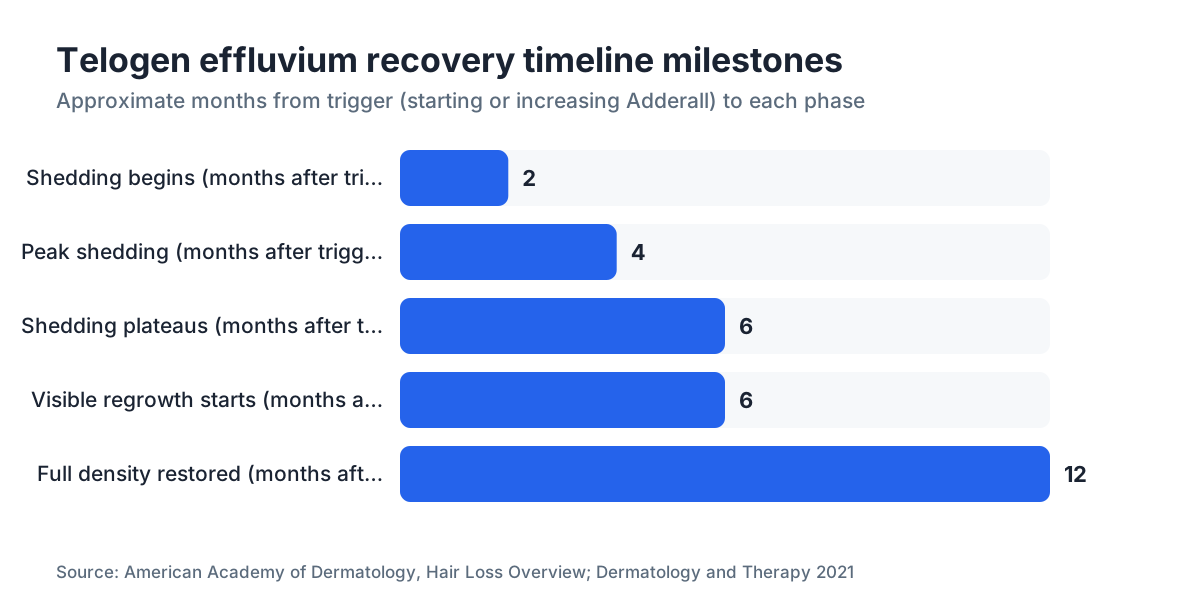
The timeline below follows the general telogen effluvium pattern described in dermatology literature [1][5], applied to Adderall as the trigger. Individual variation is wide.
| Phase | Approximate timing | What happens |
|---|---|---|
| Trigger | Week 0 (starting or increasing Adderall) | Follicles pushed early into telogen by drug effect, appetite loss, or rapid weight loss |
| Silent phase | Weeks 1 to 8 | No visible shedding; affected hairs are resting |
| Shedding onset | Months 2 to 4 | 200 to 400+ hairs per day lost; diffuse thinning across scalp |
| Peak shed | Months 3 to 5 | Worst visible thinning; shower drain, pillow, brushes |
| Plateau | Months 5 to 7 | Shedding slows as new anagen hairs begin |
| Regrowth | Months 6 to 12 | Short, fine regrowth hairs appear, especially at hairline |
| Full recovery | 12 to 18 months | Density typically restored if the cause is corrected |
Some people never hit the peak shed phase. Their shedding stays modest and they only notice it in hindsight when regrowth shows up. Others get dramatic, frightening episodes. No reliable way to predict which camp you land in.
Should you stop taking Adderall to stop the hair loss?
This is a decision between you and the doctor who prescribed it. Nobody online should make that call for you, and that includes this article.
Here's what the evidence supports. If you stop Adderall and the hair loss was driven mainly by the drug rather than a deficiency, shedding should taper within a few months and regrowth follows. If the cause was nutritional, quitting the medication without fixing the deficiency may not resolve the shedding quickly.
Some prescribers try switching to a non-stimulant ADHD medication like atomoxetine or guanfacine, which don't carry the same appetite-suppression load. Whether that prevents hair loss isn't well studied. The 2018 Journal of Clinical Psychiatry analysis did find fewer hair-related events with non-stimulants than stimulants, though sample sizes were small [3].
Staying on Adderall? The most evidence-backed move is treating the changeable contributors hard: close the nutritional gaps, eat enough calories even when you have to force it, and consider adding minoxidil to support the follicles through recovery. Minoxidil for men and oral minoxidil are both worth understanding if you go that way. Keep in mind minoxidil doesn't fix the root cause. It supports regrowth while you correct whatever set off the shedding.
What blood tests should you get if you're losing hair on Adderall?
A dermatologist or your prescriber should run a basic panel before pinning hair loss entirely on Adderall. Several deficiencies and conditions cause or worsen telogen effluvium and are easy to correct once you spot them.
Ask for these at minimum:
Ferritin. More useful than hemoglobin or a standard iron panel. Ferritin is the stored-iron marker that tracks most closely with shedding. The American Academy of Dermatology recommends repleting ferritin above 40 ng/mL when managing telogen effluvium, and some dermatologists aim for 70 ng/mL [4].
Thyroid panel (TSH, free T4). Hypothyroidism causes diffuse loss that looks identical to telogen effluvium. If TSH is out of range, that may be your primary driver.
Complete blood count. Rules out frank anemia.
Zinc. Zinc deficiency is underdiagnosed and directly linked to hair loss [6].
Vitamin D. Deficiency is associated with non-scarring alopecia in several studies, though causality is debated [6].
Total protein and albumin. If you've been eating very little, protein deficiency can get bad enough to trigger shedding on its own.
Getting these results back before you decide whether to continue, cut, or switch medications hands you and your prescriber real data instead of guesswork.
Can you treat the hair loss without stopping Adderall?
For many people, yes. The plan has three parts: fix nutritional gaps, support regrowth, and lower the sympathetic stress load.
Fix nutritional gaps first. If ferritin is low, oral iron (usually ferrous sulfate 325 mg, taken with vitamin C for better absorption) can raise levels meaningfully within 3 months, though full repletion takes 6 months or more. Zinc at 25 to 45 mg per day is reasonable if you're deficient, but skip megadosing. Excess zinc blocks copper absorption and causes its own problems.
Force yourself to eat enough. Sounds obvious. It's genuinely hard on stimulants. Eating a big, protein-rich meal before your first dose, while appetite is still intact, makes a real difference. Protein needs for hair maintenance land around 50 to 60 grams per day at minimum, higher for active people.
Minoxidil as a bridge. Topical minoxidil (2% or 5%) is FDA-cleared for hair loss and gets used off-label to support regrowth during telogen effluvium recovery [7]. It doesn't treat the cause. It shortens the lag before follicles re-enter growth. If you use it, commit to at least 6 months before judging results. Downsides are covered in the minoxidil side effects article.
Manage cortisol load. Easier said than done. Sleep, resistance training, and enough calories all lower chronic sympathetic tone. On Adderall, not sleeping, and eating 1,200 calories a day? All three levers are working against you at once.
At myhairline.ai, the free AI hair scan (/scan) helps you document your shedding pattern and track whether diffuse loss or patterned thinning dominates. That distinction decides whether you're dealing with telogen effluvium alone or an overlapping androgenetic alopecia.
What probably won't help: hair loss supplements marketed for stimulant-induced shedding. None have clinical trial evidence for this specific case. Truly deficient in something? Correcting it matters. Past that, the evidence thins out fast.
Is Adderall-induced hair loss different from male or female pattern baldness?
Yes, and the difference changes both your outlook and your treatment.
Androgenetic alopecia (male or female pattern baldness) is driven by dihydrotestosterone (DHT) acting on genetically susceptible follicles, and it gets worse without treatment. It follows set spatial patterns: the Norwood scale for men, hitting the crown and temples; diffuse central thinning with a kept frontal hairline for women. It does not reverse on its own.
Adderall telogen effluvium is diffuse, hits the whole scalp roughly evenly, and reverses once the trigger clears. The follicles themselves aren't damaged. The loss comes from the hair shaft, not follicle miniaturization.
The practical test: pull about 60 hairs from different parts of your scalp. In telogen effluvium, shed hairs have a small white bulb at the root (telogen bulb). In androgenetic alopecia, hairs in the affected areas are shorter and thinner than usual (miniaturized).
Seeing a receding hairline specifically? Adderall isn't the cause. The receding hairline article explains what's actually driving that pattern. And if DHT-mediated loss runs alongside your Adderall-triggered shedding, a DHT blocker conversation with a dermatologist may be worth having, though it won't touch the telogen effluvium part.
What do dermatologists actually recommend for this?
The American Academy of Dermatology's guidance on telogen effluvium centers on finding and correcting the underlying cause as the main intervention [1]. For drug-induced cases, that means the prescribing physician handles the medication while a dermatologist manages the hair-specific factors.
In practice, a board-certified dermatologist evaluating Adderall hair loss will usually:
- Run the blood panel above to find correctable deficiencies.
- Order a trichoscopy (in-office dermoscopy of the scalp) to check for follicle miniaturization, which would flag co-occurring androgenetic alopecia.
- Consider a scalp biopsy if the presentation is atypical or shedding runs past 6 months without improvement.
- Recommend topical minoxidil as a bridge.
- Talk to the prescribing psychiatrist or physician about whether a dose cut or medication switch is possible.
What they usually won't do is prescribe finasteride for telogen effluvium alone. Finasteride is for androgenetic alopecia mediated by DHT, not a reversible shedding episode. If your dermatologist recommends finasteride for Adderall telogen effluvium with no sign of co-occurring pattern baldness, ask them to explain the reasoning. Using both makes sense when there's real overlap: see finasteride and minoxidil for how the two work together.
How do you know if the shedding is getting better or worse?
Progress is hard to see because hair grows slowly. About half a millimeter a day, roughly half an inch a month. Watching hair fall out while regrowth crawls along makes objective tracking worth the effort.
A few practical methods:
The daily count. Collect every shed hair for a full day (shower, pillow, brush, whatever falls) and count it. Under 100 a day is generally normal. Consistently over 150 to 200 a day means active telogen effluvium is still going [1].
Photographs. Take a consistent overhead photo in the same lighting every 4 weeks. Diffuse changes are nearly invisible day to day but obvious across a 3-month photo record.
The part width. Part your hair in the same spot and photograph it every 4 weeks. A narrowing part is one of the first signs of regrowth, visible before density fully returns.
Regrowth texture. New telogen effluvium regrowth is often fine and shorter than surrounding hair. Running your fingers along the hairline and feeling those fine hairs is a good sign. It means follicles are cycling back into anagen.
Got access to a dermatologist? A repeat trichoscopy at 3 and 6 months beats any home method. They measure the anagen-to-telogen ratio directly.
Does Adderall hair loss affect men and women differently?
The telogen effluvium mechanism is the same in both sexes. The context differs in ways that matter clinically.
Women are more prone to telogen effluvium at baseline, partly from extra triggers: hormonal shifts, postpartum changes, and higher rates of iron deficiency in premenopausal women [4]. A woman on Adderall who's also eating less stacks three known triggers at once: the drug, low iron, and caloric restriction. The shedding can be dramatic.
Men genetically prone to androgenetic alopecia may find telogen effluvium speeds up the apparent progress of pattern baldness. The diffuse shedding doesn't cause pattern baldness, but it thins overall density enough that whatever miniaturization was quietly happening becomes suddenly visible. That's probably the most common reason Adderall gets blamed for a receding hairline that was already underway.
Sex also changes how noticeable the loss is. Women usually carry more hairs per follicular unit and more overall density, which can mean they lose more before a partner or hairdresser notices. Men often start with less density and clock diffuse thinning sooner.
There's no good evidence that either sex is more likely to get Adderall-induced alopecia. The published adverse event data doesn't stratify well by sex [3].
Sources
- American Academy of Dermatology, Hair loss types: Telogen effluvium overview
- FDA, Adderall (amphetamine mixed salts) prescribing information
- Journal of Clinical Psychiatry, ADHD medications and hair-related adverse events, 2018
- American Academy of Dermatology, Iron deficiency and hair loss clinical guidance
- Dermatology and Therapy, Caloric restriction, weight loss, and telogen effluvium review, 2021
- Dermatology and Therapy, Micronutrient deficiencies and hair loss: zinc, vitamin D, 2019
- FDA, Minoxidil topical solution prescribing information and OTC monograph
- JAMA Dermatology, Telogen effluvium pathophysiology and clinical management review
- National Institutes of Health, MedlinePlus, Telogen effluvium
- FDA, Adderall XR (amphetamine extended release) prescribing information