

TL;DR: Two treatments have FDA approval for androgenic alopecia: minoxidil (topical, for men and women) and finasteride (oral, for men only). Together they stop progression in most people and regrow some hair. Hair transplants are the only permanent fix. Everything else sits somewhere on a spectrum from promising-but-unproven to expensive placebo.
What is androgenic alopecia and why does it keep getting worse?
Androgenic alopecia (AGA) is the medical name for pattern baldness. It's the most common cause of hair loss worldwide, affecting roughly 50% of men by age 50 and about 50% of women by age 80 [1]. The mechanism is not complicated: a hormone called dihydrotestosterone (DHT) binds to receptors in genetically susceptible follicles, progressively shrinking them until they stop producing visible hair. Once a follicle miniaturizes completely, no current treatment brings it back. That window of partial miniaturization is where every approved therapy operates.
The word "androgenic" points to androgens, the hormone class that includes testosterone. An enzyme called 5-alpha reductase converts testosterone into DHT inside the follicle. People with a genetic variant that makes their follicles more sensitive to DHT lose hair faster. That's why identical twins can have completely different outcomes if only one inherited the sensitive version. To learn more about the underlying biology, see our guide on what causes hair loss.
One thing most people underestimate: AGA is progressive by nature. Without treatment, the loss continues. The Norwood scale (men) and the Ludwig scale (women) describe the stages, and most untreated people move through them slowly but consistently over decades. Starting treatment early, while follicles are miniaturized but not yet dead, is the single biggest variable under your control.
Which androgenic alopecia treatments are FDA-approved?
Only two drugs have FDA approval specifically for androgenic alopecia: topical minoxidil and oral finasteride [2].
Minoxidil started out as a blood-pressure medication. Researchers noticed patients grew extra hair as a side effect, and 2% topical minoxidil was approved for men in 1988, 5% foam followed, and a 2% solution was approved for women in 1991 [2]. It works by prolonging the anagen (growth) phase of the hair cycle and probably by improving blood flow to the follicle, though the exact mechanism is still debated. It does not block DHT. That means it treats the symptom, not the cause, and the hair you gained sheds out within months of stopping.
Finasteride at 1 mg daily was approved by the FDA in 1997 for male-pattern baldness [3]. It blocks type-II 5-alpha reductase, the enzyme most active in scalp follicles, and reduces scalp DHT by roughly 60% at the standard dose [3]. For women of childbearing age, it is contraindicated because of risks to a male fetus. Postmenopausal women sometimes use it off-label under physician supervision.
Dutasteride, which blocks both type-I and type-II 5-alpha reductase and reduces DHT by up to 90%, is approved for AGA in South Korea and Japan but is used only off-label in the US [4]. It is not FDA-approved for hair loss. Everything else covered below, from PRP to low-level laser to oral minoxidil, is either off-label or investigational in the US.
How effective is minoxidil for pattern hair loss?
The numbers are real but modest. In the FDA registration trials for 5% minoxidil foam, 84.3% of men rated their hair loss as stabilized or improved at 16 weeks compared with the baseline [2]. Hair count studies typically show a net gain of 10-20 terminal hairs per cm² after one year, which is statistically significant but often cosmetically subtle, especially on an already bare crown.
For women, a 48-week multicenter trial of 2% minoxidil showed 63% of women rated their hair regrowth as minimal to moderate, versus 39% in the placebo group [5]. Women tend to respond at least as well as men, possibly better, because their AGA is driven less by DHT and more by follicle cycling issues that minoxidil specifically helps.
Oral minoxidil (typically 0.625 mg to 5 mg daily) is an increasingly popular off-label option that bypasses the scalp absorption problem and may outperform topical in some patients. A 2021 review in the Journal of the American Academy of Dermatology found meaningful hair regrowth in the majority of patients studied, though head-to-head trials against topical are still limited [6]. Side effects including fluid retention, unwanted body hair, and rarely reflex tachycardia are more common with oral use. Our full breakdown is in the oral minoxidil article, and the complete side effect profile for topical is at minoxidil side effects.
Minoxidil for men specifically, including how to apply it and what concentration to choose, is covered in minoxidil for men.
How effective is finasteride and what are the real risks?
In the 5-year randomized controlled trial supporting FDA approval, finasteride 1 mg daily increased hair count by a mean of 277 hairs in a 1-inch circular area of the vertex scalp, against a loss of 100 hairs in the placebo group [3]. About 90% of men on finasteride either grew hair or held the line at 5 years, versus only 25% in placebo [3]. That's about as good as any oral drug in dermatology.
The sexual side effect question is legitimate. The FDA label reports sexual adverse effects (decreased libido, erectile dysfunction, ejaculatory disorder) in roughly 2-4% of users in clinical trials, and these resolved in most men after stopping [3]. A subset of men report persistent symptoms after discontinuation, a condition sometimes called post-finasteride syndrome. The evidence base for this as a persistent clinical entity is contested. A 2020 review in the British Journal of Dermatology found the studies supporting it are largely case series and questionnaire-based with no comparison group [7]. That doesn't mean individual men don't suffer real symptoms. It means we don't have clean population-level data on prevalence.
If you're worried about sexual side effects but still want DHT blockade, low-dose finasteride (0.2 mg to 0.5 mg) is being studied and shows meaningful DHT reduction with a potentially better side effect profile, though it is not FDA-approved at these doses. Our full guide on finasteride covers dosing, alternatives, and the side effect evidence in detail. For the broader DHT-blocking category including natural options, see dht blocker.
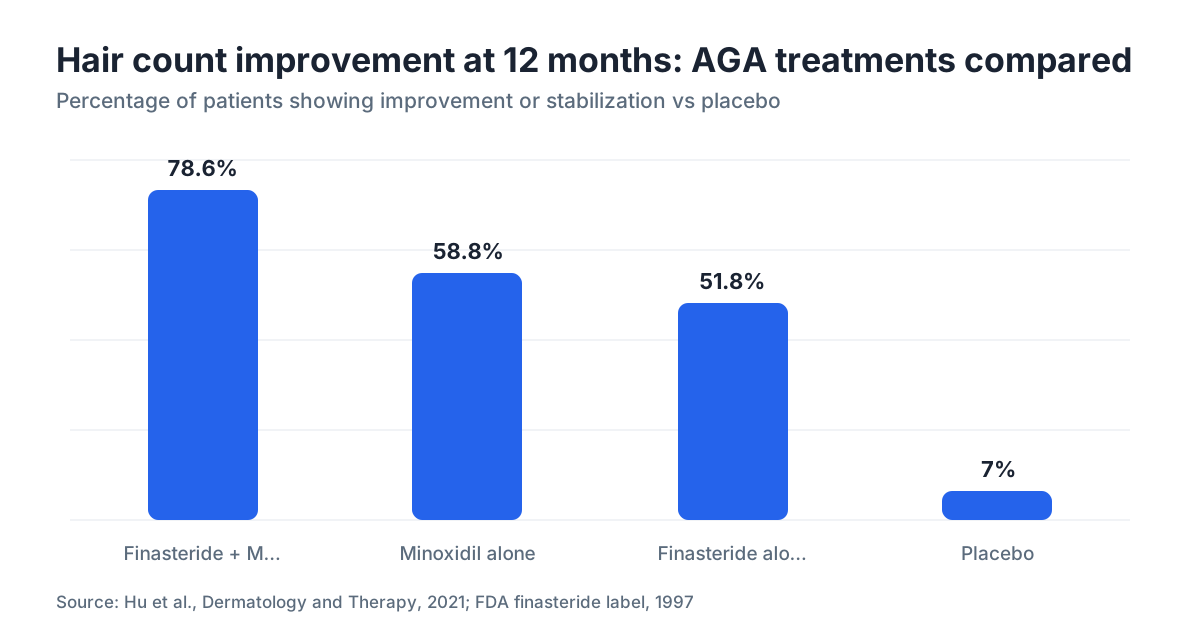
Combining finasteride and minoxidil is the standard of care for men who want maximal non-surgical response. A 2021 randomized trial showed the combination beat either drug alone, with 78.6% of combination users showing improvement versus 58.8% for minoxidil alone and 51.8% for finasteride alone [8]. See finasteride and minoxidil for the practical how-to.
How do androgenic alopecia treatments compare to each other?
Here's an honest side-by-side on the main options:
| Treatment | FDA Approved for AGA | Evidence Level | Typical Cost (monthly) | Stops Progression | Regrows Hair | Permanent |
|---|---|---|---|---|---|---|
| Topical minoxidil | Yes (men + women) | High (RCTs) | $15, $40 | Yes, while using | Moderate | No |
| Oral finasteride 1 mg | Yes (men only) | High (RCTs) | $20, $60 | Yes, while using | Moderate | No |
| Oral minoxidil | No (off-label) | Moderate (case series, small RCTs) | $30, $80 | Likely | Moderate-High | No |
| Dutasteride | No (off-label in US) | Moderate | $40, $100 | Likely better than FIN | Moderate-High | No |
| Low-level laser therapy | FDA-cleared (device) | Low-Moderate | $30, $100 (amortized) | Possibly | Minimal | No |
| PRP injections | No | Low-Moderate | $500, $2,000/session | Unclear | Minimal-Moderate | No |
| Hair transplant (FUE/FUT) | N/A (surgical) | High (long-term data) | $4,000, $20,000 one-time | No (non-transplanted hair still at risk) | Yes (transplanted) | Yes (transplanted) |
| Ketoconazole shampoo | No | Low | $15, $30 | Possibly mild | None proven | No |
FDA clearance for low-level laser devices (LLLT) means the device was cleared as safe, not that it was proven effective. The FDA's 510(k) pathway clears devices that are substantially equivalent to a predicate device, which is a different and much lower bar than a drug approval [9].
Does platelet-rich plasma (PRP) work for androgenic alopecia?
PRP involves drawing your own blood, spinning it to concentrate growth factors in the plasma, and injecting that into your scalp. The theory is reasonable: growth factors like PDGF and VEGF are genuinely involved in the anagen phase. The data is messier.
A 2019 systematic review in Dermatologic Surgery analyzed 19 studies and found statistically significant improvements in hair density in most trials, but also noted that PRP preparation varied enormously between clinics, placebo controls were weak or absent in most studies, and the optimal number of sessions is unknown [10]. In plain terms: it probably does something, but we don't know how much, for how long, or who responds best.
Cost is a real barrier. Sessions typically run $500 to $2,000 each, and most protocols call for 3 initial sessions plus maintenance every 6-12 months. There is no insurance coverage. If money is tight, I'd spend it on proven medications first and revisit PRP only if medications fall short or are contraindicated.
One thing worth saying plainly: PRP is not a substitute for medical therapy if the underlying DHT-driven miniaturization continues. Growth factors can encourage follicle activity, but they don't stop the androgen-mediated damage.
When does a hair transplant make sense?
A hair transplant is the only treatment that permanently replaces lost hair. The two main techniques are follicular unit excision (FUE), where individual follicles are harvested one by one, and follicular unit transplantation (FUT), where a strip of scalp is removed and follicles are dissected out. FUE leaves no linear scar and has a faster recovery. FUT allows more follicles per session and may be better for patients needing high graft counts [11].
The average FUE procedure costs $4,000 to $20,000 in the US depending on the number of grafts and the clinic. Graft counts for meaningful coverage range from about 1,500 for a hairline to over 4,000 for extensive crown thinning. Results take 9-18 months to fully mature.
Here's what people miss: a transplant does not stop the underlying AGA. Hair transplanted from the back of your head (the donor zone) is DHT-resistant and keeps growing. But the surrounding native hair that wasn't transplanted continues to miniaturize. Without concurrent medical therapy, you can end up with transplanted islands surrounded by progressively thinning native hair, which looks unnatural. Most transplant surgeons recommend staying on finasteride or minoxidil indefinitely after surgery.
Transplants also require a stable donor supply. Someone at Norwood stage VI or VII with a depleted donor zone may not have enough follicles to achieve meaningful coverage. Good surgeons discuss this honestly before taking on a case. More detail is in our hair transplant guide.
For women, transplants are an option but far less commonly done, because female pattern hair loss is typically diffuse rather than following a predictable recession pattern, and women's donor zones are less reliably DHT-resistant.
What about low-level laser therapy (LLLT)?
Low-level laser (or light) therapy devices, sold as laser combs, helmets, and caps, are cleared by the FDA as safe under the 510(k) pathway but not approved as effective drugs [9]. Several randomized trials have shown modest but statistically significant improvements in hair density compared to sham devices. A 2009 trial in the American Journal of Clinical Dermatology found a 39% increase in hair growth in the LLLT group versus 0% in the sham group over 26 weeks, though absolute hair counts were relatively small [12].
The devices cost about $200 to $900 to buy, or $30 to $100 per month amortized. They require regular use, typically 20-30 minutes every other day, which is a real compliance burden. Most dermatologists view LLLT as a reasonable adjunct to medications rather than a replacement. The side effect profile is essentially nil, which is an advantage for patients who can't tolerate finasteride.
Don't confuse FDA clearance with FDA approval. They are not the same thing. Clearance via 510(k) means a device is substantially equivalent to something already on the market; it does not require clinical proof of efficacy [9].
Are there any effective treatments for androgenic alopecia in women?
Women's options are narrower and the evidence base is thinner, but real options exist. Topical minoxidil (2% or 5%) is the only FDA-approved treatment for female pattern hair loss [2]. The 5% concentration may be more effective but carries a higher risk of facial hair growth. Many dermatologists now start women on 5% foam applied only to the scalp.
Oral minoxidil at very low doses (0.625 mg to 2.5 mg) is increasingly prescribed off-label in women and has good anecdotal and emerging trial support. Spironolactone, an aldosterone antagonist with anti-androgenic effects, is widely used off-label in the US for women with AGA, particularly those who also show signs of elevated androgens (acne, hirsutism, irregular periods). A 2020 retrospective study in JAMA Dermatology found 74.4% of women rated their hair loss as improved with spironolactone, though it was an uncontrolled study [13].
Finasteride off-label in postmenopausal women at 1 mg to 2.5 mg daily has been studied with some positive results. It is absolutely contraindicated in women who are pregnant or may become pregnant due to risk of feminization of a male fetus.
Before starting any treatment, women with AGA should be evaluated for treatable underlying causes like thyroid disease, iron deficiency, or elevated androgens from polycystic ovary syndrome. Confusing AGA with telogen effluvium (a temporary shedding disorder) is common and leads to unnecessary treatment.
If you're not sure whether what you're seeing on your scalp is AGA, diffuse thinning, or something else entirely, an early-stage analysis helps. MyHairline's free AI scan lets you upload photos and get a pattern assessment before your dermatologist appointment.
What supplements actually help with hair loss?
Short answer: very few, and none approved for AGA specifically. The supplement market for hair loss is enormous and mostly disconnected from real evidence.
Nutrient deficiencies that genuinely cause hair loss include iron deficiency, vitamin D deficiency, zinc deficiency, and severe protein malnutrition. Correcting a real deficiency can restore hair. But taking extra iron or zinc when you're not deficient does nothing and can cause harm.
Saw palmetto is a popular DHT-blocking supplement. A few small studies show it reduces DHT and may slow hair loss, but the effect size is much smaller than finasteride and the studies are low quality. A 2020 systematic review in Skin Appendage Disorders found limited evidence for saw palmetto as a monotherapy but noted it may have adjunct value [14].
Biotin is aggressively marketed for hair loss. Unless you have a genuine biotin deficiency (rare in adults eating a normal diet), there's no evidence it helps AGA at all. High biotin doses do interfere with lab tests, including thyroid tests, which is a real practical concern. The FDA has issued warnings about this [9].
Our full review of hair loss supplements covers what the evidence actually says for each major ingredient. The short version: fix deficiencies, be skeptical of everything else.
What's the best treatment strategy if you're just starting out?
Picture a 28-year-old man with early Norwood II thinning who's worried about losing his hair. Here's what I'd tell him: start with finasteride 1 mg daily. It stops progression in the majority of men, it's cheap as a generic (often under $30/month), and early intervention gives you the most to protect. Add topical minoxidil to the crown if there's visible thinning. That combination is the best evidence-supported non-surgical protocol available.
Wait 12 months before judging. Hair cycles are long. People abandon effective treatments after 3-4 months because they don't see enough change, and then they spend thousands on unproven alternatives.
If finasteride is off the table due to side effect concerns or personal preference, topical minoxidil alone is still worth doing. Oral minoxidil is a reasonable alternative for people who find topical application inconvenient.
For someone at Norwood IV or above with significant loss already: medications will not restore bare scalp. They can protect what's left. If restoration matters to you, a transplant consultation with a board-certified surgeon (look for ABHRS or ISHRS credentials) is worth having, with medications as a concurrent plan.
For women at any stage: start with a full blood panel to rule out treatable causes, then topical minoxidil while discussing spironolactone or oral minoxidil with a dermatologist.
To understand where your pattern falls on the scale before your appointment, the receding hairline article walks through how to self-assess your Norwood stage, and MyHairline's free AI scan can give you a baseline photo assessment.
Does creatine or any other supplement make androgenic alopecia worse?
This question comes up constantly, especially among men who lift weights. The concern is that creatine raises DHT levels, and DHT drives AGA. The evidence is thin but not zero.
A single 2009 study in the Clinical Journal of Sport Medicine found that college rugby players taking 25 g/day of creatine loading followed by 5 g/day maintenance for 3 weeks had a 56% increase in DHT and a 40% increase in the DHT-to-testosterone ratio [15]. That study has never been replicated, and it measured serum DHT, not scalp DHT, which are not the same thing. No study has ever shown creatine speeds up clinical hair loss in humans.
Still, if you're already genetically susceptible, even a temporary DHT bump is theoretically a concern. If you're worried, our does creatine cause hair loss article walks through the full evidence in detail.
Other supplements sometimes linked to faster AGA include high-dose testosterone (obviously) and DHEA. Anabolic steroid use is a documented accelerant of AGA in genetically predisposed men and is not a theoretical risk.
Sources
- FDA, Minoxidil Drug Approval History
- FDA, Propecia (finasteride) Prescribing Information
- National Institutes of Health, StatPearls: Dutasteride
- Olsen EA et al., Journal of the American Academy of Dermatology, 2002
- Randolph M, Tosti A, Journal of the American Academy of Dermatology, 2021
- Gupta AK et al., British Journal of Dermatology, 2020
- Hu R et al., Dermatology and Therapy, 2021
- FDA, 510(k) Premarket Notification Overview
- International Society of Hair Restoration Surgery, Patient Information
- Leavitt M et al., American Journal of Clinical Dermatology, 2009
- Marks DH et al., JAMA Dermatology, 2020
- Evron E et al., Skin Appendage Disorders, 2020