

TL;DR: Telogen effluvium in women causes diffuse shedding across the whole scalp, not a receding hairline. Peak loss usually hits 2-4 months after a trigger. Most women see visible regrowth within 3-6 months of the shedding stopping. The hairline stays intact. Cases lasting past 6 months need a dermatologist to hunt for an underlying cause.
What does telogen effluvium look like in women?
Telogen effluvium looks like diffuse thinning, hair lost more or less evenly across the whole scalp instead of in patches or along a receding hairline. Most women see it first in the shower drain, on the pillow, or in the brush. The volume shocks them. Normal daily shedding runs roughly 50-100 hairs. During an active episode that number can climb to 300-400 hairs a day [1].
The scalp itself looks normal. No redness, no scaling, no bald spots. That's one of the clearest clues separating telogen effluvium from alopecia areata (smooth, coin-shaped patches) and from androgenetic alopecia (slow thinning at the crown and part over years). In telogen effluvium the part may look a little wider and overall density feels reduced, but the hairline across the forehead almost always holds.
The shed hair has a giveaway shape. Hold a few strands up to decent light and you'll often see a tiny white or pale bulb at the root end. That's the telogen club hair, and its presence confirms the strand finished its cycle before it fell. Normal morphology for a shed hair. It looks nothing like a broken or split shaft, which points to mechanical damage instead.
Same shedding, different mirror. Two women losing 250 hairs a day can look completely unalike. A woman with fine hair or naturally lower density shows it fast. A woman who started with thick hair may lose the same count and stay invisible to everyone but herself.
What triggers telogen effluvium in women specifically?
Any big physical or emotional stress can shove a large share of growing hairs (anagen hairs) into the resting phase at once. The scalp holds roughly 100,000 hairs. Telogen effluvium happens when 10-15% or more flip into telogen together, then shed 2-4 months later [11].
For women, the usual triggers are:
- Childbirth (postpartum telogen effluvium is the textbook case; estrogen falls sharply after delivery and ends the hair-prolonging effect of pregnancy)
- Crash dieting or steep calorie restriction, especially protein under about 45-50 grams a day
- Iron deficiency, even without full-blown anemia; ferritin below 30 ng/mL is consistently tied to more shedding in women [3]
- Thyroid trouble, both under and over active
- Major surgery, serious illness, or high fever
- Stopping combined oral contraceptives (the same hormone drop as postpartum, in miniature)
- Long-running psychological stress
- Fast weight loss after bariatric surgery
One trigger blindsides a lot of women: a new prescription. Beta-blockers, retinoids, anticoagulants, and some antidepressants are all documented causes [2]. The 2-4 month gap between trigger and shedding is exactly why women can't ID the cause themselves. They feel fine now. Nothing connects today's shedding to a stressor from three months back.
For the wider picture of what drives hair loss, what causes hair loss covers androgenetic and medical causes alongside effluvium.
How is telogen effluvium different from other female hair loss patterns?
This is the most useful question to get right, because the treatment path changes completely depending on which condition you actually have.
| Feature | Telogen effluvium | Androgenetic alopecia | Alopecia areata |
|---|---|---|---|
| Pattern | Diffuse, whole scalp | Crown/part line, Ludwig scale | Patchy, smooth bald spots |
| Hairline | Preserved | Can recede or thin | Preserved |
| Onset | Weeks to months after trigger | Gradual, years | Rapid, often sudden |
| Scalp appearance | Normal | Normal or slightly shiny | Smooth, may have exclamation-mark hairs |
| Hair pull test | Positive (many hairs pull free) | Usually negative | May be positive at patch edges |
| Typical reversibility | High if trigger resolves | Needs ongoing treatment | Variable |
| Self-resolves | Yes, in acute cases | No | Unpredictable |
Here's the wrinkle: telogen effluvium and androgenetic alopecia often show up in the same woman. A big physical stress can expose a genetic pattern she never knew she had. When the acute shedding slows but the thinning keeps going, that's your signal to look harder for a genetic component.
The hair pull test takes ten seconds. Grab about 40-60 hairs between your fingers, hold near the root, and pull with light but firm tension along the full length. More than 6 hairs coming free counts as positive for active effluvium [4]. A dermatologist can add trichoscopy (scalp magnification) to count miniaturized hairs, which flags androgenetic involvement.
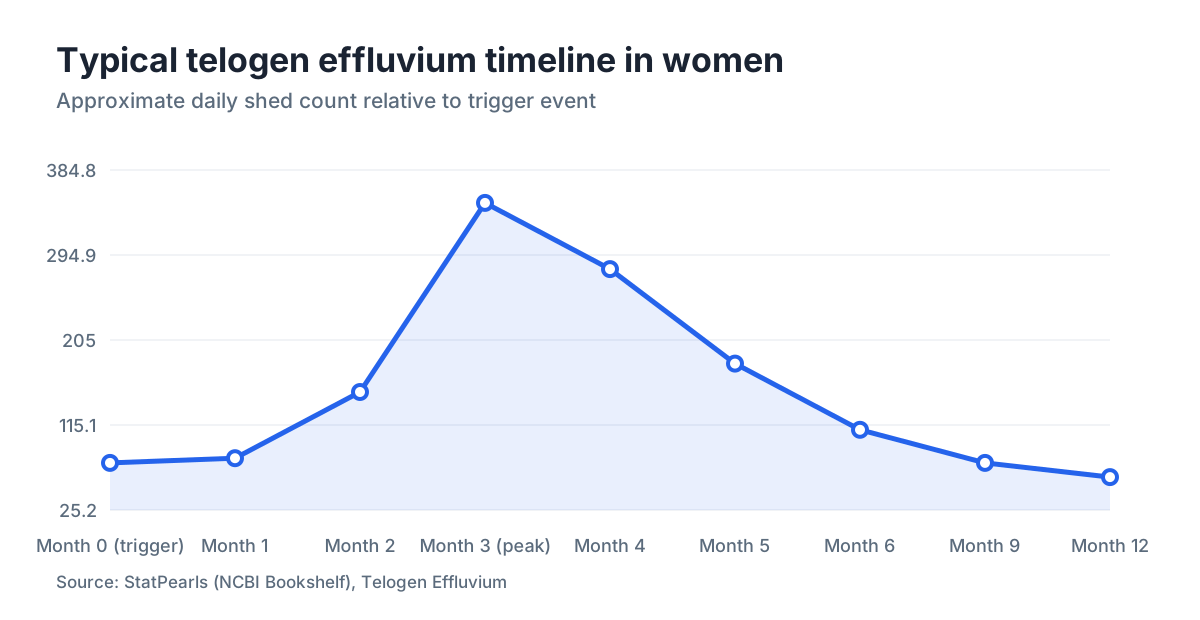
What does telogen effluvium look like at peak shedding vs. recovery?
Shedding peaks roughly 3-4 months after the trigger. At that point the scalp looks noticeably less dense. The part widens. The ponytail feels thin. Some women say their hair goes "see-through" at the crown under bright light. Photos taken under harsh overhead lighting are the most distressing, because they show scalp straight through sparse hair.
Peak shedding can run 6-8 weeks before it slows on its own, assuming the trigger is gone. This is the stretch women find most alarming, and it's when most of them book a dermatologist.
Recovery starts quietly. New growth comes in as short, fine hairs (people call them baby hairs) that you can feel along the hairline and part before you can really see them. Women with dark hair often catch them first as a haze of short hairs at the temples. These new hairs feel thin because they're short and haven't reached full diameter yet.
The recovery arc: visible short hairs 3-6 months after shedding peaks, real density return at 6-9 months, near-complete recovery by 12-18 months in most acute cases [2]. Full recovery drags longer than people expect because hair grows about half an inch a month. Even if every follicle restarts anagen at the same moment, it takes a year for that hair to reach shoulder length.
Impatient with that timeline? Read minoxidil side effects before you start any topical to push regrowth.
What do telogen effluvium regrowth pictures actually show?
Real regrowth photos, the kind from dermatology practices and patient communities, keep showing the same three things.
First, a halo of short hairs along the hairline and temples. It's the most photogenic sign of recovery because it shows up even in selfies. Women with straight hair notice it as flyaways or a fuzzy fringe that won't lie flat. That's hair that started a new anagen cycle 3-4 months before the photo.
Second, a widened part slowly filling in. Before-and-after shots taken 6-12 months apart show the part going from wide and skin-visible to narrower and denser. It's a slow shift that barely photographs over short intervals.
Third, the ponytail circumference test. Women who tied their ponytail in the same spot before, during, and after the episode often catch the circumference shrinking at peak and rebuilding afterward. Ponytail thickness is one of the more reliable self-monitoring tools because it sums up density across the whole length of the hair.
One honest caveat: internet before-and-after photos vary wildly in lighting, angle, and styling, which makes them lousy reference points. Clinical photographs shot under standardized lighting (the kind used in trials) tell you far more. The American Academy of Dermatology has published guidance on standardized scalp photography for exactly this reason [4].
Want a systematic look at your own scalp? MyHairline's free AI scan (/scan) uses photos you take at home to map density and flag patterns that may deserve a dermatologist visit.
How do you tell if your hair is actually regrowing after telogen effluvium?
The most reliable home signs are:
- Shedding has slowed toward normal (under 100-150 hairs a day, rough count from drain and pillow)
- Short hairs appear at the scalp, mostly at the temples and hairline
- The scalp feels less exposed under direct light
- Hair texture feels slightly off from your old baseline at first, as new hairs come in at an immature caliber
Dermatologists run the tug test in reverse. Instead of counting pulled hairs, they look for new anagen hairs with a pigmented root (versus the white club of a telogen hair). Trichoscopy can spot miniature hairs at the follicle before they're visible to the naked eye.
One thing worth knowing: shedding often ticks up briefly as new anagen hairs push the last resting telogen hairs out. Women read this as a relapse. It usually isn't. If shedding re-accelerates hard and sticks around more than a few weeks, that's your cue to go back to the dermatologist.
Blood work confirms recovery indirectly. If iron deficiency was the trigger, a rising ferritin (ideally above 40-70 ng/mL, though dermatologists argue over the exact target) usually leads visible regrowth by 1-2 months [3].
Does telogen effluvium cause permanent hair loss in women?
Acute telogen effluvium, set off by a single identifiable event and lasting under 6 months, almost always resolves fully with no permanent loss. The follicles are alive and intact. They just need time to re-enter and finish the anagen cycle.
Chronic telogen effluvium, defined as diffuse shedding lasting more than 6 months, is a different animal. It can be harder to reverse and may point to an ongoing trigger (stubborn iron deficiency, uncontrolled thyroid disease, an unspotted medication) or a coexisting androgenetic pattern. A 2018 review in the Journal of the American Academy of Dermatology called chronic telogen effluvium "one of the most under-diagnosed causes of diffuse hair thinning in premenopausal women" and said workup should include ferritin, TSH, complete blood count, and a hormonal panel [5].
The follicle is not destroyed in telogen effluvium, which is why the outlook is good. That's the opposite of scarring alopecias (like lichen planopilaris or frontal fibrosing alopecia), where fibrous tissue permanently replaces the follicle and loss is irreversible.
Permanent-looking thinning after an episode in a woman over 30 should trigger a workup for androgenetic alopecia. That's the likelier explanation than lasting effluvium damage.
What blood tests should women get for telogen effluvium?
A standard dermatology workup for diffuse hair loss in women usually covers:
- Ferritin (matters more than hemoglobin; you can be non-anemic and still carry low ferritin that drives shedding) [3]
- TSH and free T4 (thyroid)
- Complete blood count with differential
- Serum B12 and folate
- Zinc
- Vitamin D (25-OH)
- Testosterone (total and free) and DHEA-S if an androgenic pattern is suspected
- ANA if autoimmune causes are on the table
The American Academy of Dermatology's guidance on female hair loss lists ferritin and thyroid function as first-line tests [4]. Some dermatologists add a sex hormone binding globulin (SHBG) panel to read androgen exposure more fully.
Interpretation matters as much as the numbers. A ferritin of 14 ng/mL sits inside the "normal" lab range at many institutions but ties consistently to shedding in the dermatology literature. Ask your doctor for the actual number, not a "normal" flag.
Curious about DHT's role in female loss? dht blocker explains the mechanism and where DHT fits into female versus male pattern loss.
What treatments actually help telogen effluvium in women?
Removing the trigger is the treatment. Iron deficiency? Iron supplementation (target ferritin above 40-70 ng/mL) usually cuts shedding within 2-4 months. Thyroid disease? Treat the thyroid. Crash diet? Restore protein and calories.
Beyond the cause, the evidence-based options are short.
Minoxidil (topical): The FDA has approved 2% topical minoxidil for female pattern hair loss [6]. Dermatologists use it off-label in telogen effluvium to speed regrowth, though it does nothing for the underlying trigger. It works by prolonging anagen and boosting blood flow to the follicle. Women typically use the 2% solution twice a day or 5% once a day (the 5% foam is the labeled OTC female product). Give it 4-6 months before judging.
Oral minoxidil at low doses: Doses of 0.25-2.5 mg daily are used more and more in women and studied in several trials. A 2021 study in the Journal of the American Academy of Dermatology found oral minoxidil 1 mg daily cut shedding and improved density in women with pattern hair loss [7]. Off-label, prescription only. Oral minoxidil digs into the evidence.
Nutritional correction: Fix confirmed iron, zinc, and biotin deficiencies. Biotin without a deficiency has thin evidence for hair growth despite the marketing. A 2017 review found biotin deficiency is rare, and most people gain nothing from supplementing unless they're actually deficient [8]. Hair loss supplements sorts what the evidence backs.
What doesn't help: Expensive "hair growth" shampoos, keratin masks, and laser combs have no meaningful data for telogen effluvium. Spend that money on the blood work instead.
Finasteride is the wrong tool for telogen effluvium, and it's contraindicated in women who may become pregnant. It's for androgenetic alopecia. Finasteride explains who it's actually for.
When does telogen effluvium need a dermatologist, not a wait-and-see approach?
Wait and watch makes sense if:
- You can name a clear, resolved trigger (surgery, childbirth, or an illness 2-4 months ago)
- Shedding is slowing or has stopped
- You have no other symptoms (fatigue, cold intolerance, irregular periods)
- Loss has run less than 3-4 months
See a dermatologist soon if:
- Shedding is heavy and has continued past 6 months
- You see patches of complete hair loss (points to alopecia areata)
- The hairline is receding or the part is widening over years (points to androgenetic alopecia)
- You have systemic symptoms that could mean thyroid disease, anemia, or autoimmune disease
- An at-home pull test releases more than 6-10 hairs easily
- Your scalp is itchy, painful, or shows scaling or redness
One visit can cover dermoscopy, in-office trichoscopy, and targeted bloodwork. A board-certified dermatologist with hair loss training is your most reliable option in the US (trichologists are a non-physician subset). Find one through the American Academy of Dermatology's physician locator at aad.org [4].
MyHairline's AI scan (/scan) gives you a baseline photo analysis to bring to that appointment, which helps a dermatologist read patterns across the scalp that are hard to judge in a mirror.
How long does telogen effluvium last, and what is the full recovery timeline?
Acute telogen effluvium follows a fairly predictable arc in most women:
- Trigger event: Time zero. The stressor hits.
- 2-4 months later: Shedding begins. Many women mistake this FOR the trigger, which is why pinning down the cause is so hard.
- 3-4 months after trigger: Peak shedding. Maximum daily loss.
- 4-6 months after trigger: Shedding slows if the trigger is gone.
- 6-9 months after trigger: Short new hairs show up. Density starts to improve.
- 12-18 months after trigger: Most women see near-complete return to baseline density.
Chronic telogen effluvium (past 6 months, often 6 months to several years) runs a less predictable course and can wax and wane. Some women cycle through it without a clean resolution. The outlook is still good once the underlying cause is controlled, but full recovery can take 2 years or more.
Hair grows at roughly 0.35-0.44 mm per day, about half an inch a month, in normal adults [9]. That biological ceiling means even the best treatment can't push hair back to its old length faster than the follicle allows.
Sources
- American Academy of Dermatology, Hair Loss: Who Gets and Causes
- StatPearls (NCBI Bookshelf), Telogen Effluvium
- Journal of the American Academy of Dermatology, Serum ferritin and alopecia in women (Kantor et al.)
- American Academy of Dermatology, Clinical guidance on hair loss in women
- Journal of the American Academy of Dermatology, Chronic telogen effluvium review 2018
- FDA, Drugs (Minoxidil / Rogaine for Women 2% label)
- Journal of the American Academy of Dermatology, Oral minoxidil 1 mg in women (Ramos et al. 2021)
- Skin Appendage Disorders, Biotin and hair loss (Patel et al. 2017)
- NCBI Bookshelf, Hair Growth and Disorders (Blume-Peytavi et al.)
- NIH National Institute of Arthritis and Musculoskeletal and Skin Diseases, Alopecia areata overview
- American Hair Loss Association, Women and hair loss