TL;DR: Most doctors order a PSA (prostate-specific antigen) test, a liver function panel, and a complete blood count before prescribing finasteride. Some add a testosterone or thyroid panel. None are legally required. They set baselines that protect you if side effects show up or if finasteride hides a cancer signal later.
Why does your doctor want blood work before prescribing finasteride?
Finasteride blocks 5-alpha reductase, the enzyme that turns testosterone into dihydrotestosterone (DHT). That one mechanism is why it regrows hair, and it's also why the drug nudges your hormones, your liver, and your prostate markers in ways that show up in blood [1]. A baseline before you start gives your doctor a reference point. If a number shifts at month three, they can tell whether finasteride moved it or whether it was already drifting.
Then there's PSA. Finasteride at 5 mg (the prostate dose, Proscar) cuts PSA roughly in half [2]. The 1 mg hair-loss dose (Propecia) suppresses it less, but the effect is real. Skip the pre-treatment PSA and every future reading gets hard to trust. A PSA of 2.0 ng/mL looks calm on paper but could be a 4.0 that finasteride quietly deflated.
No federal law requires any blood test before a finasteride prescription. A telehealth service can legally send the drug after a short questionnaire. Good prescribers still order at least a PSA, and many order more. The real question is which tests change a decision and which are just cover.
Which blood tests should you actually get?
Three tests matter most: PSA, a liver function panel, and a complete blood count. Everything else depends on your age, symptoms, and what the exam turns up. Here's the full menu, why each earns a place, and how much it moves the needle in practice.
| Test | Why it matters before finasteride | Urgency |
|---|---|---|
| PSA (prostate-specific antigen) | Finasteride suppresses PSA; baseline is needed to read future results | High |
| Liver function panel (LFTs) | Rare cases of drug-induced liver injury reported; baseline protects you | Moderate |
| Complete blood count (CBC) | Rules out anemia or blood disorders that muddy a hair-loss diagnosis | Moderate |
| Total and free testosterone | Helps rule out hypogonadism as the real cause of hair loss | Moderate |
| DHT (dihydrotestosterone) | Confirms 5-alpha reductase activity; sometimes tracks treatment response | Low-moderate |
| TSH (thyroid-stimulating hormone) | Thyroid disease causes shedding that mimics androgenetic alopecia | Moderate |
| Prolactin | High prolactin causes hair loss and sexual symptoms that overlap with finasteride complaints | Low-moderate |
| Lipid panel | Some research suggests finasteride may affect lipid metabolism [3] | Low |
Get the top three. Treat the rest as symptom-driven.
What does the PSA test tell you and why is it the most important one?
PSA is a protein made by prostate tissue. A high reading can point to prostate cancer, benign prostatic hyperplasia, or prostatitis. Finasteride at 1 mg drops PSA by roughly 30 to 50 percent after six months [2], and that suppression is the trap. Develop prostate cancer while on the drug and the warning signal reads lower than it should.
The FDA prescribing information for finasteride 1 mg puts it plainly: "PSA values should be doubled for comparison with normal ranges in untreated men" [1]. Doubling only works if you have a pre-treatment number to double. Without a baseline, you're guessing.
Normal PSA for most men under 50 sits below 2.5 ng/mL. For men 50 to 59 it's usually below 3.5 ng/mL, though labs differ [4]. An elevated baseline should send you to a urologist before you start a drug that makes future screening murkier.
Women taking finasteride off-label for female pattern hair loss or frontal fibrosing alopecia don't need PSA at all. Their pre-treatment panel leans on hormones, thyroid, and liver instead.
Do you need a liver function test before starting finasteride?
Serious liver injury from finasteride is rare. Published case reports of hepatotoxicity exist, but the absolute rate is very low [5]. "Rare" reads differently, though, if you already run high liver enzymes from drinking, a fatty liver, or another medication.
A standard liver panel (also called a hepatic function panel or LFTs) measures ALT, AST, alkaline phosphatase, bilirubin, and albumin. Elevated before you start? Your doctor knows not to blame a future spike on finasteride. Normal before you start, and rising later? That catches a real problem early on a follow-up draw.
Here's the practical call. If you drink regularly, take other drugs the liver processes (some statins qualify), or have any liver history, push for this test. A healthy 25-year-old with no risk factors can skip it, and that's defensible. But the test is cheap. Getting it costs you nothing but a needle stick.
Should you test testosterone and DHT levels before starting?
This one is about diagnosis, not drug safety. If your hair is thinning and nobody has confirmed why, a testosterone panel rules out hypogonadism (abnormally low testosterone), which thins hair through a different pathway and needs a different fix. Treating low testosterone with finasteride alone is the wrong move.
DHT testing is less settled. Some dermatologists measure baseline serum DHT to confirm an androgenetic pattern before starting a DHT blocker [6]. Our guide to dht blocker explains how DHT drives the miniaturization in the first place. Other doctors argue the clinical picture (the pattern of thinning, family history, response to a pull test) already tells the story. Measure it and you're thorough. Skip it and you're not automatically getting worse care.
Free testosterone often matters more than total, because it's the fraction your body can actually use. Ask for both if you're testing at all.
Why should you test thyroid and prolactin before starting finasteride?
Both hypothyroidism and hyperthyroidism trigger diffuse shedding that looks like early androgenetic alopecia or telogen effluvium. Abnormal TSH means fixing the thyroid might solve the hair loss on its own, and you'd never need finasteride. Start the drug without checking, and you could burn a year wondering why it isn't working. Our overview of telogen effluvium covers how these overlapping causes get confused.
High prolactin (hyperprolactinemia) is less common but worth catching. It causes hair loss, low libido, and sometimes erectile dysfunction in men. All three overlap with the classic finasteride side effect complaints. If prolactin is already high before you start, any sexual side effect that shows up later becomes almost impossible to pin on the drug. One blood draw settles it.
For the wider view of what drives thinning, what causes hair loss walks the full differential.
What hormone panel do women need before starting finasteride?
Finasteride is not FDA-approved for women and is contraindicated in any woman who is pregnant or might become pregnant, because of the risk of feminizing a male fetus [1]. Women taking it off-label for female pattern hair loss or frontal fibrosing alopecia get a fuller hormone workup than men do.
A reasonable pre-treatment panel for women covers total and free testosterone, DHEA-S (dehydroepiandrosterone sulfate), free androgen index, LH, FSH, estradiol, SHBG, prolactin, TSH, and a metabolic panel [10]. The point is to find conditions like polycystic ovary syndrome (PCOS) or adrenal hyperplasia that push androgens up, because those are treatable and might change whether finasteride is even the right drug.
A pregnancy test is standard, and reliable contraception is required for the whole time she takes it. No exceptions.
How do these test results actually change what your doctor prescribes?
Most results come back clean and finasteride goes ahead. But the tests earn their cost in the cases that don't.
A PSA above age norms triggers a urology referral first. Skipping that would be a real gamble. A high TSH means treat the thyroid, then reassess the hair in three to six months. Abnormal LFTs mean closer monitoring or a lower starting dose if there's any reason to proceed. Low total testosterone changes the whole conversation, since finasteride does nothing for that cause and could make symptoms feel worse.
High prolactin points to a pituitary MRI before any hormone medication. That's a separate path entirely.
Many men run finasteride and minoxidil together. Our finasteride and minoxidil guide covers how the two work side by side and what monitoring looks like when you're on both.
How often should you repeat blood tests while taking finasteride?
There's no clean consensus, and nobody has run a randomized trial telling us the exact interval. The closest guidance comes from the American Urological Association's BPH guideline, which recommends PSA monitoring for men on 5-alpha reductase inhibitors [7]. For the 1 mg hair-loss dose, most dermatologists who follow up at all check PSA once a year.
A workable schedule based on how doctors actually practice: repeat LFTs at three to six months if the baseline showed anything borderline, then yearly. PSA every year for men over 40, or every two years for men under 40 who started completely normal. Testosterone and thyroid only if symptoms shift or a new complaint shows up.
Get labs sooner if any of these appear: breast tenderness or growth (possible gynecomastia), a marked mood change, sexual dysfunction that sticks around, or yellowing skin or eyes. The full side effect profile lives in our main finasteride guide.
What if you're using a telehealth service that doesn't order any tests?
This happens all the time. Several online platforms ship finasteride after a photo and a short health questionnaire, no blood work at all. That's legal, and for a 22-year-old with no symptoms and no risk factors, the odds of a skipped PSA causing harm are low.
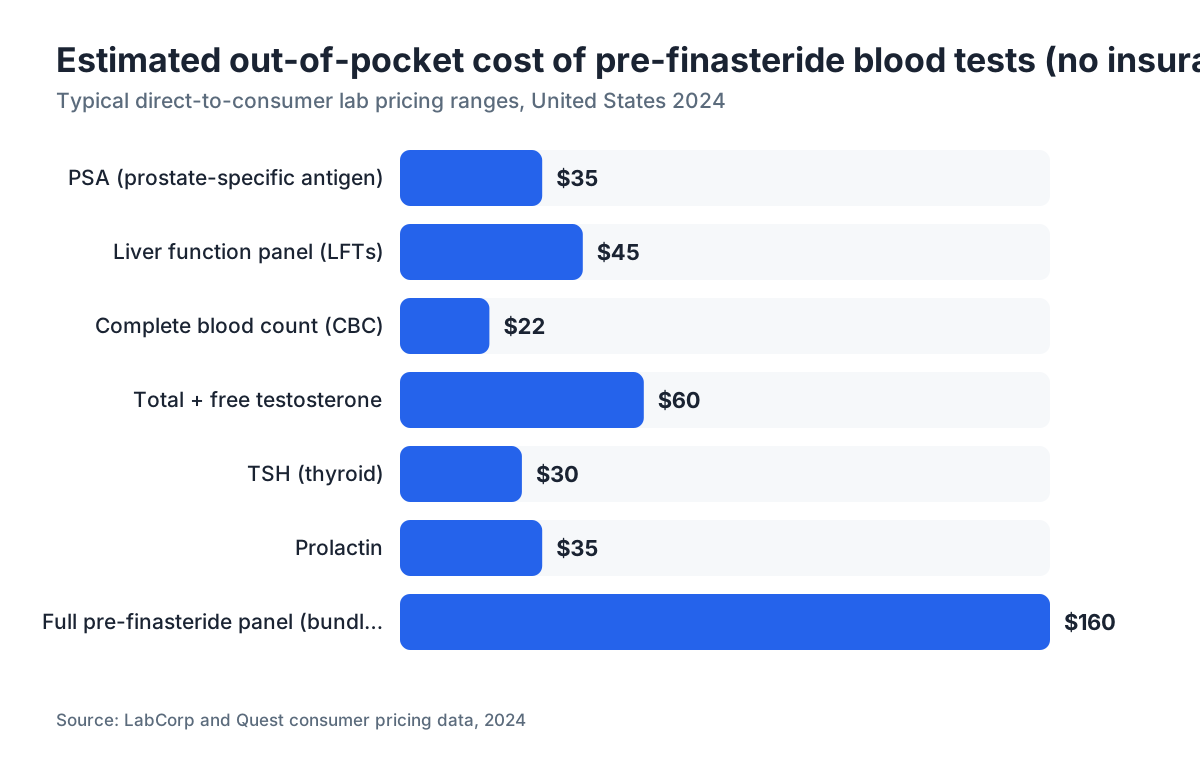
Get the tests anyway. Any primary care doctor or lab service (LabCorp, Quest) can order them. A basic panel covering PSA, LFTs, and CBC runs about $80 to $200 out of pocket without insurance, depending on the lab and where you live. That's a one-time cost for a drug plenty of men take for years.
Want to size up your hair loss before you decide whether to treat at all? MyHairline's free AI scan at myhairline.ai/scan reads your hairline photos against the Norwood scale and flags the pattern, which gives you something concrete to bring to a doctor or a telehealth visit.
Honest bottom line: a telehealth prescription without labs beats untreated hair loss for most young men with no risk factors. You're just accepting a small, avoidable risk. Spending $100 on baseline labs is the smarter play.
What should you tell your doctor if you want thorough pre-finasteride testing?
Some primary care doctors aren't fluent in hair loss workups and will write the script without ordering anything. Some dermatologists skip blood work for a textbook androgenetic case. Neither stops you from asking.
A specific request beats a vague one. Try this: "I'd like a baseline PSA, liver panel, CBC, and total testosterone before we start, so we have reference values going forward." Most doctors say yes without a fight. If yours pushes back, ask them to note the reasoning in your chart, which usually moves things along.
Bring up anything relevant: heavy drinking, liver disease, prostate symptoms, sexual dysfunction, mood problems, or a family history of prostate cancer. Each one justifies a fuller panel, and your doctor needs to hear it regardless.
Curious about the topical route that needs no blood work? minoxidil for men covers what monitoring, if any, that approach asks for.
Sources
- FDA, Propecia (finasteride 1 mg) prescribing information
- Gormley GJ et al., New England Journal of Medicine, 1992 -- Finasteride for Benign Prostatic Hyperplasia
- Traish AM et al., Journal of Sexual Medicine, 2015 -- Adverse effects of 5-alpha reductase inhibitors
- National Cancer Institute, Prostate Cancer information
- Southern Medical Journal, 2011 -- Drug-induced hepatotoxicity case reports including finasteride
- American Academy of Dermatology, Clinical Guidelines
- American Urological Association, Benign Prostatic Hyperplasia Clinical Guideline
- FDA, Drugs safety information -- Finasteride (Propecia, Proscar)
- Endocrine Society, Clinical Practice Guidelines
- Thompson IM et al., New England Journal of Medicine, 2003 -- Prostate Cancer Prevention Trial (finasteride)
- Piraccini BM, Alessandrini A, 2014 -- Androgenetic alopecia review