TL;DR: Give finasteride at least 12 months before deciding it isn't working. Studies show meaningful hair retention at 12 months, with peak density gains measured at 24 months. Early shedding in the first 2-3 months is normal and not a sign of failure. Quitting before 12 months means you almost certainly haven't seen what the drug can do.
What does finasteride actually do, and why does it take so long?
Finasteride blocks 5-alpha reductase type II, the enzyme that converts testosterone into dihydrotestosterone (DHT). DHT is the primary driver of androgenetic alopecia in men and women with that hormonal sensitivity. Suppress DHT and you remove the chemical signal that's been slowly shrinking your follicles. [1]
But follicles don't bounce back overnight. Hair grows in cycles, and the anagen (growth) phase of a scalp hair lasts two to six years before it rests, sheds, and restarts. A follicle that DHT has been attacking for years won't snap back in a few weeks just because you started a daily pill. The timeline isn't about the drug being slow. It's about biology being slow.
Every follicle on your scalp is at a different point in its cycle when you start treatment. Some are actively growing, some are resting, some are about to shed. Finasteride has to work through multiple full cycles before the cumulative effect on density shows up. That's the core reason dermatologists and the FDA-reviewed clinical data both point to 12 months as the minimum evaluation window. [2]
Knowing the mechanism helps you set expectations. DHT blockers like finasteride don't regrow hair from dead follicles. They preserve living ones. The sooner you start and the longer you stay, the more follicles you keep.
What does the clinical evidence say about the 12-month timeline?
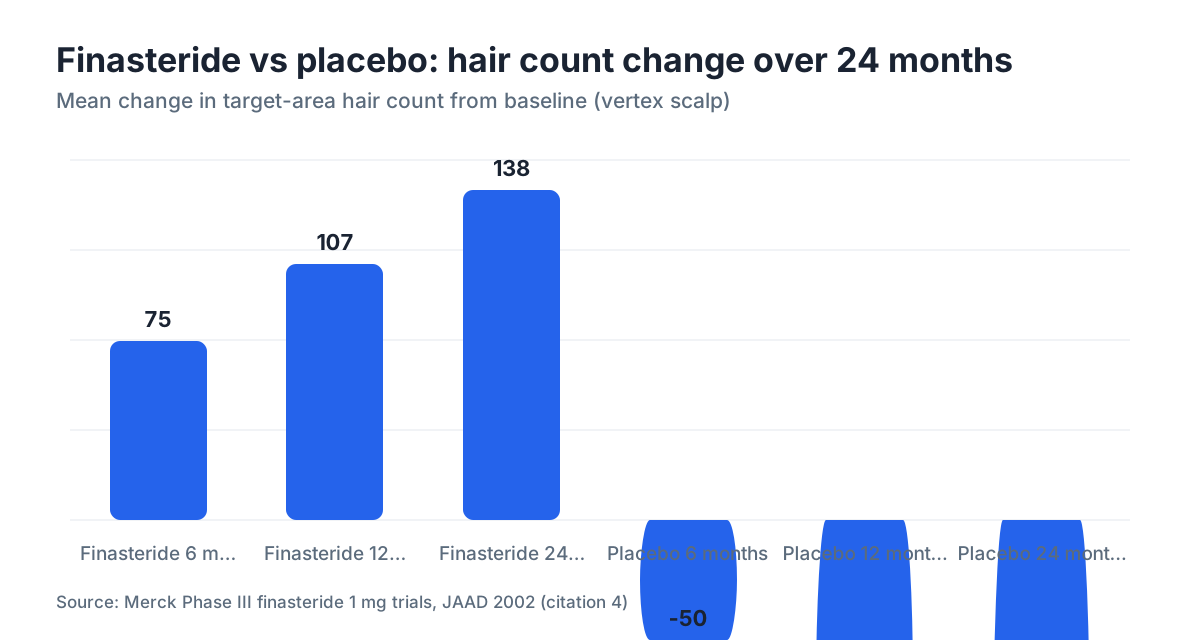
The foundational finasteride studies published in the late 1990s followed men for two years. In the two-year trial by Kaufman et al., men taking 1 mg finasteride daily saw a statistically significant increase in hair count at 12 months, and that count kept rising through month 24. Men on placebo lost hair the whole time. [3]
The Merck Phase III trials measured vertex hair count. At 12 months, finasteride-treated men had gained a mean of roughly 107 hairs in the target area compared to a loss of around 138 hairs in the placebo group, a difference of about 245 hairs. At 24 months, the treated group's count was even higher. [4]
Be clear about one thing: "hair count" in a small target area isn't the same as what you see in the mirror. Subjective global photographic assessments in those same trials showed around 65% of men on finasteride were rated as improved or maintained at 12 months, versus roughly 37% on placebo. That's a real gap. It also means about a third of men on finasteride didn't look improved to blinded raters at 12 months.
Twenty-four months is where the data gets more convincing. By two years, roughly 83% of men in the finasteride group were rated as maintaining or improving, versus 28% on placebo. [4] If you're chasing the best chance at a clear answer, two years is the honest benchmark. Twelve months is the minimum before you can reasonably conclude the drug isn't helping you.
Here's a quote straight from the FDA prescribing information for Propecia: "Clinical studies were conducted in men 18 to 41 years of age with mild to moderate degrees of vertex baldness... In men treated with PROPECIA, the increases from baseline in total and anagen hair counts were significant (p<0.01) at 6 and 12 months, and these increases were maintained through 5 years of treatment." [2] That phrase "maintained through 5 years" matters. This isn't a drug that works for a year and then quits.
What is finasteride shedding and does it mean the drug isn't working?
Shedding in the first two to three months on finasteride is common and alarming to nearly everyone who goes through it. It is almost never a sign the drug is failing.
Here's what's happening. When DHT suppression kicks in, follicles stuck in a prolonged resting phase get a signal to restart growth. Before a new hair can come in, the old resting hair sheds. You end up with a temporary jump in daily shed hairs. This is sometimes called a "purge" or a transitional shed, and it's mechanistically similar to what happens with minoxidil for men in the first few weeks. [5]
This shed typically peaks around weeks 8 to 12 and resolves by month 4 to 6 for most people. If you're seeing increased shedding at month 8 or beyond with no improvement, that's a different story worth raising with a dermatologist.
The psychological trap is real. You start a drug to stop losing hair, and for the first two months you seem to lose more. Most people who quit finasteride early name this period as the reason. Quit during the shed and you'll never know if the drug would have worked for you. This kind of shedding is also distinct from the telogen effluvium caused by stress or illness, which has different triggers and a different pattern.
If you're mid-shed and want to know what a normal pattern looks like versus a red flag, a free AI hair scan at MyHairline can help you track density changes over time and catch trends you'd miss in the bathroom mirror.
How do you track whether finasteride is working?
The mirror is a terrible measuring instrument. Hair loss is gradual, you see yourself every day, and you're primed to catastrophize any shed hair. You need something more systematic.
The most reliable home method is standardized photographs. Same lighting (natural light from a window works), same angle, same wet or dry state, every 8 weeks. Hairline, vertex, and crown from directly above. Keep them in a dated folder. At 12 months, compare month 1 to month 12 side by side. The difference, if any, becomes visible in a way daily inspection never captures.
A dermatologist can do trichoscopy, a handheld dermoscope exam of the scalp, to measure follicle miniaturization objectively. Some practices use phototrichograms or computer-assisted hair counts. Those are the same methods used in clinical trials, and they give you actual numbers instead of impressions.
Blood work isn't needed to track efficacy, but it matters if you're worried about side effects. Some doctors check baseline PSA (prostate-specific antigen) before starting, since finasteride lowers PSA by roughly 50% and can skew prostate cancer screening. [2]
The honest answer on tracking: if you're not losing ground by month 12, finasteride is probably working. Maintenance is the main job of this drug. Regrowth is the bonus.
At what point should you actually stop finasteride?
There are two legitimate reasons to stop before 12 months: persistent sexual side effects that hurt your quality of life, and confirmed liver issues (rare, and documented mostly at the higher doses used in prostate treatment). Shedding alone isn't a reason. Anxiety about the drug isn't a reason either, though it's worth talking through with your prescribing doctor.
After 12 months, stopping is reasonable if you've done standardized photography and see continued progression with no plateau, you've consulted a dermatologist who agrees there's no maintenance effect, and you've ruled out that your hair loss is primarily from something other than androgenetic alopecia. What causes hair loss varies a lot, and finasteride does nothing for alopecia areata, traction alopecia, or nutritional deficiencies.
Androgenetic alopecia in men follows the Norwood scale. If you started at Norwood III and you're clearly Norwood IV after 18 months of consistent finasteride use, that's a meaningful data point. It doesn't mean you failed. It might mean finasteride alone isn't enough and you need to add minoxidil for men or start the hair transplant conversation.
The key word is "consistent." Missing doses often disrupts DHT suppression. Finasteride has a half-life of about 6 to 8 hours, but the 5-alpha reductase inhibition lasts longer. Chronic inconsistency will still undermine results. If you've been taking it irregularly, you can't fairly evaluate the drug.
Does combining finasteride with minoxidil change the timeline?
Yes, in a meaningful way. A 2015 randomized controlled trial published in Dermatologic Therapy compared finasteride alone, minoxidil alone, and the combination. At 12 months, the combination group showed statistically greater hair density improvement than either drug on its own. [6]
The combination doesn't shorten the biological timeline of the hair cycle. It attacks the problem through two different mechanisms: finasteride removes the DHT signal, and minoxidil dilates blood vessels and extends the anagen (growth) phase. Follicles just barely hanging on may respond more strongly to both inputs than to either alone.
Practically, if you're on finasteride alone at month 8 and seeing no change, adding topical minoxidil is a reasonable next step before deciding finasteride has failed. You'd then evaluate the combination at the 12-to-18-month mark. Read more about using finasteride and minoxidil together and whether the combination fits your situation.
Some men also weigh oral minoxidil as an alternative to topical, especially if they find topical formulas irritating or a hassle. The efficacy profile differs slightly and the side effect profile differs more, so that's a separate conversation with your doctor.
Does finasteride work for women and is the timeline the same?
Finasteride is not FDA-approved for hair loss in women. It's sometimes prescribed off-label, usually at 2.5 mg or 5 mg daily, particularly for postmenopausal women with androgenetic alopecia. [7] It is absolutely contraindicated in women who are pregnant or may become pregnant because of the risk of male fetal genital abnormalities. [2]
The limited trial data in women points to a similar or slightly longer timeline. A small randomized trial published in the Journal of the American Academy of Dermatology found no significant benefit at 12 months in postmenopausal women, which drew controversy because later longer-term observational data and trials at higher doses have shown more consistent results. [7] The honest summary: the evidence base is thinner, the dosing is less settled, and women should plan to evaluate with a dermatologist at 12 to 18 months rather than relying on a hard cutoff.
For women losing hair, the receding hairline pattern is often different from men's, and judging whether any treatment is working takes pattern-specific photography and clinical assessment.
What if finasteride genuinely doesn't work for you?
Some men are non-responders. The rate varies across studies, but roughly 10 to 20% of men in clinical trials keep losing hair despite consistent finasteride use over 12 months. Nobody has a perfectly clean answer for why, though genetic variation in androgen receptor sensitivity and 5-alpha reductase enzyme expression are the leading hypotheses.
If you've done 12 months of consistent use with standardized tracking and you're confident you're losing ground, here's a practical framework.
First, confirm your diagnosis. See a dermatologist, more than your GP. An accurate diagnosis rules out treatable causes finasteride won't touch, like iron deficiency, thyroid disorders, or alopecia areata.
Second, consider combination therapy if you haven't already. The evidence for finasteride plus minoxidil is stronger than for either alone.
Third, look honestly at the Norwood staging of your loss. Aggressive early-stage loss in your 20s sometimes moves faster than any medical therapy can counter. In those cases, a hair transplant consultation with a qualified surgeon makes sense, ideally while you keep your remaining hair with medication.
Fourth, don't waste money on hair loss supplements as a replacement for proven therapies. Biotin, collagen powders, and most branded "hair growth" supplements have weak or no evidence. They're not harmful. They're also not a plan.
Some men who take creatine wonder whether it's speeding up their loss. We break down the creatine and DHT question in our piece on whether creatine causes hair loss.
What are the real side effect risks that might make you stop early?
The most discussed side effects of finasteride are sexual: reduced libido, erectile dysfunction, and decreased ejaculatory volume. In the original Merck trials, these showed up in roughly 3.8% of men on finasteride versus 2.1% on placebo, a statistically significant but numerically small difference. Most resolved when the drug was stopped, and some resolved even while men kept taking it. [2]
The more contested topic is post-finasteride syndrome (PFS), a cluster of persistent sexual, neurological, and psychological symptoms that some men report continuing after they stop. The FDA updated the finasteride label in 2012 to include persistent sexual dysfunction as a possible adverse effect. [8] The honest position: PFS is real for some subset of men, the mechanism isn't fully understood, and the frequency is genuinely uncertain. Nobody has good population-level data on this. The closest systematic review found persistent effects reported in case series, with controlled prevalence data still missing.
This isn't a reason to avoid finasteride across the board. Millions of men have taken it without incident. It is a reason to have a real conversation with your prescribing doctor before starting, to know which symptoms to report, and to not push through significant sexual side effects hoping they'll fade. They often do. Sometimes they don't.
The side effects profile of minoxidil is quite different, which is part of why leaning more on minoxidil and less on finasteride works for some men.
A realistic timeline from day one to a verdict
Here's a practical month-by-month framework based on the clinical data:
| Timeframe | What's typically happening | What to do |
|---|---|---|
| Weeks 1-4 | No visible change. DHT suppression begins. | Take standardized baseline photos. |
| Months 2-3 | Possible increase in shedding. Normal for many. | Don't panic. Track the shed, don't read it as failure. |
| Months 4-6 | Shed resolves. Some men notice early maintenance. | Continue. Take comparison photos. |
| Month 12 | Minimum evaluation point. Most meaningful for maintenance. | Compare photos. Consult a dermatologist if uncertain. |
| Month 24 | Peak measurable density gains in trials. | Clearest verdict on full regrowth potential. |
| Ongoing | Maintenance is the long-term goal. | Continue indefinitely if working. Hair loss resumes within months of stopping. |
One number to keep: in a 5-year open-label extension of the Merck finasteride trials, men who took finasteride for 5 years kept significantly more hair than those who switched to placebo partway through. [4] This drug asks for a genuine long-term commitment.
If you want objective tracking data instead of mirror anxiety, a free AI hair analysis at MyHairline gives you a structured baseline to compare against at 6 and 12 months. That kind of systematic comparison is what separates a real verdict from a guess.
Does stopping finasteride undo the benefits?
Yes, relatively fast. This is one of the most important facts to understand about finasteride before you start.
Within 12 months of stopping, men typically return to the hair loss trajectory they'd have been on without treatment. Some studies suggest most of the gained or preserved hair is lost within 9 to 12 months of discontinuation. [3] You don't crash to a worse state than if you'd never taken it, but the benefits don't linger once DHT suppression ends.
This matters for the evaluation question. If you stop finasteride at month 9 because you're unsure it's working, then lose more hair over the next 6 months, you might wrongly conclude the drug failed. What you're actually seeing is the return of DHT-driven loss the drug had been holding back.
This reversibility is also why finasteride is treated as a lifetime medication for men who respond to it. Dermatologists describe it as a tap you keep turned on: shut it off, and the loss resumes. That's not a product pitch. It's the mechanism, and it should factor into your decision to start.
Sources
- FDA, Propecia (finasteride) Prescribing Information
- FDA, Propecia Prescribing Information: Indications, clinical pharmacology, warnings
- Kaufman KD et al., 'Finasteride in the treatment of men with androgenetic alopecia', Journal of the American Academy of Dermatology, 1998
- Merck & Co., Phase III finasteride 1 mg clinical trial data; 5-year open-label extension results published in JAAD 2002
- American Academy of Dermatology Association, Hair Loss: Diagnosis and Treatment
- Hu R et al., 'Combined treatment with oral finasteride and topical minoxidil in male androgenetic alopecia', Dermatologic Therapy, 2015
- Price VH et al., 'Lack of efficacy of finasteride in postmenopausal women with androgenetic alopecia', Journal of the American Academy of Dermatology, 2000
- FDA Drug Safety Communication: 5-alpha reductase inhibitors label update (2012)
- National Institutes of Health, MedlinePlus: Finasteride
- Rossi A et al., 'Comparative effectiveness of finasteride vs. Serenoa repens in male androgenetic alopecia: a two-year study', International Journal of Immunopathology and Pharmacology, 2012
- American Academy of Dermatology Association, Androgenetic Alopecia clinical guidelines
- Olsen EA et al., 'The importance of dual 5-alpha reductase inhibition in the treatment of male pattern hair loss', Journal of the American Academy of Dermatology, 2006