
TL;DR: Yes, DHT shows up in a blood test, but measuring it accurately is harder than most people expect. Standard immunoassay tests miss badly at low levels, especially in women and men on finasteride. Mass spectrometry (LC-MS/MS) is far more reliable. For most men with pattern hair loss, the test rarely changes anything, because the diagnosis is made by looking at your scalp, not your bloodwork.
What exactly is DHT and why does it matter for hair loss?
Dihydrotestosterone (DHT) is an androgen hormone your body makes from testosterone using an enzyme called 5-alpha reductase. It's stronger than testosterone and grabs onto androgen receptors with roughly three to five times the affinity. In follicles that carry a genetic sensitivity, that binding shrinks the follicle over years, shortens the growth cycle, and eventually turns thick hair into fuzz too fine to see. That process is androgenetic alopecia, the most common cause of hair loss in men and women alike. [1]
For men, DHT is the main driver. For women the picture is messier, because estrogen, prolactin, and thyroid hormones all pull on the hair cycle too. DHT still matters in women, which is one reason dht blocker medications get used in both sexes.
About 5 to 10 percent of circulating testosterone converts to DHT, mostly in the skin, liver, and prostate. Here's the catch: serum DHT doesn't reliably predict follicle sensitivity. Two men with identical blood DHT can have wildly different hair, depending on how many androgen receptors their follicles carry and how touchy those receptors are. The number on your lab report only tells part of the story. [2]
How is DHT actually measured in a blood test?
Labs use two main methods, and they are not equal. One is old and cheap. The other is accurate.
The common method is immunoassay, either radioimmunoassay (RIA) or enzyme-linked immunosorbent assay (ELISA). Antibodies bind to DHT and produce a signal the machine reads. They're cheap, fast, and everywhere. The weak spot is cross-reactivity. The antibodies can't always tell DHT apart from structurally similar steroids like androstenediol or testosterone metabolites, so the reading gets inflated or deflated depending on what else is floating in the sample. [3]
The better method is liquid chromatography with tandem mass spectrometry, written LC-MS/MS. It separates molecules by their actual mass, then breaks them apart to confirm identity. It's specific to DHT. Academic medical centers and specialized endocrine labs run it, and both Quest Diagnostics and LabCorp offer LC-MS/MS steroid panels. Not every test on their menu is the mass spec version, though, so you have to ask or read the assay description. [4]
The Endocrine Society's guidance on sex steroid measurement is blunt: "immunoassay methods perform poorly for the measurement of low serum concentrations," and it recommends extraction and chromatography-based methods for accuracy. [3] That matters most for women and postmenopausal patients, whose DHT sits in the low range where immunoassay falls apart.
Physically, a standard blood draw is all it takes. DHT is fairly stable in serum when the sample is processed and stored right, so the collection isn't the variable. The lab method is.
What are normal DHT levels in blood, and what counts as high or low?
Reference ranges shift by lab and by assay, which is exactly why you can't compare a result from one lab against another. Measured by LC-MS/MS, commonly cited ranges look roughly like this:
| Group | Approximate normal DHT range |
|---|---|
| Adult men (ages 18-50) | 30 to 85 ng/dL |
| Adult men (ages 50+) | 25 to 75 ng/dL |
| Adult women (premenopausal) | 4 to 22 ng/dL |
| Adult women (postmenopausal) | 3 to 19 ng/dL |
These are rough population averages, not clinical cutoffs. [5] Labs set their own reference intervals and they genuinely differ. A result of 60 ng/dL can read as normal at one lab and "elevated" on another lab's printout that uses a tighter range.
Here's the part people miss. Most men with androgenetic alopecia have DHT sitting squarely in the normal range. Hair loss usually isn't caused by too much DHT. It's caused by follicles that are sensitive to normal DHT. So "your DHT is normal" does not mean DHT isn't behind your hair loss. And "your DHT is high" by itself doesn't mean your loss will be worse than the next guy's.
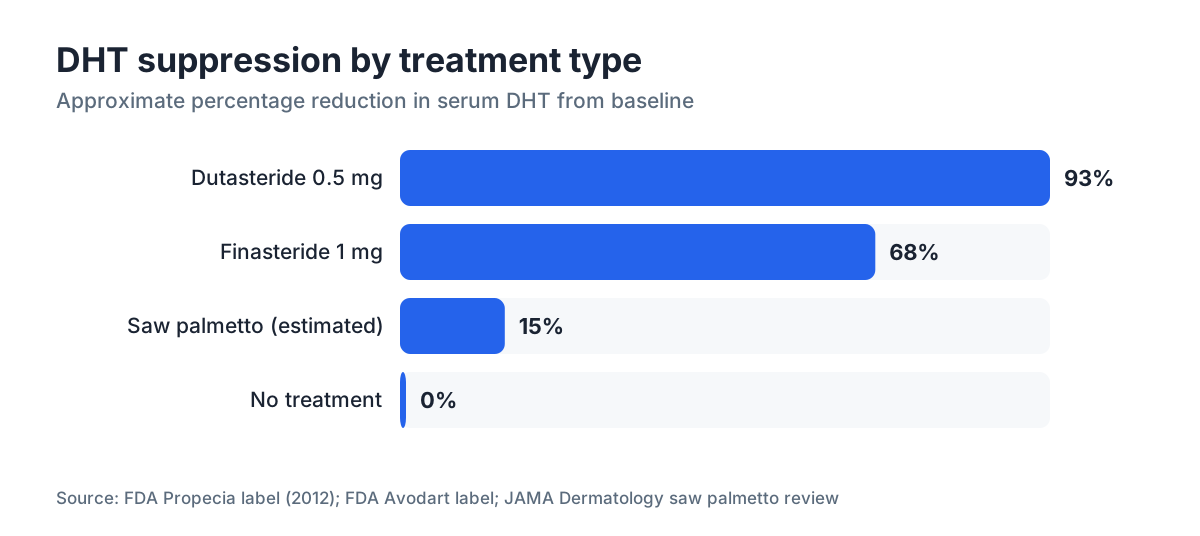
Finasteride, the most studied oral treatment for hair loss, cuts serum DHT by roughly 65 to 70 percent at the 1 mg dose, per the FDA-approved label. [6] Useful context: treatment gets tracked by percentage drop, not by hitting some magic absolute number.
How accurate are standard DHT blood tests compared to mass spectrometry?
The gap between immunoassay and LC-MS/MS is large and well documented in endocrinology journals. Immunoassay is directionally useful for a typical man. For low values, it's close to guessing.
Studies comparing immunoassay against mass spectrometry for multiple androgens have found systematic over- and underestimation depending on the hormone and the concentration. For DHT, immunoassay tends to overestimate at low levels, and its correlation with mass spec is imperfect. [3] Work published in the Journal of Clinical Endocrinology and Metabolism on androgen measurement in women found immunoassay results so variable as to be "unreliable for clinical decision-making" in the low ranges where women's DHT lives. [7]
So if you're a man with DHT in the 40 to 80 ng/dL range, an immunoassay is probably in the right ballpark even if it's off by 10 to 15 percent. If you're a woman, or a man on finasteride whose DHT has dropped to 15 to 20 ng/dL, immunoassay becomes genuinely unreliable. At low concentrations the absolute error can be bigger than the value itself.
When you order a DHT test from a consumer lab or your GP, ask which assay they run. If the report doesn't say LC-MS/MS or gas chromatography mass spectrometry (GC-MS), assume immunoassay.
One more wrinkle: DHT has some daily variation, less than cortisol but enough to matter. Most guidance says draw androgens in the morning, ideally before 10 AM, to keep measurements comparable. [5]
When does testing DHT actually change what a doctor does?
This is the question most people skip before ordering the test. Honest answer: for the average man losing his hair, almost never.
A man with thinning at the crown or temples, a receding hairline, and a family history of hair loss has a clinical diagnosis. A dermatologist or GP makes that call by looking at the hair. A DHT blood test adds close to nothing. You can have low DHT and still have pattern hair loss if your follicles are sensitive. The blood number doesn't decide whether you can try finasteride or minoxidil for men.
DHT testing earns its cost in a smaller set of cases:
First, women with hair loss where the cause isn't obvious. Androgenetic alopecia, polycystic ovary syndrome (PCOS), and adrenal disorders can all push androgens up, DHT included. A full panel with DHT, total testosterone, free testosterone, DHEA-S, and sometimes sex hormone binding globulin (SHBG) helps point toward or away from a hormonal source. [1]
Second, men or women with signs of androgen excess beyond hair loss: severe acne, virilization in women, unexpected muscle changes. Those patterns hint at something past ordinary sensitivity.
Third, checking treatment. If a man is on finasteride and the doctor wants to confirm the drug is suppressing DHT physiologically, a level at 3 to 6 months confirms it. That's more a research habit than routine care, but it has real uses.
If none of those fit you, the DHT test is a $60 to $200 data point that won't change what you do. That money buys more as a dermatologist visit or a proven treatment. Want a fast read on where your hair loss stands before booking appointments? The free AI scan at MyHairline helps you figure out your stage and which questions are worth asking a clinician.
Does a high DHT level in blood predict faster or worse hair loss?
You'd expect yes. The data says it's complicated, and the link is weaker than intuition suggests.
Several studies have hunted for a clean relationship between serum DHT and androgenetic alopecia severity. The relationship exists but it's faint. Research in the British Journal of Dermatology found that serum DHT did not reliably separate men with severe pattern hair loss from men with mild loss or none. [8] The real driver is genetic androgen receptor sensitivity, which a blood test can't touch.
The stronger evidence is that DHT in scalp tissue, not blood, tracks more closely with follicle miniaturization. Scalp biopsy and tissue DHT measurement exist in research settings but aren't routine tests. The scalp's own 5-alpha reductase activity decides how much testosterone converts right at the follicle, and that can drift away from serum levels. [2]
A blood test tells you about systemic DHT. The follicle lives in its own local neighborhood. The two don't always agree.
This is also why some men with perfectly normal serum DHT respond dramatically to finasteride while others barely budge. The variance in response comes down to receptor genetics, not to where your blood test started.
How does finasteride affect DHT levels in blood tests?
Finasteride blocks 5-alpha reductase type 2, the enzyme isoform most active in hair follicles and the prostate. At the 1 mg oral dose for hair loss, the FDA label reports about a 65 to 70 percent drop in serum DHT, typically measured 6 to 12 months in. [6] At the 5 mg dose used for benign prostatic hyperplasia, suppression reaches roughly 70 to 75 percent.
Dutasteride blocks both the type 1 and type 2 isoforms and pushes serum DHT down closer to 90 to 95 percent, which is why some dermatologists reach for it when finasteride underperforms. [9]
Already on finasteride and getting tested? Expect a result around 8 to 25 ng/dL for men. At that concentration immunoassay reliability gets shaky, so LC-MS/MS is the right call. Some physicians run a baseline and a follow-up DHT to confirm 5-alpha reductase inhibition and, frankly, to check that the patient is actually taking the pill.
For the full picture on how finasteride and minoxidil work together, finasteride and minoxidil covers the combination approach.
Can DHT testing help diagnose hair loss in women?
Yes, and in women the test carries more clinical weight than it does in men.
Women with a diffuse or widening-part pattern, especially alongside acne, irregular periods, or hirsutism (excess facial or body hair), often get a full hormonal workup that includes DHT. The American Academy of Dermatology notes that androgenetic alopecia in women can tie to underlying hormonal conditions, and that lab evaluation is appropriate when androgen excess is suspected. [1]
Elevated DHT in a woman can point toward:
- PCOS (the most common hormonal cause of androgen excess in women)
- Adrenal hyperplasia
- Androgen-secreting tumors (rare but serious)
- Ovarian dysfunction
When elevated DHT is confirmed by LC-MS/MS, treatment might include spironolactone (which blocks androgen receptors and slightly lowers androgens) or low-dose oral contraceptives with anti-androgenic progestins. These need an endocrinologist or gynecologist in the loop.
Women with hair loss and normal DHT are more often dealing with telogen effluvium, nutritional deficiencies, thyroid problems, or the autoimmune condition alopecia areata. Those need different workups, and the treatment paths split hard. Getting the cause right changes everything downstream.
If your hair is shedding heavily and you're a woman, DHT is one piece of a bigger panel. Not the whole story.
What other tests should be ordered alongside DHT for hair loss?
A DHT reading alone is like checking only your blood pressure when you've got chest pain. It's one data point. The context around it is what makes it mean anything.
For a fuller look at hair-loss-relevant hormones and nutrition, most dermatologists and endocrinologists would consider these:
| Test | What it shows | Relevant to |
|---|---|---|
| Total testosterone | Androgen production level | Both sexes |
| Free testosterone | Bioavailable fraction | Both sexes |
| SHBG | Binds androgens, affects free levels | Both sexes |
| DHEA-S | Adrenal androgen marker | Women especially |
| DHT (LC-MS/MS) | Direct androgen at follicle level | Both sexes |
| TSH (thyroid) | Thyroid function | Both sexes |
| Ferritin | Iron stores, common deficiency cause | Women especially |
| Prolactin | Pituitary marker | Women with irregular periods |
| CBC, CMP | General health screen | Both sexes |
That's a broad panel, and not everyone needs every line. A dermatologist doing a focused hair loss assessment tailors it. The point is to rule out reversible systemic causes like iron deficiency and thyroid disease before assuming androgenetic alopecia explains the whole thing.
Want to understand your specific pattern before seeing a specialist? Reading what causes hair loss and looking honestly at your own hairline changes is a fine starting point.
Where can you get a DHT blood test and what does it cost?
Several routes exist in the US, each with trade-offs. Expect to pay $40 to $200 depending on the assay and lab.
Your GP or dermatologist can order a DHT test and bill insurance. Coverage varies. Many insurers cover it as part of an androgen evaluation when there are documented signs of androgen excess. Ordering out of pure curiosity ("I want to check my DHT") is more likely to get denied and land on you out-of-pocket.
Direct-to-consumer labs let you order without a physician's requisition in most states. Quest Diagnostics offers a DHT test, and so does LabCorp. Immunoassay panels through these routes usually run $40 to $90. LC-MS/MS steroid panels cost more, typically $80 to $200 depending on the lab and how many analytes are bundled. [4]
Aggregators like Ulta Lab Tests and Walk-In Lab connect to the same reference labs and sometimes price panels below the cost of individual tests. A "male hormone panel" or "androgen panel" often includes DHT alongside testosterone and SHBG for one price.
One practical habit: when the result comes back, check the assay method on the report. If it says "RIA" or lists nothing, it's almost certainly immunoassay. If it says "LC-MS/MS" or "mass spectrometry," you've got the accurate version.
Telehealth services that specialize in men's health (the ones prescribing finasteride) sometimes fold DHT monitoring into baseline labs. That monitoring has real but limited value for treatment decisions, as covered above.
Are there natural ways to lower DHT and do they show up in blood tests?
Saw palmetto is the most studied natural 5-alpha reductase inhibitor. Same basic mechanism as finasteride, much weaker. Some small studies show a modest serum DHT drop with saw palmetto, but the evidence is nowhere near finasteride's quality. [10] Whether it lowers DHT enough to slow hair loss in a way you'd notice is genuinely unclear. The clinical hair loss trials on it are small and methodologically shaky.
Other supplements sold as DHT blockers (pumpkin seed oil, beta-sitosterol, zinc, and the rest) have thin or very preliminary evidence. The hair loss supplements space runs on more marketing than data. None have been shown in rigorous trials to cut serum DHT to the 65 to 70 percent finasteride reaches.
Take any of these, then measure DHT by immunoassay, and small changes may reflect real shifts or just assay noise. You'd need LC-MS/MS plus a baseline to interpret any difference at all.
Creatine deserves a mention because there's ongoing debate about whether it raises DHT. One small 2009 study in rugby players found creatine supplementation raised serum DHT by about 56 percent over three weeks. The study was tiny (20 subjects) and hasn't been replicated at scale. [11] The does creatine cause hair loss question is still open, and this DHT signal is part of why it keeps coming up.
For a wider view of what actually works at the treatment level, the dht blocker article grades pharmaceutical and supplemental options with the evidence laid out honestly.
What does your DHT result actually mean for your hair loss treatment plan?
Here's how to use a DHT result, assuming one is sitting in front of you. The number gives context. It doesn't make the decision.
Man with typical pattern hair loss (temples, crown, family history) and normal DHT: the test just told you your system is working normally. Your follicles may still be sensitive to that normal DHT. Your options don't change. Finasteride, minoxidil, and for heavier loss a hair transplant evaluation are the choices with real evidence behind them. The blood test gates none of them.
Man with a clearly elevated DHT: worth a conversation with an endocrinologist to look for an underlying driver. But high DHT in an otherwise healthy man is uncommon, and it often means the test was immunoassay-based and imprecise. Repeat with LC-MS/MS before acting on it.
Woman with elevated DHT confirmed by mass spec: this genuinely guides treatment. It strengthens the case for anti-androgen therapy and prompts a look for PCOS or adrenal issues.
On finasteride with DHT suppressed appropriately: the drug is doing its pharmacological job. Visible response (real hair retention or regrowth) still takes 6 to 12 months to judge. A suppressed DHT with no visible change at 12 months isn't a reason to quit early. Some people respond later.
A normal DHT result does not mean DHT isn't causing your hair loss. A high DHT result does not mean your loss will inevitably be severe. A dermatologist who has looked at your scalp, your pattern, and your history still beats the lab printout.
Want to map where your hairline sits before that appointment? MyHairline's free AI scan gives a Norwood or Ludwig stage estimate from photos, which is a more actionable start than a DHT number alone.
Sources
- American Academy of Dermatology, Hair Loss in Women
- StatPearls (NCBI Bookshelf), Androgenetic Alopecia
- Endocrine Society, Position Statement on Testosterone Measurement
- Quest Diagnostics, Test Directory
- Mayo Clinic Laboratories, Test Catalog
- FDA, Propecia (Finasteride 1 mg) Prescribing Information
- Journal of Clinical Endocrinology and Metabolism
- British Journal of Dermatology
- FDA, Avodart (Dutasteride 0.5 mg) Prescribing Information
- JAMA Dermatology