
TL;DR: Cold turkey and tapering land in the same place. DHT rebounds to baseline within about two weeks either way, and most hair you regained on the drug sheds within 9 to 12 months. No trial shows tapering softens the shed or slows the rebound. The real question isn't how you stop. It's whether you stop, and what you put in finasteride's place if you do.
What does finasteride actually do, and why does stopping matter?
Finasteride is a 5-alpha reductase inhibitor. It blocks the enzyme that turns testosterone into dihydrotestosterone (DHT), the hormone that shrinks genetically sensitive hair follicles in male-pattern and female-pattern loss [1]. The FDA approved 1 mg finasteride (Propecia) for male androgenetic alopecia in 1997. The drug works only while it's in your system.
Stop taking it and the enzyme wakes back up fast. Scalp DHT climbs back to baseline within roughly one to two weeks of your last dose [2]. The follicles that had been partly rescued by lower DHT start their retreat again. It isn't instant, and day one looks like nothing, but once the process gets going it's essentially irreversible.
So stopping matters because finasteride cures nothing. It mutes a hormonal signal. Cut the signal and the genetic program picks up right where it left off.
That single fact is the whole basis for thinking clearly about cold turkey versus tapering. For a deeper look at how DHT drives follicle miniaturization, see our guide on DHT blockers.
What happens to your hair when you stop finasteride cold turkey?
Short version: you shed the hair finasteride helped you keep, and you mostly do it inside a year.
The 5-year phase III extension data and the discontinuation cohort both show men who quit finasteride lost the hair-count benefit within about 9 to 12 months [3][11]. Loss then continued at roughly the pace it would have followed with no treatment at all. You don't end up worse than if you'd never taken the drug. You just don't get to keep the gift.
A few things worth knowing:
- The shedding isn't a crash. It follows the normal hair cycle. Follicles don't all drop at once. They cycle out over the months after DHT rebounds.
- Some men report what feels like accelerated shedding in the first two to three months. This is probably telogen effluvium triggered by the hormonal shift, though it's poorly documented in the specific context of finasteride cessation.
- Men who regrew the most have the most to lose. Men who were mostly holding steady on the drug mostly return to where they started.
The FDA prescribing information for finasteride 1 mg puts it plainly: "Discontinuation of treatment with finasteride leads to reversal of the effect of the treatment within 12 months" [1]. The trial data backs that language up.
Is tapering finasteride better than stopping cold turkey?
This is the question most people actually have. The honest answer: probably not, at least not in any way the evidence supports.
There are no randomized controlled trials comparing a tapered finasteride discontinuation to abrupt cessation. None. The belief that tapering cushions the hair-loss rebound is borrowed from other drugs where a taper genuinely matters, like corticosteroids or antidepressants. Finasteride's mechanism doesn't obviously demand one for the hair-loss endpoint.
Here's why. DHT suppression from finasteride 1 mg is already close to maximal at that dose. Dropping to 0.5 mg or 0.25 mg doesn't buy meaningful extra suppression time. You're just extending a somewhat lower level of protection before the floor drops out anyway [2]. The follicle's response to DHT resumes on a schedule set by the hair cycle, not by how slowly you cut your dose.
Where tapering might actually matter is for men who think they're getting persistent sexual side effects (sometimes called post-finasteride syndrome, or PFS). A small subset report ongoing dysfunction after stopping, and some clinicians have floated tapering to soften the abruptness of the hormonal drop. But the evidence base for PFS itself is limited and contested, and no published protocol shows tapering lowers its incidence or severity [4].
The bottom line splits two ways. Stopping because you're done managing hair loss? Cold turkey and tapering get you to the same place. Stopping because of side effects? Talk to your prescriber before you do anything.
How fast does DHT rebound after you stop finasteride?
Fast. Finasteride 1 mg has a half-life of roughly 5 to 6 hours in young men and up to 8 hours in men over 70 [2]. The drug itself is essentially gone within 24 to 48 hours of your last dose [9].
DHT suppression outlasts the drug's presence by a bit, because 5-alpha reductase type II takes some time to recover its full activity once the inhibitor clears. Scalp DHT returns to pre-treatment levels within about one to two weeks [2].
So by the end of your second week off, your scalp is running as if you'd never taken it. Hair doesn't fall out in week two because the cycle lags. Follicles in anagen (the growth phase) don't miniaturize on cue. The regression plays out over the following months as affected follicles cycle through and return thinner each pass.
This is exactly why tapering doesn't delay the DHT rebound in any useful way. Spreading a dose cut over 4 to 8 weeks adds a few weeks on the front end. The DHT environment after your final dose is identical no matter how you got there.
What does the hair loss look like in the months after stopping?
Most men notice nothing dramatic in month one. The first real signal is usually more shedding around weeks 8 to 16, as follicles that lost DHT protection cycle into telogen and let their hairs go.
By 6 months, visible thinning often returns in the areas finasteride helped most. Crown and midscalp changes tend to stand out, because those are usually where the drug did its most visible work.
By 12 months, the Merck-sponsored phase III data show objective hair counts back to roughly baseline in men who quit [3]. How much you actually see depends on how much the drug was doing. Borderline stable, with finasteride just holding the line? The regression looks mild. Real regrowth on the drug? You'll probably lose it.
One thing catches people off guard: the hairline can look worse than before you started, because you're older now. Finasteride doesn't stop the clock. It slows the progression while you take it. Quit at 35 instead of 25 and you're facing ten more years of whatever your follicles were programmed to do.
If your receding hairline has already moved a lot, pin down your Norwood stage before you decide whether a medical or surgical path fits you better.
Are there side effects specific to stopping finasteride?
The most commonly reported issue after stopping is the hair loss itself. That's the expected pharmacological outcome, not a side effect in the usual sense.
Beyond that, some men report a short-term improvement in sexual side effects (libido, erectile function, ejaculate volume) once they stop, which tracks with the fact that those effects correlate with DHT suppression. If you had side effects on finasteride, stopping resolves them within weeks to a few months for the large majority of men [4].
The contested area is post-finasteride syndrome. A subset of men report persistent sexual, cognitive, and mood symptoms after stopping that don't resolve. The real incidence is genuinely unknown and argued over. The FDA updated the finasteride label in 2012 to include persistent sexual side effects as a reported adverse event after discontinuation [10]. The scientific community still disagrees about mechanism, prevalence, and whether PFS is a distinct clinical entity or a mixed bag of symptoms.
Still having symptoms months after stopping? That's a conversation with a physician, not a DIY taper. Don't troubleshoot this one alone.
The American Hair Loss Association has published statements treating PFS as a real concern for some patients while noting the evidence base stays limited [5].
What are your options if you want to stop finasteride but keep your hair?
There aren't many. There are some real ones.
Minoxidil is the most evidence-backed alternative. It works through a completely different pathway (vasodilation, potassium channel opening at the follicle) and never touches DHT. Switch from finasteride to minoxidil when you stop and you'll still lose some of what finasteride was protecting, because minoxidil doesn't address the DHT problem. But it can stabilize some of the remaining hair and drive some independent regrowth [6]. Finasteride plus minoxidil beats either one alone in the trial literature, so pulling one out leaves you with less coverage, not none.
Oral minoxidil has gained ground as an alternative or add-on for people who can't stand the topical. The evidence for oral minoxidil keeps growing, though it carries its own side effect profile (fluid retention, unwanted body hair, cardiovascular considerations).
A hair transplant permanently moves DHT-resistant follicles from the back and sides to thinning areas. Stopping finasteride doesn't undo a transplant, because those grafts are genetically resistant to DHT. But the native hair around them keeps thinning, which can look increasingly unnatural over time if you don't manage the ongoing loss. More in our hair transplant guide.
Low-level laser therapy (LLLT) has some FDA clearance for hair loss and a modest evidence base, though most clinicians rate it weaker than minoxidil alone [7].
Not sure whether stopping makes sense for where your hair stands? Get a baseline first. The free AI hair analysis at MyHairline gives you a visual read on your current Norwood stage before you commit.
For men who want to run both drugs, see our guide on finasteride and minoxidil together.
Does stopping finasteride cause a 'shed' that makes hair loss worse before it gets better?
There's no clinical evidence of a 'rebound shed' that temporarily drops you below your underlying pattern. Hair loss resumes at roughly the rate you'd expect for your age and genetics. That's it.
The confusion comes from comparing the post-stop period to being on the drug. Against the protection finasteride was giving you, stopping does look like a shed. You're losing ground you'd held. But you're not losing it faster than your baseline rate. You're just losing it again after a stretch when it was suppressed.
The telogen effluvium parallel is worth addressing head-on. When some men start finasteride, they get a temporary shed in the first 2 to 3 months as follicles shift from miniaturized to healthier cycles. The reverse, a shed driven by the DHT rebound when stopping, has been reported anecdotally but isn't well documented in peer-reviewed work. If you get dramatic shedding within weeks of stopping, book a dermatology visit to rule out other causes.
See our full article on telogen effluvium if you're trying to work out whether what you're seeing is the expected pattern or something else.
What if you stop finasteride because of side effects, not by choice?
This is a different situation from electively quitting, and it deserves its own treatment.
The most commonly reported sexual side effects on finasteride 1 mg in the original phase III trials were decreased libido (1.8% vs 1.3% placebo), erectile dysfunction (1.3% vs 0.7% placebo), and decreased ejaculate volume (0.8% vs 0.4% placebo) [3]. Small numbers, but real. The trial data also showed that in men who quit because of side effects, symptoms resolved in most cases.
If you're stopping because of side effects, the hair-loss trajectory is the same as stopping for any other reason. DHT rebounds, hair follows. What to do next is the harder part, because you probably can't go back on finasteride, and the alternatives don't suppress DHT the same way.
Dutasteride is a stronger 5-alpha reductase inhibitor that blocks both type I and type II enzymes (finasteride hits only type II). It has a much longer half-life and isn't FDA-approved for hair loss, though it's used off-label. It carries similar and possibly stronger side effect risks, so it's no clear answer for someone who couldn't tolerate finasteride.
Minoxidil, LLLT, and eventually a hair transplant become the realistic toolkit. A what causes hair loss read can also help you place how much of your situation is DHT-driven versus something else.
Is there any reason to taper finasteride instead of stopping abruptly?
For the hair-loss endpoint, no strong reason exists based on the available evidence.
That said, a slow taper has reasonable arguments in a few narrow spots:
- Your prescribing physician recommends it, especially if you've reported mood-related side effects (depression and anxiety appear in post-marketing reports for finasteride, though causality is debated).
- You want time to start an alternative like minoxidil and reach a therapeutic steady state before finasteride's protection drops out. That's not a true taper in the clinical sense. It's a transition plan. The overlap makes practical sense even when the taper itself is pharmacologically pointless.
- You have a hard time with abrupt stops and a gradual reduction helps you sit with the decision.
None of the three is a medical requirement. A taper won't save your hair. It might buy you time to set up a replacement, and that has real value.
If you're weighing this, talk to your dermatologist. "Nobody has good data on finasteride tapering for hair preservation" is an honest read of where the literature stands. Your own situation (side effect history, current Norwood stage, other medications) should steer the conversation.
What do the clinical trials actually show about stopping finasteride?
The most direct data comes from the 5-year phase III trial by Kaufman et al. (1998) in the Journal of the American Academy of Dermatology, plus the PLESS (Proscar Long-Term Efficacy and Safety Study) work, which used 5 mg finasteride for benign prostatic hyperplasia but gives useful pharmacodynamic information [3].
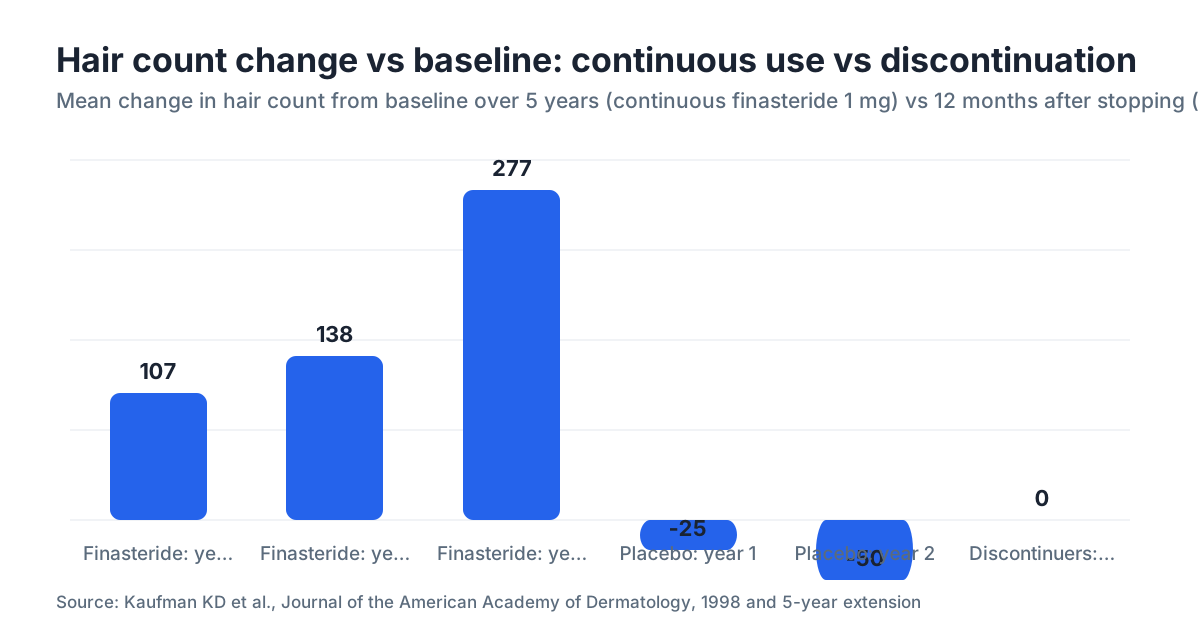
In the 1 mg hair loss trial, a group of men took finasteride for two years and then switched to placebo. One year after discontinuation, their hair counts were back to roughly baseline (year-zero) levels [11]. Men who stayed on finasteride held their gains through the study.
The 5-year extension showed continuous users kept a net positive hair count versus baseline at year 5. Discontinuers weren't tracked for the full 5 years in the extension, but the trajectory pointed clearly downward inside the first year after stopping.
No peer-reviewed study has compared a tapered discontinuation protocol to abrupt cessation for the hair-count endpoint. That gap is real, and worth saying out loud.
A 2010 systematic review in the Journal of the American Academy of Dermatology on finasteride for androgenetic alopecia confirmed sustained efficacy with continued use and return of hair loss after discontinuation, matching the earlier trial data [8].
The chart below sums up the key efficacy numbers from the 5-year trial.
Sources
- FDA, Propecia (finasteride 1 mg) prescribing information
- FDA, Proscar (finasteride 5 mg) prescribing information, clinical pharmacology section
- Kaufman KD et al., Journal of the American Academy of Dermatology, 1998, 5-year finasteride trial for androgenetic alopecia
- Traish AM et al., Reviews in Urology, 2011, post-finasteride syndrome review
- American Hair Loss Association, finasteride position statement
- Olsen EA et al., Journal of the American Academy of Dermatology, 2002, minoxidil and finasteride combination trial
- Gupta AK et al., Journal of Dermatological Treatment, 2014, LLLT for hair loss
- Mella JM et al., Journal of the American Academy of Dermatology, 2010, systematic review finasteride for androgenetic alopecia
- Mysore V, Indian Dermatology Online Journal, 2012, finasteride and its uses in dermatology
- FDA, MedWatch, finasteride label update 2012
- Drake L et al., Journal of the American Academy of Dermatology, 1999, finasteride 1 mg long-term study