TL;DR: DHT (dihydrotestosterone) is the androgen that shrinks genetically sensitive hair follicles and drives male and female pattern hair loss. DHT blockers are drugs or supplements that either stop DHT from forming or block it from binding to follicles. Finasteride has the strongest human evidence, cutting scalp DHT by roughly 60 to 70 percent. Most supplements sold as DHT blockers have thin or no human trial data.
What exactly is DHT and why does it matter for hair?
DHT stands for dihydrotestosterone. It's an androgen, meaning it's a hormone that drives male-pattern physical traits, and it's made from testosterone by an enzyme called 5-alpha reductase (5-AR). You have two main types of that enzyme: Type 1, found mostly in the skin and liver, and Type 2, concentrated in the scalp's hair follicles and prostate.
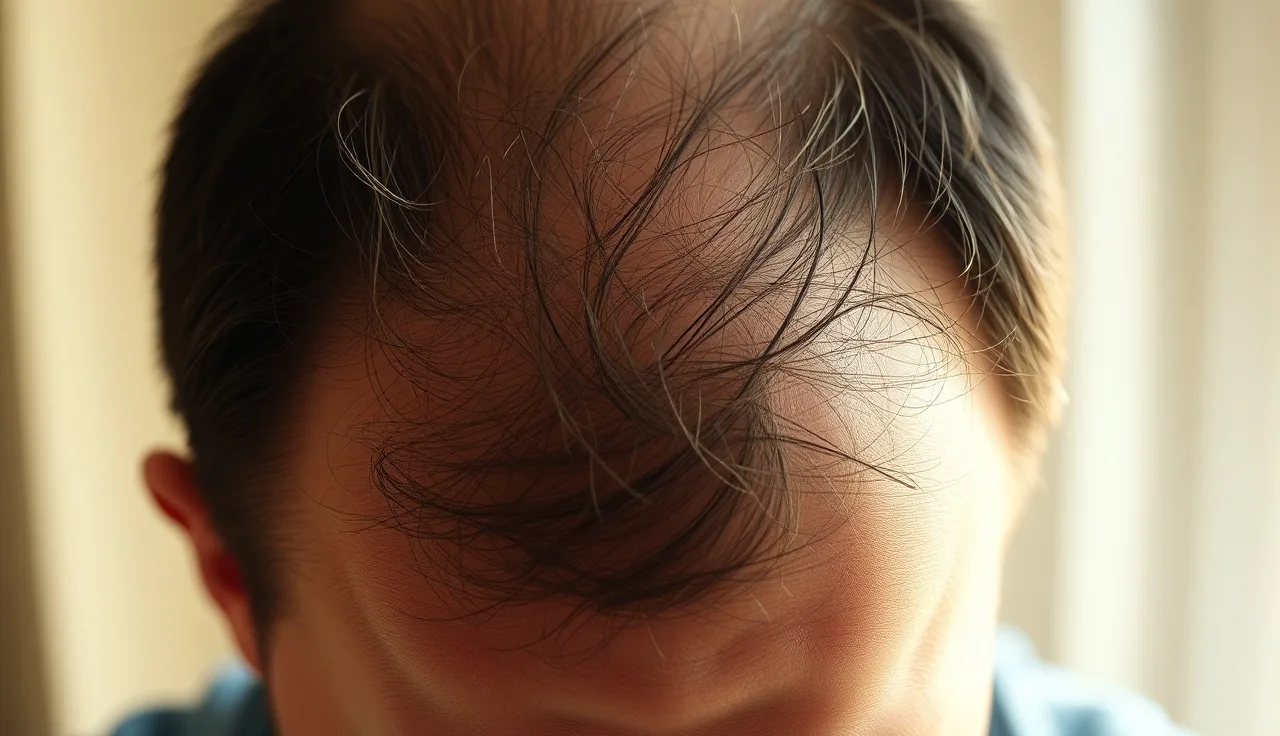
When 5-AR converts testosterone to DHT in the follicle, DHT binds to androgen receptors inside the dermal papilla, the cluster of cells at the root that controls hair growth. In people with a genetic sensitivity to DHT, this binding triggers a process called miniaturization. The follicle shrinks a little with each hair cycle. Hairs come in thinner and shorter until the follicle stops producing visible hair entirely. That process is androgenetic alopecia, better known as male pattern baldness or, in women, female pattern hair loss. [1]
The key word is "genetic sensitivity." Two men can have identical DHT levels. One goes bald, the other keeps every hair. What differs is how aggressively the androgen receptors in their follicles respond. [2] That's why DHT blockers help people who are losing hair but do almost nothing for people whose follicles aren't sensitive in the first place.
Learn more about the full picture of what causes hair loss beyond just DHT.
How do DHT blockers work?
DHT blockers work through one of two mechanisms: they either reduce DHT production or block DHT from binding to androgen receptors.
5-alpha reductase inhibitors (5-ARIs) stop the enzyme from converting testosterone to DHT in the first place. Less DHT is made, so less reaches the follicle. Finasteride inhibits Type 2 5-AR almost exclusively. Dutasteride inhibits both Type 1 and Type 2, which is why it drops DHT levels more aggressively.
Androgen receptor blockers don't lower DHT levels. They compete with DHT at the receptor, making it harder for DHT to bind and signal miniaturization. Spironolactone (used off-label in women) works this way. Some topical formulations combine both approaches.
There's a third, looser category: plant extracts and supplement ingredients marketed as DHT blockers because they show weak 5-AR inhibition in lab dishes or animal studies. Saw palmetto is the most common example. These aren't the same class of evidence as pharmaceutical 5-ARIs, and the distinction matters a lot when you're deciding what to spend money on.
The goal in every case is the same: fewer follicles miniaturizing, and ideally some partial recovery of follicles that have already shrunk but haven't gone completely dormant. Neither approach regrows hair in a dead follicle. That's why starting earlier almost always produces better results.
Which DHT blockers have real clinical evidence?
Here's the honest breakdown. Three options have genuine controlled human trial data. Everything else is working from weaker evidence.
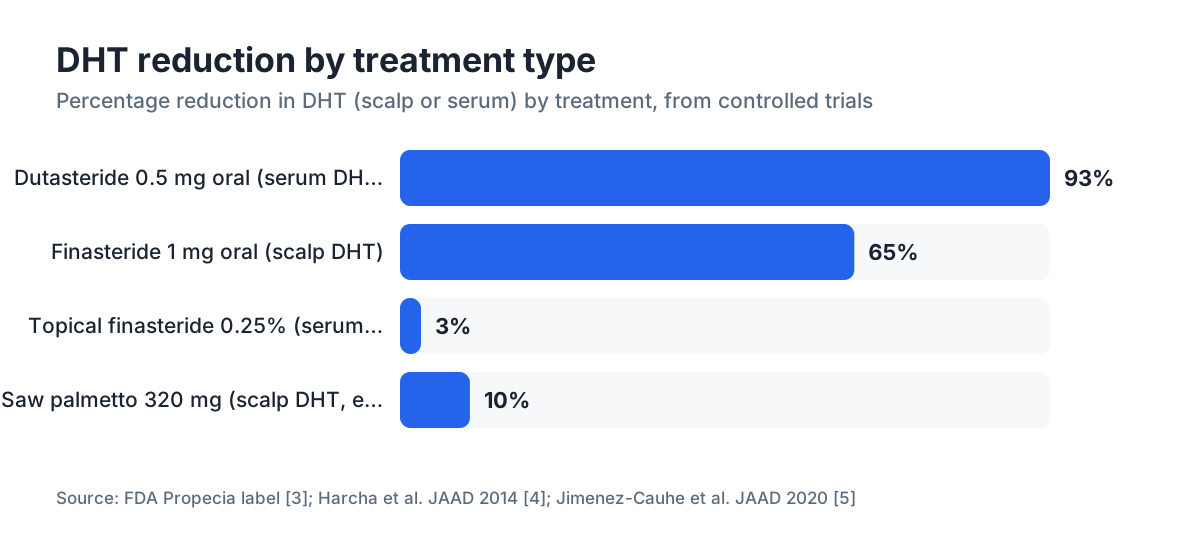
Finasteride 1 mg (oral, brand name Propecia) is FDA-approved for male pattern hair loss. The registration trials showed that after two years, 83% of men taking finasteride maintained or increased their hair count versus 28% on placebo, and after five years, roughly two-thirds of men saw visible improvement. Scalp DHT drops about 60 to 70% on finasteride. [3] It does not have FDA approval for women, and it's contraindicated in pregnancy because it can cause birth defects in male fetuses.
Dutasteride 0.5 mg (oral, brand name Avodart) inhibits both isoforms of 5-AR and drops DHT by around 90 to 95%. It's FDA-approved for benign prostatic hyperplasia, not for hair loss in the US. It is approved for hair loss in South Korea and Japan. Head-to-head studies suggest it outperforms finasteride on hair count, though the sexual side effect profiles are broadly similar. [4]
Topical finasteride and topical dutasteride are compounded formulations applied to the scalp. The idea is to block 5-AR locally while limiting how much drug reaches the bloodstream. A 2020 study in the Journal of the American Academy of Dermatology found topical finasteride 0.25% solution cut scalp DHT about as much as oral finasteride, but dropped serum DHT far less (roughly 3% versus 56%), which suggests most of the effect stays in the scalp. [5] This approach is growing fast, especially among men worried about systemic side effects.
Spironolactone (oral) is used off-label in women with androgenetic alopecia or hormonal hair loss. It's an aldosterone antagonist that also blocks androgen receptors. Doses of 100 to 200 mg/day are typical in practice. It's not a 5-ARI but works as a DHT blocker by receptor competition. Men generally don't use it because the feminizing side effects are pronounced at effective doses.
Saw palmetto extracts show some 5-AR inhibitory activity in vitro. One small randomized trial (n=100, 2012) found saw palmetto 320 mg/day increased hair count versus placebo after 24 weeks, but the effect was much smaller than finasteride in comparable trials, and the study wasn't large enough to settle the question. [6] Nobody should take saw palmetto expecting finasteride-level results.
For a detailed look at the most evidence-backed option, read our finasteride guide and our article on combining finasteride and minoxidil.
How do prescription DHT blockers compare to each other?
| Drug | FDA-approved for hair loss | DHT reduction | Typical cost/month (US, generic) | Evidence quality |
|---|---|---|---|---|
| Finasteride 1 mg oral | Yes (men) | ~60-70% scalp DHT [3] | $15-35 | Multiple large RCTs |
| Dutasteride 0.5 mg oral | No (US) | ~90-95% serum DHT [4] | $25-60 | RCTs, head-to-head vs finasteride |
| Topical finasteride 0.25% | No | Comparable scalp effect, <5% systemic DHT [5] | $40-90 (compounded) | Growing RCT base |
| Spironolactone 100-200 mg | No (off-label, women) | N/A (receptor blocker) | $10-30 | Observational, small RCTs in women |
| Saw palmetto 320 mg | No | Weak, poorly quantified | $10-25 | 1 small RCT, in-vitro data |
Prices are estimates from GoodRx and major pharmacy data as of mid-2025. Compounded topical prices vary widely by pharmacy and formulation.
The gap between generics and brand-name versions is large. Brand Propecia runs $70 to $100/month or more. Generic finasteride, approved by the FDA as bioequivalent, costs a fraction of that. Dutasteride (brand Avodart) also has generic availability.
If you're choosing between finasteride and dutasteride, the real question is this: are you okay with a somewhat higher side-effect ceiling in exchange for a more aggressive DHT reduction? Most dermatologists start with finasteride because it's well-characterized and its side effect rate is known from large long-term trials.
What are the side effects of DHT blockers?
This is where people get scared off, sometimes for good reason and sometimes based on misread statistics. Let's go through the real numbers.
The FDA-required label for finasteride lists sexual side effects, including decreased libido, erectile dysfunction, and decreased ejaculate volume, occurring in roughly 1 to 4% of men in controlled trials, compared to about 1 to 2% on placebo. [3] Most side effects resolved after stopping the drug in trials. A smaller subset of men report persistent sexual dysfunction after stopping, a phenomenon sometimes called post-finasteride syndrome, though this isn't well-characterized in controlled studies and remains disputed in the literature.
Dutasteride carries a similar sexual side effect profile. Because it suppresses DHT more completely, some researchers hypothesize it might have slightly higher side-effect rates, but the head-to-head data on this specific question are limited.
Spironolactone causes breast tenderness and menstrual irregularity in women at therapeutic doses. In men, gynecomastia (breast tissue growth) is common enough that it's rarely prescribed for hair loss in men.
Topical finasteride appears to carry a lower systemic side-effect burden based on current data, which is why it's increasingly attractive to men who want efficacy with less drug in their bloodstream. [5]
Saw palmetto's reported side effects are generally mild (GI discomfort mostly), but it also has weaker efficacy, so you're trading away both sides of the equation.
One thing to know: finasteride lowers PSA (prostate-specific antigen) levels by about 50%. If you're getting PSA screening for prostate cancer, your doctor needs to know you're on finasteride so they can read the results correctly. [3] The FDA label makes this explicit.
Another thing to know: finasteride is FDA Pregnancy Category X. Women who are or may become pregnant should not handle crushed or broken finasteride tablets. [3]
You can also read our rundown of minoxidil side effects if you're weighing a combination approach.
Do DHT blockers work for women?
This is more complicated than the men's side of the question. Women do produce DHT, and female pattern hair loss (FPHL) is androgen-sensitive in many, though not all, women. The underlying biology is less uniform than in men.
Finasteride is not FDA-approved for hair loss in women and is contraindicated in premenopausal women because of the fetal risk. Some dermatologists prescribe it off-label to postmenopausal women. A 2017 meta-analysis in JAMA Dermatology found finasteride was associated with hair density improvement in women, but rated the quality of existing evidence moderate at best. [7]
Spironolactone is the most commonly used anti-androgen for women in the US. It's prescribed off-label for androgenetic alopecia and for hormonal acne. Most evidence is observational rather than from large randomized trials.
Topical minoxidil is still the first-line FDA-approved treatment for women with pattern hair loss. Many women end up using minoxidil plus an anti-androgen like spironolactone together, since they target different mechanisms. If you're a woman with hair loss, your pattern and hormonal status shape what makes sense, which is a conversation to have with a board-certified dermatologist.
Some causes of hair loss in women, like telogen effluvium, aren't androgen-driven at all. DHT blockers do nothing for those cases.
Do DHT-blocking shampoos and supplements actually work?
The supplement and cosmetic DHT-blocker market is enormous and, honestly, mostly ahead of its evidence.
DHT-blocking shampoos typically contain ketoconazole, saw palmetto extract, or zinc pyrithione. Ketoconazole at 2% concentration has the most interesting data: a 1998 study found it improved hair density about as much as low-dose minoxidil in one small trial. [8] The mechanism isn't fully understood, but ketoconazole does show antifungal and possible anti-androgenic properties in the scalp. It won't do what finasteride does, but it's not a complete placebo either.
Biotin supplements are heavily marketed for hair. Biotin deficiency does cause hair loss, and correcting deficiency helps. But biotin deficiency is rare in adults who eat a varied diet, and there's no solid evidence that extra biotin does anything for androgenetic alopecia in someone who isn't deficient. [9] The FDA has also warned that high-dose biotin interferes with certain lab tests, including thyroid tests and cardiac troponin assays. [9]
Other supplement ingredients you'll see marketed as DHT blockers: pumpkin seed oil, green tea extract (EGCG), beta-sitosterol, pygeum. All have some in-vitro or animal data suggesting 5-AR inhibition. Pumpkin seed oil had one randomized controlled trial (n=76, 2014) showing a 40% improvement in hair count versus 10% in the placebo group after 24 weeks. [10] That's a real study, but it's one small trial. Treat it as preliminary, not proof.
For a full breakdown of what supplements have real data, see our article on hair loss supplements.
The bottom line: if you're choosing between a supplement stack and a finasteride prescription, the evidence gap is enormous.
When do DHT blockers stop working?
DHT blockers don't usually "stop working" the way people assume. What they do is halt or slow the progression of androgenetic alopecia. They don't permanently reprogram your follicles.
Stop taking finasteride or dutasteride and DHT levels return to baseline within weeks. Within 6 to 12 months after stopping, most people resume losing hair at roughly the rate they would have without treatment. [3] You're not banking permanent gains. Whatever hair was maintained or regrown on the drug starts to miniaturize again.
Some follicles may respond less over very long stretches of use, possibly because they've kept miniaturizing to a point where they're harder to recover. But that isn't the drug losing efficacy in a pharmacological sense.
There's also a real phenomenon where men see initial shedding (increased hair fall) in the first 2 to 3 months of finasteride. This is usually follicles cycling through, not a sign the drug isn't working. Most guidelines suggest giving any medical treatment 6 to 12 months before judging its effect.
If you already have significant hair loss, DHT blockers protect remaining hair better than they regrow lost hair. For large bald areas, the only evidence-based restoration option is a hair transplant. DHT blockers are often used after transplants to protect the non-transplanted hair.
Can DHT blockers prevent hair loss if you start early?
This is probably the most important practical question. The short answer: yes, and starting earlier is consistently linked to better outcomes in the trial data.
Finasteride's five-year trials show that men in the earliest stages of hair loss (Norwood II to III) responded better than men who started later. [3] That makes biological sense. The drug can hold onto miniaturized follicles that still have some function far more easily than it can revive follicles dormant for years.
The American Academy of Dermatology (AAD) recommends finasteride as a first-line treatment for androgenetic alopecia in men and notes that it works best when started before hair loss is advanced. [1] The AAD doesn't endorse supplements as first-line options.
If you've noticed a receding hairline starting, getting to a dermatologist sooner rather than waiting to see "how bad it gets" is almost always the right call. Follicles that have miniaturized but still push out thin hairs are recoverable. Follicles dormant for years generally aren't.
At MyHairline, our free AI hair scan can help you identify your current pattern and loss stage so you have something concrete to bring to a dermatologist. That's not a substitute for a clinical exam, but an objective baseline helps.
Men who want the most careful preventive strategy often use topical minoxidil plus finasteride together. The combination hits two different mechanisms and has solid evidence for additive benefit. See minoxidil for men and finasteride and minoxidil combined.
What should you actually do if you think DHT is causing your hair loss?
See a dermatologist, ideally one who specializes in hair (a trichologist or hair-focused derm). That's the honest starting point. Hair loss has many causes, and DHT-driven androgenetic alopecia is only one. Treating yourself for DHT-driven loss when the real cause is thyroid dysfunction, nutritional deficiency, or autoimmune alopecia areata doesn't help and delays the right treatment.
If you do have androgenetic alopecia and you're a man, the evidence strongly supports trying finasteride. The side-effect risk is real but relatively low, the drug has decades of post-market data, and generic pricing is modest. If you're genuinely worried about systemic side effects, topical finasteride is a reasonable alternative to ask about.
Want to stay extra conservative? Oral minoxidil for men and topical minoxidil are non-hormonal options that work differently. They don't block DHT at all but do stimulate follicles through a separate mechanism. Pairing them with a DHT blocker is the strategy most evidence supports for men with moderate ongoing loss.
Skip the supplement stacks as your main intervention. Use ketoconazole shampoo if you want an easy add-on with a small amount of supporting evidence. But don't let a $60/month supplement habit stand in for the conversation with a dermatologist that could actually change your trajectory.
If loss is already significant, get a realistic picture of what DHT blockers can and can't do. They protect existing hair better than they restore lost hair. Combining medical treatment with a hair transplant consultation is sometimes the most practical path for men who've already lost substantial density. You can read about what hair transplants actually involve to see if that conversation makes sense for you.
For a broader look at all the dht blocker options and how they rank, including topical options and newer formulations, that article goes deeper on the comparison.
Sources
- American Academy of Dermatology, Hair Loss: Diagnosis and Treatment
- National Institutes of Health, StatPearls: Androgenetic Alopecia
- Harcha WG et al., Journal of the American Academy of Dermatology, 2014 — Dutasteride vs finasteride RCT
- Jimenez-Cauhe J et al., Journal of the American Academy of Dermatology, 2020 — Topical finasteride study
- Rossi A et al., Journal of Alternative and Complementary Medicine, 2012 — Saw palmetto RCT
- Adil A and Godwin M, JAMA Dermatology, 2017 — Meta-analysis of treatments for female pattern hair loss
- Piérard-Franchimont C et al., Dermatology, 1998 — Ketoconazole shampoo study
- Cho YH et al., Evidence-Based Complementary and Alternative Medicine, 2014 — Pumpkin seed oil RCT