
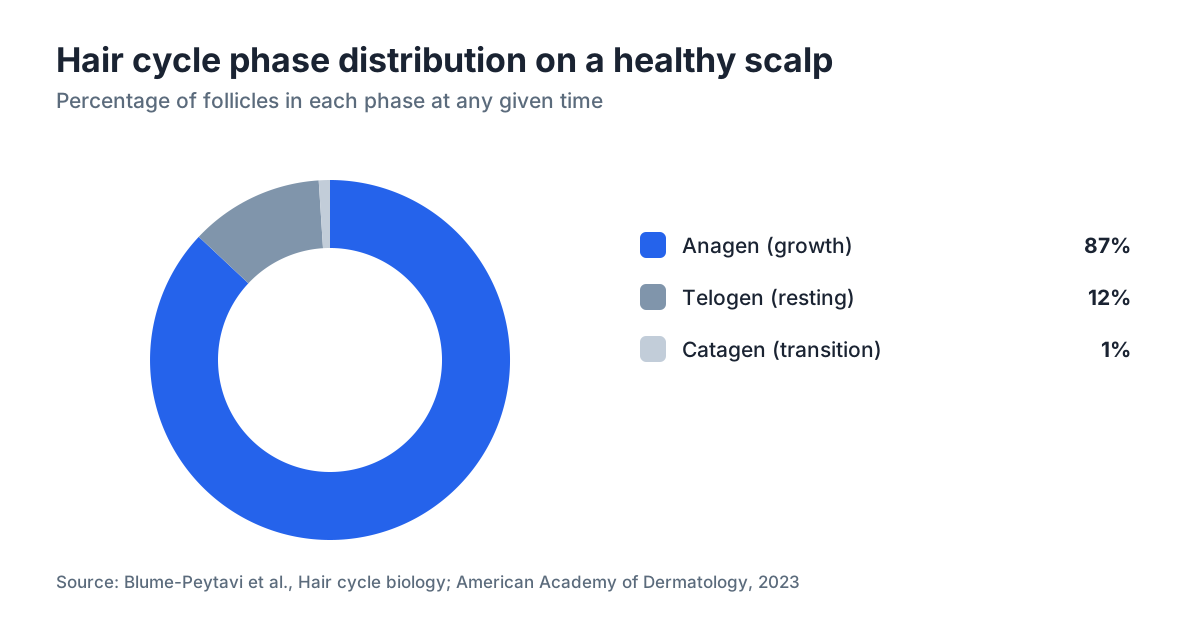
TL;DR: On a healthy scalp, roughly 85-90% of hairs are in the anagen (growth) phase at any given time, about 1-2% are in catagen (transition), and 10-15% are in telogen (resting/shedding). Scalp hair has roughly 100,000 follicles total. When the telogen fraction climbs above 20-25%, noticeable shedding and thinning follow.
What are the three phases of the hair cycle?
Every scalp hair follicle cycles through three stages, one after another, for your whole life.
Anagen is the active growth phase. The follicle builds a hair shaft, and it keeps at it for anywhere from two to seven years depending on your genetics and health [1]. The longer your anagen phase, the longer your hair can grow. Telogen is the resting phase, and it lasts roughly two to four months. The old hair sits in the follicle, not growing, before it sheds. Between those two sits catagen, a short two-to-three-week transition where the follicle shrinks and pulls away from its blood supply [1].
These phases do not run in sync across your head. That mismatch is the whole reason you do not molt all your hair at once the way a dog does in spring. Each follicle keeps its own clock.
What percentage of scalp hairs are in the growth phase on a healthy scalp?
On a healthy adult scalp, roughly 85-90% of hairs are in anagen at any single moment [2]. Catagen is a sliver, usually 1-3%. Telogen takes the remaining 10-15%.
These numbers come from trichogram studies. Researchers pluck hairs from marked scalp areas and read the root bulbs under a microscope to sort each hair by phase [3]. The figures hold up across the dermatology literature, though the exact anagen percentage can sit anywhere from 80% to 93% depending on scalp region, age, sex, and season [2].
| Phase | Name | Typical % on healthy scalp | Duration |
|---|---|---|---|
| Anagen | Active growth | 85-90% | 2-7 years |
| Catagen | Transition | 1-3% | 2-3 weeks |
| Telogen | Rest / shedding | 10-15% | 2-4 months |
The vertex (top of scalp) and frontal hairline run slightly higher telogen percentages than the occipital (back) area, even in people with no hair loss, which is one reason patterned thinning shows up where it does [4]. The back and sides are also why transplant surgeons harvest donor hair from the occipital zone. Those follicles hold a longer, steadier anagen phase and shrug off DHT.
How many hairs does a healthy scalp shed per day?
The number you hear most is 50-100 hairs per day, and that lines up with what the American Academy of Dermatology reports [5]. The math checks out. With roughly 100,000 follicles on the average scalp [2] and about 10-15% in telogen at any time, that is 10,000-15,000 hairs resting. A telogen phase runs about 90 days, so 10,000 divided by 90 gives you roughly 110 hairs shed per day, right at the top of the normal range.
Counts swing a lot based on how often you wash, the season, and your follicle density. Wash every three days and you will collect more shed hairs in one session than someone washing daily. That is not more loss. That is accumulation.
Counting shed hairs precisely at home is hard. The 60-second hair count (comb for 60 seconds, count the result) tracks reasonably with trichogram findings in the clinic, but it is not a diagnostic standard [3].
What shifts the anagen-to-telogen ratio, and when does that become hair loss?
The ratio tips when more follicles than usual drop into telogen early, or when the anagen phase gets shorter. Either way, the share of actively growing hairs shrinks and the resting share climbs.
The most common cause of a sudden shift is telogen effluvium: a physiological shock (fever, surgery, rapid weight loss, childbirth, severe nutritional deficiency, or heavy psychological stress) that shoves a big cohort of anagen follicles into telogen all at once [5]. Two to four months later, those hairs shed together. Telogen effluvium is defined by a telogen fraction above 20-25% on trichogram [3].
Androgenetic alopecia (pattern hair loss) works differently. DHT slowly miniaturizes vulnerable follicles and shortens their anagen phase, sometimes down to weeks instead of years [4]. The hair that regrows is finer each cycle. Early on, the ratio on an affected patch can read nearly normal, because the anagen hairs are there. They are just too short and thin to see. That is why what causes hair loss matters so much: the fix for a stress-driven ratio shift looks nothing like the fix for a DHT-driven one.
Nutritional deficiencies, thyroid disorders, iron deficiency, and some medications can also push follicles into telogen without the permanent miniaturization that androgenetic alopecia brings.
Does the growth phase ratio change with age?
Yes, and it happens slowly. Anagen duration shortens with age in most people, separate from pattern hair loss [2]. The telogen share creeps up, and individual hairs grow more slowly. Studies of hair shaft elongation report a peak of roughly 1.25 cm per month in young adults, dropping to closer to 0.9-1.0 cm per month in older adults [2].
If you carry a genetic predisposition to androgenetic alopecia, that age-related shortening of anagen speeds up sharply in DHT-sensitive follicles. This is why hitting the DHT component early pays off. A DHT blocker like finasteride can protect the anagen duration of vulnerable follicles if you start while those follicles can still push out a visible hair shaft.
How do dermatologists measure the anagen-to-telogen ratio?
The oldest tool is the trichogram. About 50 hairs are epilated (plucked by the root) from a marked scalp area and read under light microscopy. Anagen roots look like rounded, pigmented bulbs with an intact root sheath. Telogen roots are club-shaped, pale, and missing a sheath [3]. Catagen roots land in between.
A newer, gentler option is trichoscopy (dermoscopy of the scalp), which lets a clinician study follicle openings, shaft caliber, and telogen hairs (marked by a peripilar halo) without plucking anything [6]. It will not give a precise percentage the way a trichogram does, but it is fast and reliable for reading miniaturization.
Phototrichogram (hairs are clipped, then the scalp is photographed 48-72 hours later to see which hairs have grown back) can quantify anagen percentage without epilation, though it shows up more in clinical trials than in routine visits [3].
If you want a rough read on where your hair stands before seeing a dermatologist, tools like the free AI scan at MyHairline can flag visible thinning patterns and density changes from photos. They cannot replace a clinical trichogram.
Blood tests for ferritin, TSH, zinc, and vitamin D catch correctable causes of ratio shifts, but they do not measure the ratio itself.
Does minoxidil or finasteride actually change the anagen-to-telogen ratio?
Both do, through different routes.
Minoxidil stretches the anagen phase and clips telogen short, tilting the ratio back toward a higher anagen fraction [7]. Exactly how is still unsettled. The leading idea is that minoxidil opens ATP-sensitive potassium channels in follicle cells, which may keep the dermal papilla proliferating longer. Trials of 5% topical minoxidil show measurable jumps in anagen hair counts at 48 weeks versus baseline [7]. The shedding many people hit in the first four to eight weeks of minoxidil for men is that ratio shifting on purpose: minoxidil evicts telogen hairs early so the follicle can start a fresh anagen cycle sooner.
Finasteride works further upstream. It blocks 5-alpha reductase type II, cutting scalp DHT by roughly 60-70% [8]. Less DHT means less miniaturization pressure on vulnerable follicles, which lets their anagen phases recover length over time. In a five-year trial published in the New England Journal of Medicine, men taking 1 mg finasteride daily kept significantly more hair than men on placebo, while the placebo group kept miniaturizing and shortening anagen [8]. There is more on how finasteride works and what the long-term data actually shows.
Running both together hits two separate parts of the same problem, which is why finasteride and minoxidil is a common pairing in practice.
Why does the ratio vary by scalp region?
The occipital scalp (back of the head) consistently reads higher anagen percentages and longer anagen duration than the vertex or frontal scalp, even in people with no clinical hair loss [4]. Part of the reason is androgen receptor density: occipital follicles carry fewer androgen receptors and take less DHT damage, so their anagen phase runs longer.
For people with a receding hairline or vertex thinning, the frontal and crown follicles shift toward shorter anagen cycles first, which shows up on trichogram as a lower anagen percentage in those zones. That regional weakness is also why advanced hair loss, like Norwood V or VI, usually spares the occipital band completely.
Season adds another layer. A 1991 study of 14,596 women found a peak in telogen hairs in July, with the lowest telogen rates in February and March [2]. Nobody has confirmed the biological trigger, but photoperiod (daylight length) nudging melatonin and prolactin is the leading guess. The practical upshot: shedding tends to run heavier in late summer and early fall, which matches hairs that entered telogen months earlier.
Can supplements or diet affect the growth phase ratio?
Correcting a deficiency can restore a shifted ratio. Piling on supplements past sufficiency generally cannot.
Iron deficiency, even without full-blown anemia, is one of the better-documented reversible causes of a raised telogen percentage, especially in premenopausal women [9]. Fixing low ferritin (some researchers use a threshold of 30 ng/mL, some push to 70 ng/mL, and the exact cutoff is still argued) can normalize the telogen fraction over several months. Zinc deficiency drives follicles toward telogen the same way [9].
Biotin gets marketed hard for hair growth, but it does not show any effect on the anagen-to-telogen ratio in people who are not biotin-deficient, which is rare. The FDA has warned separately that high-dose biotin supplements interfere with certain lab assays [10], worth knowing before you get thyroid or troponin bloodwork. A closer read on the evidence for hair loss supplements puts the biotin claim in context.
Protein intake matters for building the shaft (hair is roughly 95% keratin) but does not clearly change phase percentages in well-fed people. Rapid caloric restriction, though, is a well-documented trigger for telogen effluvium.
What does a normal vs. abnormal ratio look like on a trichogram report?
A trichogram report gives you anagen and telogen counts for the hairs plucked. A healthy-scalp report might read: anagen 88%, telogen 11%, catagen 1%.
A telogen percentage above 20% alongside diffuse shedding is generally considered diagnostic for telogen effluvium [3]. In androgenetic alopecia, the finding is more specific: miniaturized shafts (diameter below 0.06 mm) mixed with a modestly raised telogen count on the frontal or vertex scalp, while the occipital zone reads normal.
Dermatologists read the ratio next to a hair density count. The American Academy of Dermatology puts average scalp hair density at 200-300 hairs per square centimeter [5], with wide variation by ethnicity and age. A low anagen percentage plus low density in one zone points toward androgenetic alopecia. A diffuse drop in density with a globally raised telogen count points toward effluvium.
If you have a trichogram in hand and you are trying to read it for treatment decisions, a board-certified dermatologist or trichologist is the right next stop. The ratio is one data point, not a diagnosis.
If you are earlier in the process, still figuring out whether there is a problem, a baseline visual read is reasonable before spending money on treatment. The free AI scan at MyHairline can document what your hairline looks like now, so you have something to compare against in six or twelve months.
How does telogen effluvium affect the ratio, and does it reverse?
Telogen effluvium is the condition where a physiological shock yanks anagen follicles into telogen fast. Instead of the normal 10-15% telogen fraction, 20-50% of follicles can sit in telogen at once [3]. The shedding lands two to four months after the trigger and can be alarming, but it almost always reverses once the trigger clears.
Recovery follows the cycle. Follicles re-enter anagen, the new hairs push out the telogen clubs, and the anagen percentage climbs back to baseline over three to six months. Getting your visible volume back usually takes six to twelve months, because the new anagen hairs need time to grow long enough to restore density.
Chronic telogen effluvium, defined as diffuse shedding lasting more than six months, is a different animal. The telogen elevation is milder (usually 20-25%) but it sticks around, and the cause is often harder to pin down. Chronic cases deserve a full workup for thyroid disease, autoimmune conditions, and ongoing nutritional deficiencies.
Sources
- StatPearls, NCBI Bookshelf: Hair Follicle Anatomy and Physiology
- Springer: Hair and Hair Diseases (Orfanos & Happle), chapter on hair cycle biology; also cited by Blume-Peytavi et al. 2012 review in JDDS
- Journal of Investigative Dermatology: Olsen EA et al., 'Objective and subjective assessments of alopecia' (trichogram methodology and telogen effluvium threshold)
- Journal of the American Academy of Dermatology: Hamilton JB, 'Patterned loss of hair in man; types and incidence' and subsequent regional follicle studies
- American Academy of Dermatology: Hair Loss Overview
- Dermatology Online Journal: Miteva M, Tosti A, 'Hair and scalp dermatoscopy'
- National Center for Biotechnology Information, StatPearls: Minoxidil
- New England Journal of Medicine: Kaufman KD et al., 'Finasteride in the treatment of men with androgenetic alopecia' (5-year data)
- Journal of the American Academy of Dermatology: Rushton DH, 'Nutritional factors and hair loss'
- U.S. Food and Drug Administration: Biotin Safety Communication