

TL;DR: The Savin scale is an 8-grade visual classification for female-pattern hair loss, introduced by dermatologist Dr. Ronald Savin in the 1990s. It grades thinning from Grade 1 (barely widened central part) through Grade 8 (near-total scalp exposure), plus a separate frontal grade (F1). Doctors use it to set a baseline, track progression, and measure whether a treatment is working.
What is the Savin scale and why does it exist?
The Savin scale is a photographic grading system for female-pattern hair loss (FPHL), the condition also called androgenetic alopecia in women. Dr. Ronald Savin, a Yale-affiliated dermatologist, put it forward in the mid-1990s to fix a specific problem. The Ludwig scale, which most clinicians used at the time, had only three grades. Three grades are too blunt to describe a mild case or to catch the small shifts that tell you whether a treatment is doing anything. [1]
Female hair loss differs from male hair loss in one anatomically important way. Men usually lose the hairline first, then thin backward across the scalp. Women almost always keep the frontal hairline and lose density diffusely across the crown and central part. The Savin scale grades exactly that: the width and density of the central parting, matched against a set of reference photographs.
The scale earns its keep because hair loss is progressive and because treatments like minoxidil take months to show anything. Without a baseline grade, a clinician can't say with any confidence whether a patient has stabilized, improved, or kept thinning. That's the whole point. It gives the patient and the doctor a shared language.
Since then, dermatology researchers have tested the Savin scale and found it reproducible. A 2017 set of grading recommendations in the Journal of the American Academy of Dermatology described the scale as giving "greater granularity than the Ludwig scale for tracking mild-to-moderate progression in women." [2]
How many grades does the Savin scale have?
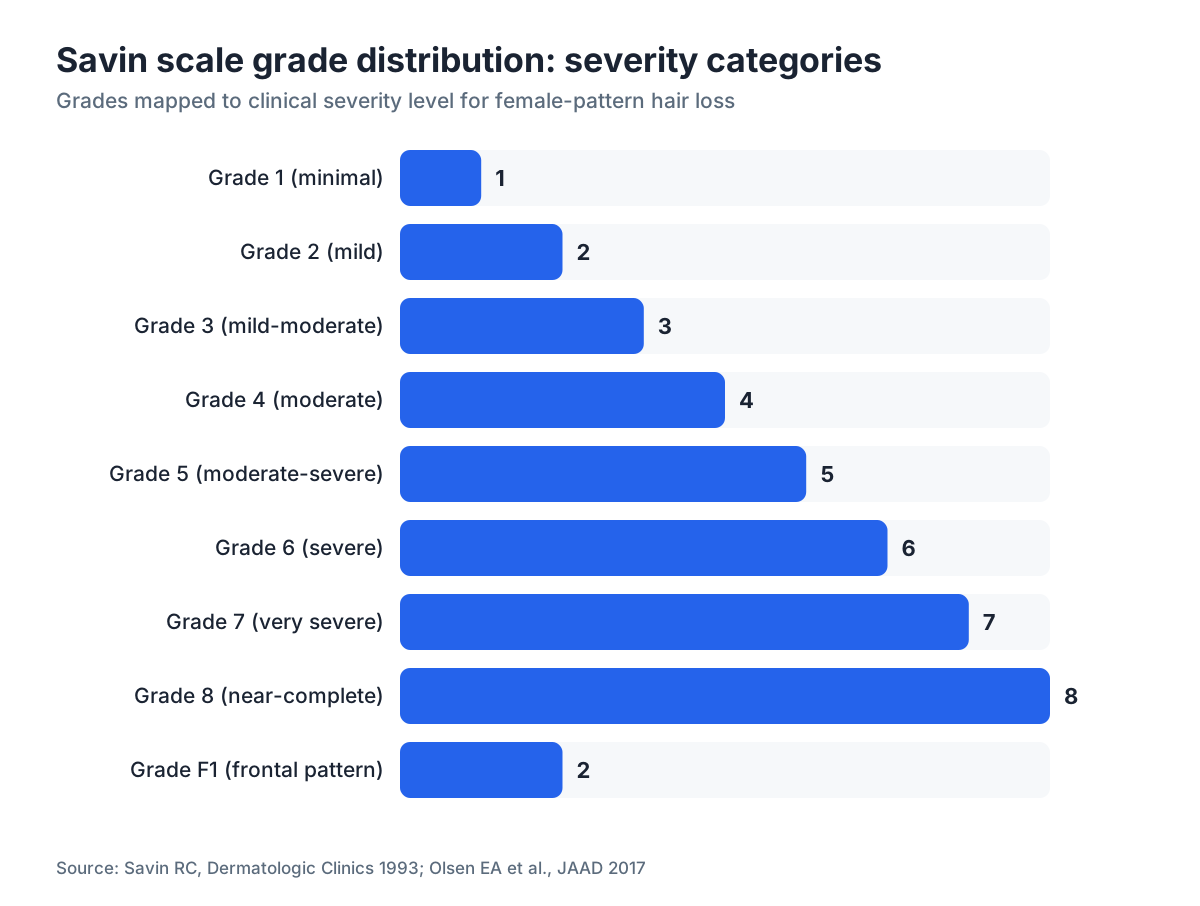
Eight main grades, numbered 1 through 8, plus a separate frontal grade called F1. Here is what each one looks like on the scalp:
| Savin Grade | What the scalp looks like |
|---|---|
| Grade 1 | Normal parting width; hair appears full |
| Grade 2 | Slight widening of the central part; density mildly reduced |
| Grade 3 | Clearly wider central part; scalp visible through the part |
| Grade 4 | Obvious thinning along the central part; wider still |
| Grade 5 | Moderate diffuse thinning; part is markedly wider |
| Grade 6 | Severe diffuse thinning across the crown; scalp visible broadly |
| Grade 7 | Very sparse hair across the entire crown |
| Grade 8 | Near-complete loss over the top of the scalp |
| Grade F1 | Frontal accentuation: hairline intact but frontal density reduced |
Grades 1 through 3 are mild. Grades 4 and 5 are moderate. Grades 6 through 8 are severe. Most women who come in for treatment the first time land between Grade 2 and Grade 4. [1]
The F1 grade deserves attention on its own. Some women thin at the front of the scalp, behind an intact hairline, without the diffuse crown thinning the main grades describe. That pattern behaves differently and can respond differently to treatment. The Savin scale accounts for it. The older Ludwig scale does not.
One practical limit: Grades 7 and 8 are rare in women whose only problem is genetic hair loss. When a woman presents at Grade 6 or higher, a good clinician rules out other causes such as telogen effluvium, scarring alopecia, and thyroid or iron problems before blaming androgenetic alopecia alone. [3]
How does the Savin scale compare to the Ludwig and Norwood scales?
Three grading systems come up in hair loss discussions: Ludwig, Savin, and Norwood. They are not interchangeable, and using the wrong one gives you a misleading picture.
The Norwood scale describes male-pattern baldness, moving from a full hairline to a horseshoe rim. It's the standard for men. It was never built for the diffuse central thinning women get.
The Ludwig scale, published in 1977, grades female hair loss in three stages: I (mild), II (moderate), and III (severe). It's simple, and that simplicity made it popular. The trouble is that three stages can't tell you whether someone moved from the low end of moderate to clearly moderate, which is precisely the point where treatment decisions change. [9]
The Savin scale extends Ludwig's framework rather than replacing it. Grade 2 lines up roughly with Ludwig I, Grades 3 through 5 with Ludwig II, and Grades 6 through 8 with Ludwig III. Those eight steps let a dermatologist say "you've gone from a 3 to a 4 over two years" instead of "you're still moderate." The first sentence is useful. The second one isn't.
A 2019 comparison in the International Journal of Dermatology found that agreement between different raters was higher with the Savin scale than the Ludwig scale when they graded photographs of mild-to-moderate female hair loss. That suggests the scale captures real differences clinicians can actually see and agree on. [4]
For a woman tracking her own hair at home, the Savin reference photos are more detailed than Ludwig's, so self-assessment means more. It still has limits. Lighting, styling, and the angle of the photo all change how the part looks.
How do dermatologists actually use the Savin scale in practice?
In the clinic, grading with the Savin scale runs through four steps.
First, the hair is parted down the center and photographed from above under standardized lighting. Some clinics add a dermatoscope, a magnifying skin scope, to check hair shaft diameter and density alongside the visual grade. [5]
Second, that photo gets compared against the Savin reference images to assign a grade. Most experienced dermatologists do this by eye. Some use digital hair analysis software to measure the parting width in millimeters.
Third, the grade goes in the chart as a baseline. If a treatment like oral minoxidil or finasteride and minoxidil starts, the same photo protocol repeats at follow-up, usually at 6 and 12 months.
Fourth, the change in grade (or the lack of one) drives the decision to continue, adjust, or switch. Stabilization, meaning no grade increase, is often the realistic target for genetic hair loss. A grade decrease happens with effective treatment, but nobody should promise it.
One nuance that trips people up: the Savin scale grades pattern and visible density. It does not count individual hairs or measure shaft diameter, which are what trichoscopy and phototrichogram analysis provide. So a full clinical assessment usually pairs the Savin grade with at least one objective measurement, especially for research or hair transplant candidacy.
Can you use the Savin scale to grade your own hair loss at home?
You can get a rough self-assessment, with real caveats. The reference photographs are published in the dermatology literature and are fairly easy to find. [1]
Do it properly. Part your hair straight down the center with a comb, stand under direct overhead light (not a bathroom mirror with side lighting, which throws shadows), and shoot straight down from above. Daylight from a skylight or open shade works well. Then compare your photo against the grade images.
Grade 1 versus Grade 2 is genuinely hard to call at home because the difference is small. Grades 3 through 5 are easier, because the widening part is obvious. If you can see scalp clearly along a wide part, you're probably at Grade 3 or higher.
The real value of home tracking isn't nailing the exact grade on a single day. It's consistency. Photograph yourself under the same conditions every six months and the trend tells you more than any one grade ever will. Most women don't notice gradual thinning until it's advanced, partly because they see themselves every day. A photo from two years ago next to a current one is often a shock.
If you want a structured starting point, the free AI scan at MyHairline reads your scalp photo and returns a hair density estimate alongside a Savin-referenced grade. It can help calibrate your own read before a dermatology visit.
One firm line: if you think you're at Grade 4 or above, or if the thinning happened over months rather than years, see a dermatologist. Fast thinning points toward causes beyond genetics, including thyroid trouble, iron deficiency, and autoimmune disease, and those need lab work, not a grading chart. [3]
What Savin grade should prompt you to start treatment?
There's no single universal cutoff, but there are patterns in how clinicians think about it.
At Grade 1 or 2, watchful waiting is common when the loss isn't progressing. The FDA-approved treatment for female-pattern hair loss is topical minoxidil, 2% and 5%, and the case for starting it gets stronger once there's documented progression. [6]
At Grade 3, most dermatologists recommend starting minoxidil and may raise low-level laser therapy as an add-on. The minoxidil evidence here is solid. A 2002 randomized trial in the Journal of the American Academy of Dermatology found women using 5% topical minoxidil had significantly more hair regrowth than those on 2%, with measurable change by 48 weeks. [7]
At Grade 4 or 5, the conversation usually widens to off-label options: finasteride (used carefully in premenopausal women because of the risk to a pregnancy), spironolactone, or other DHT blockers. None are FDA-approved for women, but many dermatologists use them with proper counseling.
At Grade 6 or higher, the follicles in the thinning zone may be miniaturized past the point where medication does much. Surgical routes, including a hair transplant evaluation, come into play, though a woman at this stage needs a careful donor-area assessment because diffuse loss can rule out transplant candidacy.
Grade F1 (frontal thinning) often responds well to minoxidil, because frontal follicles tend to hold onto more function than crown follicles at the same stage of miniaturization. Knowing the subtype changes what you should expect.
What causes the hair loss pattern the Savin scale measures?
Female-pattern hair loss, the condition the Savin scale grades, comes mainly from a genetic sensitivity to dihydrotestosterone (DHT), the androgen that drives follicle miniaturization. [8]
Over time, DHT shortens the growth phase (anagen) of susceptible follicles, so each cycle grows a finer, shorter hair. The follicle doesn't die right away. It shrinks step by step, which is why the Savin scale can pick up early change before any bald patch shows.
Why the central part and crown specifically? Those zones carry the highest density of androgen-sensitive follicles in most women. The frontal hairline has relative androgen resistance, which is why the main Savin grades keep an intact hairline even at severe stages. That's the key contrast with male-pattern loss, where the hairline recedes. You can read more about the male receding hairline pattern to see the difference.
Hormone shifts speed the process up. Menopause is the most common trigger, because estrogen partly offsets DHT's effect on follicles, and estrogen drops sharply. Postmenopausal women make up a large share of Grade 4 and above presentations.
Other contributors sit under the broader question of what causes hair loss: thyroid disorders, polycystic ovary syndrome (PCOS), iron deficiency, and nutritional gaps. The Savin scale grades the pattern. It can't tell you the cause. That still takes labs. A dermatologist seeing a woman at Savin Grade 3 or higher will typically order TSH, ferritin, a complete blood count, and hormone panels before calling it purely genetic.
How accurate and reliable is the Savin scale?
The Savin scale performs well in the middle of its range and less well at the extremes.
Inter-rater reliability, meaning how often two clinicians grading the same patient agree, is acceptable for Grades 3 through 6. A 2019 study in the International Journal of Dermatology compared common rating scales and reported the highest kappa coefficient for the Savin scale in mild-to-moderate cases (roughly 0.65 to 0.72 among trained raters). [4] A kappa above 0.60 counts as substantial agreement in clinical research.
Reliability slips at Grade 1 versus Grade 2, where the difference is often too subtle to call the same way twice, and at Grade 7 versus Grade 8, where both are severe and the distinction rarely changes what you do next. The F1 frontal grade also has lower agreement than the main grades, partly because "frontal thinning" blurs into the normal range of hair density across different women.
The scale is purely visual. It tells you nothing about shaft diameter distribution (trichoscopy handles that), follicle density per square centimeter, or the share of miniaturized hairs (a phototrichogram measures that). So while it's the most cited grading system for women, it's not the most precise measurement on offer. For clinical trials, researchers pair the Savin grade with objective tools like global photographic assessment or standardized hair counts. [2]
For a woman tracking her own hair or a clinician handling a routine case, though, the scale is practical, cheap, and reproducible enough to matter. Perfect precision isn't the goal here. A consistent, repeatable read is.
Does the Savin scale apply to all women, including women of color?
The Savin scale was developed and validated mostly on photographs of white women, and that's a real limit. Hair density, shaft shape, and styling habits differ a lot across ethnic groups, and those differences change how the central part reads under standardized photography. [3]
Black women, for one, often thin in a different distribution. Central centrifugal cicatricial alopecia (CCCA), a scarring condition that disproportionately affects Black women, can look like androgenetic alopecia on a Savin photo but is a separate disease that needs different management.
Some dermatologists have proposed modified or supplementary scales for specific populations. None has caught on the way Savin or Ludwig did.
In practice, this means the Savin scale is a rough guide for women of color, not a validated precision tool. A clinician working with a patient of South Asian, East Asian, or African descent should read the grade in context, pair it with dermoscopy, and stay alert to pattern variants the original scale never covered.
That's not a reason to throw the scale out. It's a reason to add clinical judgment and, when the pattern is atypical, a scalp biopsy. AAD hair loss guidance notes that pattern classification systems should be supplemented with clinical and histological assessment in complex cases. [3]
What should you do after figuring out your Savin grade?
A grade is a starting point, not a plan. Here's a reasonable order of operations.
At Grade 1 or 2, photograph yourself every six months under the same conditions. If the grade hasn't moved after a year, watchful waiting is fine, unless hair loss runs in your family at a young age or you're heading into menopause.
At Grade 3 or above, or if you've climbed a grade or more in under two years, see a board-certified dermatologist or a trichologist. Bring your photos. That baseline is worth a lot to someone meeting you for the first time.
Before the appointment, know your current medications, your thyroid history, your menstrual history, and whether close female relatives have thinned. That context moves the diagnosis along faster.
Expect labs on top of a clinical grade. The AAD recommends ferritin, TSH, and a complete blood count as a minimum workup for women with hair loss. [3] Low ferritin (below 30 nanograms per milliliter is the commonly cited threshold, though some researchers argue for above 70 ng/mL for good hair growth) is a fixable cause that many women carry alongside genetic thinning. [12]
If you want a preliminary read before booking, upload a scalp photo to the free AI scan at MyHairline for a density and pattern estimate. It isn't a diagnosis. It can tell you whether you're likely in Grade 2 or Grade 4 territory before you walk into a consultation.
On treatment itself, the evidence leans heavily on topical minoxidil and, in some patients, anti-androgen medications. Read up on hair loss supplements and minoxidil side effects before you start anything.
Sources
- Savin RC. Practical Evaluation and Management of Alopecia. Dermatologic Clinics, 1993
- Olsen EA et al. Journal of the American Academy of Dermatology, 2017, guidelines for female-pattern hair loss grading
- American Academy of Dermatology, clinical guidance on hair loss evaluation in women
- Starace M et al. International Journal of Dermatology, 2019, inter-rater reliability of female hair loss grading scales
- American Academy of Dermatology, dermoscopy and trichoscopy in hair loss assessment
- FDA-approved drug label, Rogaine (minoxidil) 2% and 5% topical solution for women
- Olsen EA et al. A randomized clinical trial of 5% topical minoxidil vs 2% in female androgenetic alopecia. Journal of the American Academy of Dermatology, 2002;47(3):377-385
- Herskovitz I, Tosti A. Female pattern hair loss. International Journal of Endocrinology and Metabolism, 2013
- Ludwig E. Classification of the types of androgenetic alopecia (common baldness) arising in the female sex. British Journal of Dermatology, 1977;97(3):247-254
- Sewell LD et al. Central centrifugal cicatricial alopecia. Dermatology Online Journal, 2008
- Trost LB et al. The diagnosis and treatment of iron deficiency and its potential relationship to hair loss. Journal of the American Academy of Dermatology, 2006;54(5):824-844