TL;DR: In placebo-controlled trials, topical minoxidil 5% produces measurable hair regrowth in about 60 to 80% of men with androgenetic alopecia, versus 20 to 30% on placebo. Women respond similarly with 2% or 5% formulations. Results depend heavily on how early you start, how consistently you apply it, and the underlying cause of your hair loss.
What does 'success' actually mean in minoxidil trials?
This is the question most articles skip, and skipping it is why people end up disappointed. Trial designers measure "success" in at least three different ways, and the one you care about probably isn't the one most studies report as their headline number.
The first measure is hair count, meaning the actual number of terminal hairs per square centimeter of scalp, usually counted in a fixed circular area (often 1 cm² to 5.1 cm²) under a macrophotography device. The second is hair weight, which captures thickness on top of count. The third is the patient's own assessment, which asks whether you personally think your hair improved.
These three measures produce very different numbers. In the 1992 Olsen trial published in the Journal of the American Academy of Dermatology, investigators found statistically significant increases in hair count with 2% minoxidil in women, but a subset of those women rated their own improvement as "minimal" [1]. The drug was working by the camera's standard while the mirror told a different story.
Then there's the control arm. Placebo response rates in hair loss trials run surprisingly high, around 20 to 30% for subjective improvement, because hair cycles naturally and because people using a vehicle solution often massage their scalp more carefully than they normally would. A treatment that shows 60% response looks much less impressive once you learn placebo showed 25% [2].
Most trials run 16 to 52 weeks. Long-term open-label extensions exist but rarely make the headline figures. That matters, because minoxidil is a maintenance drug. The real question isn't just whether it works at week 16 but whether the gain holds at year two and year five.
What percentage of men respond to minoxidil in clinical trials?
Roughly 60 to 80% of men show measurable hair growth or stabilization in well-controlled trials. The exact number shifts with formulation, outcome measure, and population.
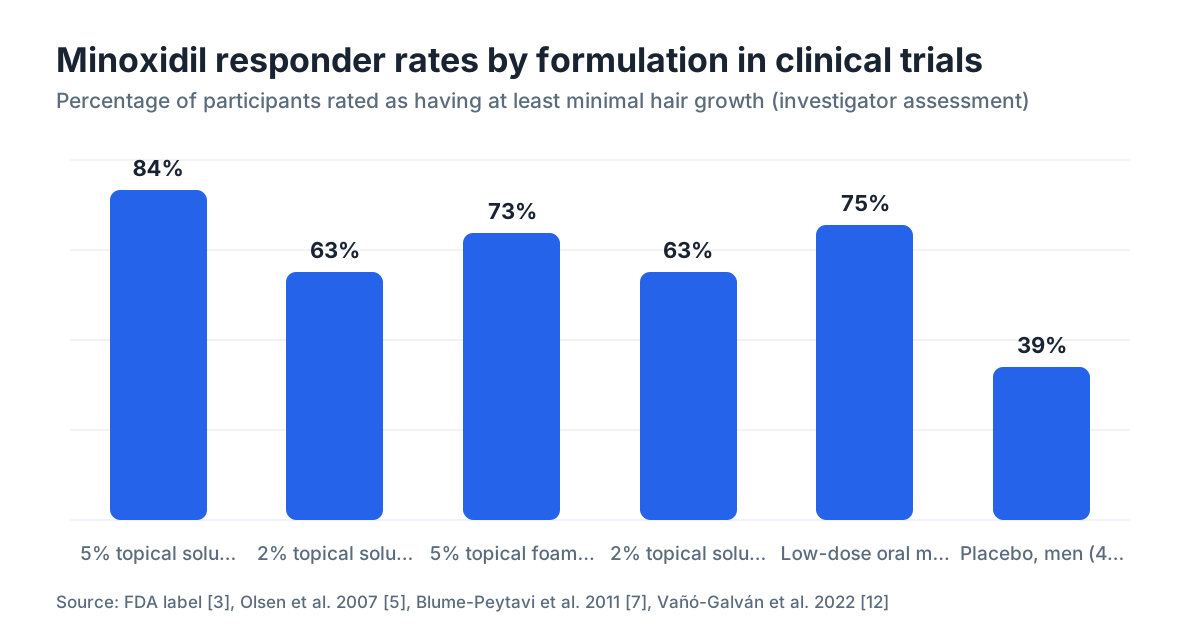
The most-cited trial is the large multicenter study that led to FDA approval of topical 5% minoxidil solution (Rogaine) for men. At 48 weeks, 5% minoxidil produced an average increase of about 17 hairs per cm² over baseline in the target area, versus roughly 1 hair per cm² for placebo [3]. In the same study, 84% of men on 5% minoxidil were rated as having at least "minimal growth" by investigators, compared with 39% on placebo.
The 2% solution, approved first, performs meaningfully worse. In a 1990 comparative trial by DeVillez et al., 5% minoxidil outperformed 2% by roughly 45% on hair count at one year [4]. Both beat placebo, but the gap between concentrations is real and clinically relevant.
Foam formulations (5% minoxidil foam, FDA-approved in 2006) were tested in a multicenter double-blind trial by Olsen et al. published in 2007. At 16 weeks, 5% foam produced hair count increases similar to 5% solution with better tolerability, particularly less scalp irritation and less unwanted facial hair in some users [5].
Be honest about what "measurable growth" means in practice. The average absolute hair count gain in these trials is modest, often 12 to 20 hairs per cm² over placebo. For someone with diffuse thinning across a large area, that reads as visible improvement. For someone trying to regrow a fully bald crown, it usually does not.
| Formulation | Trial duration | Responder rate (≥minimal growth) | Mean hair count gain over placebo |
|---|---|---|---|
| Topical 5% solution (men) | 48 weeks | ~84% [3] | ~17 hairs/cm² |
| Topical 2% solution (men) | 48 weeks | ~63% [4] | ~9 hairs/cm² |
| Topical 5% foam (men) | 16 weeks | ~73% [5] | ~12 hairs/cm² |
| Topical 5% solution (women) | 48 weeks | ~60% | ~8 hairs/cm² [1] |
Why do some men respond and others don't? The likely driver is sulfotransferase enzyme activity in the scalp. Minoxidil is a prodrug. It has to be converted to minoxidil sulfate by scalp sulfotransferases to work. People with low enzyme activity respond poorly regardless of adherence. Work summarized by Buhl et al. and later researchers suggested this enzyme activity could predict response, though the test is not yet routine clinical practice [6].
What is the success rate of minoxidil in women?
Women's data is thinner but generally positive, with some nuances worth knowing.
The FDA approved 2% topical minoxidil for women in 1991 and later 5% foam. In the women's trial for 2% (Olsen 1992, JAAD), after 32 weeks 13% of women on 2% minoxidil achieved moderate to dense regrowth, 50% achieved minimal regrowth, and 37% showed no change or continued loss [1]. So the strict "moderate or better" response is lower than the headline number, but the combined "any positive response" figure lands around 63%.
The 5% foam was studied in women in a 2011 once-daily trial. Investigator assessments found it non-inferior to 2% solution applied twice daily, with a marginally better tolerability profile [7]. Some prescribers now use 5% solution off-label in women despite the FDA label being 2%, particularly in women with Female Pattern Hair Loss (FPHL) who didn't respond well to 2%.
Women with diffuse hair loss from causes other than androgenetic alopecia, such as telogen effluvium, may respond differently. Minoxidil has not been proven effective for telogen effluvium specifically. The trials were run in androgenetic alopecia populations.
How quickly do results show up, and when should you expect to see them?
This is where most people go wrong. They stop too early.
Minoxidil almost always triggers a shedding phase in the first 2 to 8 weeks. Follicles in the telogen (resting) phase get pushed into an early growth cycle, and the old hair sheds before the new one comes in. This is not a sign the drug isn't working. It's pharmacologically expected, and it's documented in the FDA label for minoxidil [3].
Most trials set the earliest meaningful assessment point at 16 weeks. Real visible improvement for most patients lands between 3 and 6 months of consistent twice-daily use. Peak effect in clinical trials usually shows up around 12 months.
After 12 months, continued use maintains the gain but rarely adds much more. Stop the drug and hair loss generally returns to its pre-treatment trajectory within 3 to 4 months, sometimes faster. Minoxidil does not change the underlying biology of androgenetic alopecia. It only sustains a friendlier environment for the follicles you have.
Seen nothing at all by month 4 to 5? Have an honest conversation with a dermatologist. Some people are genuine non-responders, and there's no point continuing indefinitely without any signal.
Does combining minoxidil with finasteride improve success rates?
Yes, substantially. This is one of the more consistent findings across combination therapy trials.
Finasteride blocks DHT (the hormone that shrinks hair follicles in androgenetic alopecia). Minoxidil prolongs the growth phase of the hair cycle through a different mechanism. They complement each other rather than overlap.
A 2002 comparative study by Khandpur et al. compared finasteride alone, minoxidil alone, and the combination. At one year, the combination group showed significantly greater hair count increases than either drug alone [8]. Later pooled analyses in dermatology journals have reached the same conclusion: combination therapy consistently outperforms monotherapy on standardized hair count measures.
For men who can tolerate both drugs, most dermatologists treat the combination as the standard for moderate androgenetic alopecia. Our guide on finasteride and minoxidil breaks down how that pairing works in practice.
For women, finasteride is not FDA-approved for FPHL and is contraindicated in women who may become pregnant, so the combination approach is less common and calls for careful clinical judgment [9].
What do the numbers look like for oral minoxidil?
Low-dose oral minoxidil (0.25 mg to 5 mg daily) has drawn heavy research attention since around 2018, and the early numbers compete with topical formulations.
A 2021 review by Randolph and Tosti in the Journal of the American Academy of Dermatology summarized data showing 5 mg oral minoxidil producing greater hair density improvements than topical 5% solution in women with FPHL over 24 weeks [10]. A 2022 position statement in JAAD by Vañó-Galván et al. pooled multiple low-dose oral minoxidil studies and found response rates ranging from 60% to 90% depending on dose and patient population, with 0.625 mg to 2.5 mg the most common effective range for women and 2.5 mg to 5 mg for men [12].
Oral minoxidil also reaches follicles that topical application might miss due to poor absorption through the scalp. That may explain why some patients who failed topical minoxidil improve on oral dosing, though head-to-head trials in topical non-responders specifically are limited.
The trade-off is systemic side effects. Hypertrichosis (unwanted body and facial hair) occurs in roughly 15 to 20% of women on doses above 1 mg. Fluid retention and palpitations are possible, especially above 5 mg. Because minoxidil started life as an antihypertensive, blood pressure effects at low doses are generally mild but not zero [10]. Our article on oral minoxidil covers the full picture on those trade-offs.
The FDA has not approved oral minoxidil for hair loss. Prescriptions are off-label. The cardiovascular warning language in the minoxidil tablet label (for hypertension) doesn't directly apply to the low hair-loss doses, but it's why a physician's involvement makes sense.
What are the real placebo response rates, and why do they matter?
Placebo arms in hair loss trials are not inactive. Participants using a vehicle solution (a base without minoxidil) still massage their scalp twice daily, which has some documented effect on follicle stimulation. They carry the expectation of improvement. And hair cycles in and out of resting phases on its own.
In the FDA approval trials, placebo response rates for "any improvement" by investigator assessment ran from 20% to 39% depending on the trial and timepoint [3]. For patient self-assessment, placebo rates sometimes topped 30%.
This matters for reading before-and-after photos and anecdotal reports. A meaningful fraction of people crediting minoxidil for their improvement would have improved anyway, or would have improved on scalp massage alone. The drug's real added value is the delta above placebo, which is clinically meaningful but smaller than the raw responder percentages suggest.
It also explains why trials need controls. An uncontrolled study showing 70% improvement on minoxidil tells you far less than a controlled trial showing 65% on minoxidil versus 30% on placebo.
Does minoxidil work for alopecia areata or other types of hair loss?
Minoxidil is FDA-approved only for androgenetic alopecia (male pattern baldness and female pattern hair loss). Any use in other conditions is off-label.
For alopecia areata, minoxidil has been studied as an add-on therapy, usually alongside corticosteroids. A 1987 Fiedler-Weiss trial found 5% topical minoxidil improved regrowth in some patients with extensive alopecia areata when added to steroid therapy, but the effect was modest and too inconsistent to make it a primary recommendation [11]. The National Alopecia Areata Foundation lists it as a secondary option.
For scarring alopecias, minoxidil is not appropriate and could theoretically worsen inflammation in active scarring conditions. Dermatologists don't typically recommend it there.
For hair loss from nutritional deficiency, thyroid disease, or acute stress (telogen effluvium), no strong randomized trial evidence supports minoxidil use. Treating the underlying cause is the first and more productive step.
What predicts whether minoxidil will work for you personally?
A few factors shift the odds meaningfully in either direction.
Age and duration of loss are probably the strongest predictors. Men who start within the first two to three years of noticeable thinning consistently show better response rates than men who wait until significant miniaturization has set in. Follicles that have been miniaturized for many years may have undergone enough structural change to be non-responsive no matter what you do. If you're trying to figure out where you fall on the Norwood scale, our overview of receding hairline stages explains the progression and which stage correlates with the best treatment response.
Scalp sulfotransferase activity, mentioned earlier, is a genuine biological predictor but not yet clinically routine. If you use the drug for six months with good adherence and see nothing, low enzyme activity is a plausible explanation.
Adherence is badly underestimated. Twice-daily topical application is genuinely hard to keep up long-term. In a real-world analysis of patients tracked over two years, adherence to topical minoxidil dropped to around 40% [2]. Many "non-responders" in the real world are actually inconsistent users. Once-daily oral dosing may help with that.
Smoking reduces scalp blood flow and may blunt minoxidil response, though the data here is observational rather than from controlled trials. Scalp conditions like seborrheic dermatitis that inflame the tissue around follicles may also cut into response.
The cause of your hair loss matters most of all. Minoxidil was developed and trialed for androgenetic alopecia. If your loss has a different cause, understanding what causes hair loss before you start treatment is time well spent.
How does minoxidil compare to other treatments on measurable outcomes?
Finasteride is the most directly comparable treatment for men, and its trial numbers are somewhat stronger on pure hair count.
The finasteride approval trials (Kaufman et al., 1998) found 86% of men on 1 mg finasteride maintained or increased hair count at 2 years versus 42% on placebo, with mean hair count rising by about 107 hairs in the target area at one year [9]. Minoxidil 5% produces mean increases of roughly 70 to 100 hairs in comparable target areas, so the numbers land close when measured this way. Direct comparisons tend to give finasteride a slight edge at the hairline, while minoxidil may hold a marginal edge at the vertex in some studies.
For women, finasteride is not FDA-approved for hair loss and the data is thinner. Minoxidil is the primary approved pharmacological option.
Hair transplant surgery produces permanent results for suitable candidates, but it redistributes existing donor hair rather than growing new hair. It isn't really a competitor to minoxidil. Many patients use minoxidil to maintain non-transplanted areas after a procedure. Our guide on hair transplants covers candidacy and realistic outcomes.
Hair loss supplements, saw palmetto, and various topical serums carry much weaker evidence than either minoxidil or finasteride. Our hair loss supplements piece reviews what the data actually shows. Short version: nothing over the counter comes close to the clinical trial performance of minoxidil.
Platelet-rich plasma (PRP) is an emerging injectable treatment. Early trials show promise, but the evidence base is smaller and less consistent than minoxidil's, and the cost per session runs much higher.
Want to see your pattern before your dermatology appointment? MyHairline's free scan at myhairline.ai/scan helps you assess your hair loss stage first.
What are the real side effect rates from trials, more than the label?
The FDA label for topical minoxidil lists local scalp irritation, itching, and contact dermatitis as the main adverse effects. In clinical trials, these hit roughly 7% of users of 5% solution versus 2% for 2% solution, with the propylene glycol vehicle being a primary culprit rather than minoxidil itself [3].
Hypertrichosis (facial and body hair growth) was reported in about 3 to 5% of women using topical minoxidil in trials. It's more common with higher concentrations and generally reverses on stopping. In men it's noticed less clinically but does occur.
Systemic absorption from topical minoxidil is low. Measurable cardiovascular effects at standard topical doses are rare, but case reports exist. That's part of why the FDA label advises against use in people with heart disease without physician supervision.
Shedding in the first 4 to 8 weeks is nearly universal and isn't a side effect in the traditional sense, but it's consistently reported as the number one reason people quit the drug before it has a chance to work.
Our minoxidil side effects article walks through what to expect and how to manage each one.
Does minoxidil stop working after a few years?
This is one of the most common questions, and the honest answer is: partly.
The initial response, the active regrowth phase, peaks around 12 months. After that, minoxidil mainly acts as a maintenance agent, holding the hair you have rather than adding new hair. Androgenetic alopecia keeps progressing as a biological process driven by genetics and DHT, and minoxidil doesn't stop that. It shifts the hair cycle in your favor, but once you stop, the underlying genetics reassert themselves.
Some men report gradual thinning resuming after year three or four despite continued use. This likely reflects the natural progression of their androgenetic alopecia outrunning the drug's ability to compensate, rather than the drug itself losing potency. Adding or switching to a DHT blocker like finasteride at this point often stabilizes things better than bumping up the minoxidil dose.
There's no good large-scale randomized trial running past 5 years. The longest published data are open-label extensions and observational studies, which are informative but carry the usual limitations of those designs.
Sources
- Olsen EA et al., Journal of the American Academy of Dermatology, 1992. Multicenter randomized placebo-controlled trial of 2% topical minoxidil in women with androgenetic alopecia.
- Messenger AG, Rundegren J. British Journal of Dermatology, 2004. 'Minoxidil: mechanisms of action on hair growth.'
- FDA. Rogaine (minoxidil 5% topical solution) prescribing information and OTC label.
- DeVillez RL et al. 'Androgenetic alopecia in the female: treatment with 2% topical minoxidil solution.' Archives of Dermatology, 1994.
- Olsen EA et al. Multicenter double-blind trial of 5% minoxidil foam in men with androgenetic alopecia. Journal of the American Academy of Dermatology, 2007.
- Buhl AE et al. The Journal of Investigative Dermatology, and later sulfotransferase prediction work summarized in JAAD.
- Blume-Peytavi U et al. 'A randomized, single-blind trial of 5% minoxidil foam once daily versus 2% minoxidil solution twice daily in the treatment of female pattern hair loss.' Journal of the American Academy of Dermatology, 2011.
- Khandpur S et al. 'Comparative efficacy of various treatment regimens for androgenetic alopecia in men.' Journal of Dermatology, 2002.
- Kaufman KD et al. 'Finasteride in the treatment of men with androgenetic alopecia.' Journal of the American Academy of Dermatology, 1998.
- Randolph M, Tosti A. 'Oral minoxidil treatment for hair loss: A review of efficacy and safety.' Journal of the American Academy of Dermatology, 2021.
- Fiedler-Weiss VC. 'Topical minoxidil solution (1% and 5%) in the treatment of alopecia areata.' Journal of the American Academy of Dermatology, 1987.
- Vañó-Galván S et al. Position statement on oral minoxidil for the treatment of hair loss. Journal of the American Academy of Dermatology, 2022.
- Dhurat R et al. 'A randomized evaluator blinded study of effect of microneedling in androgenetic alopecia: a pilot study.' Journal of Cutaneous and Aesthetic Surgery, 2013.
- American Academy of Dermatology. 'Hair loss: diagnosis and treatment.'