TL;DR: Roughly 30% of men who take finasteride see little or no benefit, and genetics is the main reason. Variants in the androgen receptor gene (AR), the SRD5A2 enzyme gene, and how your body metabolizes the drug all shape whether DHT suppression actually slows your hair loss. No genetic test is FDA-cleared for this purpose yet, but the research is real and growing.
What does finasteride actually do, and why doesn't it work for everyone?
Finasteride blocks type II 5-alpha reductase, the enzyme that converts testosterone into dihydrotestosterone (DHT). DHT is the androgen that shrinks hair follicles in men with androgenetic alopecia, the pattern baldness that follows the classic Norwood progression. Block DHT, and follicles get a chance to recover. Simple in theory.
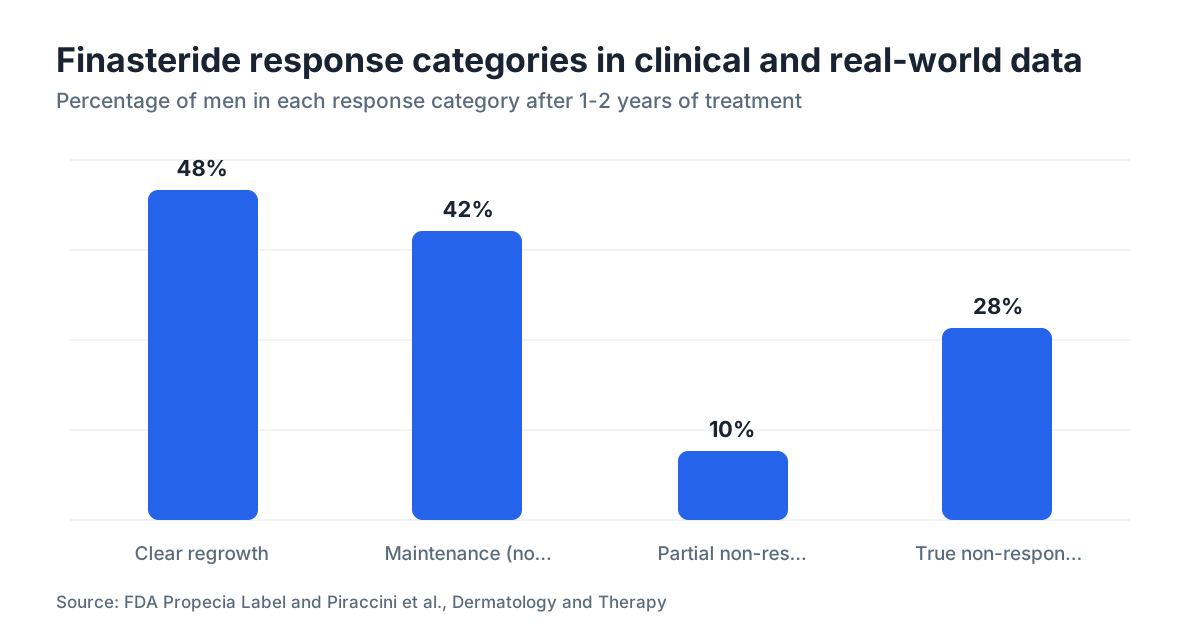
In practice, the FDA-approved label for Propecia (finasteride 1 mg) reports that in a 5-year placebo-controlled trial, 48% of men on finasteride showed visible hair regrowth while 42% had no further loss, meaning around 10% saw continued loss despite treatment [1]. Other long-term real-world data puts non-response closer to 30% when you use strict photographic criteria. That's a wide gap, and researchers have spent the last two decades trying to explain it.
The short answer is that finasteride suppresses DHT in almost everyone's blood, often by 60-70%, yet some men's hair follicles keep miniaturizing anyway. The drug works at the systemic level. The follicle-level response depends on your individual genetic biology. That distinction matters a lot if you're deciding whether to start treatment or wondering why it hasn't worked for you.
Understanding what causes hair loss at the cellular level is where this gets interesting.
What is the androgen receptor gene and why does it matter for finasteride response?
The androgen receptor (AR) gene sits on the X chromosome, which men inherit from their mothers. The AR gene encodes the protein that DHT actually binds to inside the hair follicle cell. When DHT docks onto this receptor, it triggers a signaling cascade that shortens the anagen (growth) phase and eventually miniaturizes the follicle.
Finasteride reduces the amount of DHT available to bind. But if your androgen receptor is hypersensitive, meaning it binds DHT more tightly or activates more strongly at lower DHT concentrations, the residual DHT that finasteride doesn't eliminate can still drive follicle miniaturization. This is the most consistently replicated genetic explanation for non-response.
A large meta-analysis of genome-wide association studies published in the Journal of Investigative Dermatology found that AR gene variants on the X chromosome are the strongest genetic signal associated with male pattern baldness risk [2]. These same variants correlate with how aggressively the disease progresses even under treatment.
There's also the CAG repeat polymorphism within the AR gene. Shorter CAG repeats mean a more active androgen receptor. Men with shorter CAG repeats tend to have more androgenic sensitivity, and preliminary evidence suggests they may see blunted finasteride responses compared to men with longer repeats. That hasn't been validated in a large randomized trial yet. So this is real science but not settled enough to change clinical decisions.
This is also why your maternal grandfather's hairline gets cited as a predictor of your own pattern. You inherit your AR gene from your mother, who got it from her father.
How do SRD5A1 and SRD5A2 gene variants affect finasteride response?
Finasteride specifically inhibits the type II isoform of 5-alpha reductase, encoded by the SRD5A2 gene. But there's also type I 5-alpha reductase, encoded by SRD5A1, which is active in sebaceous glands and, to a lesser degree, in scalp skin. Dutasteride blocks both isoforms. Finasteride only blocks type II.
Men who have SRD5A2 gene variants that produce a less active enzyme to begin with may already have lower DHT production from that isoform. That sounds like it would help, but it also means finasteride has less to block, so the relative effect on total scalp DHT is smaller. If type I activity is high in those men, the residual type I-driven DHT production becomes proportionally more significant.
Research on SRD5A2 polymorphisms in men treated for benign prostatic hyperplasia (a related condition also driven by DHT) found that certain variants, particularly the V89L polymorphism, are associated with lower baseline DHT levels and reduced enzyme activity [3]. The hair loss data for this specific variant is thinner, but the biological mechanism is the same.
The practical implication: a man whose scalp DHT is being partially maintained by type I reductase activity may respond better to dutasteride than to finasteride. This is one reason some dermatologists switch non-responders to dutasteride, even though dutasteride is not FDA-approved for hair loss. It's an off-label decision based on reasonable pharmacology.
As a DHT blocker, finasteride's selectivity is both its advantage (fewer side effects than dutasteride in most men) and its limitation (incomplete DHT suppression in some scalp environments).
Does the CYP1A1 or CYP3A4 gene affect how you metabolize finasteride?
Finasteride is metabolized primarily by the CYP3A4 enzyme in the liver. CYP3A4 is highly polymorphic, meaning there's a lot of genetic variation in how active it is across individuals. Men with faster CYP3A4 activity clear finasteride more quickly, which lowers steady-state plasma concentrations and reduces the drug's time in the body.
In theory, a rapid CYP3A4 metabolizer taking a standard 1 mg daily dose might have meaningfully lower drug exposure than a slow metabolizer on the same dose. This could translate to less DHT suppression. Published pharmacokinetic data confirms that finasteride blood levels vary substantially between individuals, though the clinical relevance for hair outcomes specifically hasn't been tested in a genotype-stratified randomized trial [4].
This is an area where pharmacogenomics is theoretically applicable but the clinical evidence is thin. Companies selling pharmacogenomic hair loss panels will tell you CYP testing is actionable. The honest answer: it's plausible, it's real biology, but nobody has yet run a prospective trial showing that CYP3A4-guided dosing improves hair outcomes. Treat it as a reasonable hypothesis, not a proven tool.
Where this might matter in practice: if you're taking other medications that strongly inhibit CYP3A4 (certain antifungals, some HIV drugs), your finasteride levels could run higher. If you're taking strong CYP3A4 inducers like rifampin, levels could drop. These are drug interactions worth discussing with a prescribing doctor, not genetic curiosities.
What percentage of men actually don't respond to finasteride?
It depends heavily on how you define response. The FDA label data from the original Merck trials defined response as maintenance or increase in hair count versus baseline after one year. By that standard, roughly 83-90% of men on finasteride 1 mg showed a response at the one-year mark [1]. But those were selected trial participants, not the general population, and photographic standards varied.
Real-world clinical audits are less flattering. A retrospective analysis of men in an Italian hair clinic found that around 28% showed no meaningful change or continued hair loss progression at two years on finasteride monotherapy [5]. Other clinic-based studies put non-response between 25-40% depending on the Norwood stage at initiation and the threshold used.
| Response Category | Approximate Rate |
|---|---|
| Clear regrowth | 30-48% |
| Maintenance (no further loss) | 35-45% |
| Partial non-response (slow progression) | 10-15% |
| True non-response (continued loss) | 10-30% |
The wide range reflects real methodological differences, not dishonest reporting. Earlier Norwood stages respond better. Starting at Norwood 6 or 7 gives finasteride much less to work with even if the biology is favorable. This is why dermatologists consistently say earlier treatment yields better outcomes, though the drug can still slow progression at later stages.
Age at onset also matters. Men who begin losing hair before age 25 often have more aggressive androgen sensitivity, which may correspond to the receptor-level genetic factors described above.
Can a genetic test tell you in advance if finasteride will work for you?
Not reliably, not yet. No genetic test is FDA-cleared or supported by major dermatology guidelines as a predictor of finasteride response for hair loss. The American Academy of Dermatology's clinical guidance on androgenetic alopecia does not recommend genetic testing before starting finasteride [6].
There are commercial direct-to-consumer tests that claim to predict finasteride response by examining AR gene variants, SRD5A2 polymorphisms, or pharmacogenomic markers. Some of these tests use real genetic variants that do have scientific literature behind them. But the leap from "this variant is associated with higher androgen sensitivity" to "therefore this person won't respond to finasteride" is not validated in prospective clinical trials. The positive predictive value of these tests for actual hair outcomes is unknown.
The most honest position: these tests might eventually be useful as the evidence base grows, but right now paying $200-400 for a pharmacogenomic hair panel is speculative. The better clinical approach is a monitored trial of the drug for 12 months, with standardized photography at baseline and follow-up. You get actual outcome data rather than probabilistic genetics.
If you want to understand your baseline pattern and track progress objectively, MyHairline's free AI scan at myhairline.ai/scan gives you a photographic baseline before you start any treatment. That's the minimum you need to evaluate whether a drug is working.
Researchers have called for large pharmacogenomic trials to properly validate these markers. Until those exist, clinical observation remains the standard.
Does finasteride response differ by ethnicity or ancestry?
There's real biological plausibility here, and some published data, though the evidence is weaker than the AR/SRD5A2 literature.
Allele frequencies for key AR gene variants differ across ancestral populations. The shorter CAG repeat alleles associated with higher androgen receptor activity are distributed differently across East Asian, South Asian, European, and African populations. Some epidemiological data suggests lower rates of androgenetic alopecia in East Asian men compared to European men of similar age, which may partly reflect these allele frequency differences.
Research in the Journal of Investigative Dermatology found that Japanese men with androgenetic alopecia had significantly shorter AR CAG repeats compared to Japanese men without hair loss, consistent with the receptor-sensitivity hypothesis [7]. Whether this translates to different finasteride response rates across ethnic groups hasn't been tested in a well-powered comparative trial.
In clinical practice, the standard of care doesn't vary by ethnicity for finasteride dosing or response monitoring. What does vary is baseline hair density norms and the visual thresholds used to detect progression, which affects how response gets scored in different patients.
If you're East Asian, you're not automatically a better finasteride responder. The population-level differences in hair loss prevalence are real, but individual variation within any population is large. Your personal AR gene variant matters more than your ancestral background as a population average.
Why does finasteride stop working for some men after years of success?
This happens. A man takes finasteride, does well for three to seven years, then notices renewed shedding or progression. A few mechanisms are worth knowing about.
First, androgenetic alopecia is a progressive, genetically driven process. Finasteride slows it but doesn't stop the underlying biology. Follicles that were borderline may eventually cross a threshold into miniaturization even under DHT suppression, particularly at more advanced Norwood stages.
Second, there's some evidence that androgen receptor expression in follicle cells can increase over time, a form of adaptive resistance where the follicle compensates for lower DHT by becoming more sensitive to whatever DHT remains. This is not well-proven in human hair follicle studies, but it's a known phenomenon in other androgen-driven tissues like prostate cancer.
Third, some men experience what looks like treatment failure but is actually a new wave of telogen effluvium triggered by life stressors, illness, or nutritional deficiency. This is not finasteride failure at the genetic level. It's a separate process happening on top of the treatment.
Fourth, compliance. Missing doses intermittently over years adds up. Finasteride's half-life is about six hours, but the functional inhibition of 5-alpha reductase persists longer. Still, consistent daily use gives consistently better results than sporadic use.
If finasteride seems to be losing effectiveness, a dermatologist might consider adding minoxidil for men, switching to dutasteride, or evaluating whether the apparent progression is actually a reversible shedding event rather than true drug resistance.
What other factors besides genetics affect finasteride response?
Genetics is the biggest variable in non-response, but it's not the only one. These are the other factors that matter in practice.
Norwood stage at baseline. The further along your pattern baldness is, the less surface area finasteride has to protect. Follicles that are fully miniaturized and have converted to vellus hairs may not recover. Finasteride can only preserve follicles that still have meaningful diameter.
Age at treatment start. Men who start in their early 20s, when follicle quality is still relatively intact, tend to show better response. A 45-year-old who has been losing hair for 20 years without treatment has less to work with, though he can still benefit substantially.
Scalp DHT environment. Some men have higher baseline DHT in scalp tissue relative to serum DHT. This local tissue variation, influenced by both genetics and local enzyme activity, means that even good serum DHT suppression doesn't fully translate to scalp DHT suppression in everyone.
Concurrent nutritional deficiencies. Iron deficiency, low ferritin, zinc deficiency, and severe caloric restriction all impair hair cycling independent of androgens. A man with iron-deficiency anemia losing hair will not respond well to finasteride because the driver of his shedding isn't primarily DHT. This gets missed all the time.
Combination therapy. The combination of finasteride and minoxidil consistently outperforms either drug alone in clinical trials. A randomized trial published in JAMA Dermatology found that the combination produced significantly higher hair counts than finasteride alone [8]. Men who appear to be finasteride non-responders often improve when minoxidil is added, which suggests the limitation was incomplete efficacy rather than true genetic resistance.
If finasteride hasn't worked, what are the realistic next steps?
Being a finasteride non-responder doesn't mean you're out of options. It just changes the decision tree.
Dutasteride is the most evidence-based escalation. It blocks both type I and type II 5-alpha reductase, achieving greater than 90% DHT suppression compared to finasteride's 65-70% [9]. Several randomized trials, particularly from Korea and Japan where it is approved for hair loss, show dutasteride outperforms finasteride at standard doses. The FDA has not approved dutasteride for hair loss in the US, so it's used off-label here. The sexual side effect profile is broadly similar to finasteride but affects a somewhat higher percentage of men.
Adding topical minoxidil or oral minoxidil is a practical step many dermatologists recommend before escalating to dutasteride. Minoxidil works through a completely different mechanism, prolonging anagen and improving follicle blood supply. It attacks the hair loss from a different angle, which is why combination therapy beats either drug alone.
Topical finasteride or topical dutasteride compounds are being studied and used off-label. The idea is that higher local concentrations in the scalp might overcome follicle-level resistance without proportionally higher systemic DHT suppression. The evidence base is early but promising.
For men with significant hair loss who haven't responded to medical therapy, hair transplant surgery is a permanent mechanical solution. Transplanted follicles from the occipital area are genetically resistant to DHT (that's why they're chosen), so they keep growing even in the androgen-sensitive scalp environment. Many surgeons recommend continuing finasteride post-transplant to protect native follicles.
Before concluding you're a non-responder, make sure you've done a genuine 12-month trial with standardized photographic documentation. Many men give up at six months, which is before the full benefit of finasteride is measurable. The drug takes time.
If you want an objective way to track your hair before and after starting treatment, myhairline.ai/scan offers a free AI-based analysis that gives you a documented baseline.
Is there research that could change how finasteride is prescribed in the future?
Yes, and the direction is toward precision prescribing rather than a one-size-fits-all approach.
Genome-wide association studies (GWAS) have identified hundreds of genetic loci associated with androgenetic alopecia [10]. Most of these loci have small individual effect sizes, but together they form a polygenic risk score that can predict age of onset and progression rate. Whether these polygenic scores will eventually predict treatment response is an active research question.
Pharmacogenomics companies are building databases of treatment outcomes linked to genotype data. As sample sizes grow, it may become possible to identify which AR variants or SRD5A2 haplotypes genuinely predict poor finasteride response with clinical-grade accuracy. We're probably five to ten years from this being actionable in clinical practice.
On the basic science side, single-cell RNA sequencing of hair follicle dermal papilla cells has started to reveal which gene expression pathways are active in miniaturizing versus healthy follicles. This may eventually identify biomarkers that predict more than androgen sensitivity but which therapeutic target would work best for a given patient.
For now, the most scientifically grounded approach is still this: start treatment early, document baseline with photography, give it 12 months, and adjust dose or drug based on observed response rather than predicted genetic response. The genetics explain the biology. The clinical trial on yourself provides the answer.
Sources
- FDA, Propecia (finasteride 1 mg) prescribing information
- Heilmann-Heimbach S et al., Journal of Investigative Dermatology, meta-GWAS of androgenetic alopecia
- Makridakis NM et al., The Lancet, SRD5A2 V89L polymorphism and 5-alpha reductase activity
- FDA, Clinical Pharmacology Review for Propecia (finasteride), NDA 020788
- Piraccini BM et al., retrospective Italian hair clinic cohort, Dermatology and Therapy
- American Academy of Dermatology, clinical guidance on androgenetic alopecia
- Sawaya ME & Price VH, Journal of Investigative Dermatology; Ueda M et al., AR CAG repeats in Japanese men with androgenetic alopecia
- Panchaprateep R, Lueangarun S, JAMA Dermatology, finasteride plus minoxidil combination RCT
- Clark RV et al., Journal of Clinical Endocrinology and Metabolism, dutasteride versus finasteride DHT suppression
- Hagenaars SP et al., PLOS Genetics, GWAS of male pattern baldness in UK Biobank