

TL;DR: Bosley is the largest hair restoration chain in the US, doing FUT and FUE transplants that usually run $4,000 to $15,000 or more depending on your graft count. Price shifts with location, technique, and surgeon. Full results take 9 to 18 months. Finasteride and minoxidil cost a fraction of that and can work before surgery is ever needed.
What is Bosley and how does it work?
Bosley is the largest hair restoration company in the United States, with more than 75 locations. It has been running since 1974, which makes it one of the oldest hair transplant businesses in the country. The company does surgical restoration (transplants) and non-surgical options like PRP therapy, low-level laser therapy, and topical medications.
The surgical side is where most people focus, and for good reason. Bosley does two main transplant techniques: FUT (follicular unit transplantation, sometimes called the strip method) and FUE (follicular unit extraction). In FUT, a strip of scalp comes off the donor area, gets dissected into grafts, and goes back in. In FUE, individual follicles are punched out one at a time. Each method trades off differently on scarring, recovery, and how many grafts you can move in one session.
Bosley runs like a franchise-style medical practice. That means the quality of your experience rides on the specific surgeon and location you use. The brand name is a starting point, not a promise of outcome. Keep that in mind while you scroll the polished before-and-after photos on their site.
How much does a Bosley hair transplant cost?
Bosley doesn't publish a flat price, and that's on purpose. Cost depends on how many grafts you need, which technique gets used, and which location you walk into. Based on publicly reported patient experiences and industry pricing data, a Bosley hair transplant usually runs from about $4,000 on the low end (small FUE sessions, minor hairline work) to $15,000 or more for large FUT or FUE procedures covering heavier loss [1].
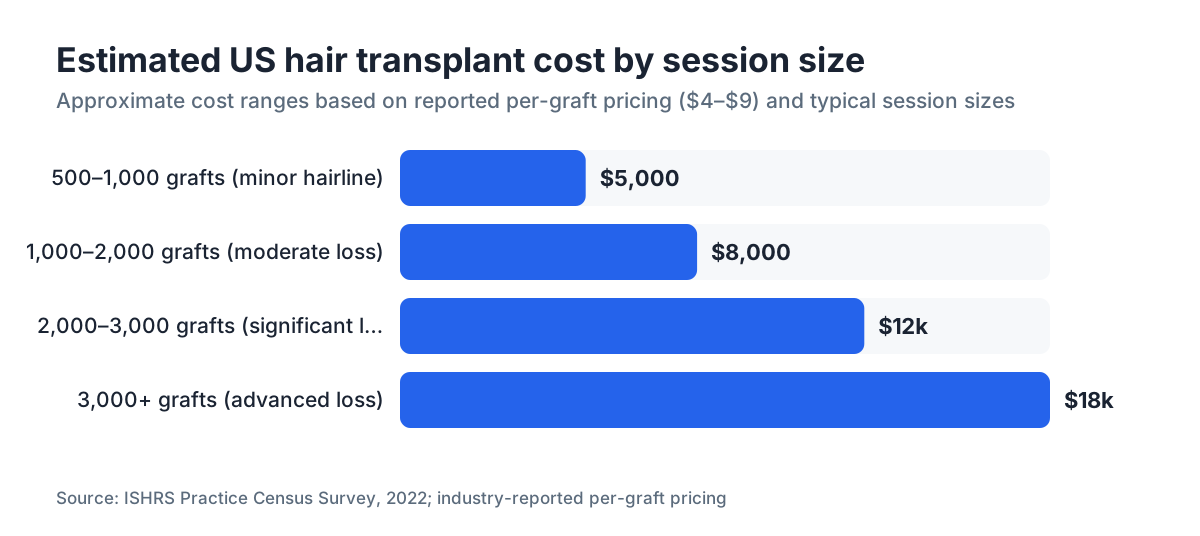
Bosley has historically priced per graft. Reported per-graft costs land between roughly $4 and $9 depending on session size and technique. A modest 1,500-graft procedure at $6 per graft comes to $9,000. A large 3,000-graft session could hit $15,000 to $18,000 at the same rate.
Bosley also offers financing through third-party lenders. That drops the upfront barrier but stacks on interest. A free consultation (in-person or virtual) is how they build a specific quote for your case. Do that before you set a budget in your head.
| Session size (grafts) | Estimated Bosley cost | Technique most common |
|---|---|---|
| 500 to 1,000 | $4,000, $6,000 | FUE (small hairline) |
| 1,000 to 2,000 | $6,000, $10,000 | FUE or FUT |
| 2,000 to 3,000 | $10,000, $15,000 | FUT or large FUE |
| 3,000+ | $15,000, $20,000+ | FUT or staged FUE |
These are estimates pulled from patient-reported figures and general US pricing benchmarks, not official Bosley price sheets [1][2].
How does Bosley's pricing compare to the rest of the US hair transplant market?
The US hair transplant market is spread out. Industry and clinic surveys put typical costs between $4,000 and $15,000, with some high-volume FUE clinics charging $20,000 to $25,000 for large sessions [1][2]. Bosley lands in the middle to upper-middle of that range, which reflects the overhead of running dozens of physical locations.
Cheaper options exist. A solo surgeon with lower overhead in a smaller market can charge $3,000 to $5,000 for a modest FUE procedure. Medical tourism (Turkey especially) offers per-graft costs as low as $1 to $2, dropping large sessions under $5,000 total. You absorb the travel cost and have almost no recourse if something goes wrong [2].
The top end of the US market is celebrity-affiliated or high-volume private clinics in big cities charging $10 to $15 per graft for FUE, selling exclusivity and longer surgeon time per case.
Bosley sits in the middle and offers something a solo surgeon can't always match: standardized aftercare across locations and a recognizable brand behind any warranty or touch-up policy. Is that worth a premium over a well-reviewed independent clinic? Fair question, and there's no universal answer.
If you're earlier in this process, hair transplant breaks down how transplants work before you start comparing prices.
What do you actually get for the money? FUT vs FUE at Bosley
Technique matters as much as graft count. FUT leaves a linear scar across the back of the scalp. Most people hide it fine with short-to-medium hair, but shave your head and it shows. FUE leaves small circular punch scars scattered across the donor area, far less visible at short lengths. FUE also heals a bit faster for most patients.
FUT usually yields more grafts per session. Need more than 3,000 grafts in one go? FUT is often the only practical single-procedure route. FUE at very high counts (2,500+) can drain the donor area faster, which matters if you're planning multiple sessions down the road.
Bosley does both. The surgeon at your consultation should match the technique to your loss pattern and donor density. If they push FUE on everyone regardless of situation, question it.
Graft survival rate matters more than graft count. Experienced surgeons achieve follicle survival rates of 85 to 95%, and that number drops hard with sloppy technique, poor handling outside the body, or a recipient site cut without attention to angle and density [3]. No price buys good technique. Ask to see the surgeon's own before-and-afters, not the clinic's compiled gallery.
What results can you realistically expect from a Bosley transplant?
The most common disappointment with any hair transplant, Bosley or otherwise, is expecting faster or denser results than biology allows. After the procedure, transplanted hair sheds within 2 to 6 weeks. That's normal. The follicle is alive; the shaft falls out while the follicle settles into its new spot.
New growth usually starts at 3 to 4 months. It comes in thin and fine at first. By 6 months you see a real change, but final density typically doesn't show until 12 to 18 months post-procedure [3][4].
Transplanted hair is permanent because the follicles came from your permanent zone, the back and sides of the scalp. They keep the genetic programming of their origin and don't fall out the way DHT-sensitive follicles do. But the native hair around them stays vulnerable to pattern baldness. A great transplant at 35 can look patchy at 50 as the surrounding non-transplanted hair keeps thinning. Surgeons who put you on finasteride alongside a transplant aren't upselling. They're accounting for that.
Bosley advertises a satisfaction guarantee and touch-up policy for qualifying patients. Read the terms before you count on it.
Is Bosley worth it, or are there better options?
Whether Bosley is worth it comes down to your stage of hair loss and your goals. Someone at Norwood stage 5 to 7 who's already maxed out medication has few tools left, and a surgical transplant is one of them. Bosley is a legitimate provider in that space.
Someone at Norwood 2 to 3 with active thinning is taking a risk operating before the underlying loss is stable. You can spend $10,000 today, keep losing native hair, and need another procedure in five years. Starting with finasteride and minoxidil first makes more financial sense there. Both are FDA-approved for male pattern hair loss [5][6]. Generic finasteride (oral, 1 mg daily) runs $10 to $30 a month. Minoxidil topical 2% and 5% solutions have been available over the counter since 1996 and cost $15 to $30 a month. Neither guarantees regrowth, but both have real trial data behind them, and neither requires surgery.
For what these drugs actually do, finasteride and finasteride and minoxidil combined are worth reading before your consultation.
If you're getting a transplant anyway, the main argument for Bosley is convenience (lots of locations, coordinated aftercare), not some unique surgical edge. A highly rated independent surgeon in your city deserves a consultation before you default to the big name. The surgeon doing your procedure matters more than the door they work behind.
What are the risks and side effects of a hair transplant?
Hair transplants are real surgery with real risks. Common side effects: swelling of the forehead and around the eyes in the first week, temporary numbness or tingling in the donor and recipient areas, and the expected shock loss (transplanted and sometimes surrounding native hair falling out temporarily after surgery) [4].
Rarer but more serious risks include infection at the incision or extraction sites, folliculitis (inflamed follicles), cyst formation, visible scarring beyond what you were told to expect, and poor graft survival that leaves thin or patchy results. Anesthesia complications are rare but possible.
The American Academy of Dermatology puts the safety of transplants done by qualified physicians as good when patient selection is handled right [4]. Risk climbs sharply when procedures happen with undertrained practitioners or in non-medical settings, which has been a documented problem in this industry.
If you're weighing whether your loss is surgical-candidate-level or still reversible, understanding the mechanism helps. What causes hair loss and receding hairline cover the underlying biology.
Some patients also see a temporary dip in overall density after surgery from telogen effluvium, the stress-driven shedding cycle. Telogen effluvium explains why it happens and how long it lasts.
How does the Bosley consultation process work?
Bosley offers free consultations, in-person at their clinics and virtually. The consult includes an assessment of your hair loss stage, donor area density, and candidacy for surgical or non-surgical options. You walk out with a graft estimate and a price.
A few things to ask before you leave:
- Which specific surgeon would do my procedure, and can I see that surgeon's personal before-and-after cases, not the clinic's general gallery?
- Do you recommend finasteride or minoxidil to protect my native hair before or after surgery, and why or why not?
- How many grafts come from my donor area, and what happens if I need a second procedure in 10 years? Will there still be enough supply?
- What does the touch-up or revision policy cover, in writing?
You're not obligated to book at the consultation. Get a second opinion from an independent board-certified hair restoration surgeon (look for ABHRS certification, the American Board of Hair Restoration Surgery [7]) before committing to any large procedure. Consultations from other providers are usually free or low cost.
To size up your current loss stage before any consultation, the free AI scan at MyHairline gives a Norwood stage estimate and helps you frame the conversation with a real surgeon.
Does Bosley work for women?
Yes, Bosley treats female hair loss. Female pattern loss looks different from male pattern loss: women usually get diffuse thinning across the crown and top of the scalp rather than the receding hairline and temple loss men see. The Ludwig classification is used for women instead of Norwood [4].
Surgical candidacy for women is trickier. Women need a stable, dense donor area (usually the back of the scalp) and loss that has settled. Women with diffuse thinning across the entire scalp, donor zone included, are usually poor surgical candidates because there's no reliable area to harvest from.
For women with localized loss (frontal hairline recession, traction alopecia from hairstyles, or post-surgical scar coverage), transplants can work well. Bosley consults women for both FUT and FUE.
FDA-approved options for women are more limited. Minoxidil 2% is FDA-approved for female pattern hair loss [5], and minoxidil 5% is used off-label with reasonable evidence. Finasteride is not FDA-approved for women and is contraindicated in women of childbearing age because of the risk of fetal harm [6].
Women researching non-surgical routes will find minoxidil for men covers the mechanism well even though the FDA label differs, and a dermatologist can walk you through off-label use for female loss.
What non-surgical alternatives should you consider before a transplant?
Surgery is the priciest and most permanent rung on the hair loss ladder. Before you get there, most dermatologists would try medical options first, especially if your loss is still moving.
Finasteride 1 mg oral (Propecia, generics) blocks the conversion of testosterone to DHT, the androgen that shrinks follicles in genetically susceptible people. In the FDA approval trial, finasteride increased hair count versus placebo at 2 years in men with male pattern hair loss [6][9]. Generic finasteride now runs $10 to $30 a month. The side effects to know: sexual side effects (reduced libido, erectile dysfunction, ejaculation changes) reported in roughly 2 to 4% of users in trials, plus a small, still-contested risk of post-discontinuation syndrome. DHT blocker walks through the mechanism.
Minoxidil topical 2% and 5% was the first FDA-approved treatment for androgenetic alopecia and works a different way: it lengthens the growth phase and may increase follicle size [5]. In a 2002 trial, 5% minoxidil beat both 2% minoxidil and placebo for regrowth in men at 48 weeks [10]. Low-dose oral minoxidil (0.625 to 2.5 mg) has growing evidence and is used off-label widely; see oral minoxidil for a full breakdown. The non-surgical options worth weighing alongside or instead of surgery: finasteride, minoxidil (topical or oral), PRP (platelet-rich plasma, mixed but improving evidence), and low-level laser therapy (also mixed evidence, FDA-cleared as a device but not FDA-approved as a drug).
None of these regrow hair over a fully bald scalp. If the follicles are gone, they're gone, and surgery is the only way back to coverage. But if follicles are still alive and just miniaturized, medical treatment can reverse that miniaturization and buy years before a surgical decision becomes necessary. Minoxidil side effects covers what to watch for if you start that route.
For a broader look at supplements, hair loss supplements reviews the evidence on biotin, saw palmetto, and the rest honestly.
How should you choose between Bosley and an independent hair transplant surgeon?
This is the real question most people land on. The honest answer: the surgeon's hands matter more than the brand. A brilliant surgeon at an independent clinic beats a mediocre one at Bosley, and the reverse is just as true.
Bosley's case for itself: consistent process, aftercare protocols, financing, and the option to follow up at a different location if you move. There's some comfort in a recognizable brand with a 50-year history, even if that comfort is partly psychological.
The case for an independent surgeon: lower overhead often means a lower per-graft cost for the same quality work. A solo surgeon whose whole reputation rides on hair transplants may have more personal stake in your result than a clinic employee working on volume. You can also research an independent surgeon deeply: ABHRS board certification, membership in the International Society of Hair Restoration Surgery (ISHRS [8]), and published complication data or peer-reviewed work.
Compare both Bosley and independent clinics on the same criteria: the specific surgeon's results (not the clinic's gallery), graft survival assumptions, technique fit for your case, and total price including follow-up.
Get at least two consultations before you sign anything. If the first one tells you exactly what you want to hear with no caveats, treat that as a warning sign. A good surgeon spends more time on what you can't realistically expect than on what you can.
For a data-backed starting point on your own loss stage before you call anyone, the free AI scan at MyHairline estimates your Norwood stage from a photo and helps you walk into a consultation with sharper questions.
Sources
- International Society of Hair Restoration Surgery (ISHRS), Practice Census Survey 2022
- American Society of Plastic Surgeons, Procedural Statistics 2022
- Bernstein RM, Rassman WR. Follicular transplantation. International Journal of Aesthetic and Restorative Surgery, 1995
- American Academy of Dermatology (AAD), Hair Loss: Diagnosis and Treatment
- FDA, Minoxidil Drug Label (NDA 019501)
- FDA, Finasteride (Propecia) Label and Approval History (NDA 020788)
- American Board of Hair Restoration Surgery (ABHRS)
- International Society of Hair Restoration Surgery (ISHRS)
- Kaufman KD et al. Finasteride in the treatment of men with androgenetic alopecia. Journal of the American Academy of Dermatology, 1998
- Olsen EA et al. A randomized clinical trial of 5% topical minoxidil versus 2% topical minoxidil and placebo in the treatment of androgenetic alopecia in men. Journal of the American Academy of Dermatology, 2002