

TL;DR: True permanent follicle death is rare and almost always caused by scarring. Most hair loss, including androgenetic alopecia, leaves follicles alive but shrunken and dormant. The signs a follicle may be gone for good: smooth shiny scalp skin, no peach-fuzz regrowth after treatment, and biopsy-confirmed fibrosis. Before you write off your follicles, get a real exam.
What does it actually mean for a hair follicle to be 'dead'?
A hair follicle is a living organ inside your scalp, more than a pore. It runs about 3 to 4 mm deep, has its own blood supply, and cycles through growth phases on its own schedule. When people say a follicle is 'dead,' they usually mean one of two very different things, and the difference decides whether treatment can help.
The first meaning is miniaturization. In androgenetic alopecia (the genetic hair loss behind male and female pattern baldness), follicles shrink over years of DHT exposure. They go from producing thick, pigmented terminal hairs to thin, pale vellus hairs, and eventually the hair gets so fine you can't see it. The follicle is still there. Still alive. Still cycling. It hasn't died. It's been suppressed [1].
The second meaning is true permanent loss. That happens when the follicle itself is physically destroyed and replaced with scar tissue. That one is irreversible. No medication reaches it. No growth factor wakes it up. A hair transplant can drop new follicles into that area, but the original ones are gone.
So when someone asks if their follicles are dead, the honest first answer is this: probably not, but the only way to know for sure is to look at the scalp properly.
What causes permanent follicle death?
Scarring is the common thread in every case of true permanent follicle loss. Dermatologists call these conditions cicatricial alopecias, and they make up roughly 7% of hair loss cases seen in hair clinics [2].
The main causes:
Scarring (cicatricial) alopecia disorders. Lichen planopilaris, frontal fibrosing alopecia, and discoid lupus erythematosus all involve inflammatory destruction of the follicle's stem cell reservoir. Once those stem cells are gone, regeneration is impossible. The American Academy of Dermatology says these conditions need early treatment to stop progression, because what's already scarred cannot be reversed [3].
Physical trauma and burns. Deep burns, radiation dermatitis from cancer treatment, and severe traction injuries from years of tight braiding or weaves can all destroy follicles at the root. Radiation-induced loss is dose-dependent. Doses above roughly 45 Gy to the scalp tend to cause permanent loss, though individual variation is real [4].
Fungal infections left untreated. Kerion, a severe inflammatory form of tinea capitis (scalp ringworm), can scar if it isn't treated promptly with oral antifungals. It's more common in children, and it's one reason pediatric hair loss deserves fast evaluation.
Surgical scarring. Old-style transplant procedures using large circular punches left scars. Modern follicular unit extraction (FUE) and follicular unit transplantation (FUT) done well do not destroy surrounding follicles. Botched procedures can.
Androgenetic alopecia, telogen effluvium, alopecia areata, nutritional deficiencies, thyroid disease: none of these kill follicles. They disrupt the cycle or shrink the follicle, but the underlying structure survives. That's why treatment can work for them.
How can you tell if your follicles are gone or just dormant?
There's no single home test that settles this. But several signs, taken together, point strongly one way or the other.
Signs that suggest follicles may be permanently gone:
- The bald area looks smooth, shiny, and featureless, with no follicular openings visible under magnification
- You've had a known scarring condition (diagnosed lichen planopilaris, lupus, severe burn, etc.)
- A dermatologist presses a dermoscope to the area and sees white or pale fibrotic patches where follicular units should be
- A scalp biopsy shows fibrosis where follicles should be
- Years of appropriate treatment (minoxidil, finasteride if relevant) produced zero regrowth, not even fine vellus hairs
Signs that suggest follicles are dormant, not dead:
- You can still see tiny, fine, colorless hairs in the area (vellus hairs mean living follicles)
- Follicular openings are still visible under dermoscopy
- The loss followed a systemic stressor like illness, rapid weight loss, or childbirth (that pattern is telogen effluvium, which is fully reversible)
- Your scalp skin has normal texture without scarring
- The loss follows the typical pattern for androgenetic alopecia
The gold standard is a 4mm punch biopsy read by a dermatopathologist. No app, no home test, no photo replaces that for borderline cases. Most people with common pattern baldness don't need a biopsy, though. A dermatologist can usually tell from history and dermoscopy alone.
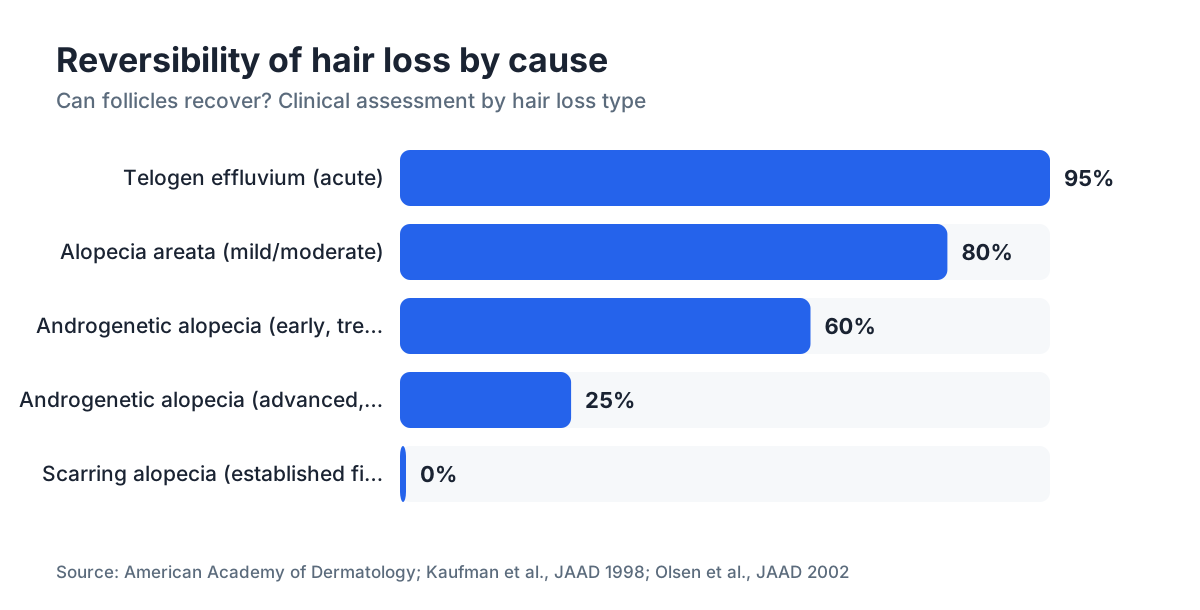
Can miniaturized follicles be revived, or is miniaturization permanent?
Miniaturized follicles can often be partly or fully revived. That's probably the most useful single fact in this whole article.
Minoxidil works partly by enlarging shrunken follicles and stretching out the anagen (growth) phase. A 48-week randomized controlled trial in the Journal of the American Academy of Dermatology found that 5% topical minoxidil produced significant increases in non-vellus hair count compared to placebo in men with androgenetic alopecia [5]. Those miniaturized follicles responded and grew back toward terminal thickness. See minoxidil for men for the mechanics.
Finasteride works differently. It cuts scalp DHT by about 60%, which removes the signal driving miniaturization. A 5-year study of 1,553 men found 48% of finasteride-treated men showed hair growth versus 7% on placebo, and 42% had no further loss versus 72% who lost more hair on placebo [6]. Again, those follicles were dormant and shrunken, not dead. See finasteride for a full breakdown of how it works and who it fits.
Used together, the two drugs hit different pathways, which is why the combination tends to beat either one alone. Finasteride and minoxidil together is the most evidence-backed non-surgical approach right now.
The catch: the longer miniaturization has run, the harder revival gets. Early treatment catches follicles before they've been suppressed for decades. Late treatment catches follicles that may have only vellus capacity left. Timing matters more than most people think.
Does a completely smooth bald scalp mean all the follicles are gone?
Not necessarily. This surprises most people.
In longstanding androgenetic alopecia, areas that look completely bald under normal light often still hold miniaturized follicles making near-invisible vellus hairs. A study using horizontal scalp sections from bald areas of men with androgenetic alopecia found that follicle counts weren't zero, just dramatically reduced in size [7]. The follicular units were still there, just pushing out hairs too fine to see.
There is a point of no return even inside androgenetic alopecia, though. Very long-standing, severe miniaturization eventually leads to true follicular dropout as the dermal papilla shrinks past functional viability. The research on exactly when that tipping point hits is imprecise. Most specialists put the practical window for medical treatment at roughly 5 to 7 years after a bald patch becomes visible, but that's a clinical rule of thumb, not a hard biological law.
Smooth shiny scalp is more worrying in the context of a scarring alopecia. In frontal fibrosing alopecia, the skin at the hairline turns pale and tight, and dermoscopy shows absent follicular openings. That genuinely does mean follicles are gone in those spots.
Smoothness alone is not the answer. The cause of the baldness matters far more than how the scalp surface looks.
What does a dermatologist look for to diagnose dead vs. dormant follicles?
A good dermatologist uses a layered approach, not a single test.
Clinical history. How fast did the loss happen? Rapid shedding over weeks points toward telogen effluvium or alopecia areata, both reversible. Slow, symmetric thinning over years points to androgenetic alopecia. A history of scalp inflammation, pain, or burning points toward scarring alopecia.
Pattern assessment. Androgenetic alopecia follows predictable patterns (Norwood scale for men, Ludwig for women). Scarring alopecias often show irregular borders, follicular dropout in clusters, or loss that extends beyond the usual androgenetic zones.
Dermoscopy. A handheld magnifier lets the clinician see individual follicular units, judge miniaturization, and spot the white fibrotic halos, peripilar casts, or absent openings that signal scarring [8]. It's standard in most dermatology offices and takes about 5 minutes.
Pull test. A gentle tug on about 60 hairs. More than 6 releasing easily suggests active shedding. Good for diagnosing active effluvium, not for judging follicle viability.
Scalp biopsy. The definitive test for uncertain cases. A 4mm punch removes a small cylinder of scalp that a dermatopathologist reads under a microscope. They can count follicles per unit area, grade fibrosis, and identify inflammatory cells. Results usually take 1 to 2 weeks.
Blood work. Not for diagnosing dead follicles, but for ruling out reversible systemic causes: thyroid panel, ferritin, vitamin D, CBC, and sometimes zinc or B12 depending on history.
If you're not near a dermatologist or want a starting point before your appointment, MyHairline's free AI scan (/scan) can analyze photos of your scalp pattern and flag things worth raising with a clinician. It's a starting point, not a diagnosis.
Can hair transplants work on areas where follicles have died?
Yes, and this is one of the few genuinely useful options when follicles are actually gone rather than dormant.
A hair transplant moves healthy follicles from a donor area (usually the back and sides of the scalp, which resist DHT) into areas where follicles have been lost. The transplanted follicles bring their own biology with them and aren't affected by whatever destroyed the original follicles, as long as that underlying cause is controlled.
The key condition for transplanting into a scarred area: the scarring condition has to be inactive. Transplanting into active lichen planopilaris, for example, is likely to get the new follicles destroyed by the same inflammation. Most surgeons wait at least 1 to 2 years of disease stability before transplanting into a previously scarred area.
For androgenetic alopecia, where follicles are shrunken rather than dead, transplants work well. But they don't stop ongoing loss in the areas you didn't transplant. That's why surgeons usually recommend staying on medical therapy (minoxidil, finasteride) after a transplant to protect the existing follicles.
Donor supply is finite. Once you've used your donor follicles, there are no more. That's why most surgeons are cautious with young patients who may keep losing hair for decades.
Do any home tests or devices accurately detect dead follicles?
No home test currently gives a reliable answer. This is an area full of marketed products and thin on evidence.
Scalp cameras and USB microscopes sold online can show you follicular openings and hair thickness, and they're genuinely handy for tracking changes over time. But they can't tell a miniaturized follicle from an absent one at the resolution most consumer devices offer. They also can't assess fibrosis, which needs a biopsy.
Red light devices, scalp massagers, and various supplements get sold with claims about 'reactivating dormant follicles.' None have solid clinical data showing they can reliably tell dead from dormant follicles or selectively revive the dormant ones. Hair loss supplements deserve their own evaluation, but this isn't the technology that answers the dead-vs-dormant question.
Platelet-rich plasma (PRP) injections get used in some clinics to try to stimulate dormant follicles. The evidence for PRP in androgenetic alopecia is mixed, small-scale, and not FDA-approved for hair loss. The FDA has not cleared any PRP system specifically for hair regrowth as of 2024 [9].
If you want a real answer about follicle viability, see a board-certified dermatologist. One office visit almost certainly costs less than months of products that do nothing.
How long does it take to know if a follicle can still grow hair?
It depends heavily on the treatment you're testing.
Minoxidil takes a minimum of 4 months to show results, and 6 to 12 months is a more realistic window for a fair assessment. The FDA-approved label for 5% minoxidil foam says results should be evaluated at 4 months, and that some users may need up to 12 months [10]. Judging it at 8 weeks and quitting is one of the most common mistakes people make.
Finasteride also takes 6 to 12 months for meaningful regrowth, and its main effect in the first year is halting further loss rather than producing dramatic regrowth. Year 2 and beyond tend to show the most visible improvement.
For alopecia areata, spontaneous regrowth can happen within months in mild cases, while severe cases may take years or never respond.
For telogen effluvium triggered by an acute stressor, most shedding resolves within 3 to 6 months of the stressor clearing, and full regrowth usually takes 9 to 12 months.
The practical answer: give any legitimate treatment at least 6 months before you conclude it isn't working. Then reassess with a clinician who can compare photos and measurements objectively.
What early warning signs mean you should act fast before follicles miniaturize further?
Early action is genuinely worth it. The case for treating hair loss sooner rather than later rests on biology: a follicle that's been miniaturizing for 2 years is far easier to revive than one suppressed for 15.
Act fast if you notice:
Rapid, diffuse shedding across the whole scalp (can signal telogen effluvium from a systemic cause that's still active and fixable)
A receding hairline that has moved visibly in under a year. A slowly receding hairline in your 20s is often early androgenetic alopecia, and this is exactly when finasteride is most effective at slowing it.
Scalp itching, burning, or tenderness with hair loss in a non-pattern distribution. These symptoms sometimes signal early scarring alopecia. If you feel them in a bald area, see a dermatologist urgently, not eventually.
A family history of significant baldness. If your father or maternal grandfather lost most of their hair, your risk is meaningfully higher. Starting to monitor in your early 20s and beginning treatment at the first sign of thinning gives you far more options than waiting until the loss is advanced.
Understanding what causes hair loss in your specific case is the starting point for knowing which of these signs applies to you. DHT is the driver in most men's pattern baldness, and a DHT blocker like finasteride addresses that directly.
Is there any research on regrowing hair in truly scarred follicles?
Honest answer: nothing that works clinically yet, but real research is happening.
The most discussed area is follicle neogenesis, the idea of growing new follicles from scratch using stem cell technology. A 2020 paper in Nature reported that researchers grew hair-bearing human skin, including functional hair follicles, entirely from human pluripotent stem cells in a lab setting [11]. Genuinely interesting work. Also a long way from a clinical treatment.
Wound-induced hair follicle neogenesis (WIHN) has been observed in mice, but the same effect hasn't been reliably reproduced in humans. Human skin has far less regenerative capacity than mouse skin.
JAK inhibitors, drugs like ruxolitinib and baricitinib, are approved or being studied for alopecia areata, which is autoimmune, not scarring. The FDA approved baricitinib for severe alopecia areata in June 2022, the first systemic drug approved specifically for the condition [12]. These drugs suppress the immune attack on follicles. They don't regenerate destroyed tissue.
For now, the honest picture is simple: truly scarred follicles cannot be regrown with any approved treatment. Prevention, through early identification and treatment of the underlying cause, is the strongest tool available.
Sources
- American Academy of Dermatology, Hair Loss Types: Alopecia Areata Overview
- Olsen EA et al., 'Primary cicatricial alopecias: NAHRS-sponsored workshop on cicatricial alopecia', Journal of the American Academy of Dermatology, 2003
- American Academy of Dermatology, Hair Loss Resource Center
- National Cancer Institute, Radiation Therapy Side Effects
- Olsen EA et al., 'A randomized clinical trial of 5% topical minoxidil versus 2% topical minoxidil and placebo in the treatment of androgenetic alopecia in men', Journal of the American Academy of Dermatology, 2002
- Kaufman KD et al., 'Finasteride in the treatment of men with androgenetic alopecia', Journal of the American Academy of Dermatology, 1998
- Whiting DA, 'Possible mechanisms of miniaturization during androgenetic alopecia or pattern hair loss', Journal of the American Academy of Dermatology, 2001
- American Academy of Dermatology, Hair Loss Resource Center
- U.S. Food and Drug Administration, Drugs Homepage
- U.S. Food and Drug Administration, Minoxidil 5% Foam OTC Label (Rogaine)
- Lee J et al., 'Hair-bearing human skin generated entirely from pluripotent stem cells', Nature, 2020
- U.S. Food and Drug Administration, Drugs Homepage