TL;DR: Microneedling with a derma roller opens channels in the scalp that let minoxidil absorb better, and it triggers a growth signal on its own. A 2013 randomized controlled trial found 82% of men using both treatments gained 100+ hairs per cm², versus 4.5% for minoxidil alone. Needle depth matters. Hygiene is non-negotiable. It's not for everyone.
What does combining a derma roller with minoxidil actually do?
The short version: it makes minoxidil work harder.
Topical minoxidil has to cross the outer layer of skin, the stratum corneum, before it can reach the follicle. That layer is a good barrier, which is the point of skin. A derma roller punches thousands of tiny channels through it with fine needles, and those channels let minoxidil slip in far more efficiently than it can on its own.
Research published in the Journal of Investigative Dermatology measured absorption and found microneedling increased topical drug delivery by roughly 4-fold compared to intact skin [1]. That is not a small difference. More minoxidil reaching the follicle means the drug has a better shot at doing its job: prolonging the growth phase of the hair cycle and increasing blood flow to the follicle.
There's a second effect, and it has nothing to do with the drug. The needle injury itself sets off a wound-healing response. The scalp releases platelet-derived growth factor, epidermal growth factor, and vascular endothelial growth factor. Those signals nudge follicles out of the resting phase (telogen) and into active growth (anagen) [7]. So you get a drug-delivery boost and a direct biological push at the same time.
The combination does not replace minoxidil for men, and it does not cure androgenetic alopecia. It's an enhancement strategy with real evidence behind it, which already puts it ahead of most things sold in the hair loss aisle.
What does the clinical evidence actually show?
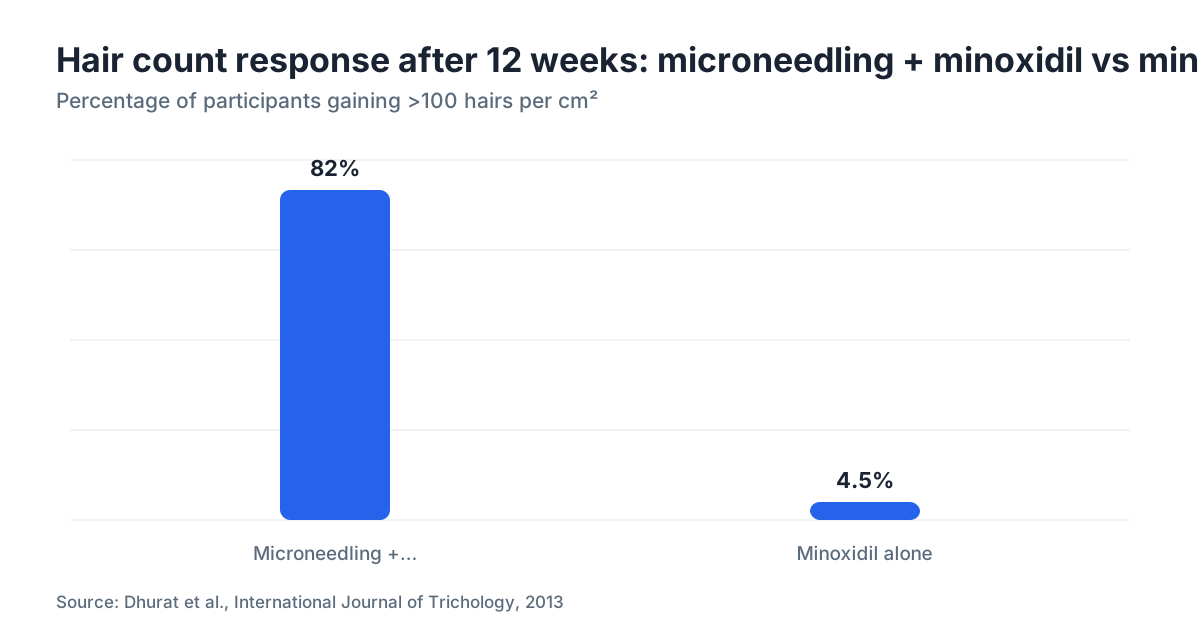
One trial anchors the whole conversation. In 2013, Dhurat and colleagues published a randomized controlled trial in the International Journal of Trichology that put 100 men with androgenetic alopecia into two groups: minoxidil 5% twice daily alone, or the same minoxidil plus weekly microneedling. After 12 weeks, 82% of the microneedling group had gained more than 100 hairs per cm², compared to 4.5% of the minoxidil-only group [2]. The authors called microneedling "a safe and a promising tool" for hair loss treatment.
That gap is enormous. It's also a single trial with 100 men, so hold the headline loosely. Smaller studies and later reviews point the same direction: adding microneedling to minoxidil beats minoxidil alone. A 2021 systematic review in Dermatologic Surgery pooled several controlled trials and found microneedling produced statistically significant gains in hair count and patient-reported outcomes [3].
Now the honest caveats. Most trials run 12 to 24 weeks. Data past two years is thin. Nearly all of the large trials studied men with male-pattern loss, so the evidence for women is weaker. And the trials used clinic protocols with precise needle depths, which may not match exactly what you do at your bathroom mirror with a $30 roller.
Still, the mechanism is understood, the side effects in the trials were mild (mostly temporary redness and some discomfort) [10], and there's no competing explanation for why the two groups pulled apart so sharply other than the one the researchers give.
If you're weighing whether to add a DHT blocker like finasteride on top of this, the case for that stack is its own discussion, but the logic of combining mechanisms is the same.
Which needle size should you use on your scalp?
Needle depth is the single most important variable for both safety and results, and it's where most people get it wrong.
For scalp use with minoxidil, the trials support a range of 0.5 mm to 1.5 mm. Here's how to think about each:
| Needle depth | What it does | Best for |
|---|---|---|
| 0.25 mm | Barely breaks the stratum corneum | Not enough for meaningful absorption gains |
| 0.5 mm | Opens channels with minimal trauma | Beginners, sensitive scalps, frequent use (weekly) |
| 1.0 mm | Reaches mid-dermis, stronger growth signal | Most users, standard protocol |
| 1.5 mm | Deeper wound signal, more discomfort | Experienced users, areas of dense scarring |
| 2.0 mm+ | Risks hitting nerves and vessels | No evidence of added benefit; avoid at home |
The Dhurat 2013 trial used a 1.5 mm roller, and that is still the most-studied depth [2]. But most dermatologists who recommend home use start people at 0.5 mm to 1.0 mm, because at home the person controls the pressure and technique, not a trained clinician. At 1.0 mm you get real channel depth with an injury profile most people tolerate fine.
Stay away from 2.0 mm and up at home. You can reach the subcutaneous fat, which is full of blood vessels and nerves. That's not a place to be puncturing yourself unsupervised, and no trial shows it works better.
Material matters too. Titanium needles hold their edge longer than stainless steel but cost more. Dull needles tear instead of pierce, which adds trauma without adding absorption. Replace your roller every 10 to 15 uses, sooner if you've dropped it or the needles look bent under a magnifying glass.
How do you use a derma roller with minoxidil step by step?
Technique decides whether this helps you or just gives you an irritated scalp. Doing it carelessly raises your infection and irritation risk without improving results at all.
Before you start: wash your hands. Soak the roller head in 70% isopropyl alcohol for 5 to 10 minutes, then let it air dry completely. Never roll over broken skin, active psoriasis, a scalp infection, or open wounds.
Step 1: Part your hair to expose the target area. Your scalp should be clean and dry, no product residue.
Step 2: Use light, even pressure. Roll in one direction at a time: horizontal, then vertical, then diagonal. Four to six passes in each direction over the target area is plenty. You should feel slight resistance and see mild redness. Not pain, not blood. If you see blood, you're pressing too hard.
Step 3: This is where protocols split, and the split matters. Some apply minoxidil right after rolling, some wait 24 hours. The case for applying immediately is maximum absorption. The case for waiting is that freshly needled skin absorbs minoxidil so aggressively that both scalp irritation and systemic absorption climb, which can raise the odds of side effects. Since the minoxidil side effects tied to systemic absorption (headache, fluid retention, heart palpitations) are real, waiting 24 hours is the safer bet. That's what most dermatologists now recommend.
Step 4: After rolling, rinse the roller in alcohol again and store it in its case. Do not share it with anyone, ever. Shared rollers can pass bloodborne pathogens between people.
Frequency: once a week for 0.5 to 1.0 mm depths. No more than that. Your scalp needs the week to finish its healing response between sessions. Extra rolling does not produce extra growth, and it can produce extra scarring.
Minoxidil stays on its normal schedule (once or twice daily, depending on your formulation) on the days you don't roll.
Are there real risks to watch out for?
Yes, and they're worth understanding before your first session.
Infection is the worst-case risk. You are opening microchannels in your skin. If the roller isn't sterile, or if you roll over an active scalp infection, you can drive bacteria into the dermis. Increasing pain, warmth, swelling, pus, or fever after rolling needs a doctor, not more minoxidil.
Over-absorption of minoxidil gets overlooked. The FDA-approved topical (2% and 5% solutions, 5% foam) is dosed for intact skin. Apply it to freshly needled skin and the effective dose goes up. Most people won't notice, but anyone sensitive to minoxidil or living with a cardiovascular condition should know systemic levels can rise. The FDA label for minoxidil solution notes the drug is systemically absorbed and warns against using it on an irritated or sunburned scalp [4]. Freshly microneedled scalp is, by definition, mildly irritated.
Propylene glycol in liquid minoxidil is a common irritant. If minoxidil liquid has ever burned or itched, the propylene glycol is usually the culprit, not the minoxidil. Put it on needled skin and that irritation amplifies. Minoxidil foam has less propylene glycol, which is one reason some people tolerate it better.
Scarring is a theoretical risk with very aggressive rolling: deep needles, heavy pressure, too-frequent sessions. There's no strong evidence it happens often with sensible use, but if you catch yourself wanting to roll every other day or push harder for faster results, don't.
Who should skip this entirely: anyone with an active scalp condition (seborrheic dermatitis flare, scalp psoriasis, folliculitis, tinea capitis), anyone on anticoagulants, anyone who forms keloids easily, and anyone with a history of poor wound healing.
How long before you see results?
Expect nothing for the first two to three months. That's not the treatment failing. That's biology. Hair cycles are slow. A follicle pushed from telogen into anagen by the growth signals still needs weeks to grow a visible shaft above the scalp.
The Dhurat trial measured outcomes at 12 weeks and saw big differences in hair counts by then [2]. Trials running to 24 weeks show continued gains. A realistic timeline looks like this:
- Weeks 1 to 4: scalp redness after sessions, no visible change in hair
- Months 2 to 3: possible early regrowth, fine light hairs called vellus hairs
- Months 4 to 6: thicker terminal hair starts to emerge in areas that responded
- Months 6 to 12: the clearest read on whether this is working for you
No change after six months of consistent, correct use means you're likely an incomplete responder. That's the point to reassess with a dermatologist. Combining finasteride and minoxidil, or talking through a hair transplant if the loss has advanced, are the logical next steps.
One thing to expect: a temporary jump in shedding around weeks three to eight. This can be telogen effluvium from the follicle transitions the treatment sets off. It looks alarming and usually settles on its own. It is not a reliable sign the treatment is failing.
What type of minoxidil works best with a derma roller?
You have three formats to pick from: liquid solution (with propylene glycol), foam, and the newer propylene-glycol-free serums.
Liquid 5% minoxidil (Rogaine and generics) has the longest track record and the lowest price. The propylene glycol helps it spread but irritates some users, especially on freshly needled skin. If you go liquid, the 24-hour wait after rolling matters even more.
Foam 5% minoxidil is easier to apply, has less propylene glycol, and tends to be gentler on post-rolling skin. It costs a little more. Some people find the foam evaporates before it soaks in, which may shave a bit off absorption, though there's not much head-to-head data on this.
Propylene-glycol-free serums are a newer category. They cost more and are less studied, but they make sense mechanically for people prone to irritation.
What doesn't change: the active ingredient. Minoxidil 5% is minoxidil 5% no matter the carrier. The FDA has approved minoxidil 5% topical for men and 2% for women, though many dermatologists now use 5% off-label in women too [4].
Want a baseline before you start? A tool like the free AI hair analysis at MyHairline gives you a quick snapshot of your hairline and density to compare against six months from now.
Oral minoxidil is a different animal. You wouldn't combine it with a roller for absorption, since it's already systemic, but the microneedling growth signal still applies on top of it. Oral minoxidil carries its own risks and needs a physician's supervision.
Can women use a derma roller with minoxidil?
Yes. The evidence base is smaller for women, but it isn't empty, and the mechanism is identical. The main reason the headline numbers (that 82% response rate) come from men is that most large randomized trials enrolled men with male-pattern loss.
Smaller trials and case series in women with female-pattern hair loss show consistent benefit in the same direction. A 2018 study in the Journal of Cosmetic Dermatology found microneedling combined with minoxidil 5% produced greater hair-density improvements in women than minoxidil alone [5].
The practical rules are the same as for men: needle depth of 0.5 to 1.0 mm to start, strict hygiene, a 24-hour wait after rolling before applying minoxidil, and once-weekly sessions.
One difference for women: diffuse thinning across a wider area means more surface to cover. That takes longer and needs careful technique across the crown. Longer hair also makes it harder to part and target the right spots. Working in small sections methodically beats rushing.
Pregnant women should not use minoxidil at all. The FDA classifies topical minoxidil as Pregnancy Category C, meaning animal studies showed adverse effects and there's no adequate human data [4]. Microneedling during pregnancy is also generally discouraged by dermatologists given the inflammatory response it sets off.
What is the best derma roller to buy for hair loss?
You don't need to spend much. You do need to buy from a reputable source and confirm the needle depth before you touch it to your scalp.
For home scalp use, look for these things:
Needle depth of 0.5 mm or 1.0 mm printed clearly on the packaging. Not estimated, not a range.
Titanium or high-grade stainless steel needles. Titanium keeps its edge longer. A roller described only as "micro needles" with no material listed is a pass.
A roller head sized for the scalp (2 cm to 5 cm wide), not a tiny facial roller. Bigger heads cover more area per pass.
Derma rollers are not cleared by the FDA as a drug or treatment for hair loss. The FDA regulates them as Class I medical devices, and many are sold as cosmetic tools [8]. There's no FDA-reviewed efficacy standard for the device itself, only for the minoxidil it helps deliver [4]. Buy from a brand that lists the specs clearly and lets you return it if the quality is poor.
Price range: $15 to $50 for a good consumer roller. No evidence says a $100 roller beats a $30 one at the same needle depth and quality. Electric derma pens (motorized microneedling pens) reach deeper with more consistent depth control, which is a real advantage, but they run $60 to $200 for home models and the learning curve is steeper.
Replace the roller every 10 to 15 sessions no matter how it looks.
How does microneedling compare to other hair loss treatments?
Here's an honest read on where derma roller plus minoxidil sits against the alternatives:
| Treatment | Evidence level | Typical monthly cost | Key limitation |
|---|---|---|---|
| Minoxidil 5% topical alone | Strong (FDA approved) | $15 to $30 | Requires indefinite use; stops working if you stop |
| Derma roller + minoxidil | Moderate-strong (multiple RCTs) | $20 to $40 (roller amortized) | Home technique varies; no long-term data past 2 years |
| Finasteride 1 mg oral | Strong (FDA approved for men) | $15 to $60 | Sexual side effects in a minority; not approved for women |
| Minoxidil + finasteride | Strong | $30 to $90 | Combines both side-effect profiles |
| PRP (platelet-rich plasma) | Moderate | $500 to $2,000 per session | Expensive; needs repeat sessions; clinic-only |
| Low-level laser therapy | Weak to moderate | $200 to $600 device | Modest effect size; bulky devices |
| Hair transplant | Strong for the right candidates | $4,000 to $15,000 | Surgery; loss must be stable first |
Sources: FDA drug approvals [4], AAD treatment guidance [6], published cost ranges from dermatology literature.
Microneedling plus minoxidil is the highest-evidence non-prescription option available. It costs almost nothing beyond the minoxidil you were probably buying anyway. The tradeoff is that you have to do it correctly and consistently, and the technique sensitivity is genuine.
For men with more advanced loss, a receding hairline that's reached Norwood 4 or beyond, or a crown that's been thinning for years, topical treatments alone won't produce dramatic regrowth. That's when the conversation about more aggressive options gets real. Understanding what causes hair loss at the follicle level helps explain why some follicles respond and others don't.
Common mistakes that reduce results or cause harm
Rolling too often. Once a week is the evidence-based frequency. Some people figure if once a week is good, three times must be better. It isn't. Overrolling causes chronic inflammation instead of the acute, resolving inflammation that triggers growth factors. You end up with more irritation and worse results.
Applying minoxidil immediately after rolling. The absorption boost is real, but so is the overdose risk on freshly injured skin. Wait 24 hours.
Not cleaning the roller. A used roller sitting in its case between sessions can harbor bacteria. Soak it in 70% isopropyl alcohol before and after every session.
Using too much pressure. The roller should glide with light to moderate pressure. You're not sanding wood. If you see blood, back off. Light pressure over several passes beats one aggressive pass.
Rolling on an actively irritated scalp. Seborrheic dermatitis, scalp psoriasis, and folliculitis are all contraindications. Rolling through a flare risks spreading infection and making the underlying condition worse.
Expecting fast results and quitting at two months. Hair biology runs on a slow clock. Most people who quit at two months stop right before early results would have shown up. Set a calendar reminder for the six-month mark and judge then.
Ignoring early shedding. A temporary shed in weeks three to eight is common and usually harmless. Panicking and stopping now means you went through the shedding and skipped the regrowth that follows.
Sources
- Journal of Investigative Dermatology: Microneedle-mediated drug delivery studies
- International Journal of Trichology: Dhurat et al. 2013, microneedling vs minoxidil RCT
- FDA: Minoxidil topical solution drug label and product information
- Journal of Cosmetic Dermatology: Microneedling with minoxidil in women 2018
- American Academy of Dermatology: Hair loss treatment guidelines
- National Library of Medicine PubMed: Platelet-derived growth factor and hair follicle cycling
- FDA: Medical device classifications for microneedling devices
- International Journal of Dermatology: Review of microneedling mechanisms and hair growth
- Dermatology and Therapy: Safety and tolerability of microneedling for androgenetic alopecia