TL;DR: Minoxidil regrows or maintains hair in roughly 40-60% of users, but results take 4-12 months to show and require permanent daily use. Expect shedding in the first 4-8 weeks, visible coverage by month 4-6, and peak density around month 12. Stopping causes most regrowth to reverse within 3-6 months.
What do typical minoxidil before and after results actually look like?
Most people who stick with it get modest but real improvement. A minority get dramatic improvement. A meaningful chunk get nothing they can see. The big 1-year vehicle-controlled trial in the Journal of the American Academy of Dermatology found that 5% topical minoxidil produced "a 45% increase in non-vellus hair count" versus baseline in men with androgenetic alopecia, against roughly 7% in the placebo group [1]. That number comes from a real controlled trial. In plain terms it means thicker, more numerous hairs in the treated zone, not a rebuilt 19-year-old hairline.
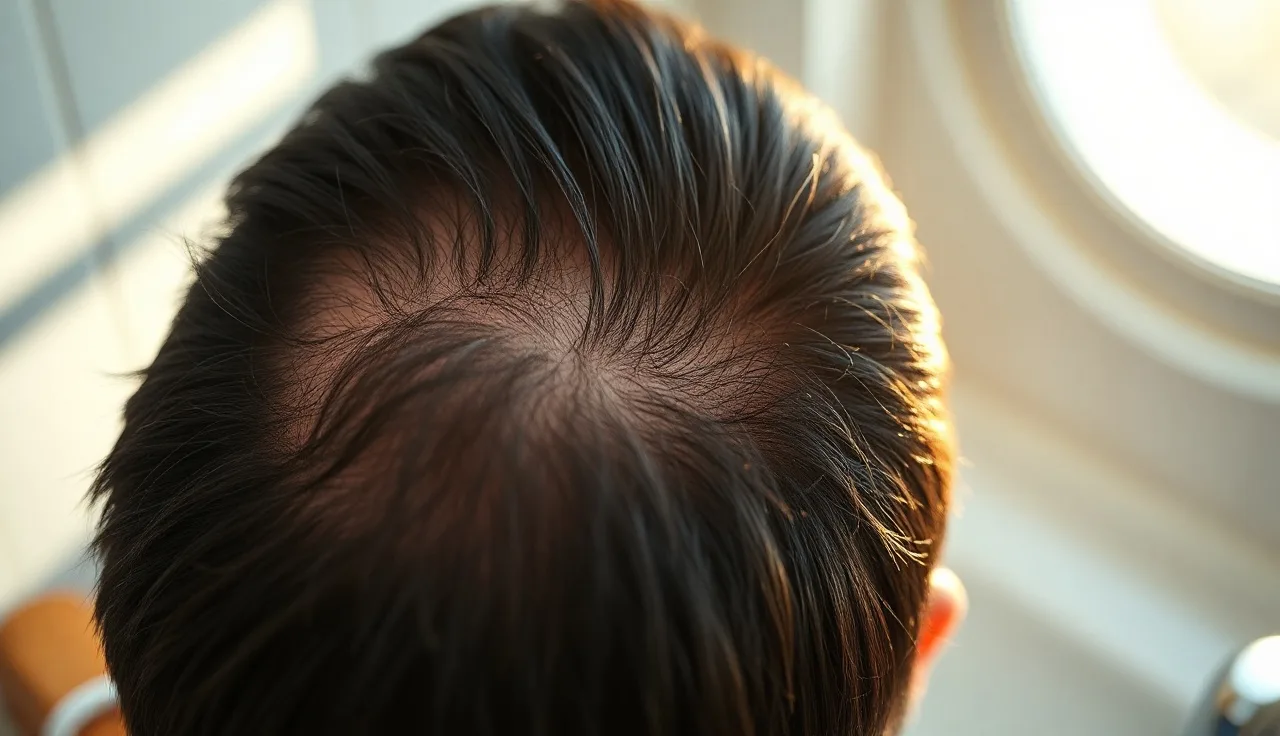
The photographic before/after images you find online are usually cherry-picked. The best responders tend to be younger, thinning for a shorter time, and losing hair at the crown rather than the front. Those men look genuinely impressive at 12 months. The median responder looks noticeably better at the vertex while the hairline itself barely moves.
Texture matters as much as count. Minoxidil works partly by stretching the anagen (growth) phase and partly by widening miniaturized vellus hairs back toward terminal caliber. So a realistic before/after difference is this: finer, shorter hairs get thicker and longer over 6 to 12 months, and the scalp stops showing through wet hair quite so much. Less photogenic than a full regrowth story. Also what most people actually get.
Want to know whether your pattern is the kind that responds best? Does minoxidil work breaks down the evidence by hair loss type and Norwood stage.
What is the minoxidil results timeline, month by month?
Month 1-2: Almost nothing visible. You may notice more shedding, which is normal and means the drug is pushing old telogen hairs out to make room for new anagen growth. This is telogen effluvium, and it scares people into quitting too early. Don't. The hair loss telogen explainer covers why this shedding phase is a sign the drug is doing something.
Month 3-4: The shedding slows. Some people see fine, short regrowth in areas that were thinning. Hair may look slightly fuller as new anagen hairs come in. This is usually when before/after comparisons stop looking worse and start looking mildly promising.
Month 5-8: The clearest improvement window for most users. Regrowth hairs have had 4 to 6 months of anagen time, so they are approaching visible length. The crown responds better than the frontal hairline here. A 48-week randomized controlled trial comparing 5% minoxidil foam to 2% solution found that 5% foam produced significantly greater increases in target area hair count by week 24 [2].
Month 9-12: Peak density for topical minoxidil lands somewhere in this range in most studies. After that, the drug tends to maintain rather than keep adding. AAD guidance tells clinicians to counsel patients that "results may take up to one year" [3].
Year 2 and beyond is maintenance. Use it consistently and most people hold their gains. If androgenetic alopecia is moving fast, you can still lose ground despite minoxidil, because minoxidil does nothing about the androgen signaling that drives follicle miniaturization. That gap is exactly why many dermatologists pair it with finasteride. Finasteride and minoxidil covers the combination data.
| Timeline | What typically happens |
|---|---|
| Weeks 1-6 | Increased shedding (telogen effluvium), no visible gain |
| Months 2-4 | Shedding slows, faint regrowth may begin |
| Months 4-6 | First visible improvement, especially at crown |
| Months 6-12 | Peak density for most topical users |
| Year 1+ | Maintenance phase; gains persist with continued use |
| After stopping | Regrowth reverses within 3-6 months |
How does oral minoxidil before and after compare to topical?
Low-dose oral minoxidil (0.625 mg to 5 mg daily) has become one of the more interesting shifts in hair loss treatment over the last decade, partly because the before/after data holds up against topical and in some studies looks better. A 2021 review in the Journal of the American Academy of Dermatology analyzed 17 studies of oral minoxidil for androgenetic alopecia and reported that "clinician-assessed improvement was reported in 78.5-100% of patients across studies" at doses mostly between 0.25 mg and 5 mg [4].
That reads better than topical, and for some people it probably is. Oral minoxidil reaches every follicle uniformly through the bloodstream instead of depending on how well you apply it and how well your scalp absorbs it. It also skips the scalp irritation and contact dermatitis some people get from topical solutions.
The side effect profile is the trade. Fluid retention, unwanted facial and body hair (hypertrichosis), and cardiovascular effects are real at higher doses. At 1 to 2.5 mg daily, the usual starting range for hair loss, these are mild for most people but not zero. Women in particular sometimes find facial hypertrichosis a dealbreaker.
Expect a timeline similar to topical: a shedding phase, visible improvement at 4 to 6 months, peak around 12 months. The coverage area can be wider since the drug circulates everywhere. People who applied topical inconsistently or had sensitive scalps often report better oral results.
Oral minoxidil is not FDA-approved specifically for hair loss. It is prescribed off-label from the original blood pressure indication. Oral minoxidil covers the dosing evidence and what to ask your prescriber.
For a direct comparison of minoxidil side effects across both formulations, that article lays out the topical versus oral risk profiles.
What do minoxidil beard before and after results look like?
Minoxidil for beard growth is off-label, and it works. The evidence base is smaller than for scalp hair, but a randomized, double-blind, placebo-controlled trial in the Journal of Dermatology in 2016 assigned 48 men with thin beards to apply 3% minoxidil lotion or placebo twice daily for 16 weeks. The minoxidil group showed a "significantly greater increase in total hair count" compared to placebo at week 16, and the improvement held for 4 weeks after they stopped [5].
Men in their early-to-mid 20s with patchy beards make the best candidates, because their follicles are likely vellus (present but underactivated) rather than gone. Minoxidil widens those vellus follicles and stretches their growth phase, filling patches over 3 to 6 months of consistent twice-daily use.
The timeline mirrors scalp use. Patchy areas can look temporarily worse at weeks 4 to 8. By month 4 to 6, most responders see real patch fill-in. A full before/after to a thick, even beard usually takes closer to 12 months.
One thing to watch: facial skin is not scalp skin. Systemic absorption from the face can run higher because facial skin is thinner and more vascular. Use the smallest effective amount and wash your hands after. Some practitioners keep facial use at 2% or 3% rather than 5% to hold down systemic exposure, though the head-to-head data on that specific point is thin.
Results are not permanent without continued use. Most beard users who stop report gradual thinning back toward baseline within a few months.
Who responds best to minoxidil, and who doesn't?
The FDA's original approval for topical minoxidil specified a "diameter of hair loss of 10 cm or less" at the vertex (crown), which tells you something: the approval was built around people with early, crown-dominant loss, not advanced or frontal loss [6].
Best responders tend to be under 40, have had hair loss for less than 5 years, still have visible follicles in the thinning area (you can still see hair, just thinner), and are losing mostly at the crown. Norwood II through IV patterns respond better than Norwood V through VII.
Worst responders have fully smooth, shiny bald areas where fibrotic tissue has replaced the follicles. Those follicles are gone. Minoxidil cannot create follicles where none exist.
Front hairline response is genuinely weaker than crown response, and that shapes what you should expect. A before/after for a receding hairline usually shows less drama than a before/after for the crown in the same person. Receding hairline covers what actually moves the needle on hairline recession.
Metabolism plays in too. The enzyme sulfotransferase converts minoxidil into its active form, minoxidil sulfate. Some people are "poor sulfators" and make less active metabolite from the same dose. A test exists (apply a small amount to the inner arm, then measure minoxidil sulfate in a hair strand sample) that can predict response, but it is not widely available and not standard of care.
Not sure what type of hair loss you actually have? A free AI hair analysis from MyHairline gives you a first read on your pattern before you spend money on treatments.
How much hair regrowth does minoxidil produce, by the numbers?
Concrete numbers from the best trials, no questionnaire fluff:
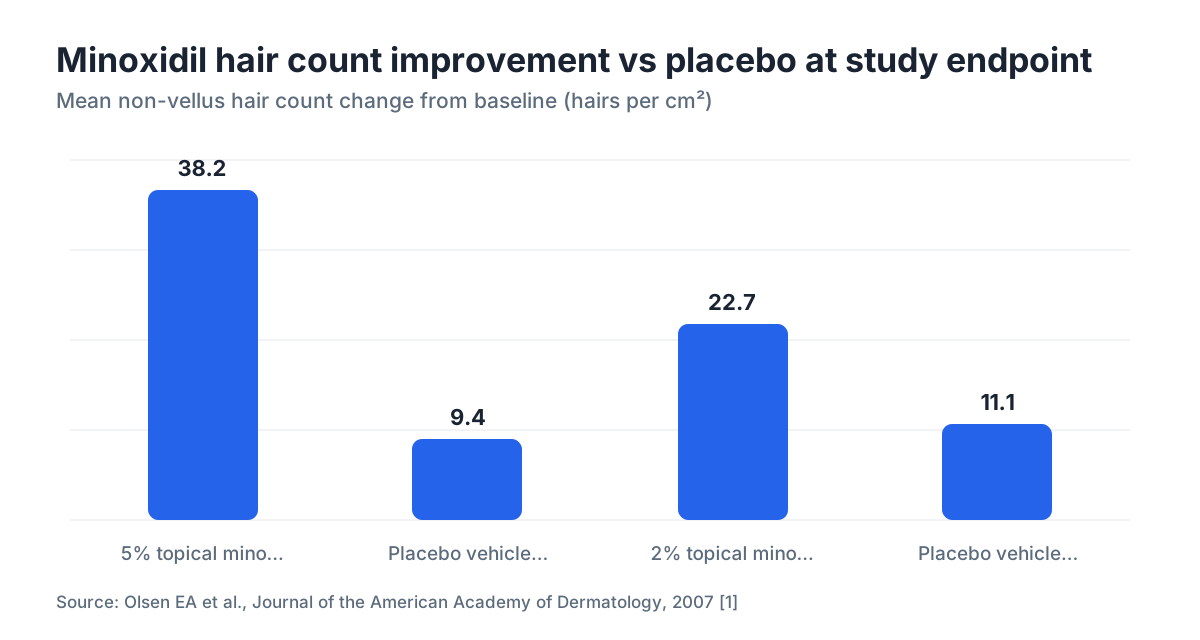
A multicenter randomized controlled trial of 5% topical minoxidil solution in men found mean increases of 38.2 non-vellus hairs per cm2 in the target area at 48 weeks, against a 9.4 hair/cm2 increase in the placebo group [1]. That is measured, not self-reported.
For women, a 32-week placebo-controlled trial found that 2% topical minoxidil produced a mean increase of 22.7 total hairs in the target area versus 11.1 for placebo, and investigators rated 63% of the active treatment group as showing "minimal to moderate" regrowth [7].
For oral minoxidil at 1.25 mg/day, a 24-week study in women found a 12.8% increase in hair density by phototrichogram [4].
The honest read: these are statistically significant improvements that real people notice in photos and feel on the scalp. They are not restorations. A 38-hair-per-cm2 gain sounds big until you learn that healthy scalp density runs roughly 175 to 300 hairs per cm2 [11]. Minoxidil gives back a fraction of what you lost.
That gap is why dermatologists keep pointing at combination therapy. Minoxidil plus finasteride outperforms either drug alone across studies. The combination hits both the growth side (minoxidil) and the miniaturization signal (finasteride) at once.
| Treatment | Study duration | Hair count improvement vs baseline |
|---|---|---|
| 5% topical minoxidil (men) | 48 weeks | +38.2 non-vellus hairs/cm2 [1] |
| 2% topical minoxidil (women) | 32 weeks | +22.7 total hairs in target area [7] |
| Oral minoxidil 1.25 mg/day (women) | 24 weeks | +12.8% hair density [4] |
| Placebo (topical vehicle) | 48 weeks | +9.4 non-vellus hairs/cm2 [1] |
What does minoxidil before and after look like for women?
Women's hair loss is usually diffuse across the top of the scalp rather than the receding hairline pattern more common in men. The FDA approved 2% topical minoxidil solution for women with androgenetic alopecia, and the 5% concentration later got approved too, though the original approval language specified it "for use in women" at 2% [6].
The visible before/after change for women is usually less scalp showing through the part, especially the central part width, which is the standard photographic measure in women's hair loss trials. Most trials rate this as "minimal" to "moderate" regrowth in responders. That is honest. Women rarely get the crown fill-in that photographs so well in some male comparisons.
The shedding phase at weeks 2 to 6 hits women harder emotionally, because their pattern often already feels like constant shedding. Knowing in advance that the initial shed is expected and temporary is what keeps people from quitting.
Foam versus solution: the 5% foam was developed partly to drop the propylene glycol in the original solution, which some users (especially women with fine hair) found left a residue or irritated the scalp. On results, foam and solution produce comparable hair counts at equal concentrations.
Very low-dose oral minoxidil (0.25 to 1 mg/day) has grown popular off-label for women lately, especially those who struggle with topical application or have sensitive scalps. Some dermatologists find it more convenient, and at these doses the hypertrichosis risk is lower than at blood-pressure doses.
What happens when you stop minoxidil?
This is the single thing to understand before you start, and most before/after marketing skips right past it.
Stop minoxidil and you lose most of the gains. The regrown hairs enter telogen and shed over roughly 3 to 6 months. You will not lose hair faster than you would have without ever starting, but you will lose the regrowth you built up and land back near where you would have been if you had never used it.
The AAD's patient resources on androgenetic alopecia state that minoxidil "must be used indefinitely" to keep its effects [3]. That is a commitment, not a treatment course.
It is also why before/after photos from people who "finished" minoxidil are misleading. There is no finishing. The drug is a maintenance tool.
If you are thinking about stopping because it is not doing enough, the real options are adding finasteride, switching to oral minoxidil, or talking to a dermatologist about whether a hair transplant fits your pattern and density. Hair transplant expenses can help you work out whether that route is realistic for your budget.
Is 5% minoxidil better than 2% for before and after results?
For men, yes, with caveats. A head-to-head randomized controlled trial in the Journal of the American Academy of Dermatology compared 5% solution to 2% solution in men over 48 weeks and found 5% produced significantly greater improvements in investigator-assessed regrowth and patient self-assessment at nearly every time point [1].
For women, it is murkier. The 5% solution earned approval for women partly on comparative data showing better hair counts than 2%, but the original label flagged the potential for increased facial hair, which changes the risk/benefit math.
The 5% foam was shown in a 52-week randomized controlled trial to be non-inferior to the 5% solution and statistically better than vehicle, with a tolerability edge because it drops the propylene glycol [2].
Practically: if you are a man starting minoxidil for the first time, 5% is the evidence-supported starting point. If you are a woman with a sensitive scalp or worried about facial hypertrichosis, starting at 2% and titrating up is reasonable. Talk it through with a dermatologist instead of self-titrating off forum advice.
Can minoxidil results be improved by combining it with other treatments?
Yes, and the combination data is convincing. The biggest effect sizes in hair loss research come from pairing minoxidil with finasteride (for men with androgenetic alopecia) or with microneedling.
A multicenter randomized controlled trial comparing finasteride alone, minoxidil alone, and the combination in men with androgenetic alopecia found the combination produced greater hair count increases and was rated "greatly improved" by significantly more patients than either drug alone [8]. If you are eligible for finasteride, adding it to minoxidil produces before/after results that beat minoxidil by itself.
Microneedling: a randomized controlled trial in the International Journal of Trichology found that adding microneedling (weekly sessions over 12 weeks) to twice-daily 5% minoxidil produced a 40-hair/cm2 greater increase in hair count than minoxidil alone [9]. The likely mechanism is that microneedling-induced wound healing raises growth factors that help follicles respond to minoxidil.
Platelet-rich plasma (PRP): the evidence is less consistent but generally positive. PRP alone or as an add-on to minoxidil has shown benefit in several small trials, though how PRP gets prepared varies widely study to study, which muddies the picture.
Hair loss supplements like biotin and saw palmetto have much weaker evidence and are unlikely to change your before/after outcome. I would not treat them as primary therapy.
If your hair loss has a trigger you have not pinned down, what causes hair loss walks through the differential, because no combination works well while the real cause (thyroid dysfunction, a nutritional deficiency, and so on) is still active.
Are there photos of real minoxidil results I can trust?
Published clinical trial photos are the most trustworthy. The major 5% minoxidil trials use standardized macrophotography under controlled lighting, often with defined target areas marked on the scalp. They show real improvement in real patients under real conditions, with a control group to measure against.
Dermatology journals (JAAD, British Journal of Dermatology, International Journal of Trichology) often include representative before/after photos in their materials. Those are not skimmed from thousands of users. They are representative patients pulled from controlled groups.
Before/after photos on commercial websites, social media, and supplement product pages are almost always best responders, often shot under flattering light, sometimes with different styling between before and after. They do not represent the average. Lighting and styling changes alone can fake a dramatic transformation with zero actual regrowth.
Here is a realistic expectation from median trial data. At 12 months of 5% minoxidil, expect a visible but moderate density gain at the crown and less obvious change at the hairline. Roughly 40 to 45% of men see regrowth rated "moderate to dense" by investigators; the rest see minimal or none [1]. Knowing which group you are likely in before you start is worth a lot.
MyHairline's free AI hair analysis at /scan reads your own photos for pattern and density, which beats comparing your hairline to a stranger's before/after.
What should I do if minoxidil is not working for me?
First, confirm you gave it a fair trial. Most people who say minoxidil failed either quit during the shedding phase or used it inconsistently. A fair trial is at least 12 months of consistent, twice-daily application [3]. Once a day instead of twice, or skipping several times a week, measurably cuts efficacy.
If you genuinely used it consistently for 12 months and see nothing, a few possibilities:
You may be a poor sulfator (see above). Some dermatology practices can test sulfotransferase activity.
Your pattern may be too advanced for minoxidil to show a clinically meaningful result. At Norwood V or higher with heavy crown loss, the remaining follicular density can simply be too low for visible coverage.
You may have a different type of hair loss that does not respond to minoxidil. Scarring alopecias, alopecia areata, and hormonal causes unrelated to DHT do not behave like androgenetic alopecia. A dermatologist can run a scalp biopsy to rule these out.
Next steps: add finasteride if you are a man and have not. Try oral minoxidil if you have only used topical. See a board-certified dermatologist or trichologist for a scalp assessment. If you have already lost significant density and want to think about restoration, reviewing hair transplant options and costs is a reasonable next move.
For men specifically, minoxidil for men covers what to do when first-line treatment stalls.
Sources
- Journal of the American Academy of Dermatology: Olsen EA et al., 'A multicenter, randomized, placebo-controlled, double-blind clinical trial of a novel formulation of 5% minoxidil topical foam versus placebo in the treatment of androgenetic alopecia in men' (2007)
- Journal of the American Academy of Dermatology: Olsen EA et al., 'Global photographic assessment of men enrolled in a randomized, placebo-controlled clinical trial using 5% minoxidil topical foam' (2007)
- American Academy of Dermatology: Hair loss types: Androgenetic alopecia overview and treatment
- Journal of the American Academy of Dermatology: Randolph M, Tosti A. 'Oral minoxidil treatment for hair loss: A review of efficacy and safety' (2021)
- Journal of Dermatology: Ingprasert S et al., 'Efficacy and safety of minoxidil 3% lotion for beard enhancement: a randomized, double-masked, placebo-controlled study' (2016)
- FDA: Minoxidil topical solution prescribing information and approval history
- Journal of the American Academy of Dermatology: DeVillez RL et al., 'Androgenetic alopecia in the female. Treatment with 2% topical minoxidil solution' (1994)
- Journal of the American Academy of Dermatology: Khandpur S et al., 'Comparative efficacy of various treatment regimens for androgenetic alopecia in men' (2002)
- International Journal of Trichology: Dhurat R et al., 'A randomized evaluator blinded study of effect of microneedling in androgenetic alopecia' (2013)
- National Library of Medicine / StatPearls: Badri T et al., 'Minoxidil' (continuously updated reference)
- British Journal of Dermatology: Price VH. 'Treatment of hair loss' (1999)