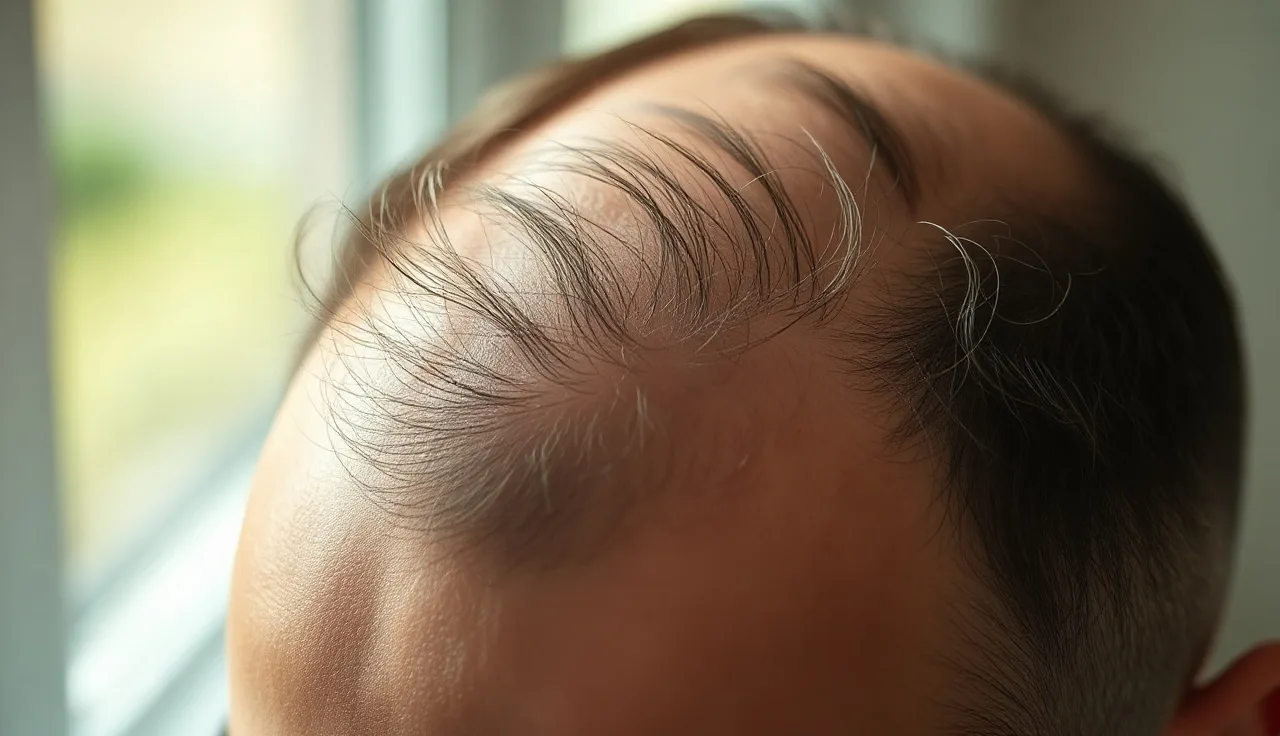
TL;DR: DHT (dihydrotestosterone) miniaturizes hair follicles in people with androgenetic alopecia. Block DHT, and you can slow the loss and, for many people, regrow some hair. Finasteride is the most evidence-backed oral DHT blocker, cutting scalp DHT by roughly 70%. Topical versions work with weaker data behind them. No DHT blocker cures hair loss for good.
What is DHT and why does it shrink hair follicles?
DHT stands for dihydrotestosterone. Your body makes it when an enzyme called 5-alpha reductase converts testosterone. DHT is more potent than testosterone itself. In follicles that carry a genetic sensitivity to it, DHT binds to androgen receptors and starts a process called miniaturization: the follicle produces thinner, shorter, lighter hairs over time until it stops making visible hair at all. [1]
The follicle doesn't die overnight. It shrinks over years. That slow timeline is exactly why starting early matters.
Most men and women with androgenetic alopecia (the medical name for pattern hair loss) have normal, even average, testosterone levels. The problem isn't a hormone imbalance. It's how their follicles react to DHT, and that reaction is written into their genes. [2]
The back and sides of the scalp carry follicles that are largely DHT-resistant. That's why hair loss follows predictable patterns and why receding hairlines hit the temples and crown first. The same fact explains why hair transplants work: donor follicles from the back stay resistant even after a surgeon moves them. [3]
DHT sensitivity is the dominant driver of pattern loss, but it isn't the only thing going on. Stress, nutrition, and hormonal shifts like thyroid changes all interact with it. The what causes hair loss guide covers the rest.
How do DHT blockers work to promote hair growth?
DHT blockers work two ways. One approach shuts down the 5-alpha reductase enzyme so your body converts less testosterone into DHT in the first place. The other blocks the androgen receptors on follicle cells so DHT can't bind and trigger miniaturization even when it's floating around.
Finasteride and dutasteride both work by enzyme inhibition. Finasteride blocks the type II isoform of 5-alpha reductase. Dutasteride blocks both type I and type II, which is why it drives a deeper reduction in DHT (roughly 90% for serum DHT versus finasteride's 70%). [4] Saw palmetto and some topical agents get marketed as receptor blockers or mild enzyme inhibitors, but the clinical evidence for them is thin.
Cut DHT at the follicle, and miniaturization slows or stops. In follicles that still respond, the hair cycle can partly reverse: a follicle producing thin vellus hairs can return to producing thick terminal hairs. That's what people call regrowth. How much you get depends on how long you've been losing hair and how sensitive your follicles are.
Here's the part nobody selling a product wants to say plainly. DHT blockers don't regrow hair on a smooth bald scalp. Once follicles have been dormant long enough, they scar over and stop responding. Blockers help while follicles are still miniaturizing, not after they're gone.
What are the most effective DHT blockers for hair growth?
Here's an honest ranking based on the strength of the clinical evidence, not the marketing.
| DHT Blocker | Mechanism | Evidence Level | Typical DHT Reduction | Prescription? |
|---|---|---|---|---|
| Finasteride 1mg oral | 5-AR type II inhibitor | Strong (RCTs) | ~70% serum DHT | Yes |
| Dutasteride 0.5mg oral | 5-AR type I+II inhibitor | Moderate (RCTs, off-label) | ~90% serum DHT | Yes (off-label for hair) |
| Topical finasteride | 5-AR type II inhibitor | Growing (smaller trials) | Lower systemic, local effect | Yes |
| Topical minoxidil | Vasodilator (not DHT mechanism) | Strong (RCTs) | None | No |
| Saw palmetto oral | Weak 5-AR inhibitor | Weak (small studies) | ~32% [5] | No |
| Ketoconazole shampoo | Possible anti-androgen | Weak (adjunct data) | Unclear | Low-dose OTC |
Finasteride is the most studied drug on this list. A 5-year randomized controlled trial in the Journal of the American Academy of Dermatology found that 48% of men taking 1mg finasteride daily showed hair growth versus 7% on placebo, and 83% held their hair count steady versus 28% on placebo. [6] The FDA approved it for male pattern hair loss in 1997 under the brand name Propecia. [7]
Dutasteride beat finasteride in head-to-head trials, with meaningfully higher hair counts at 24 weeks in men with androgenetic alopecia. [4] But it isn't FDA-approved for hair loss (only for enlarged prostate), so doctors prescribe it off-label.
Topical finasteride is newer. It puts finasteride on the scalp with far less getting into the bloodstream, which points to a friendlier side effect profile. Early trials look good. Long-term data is still piling up.
Saw palmetto gets sold as the natural answer. One small randomized trial showed 38% of participants had more hair density after six months versus 24% on placebo. [5] The samples are small and the evidence sits well below finasteride's. If prescription drugs make you uneasy, it's a low-risk thing to try. Just keep your expectations honest.
For a full breakdown of the leading prescription option, read the finasteride guide.
Does finasteride actually regrow hair or just stop loss?
Both, and which one you get depends on the person and how far the loss has gone. The large trials showed two clear effects: finasteride slowed or halted further loss in most men, and it produced measurable regrowth in roughly half of users over two years. [6]
Regrowth shows up most at the vertex (crown) and midscalp. The frontal hairline fights back harder, though loss there still slows. Any honest dermatologist will tell you finasteride stops loss better than it reverses it, especially at the hairline.
Results take patience. Most people see almost nothing in the first three months. Give it 12 months of consistent daily use before you judge whether it's working. Stop taking it, and DHT climbs back to baseline within weeks. The loss resumes and often catches up to where it would have been within 12 months. [7]
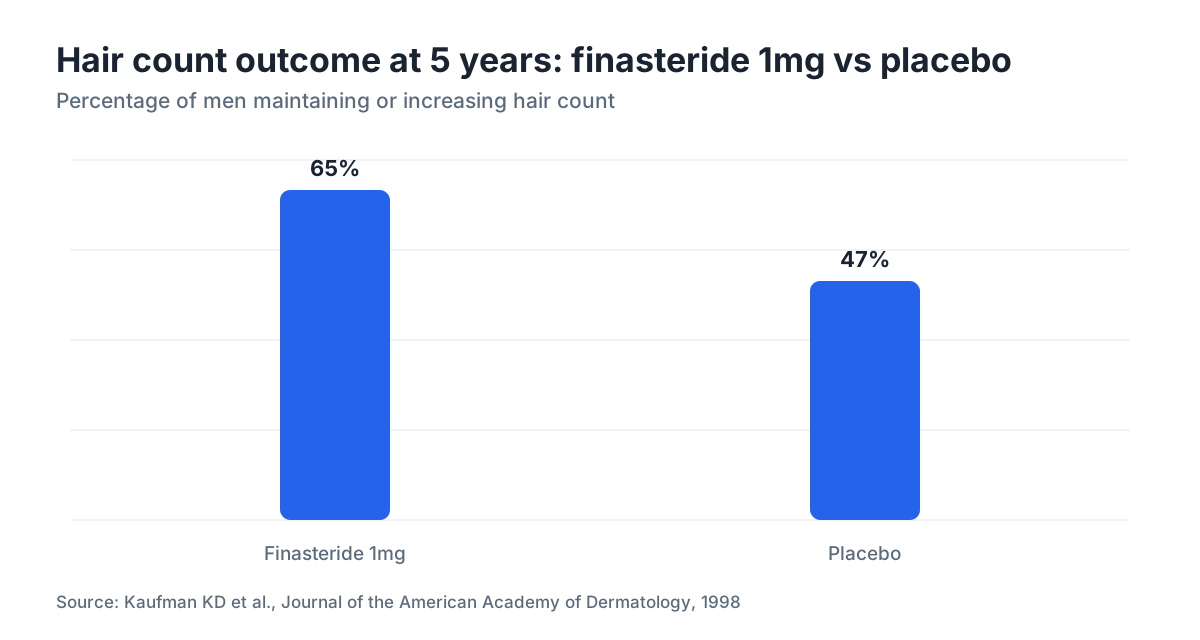
One finding is worth quoting directly. The 5-year finasteride trial reported that "hair count was maintained or increased in 65% of men treated with finasteride compared with 47% of men treated with placebo." [6] That gap is real. It also tells you finasteride is no guarantee.
If you want to stack approaches, running finasteride alongside minoxidil is well-supported. The finasteride and minoxidil breakdown covers how the two work together.
Are DHT-blocking shampoos and topical products worth buying?
This is where a lot of money disappears. Let me be blunt.
A shampoo sits on your scalp for two to five minutes, then you rinse it away. To block DHT at the follicle, an ingredient needs real contact time and enough penetration to reach the follicle bulb, which sits a few millimeters under the skin. Most shampoo formulas never get there.
Ketoconazole shampoo (originally an antifungal) is the one rinse-off product with data behind it. A study comparing 1% ketoconazole shampoo to 2% minoxidil lotion found similar gains in hair density and hair size, though the trial was small and hasn't been widely repeated. The AAD doesn't list ketoconazole shampoo as a first-line treatment for androgenetic alopecia, but some dermatologists use it as an add-on. [8]
Products sold as DHT-blocking shampoos usually pack in saw palmetto extract, pumpkin seed oil, or biotin. The evidence for those ingredients in shampoo form is basically nonexistent. Pumpkin seed oil has one randomized controlled trial in capsule form showing a 40% increase in hair count at 24 weeks in men with androgenetic alopecia. [5] That was an oral supplement, not a rinse.
Already on finasteride or minoxidil and want to add ketoconazole shampoo two or three times a week? The cost is low and there's at least a theoretical upside. But a DHT-blocking shampoo as your main plan won't move much.
The hair loss supplements article walks through what has and hasn't passed clinical testing, minus the hype.
What are the side effects of DHT blockers?
The side effects of oral DHT blockers are real and documented in clinical trials. They also get blown out of proportion in some corners of the internet, which scares off people who would genuinely benefit. Both things are true at once.
Finasteride side effects (from the FDA prescribing information): sexual side effects, including lower libido, erectile dysfunction, and ejaculatory problems, showed up in roughly 1.4% to 3.8% of men in trials versus 0.9% to 2.1% on placebo. [7] So the drug-attributable rate is low but not zero. The label also notes post-marketing reports of depression and, rarely, persistent sexual side effects after stopping (sometimes called post-finasteride syndrome), though whether the drug causes those is still argued in the literature.
One practical note for men: finasteride lowers PSA (prostate-specific antigen) by about 50%, which matters if a doctor is using PSA to screen for prostate cancer. Tell your doctor you're on it.
Dutasteride carries a similar but somewhat wider side effect profile because it blocks both enzyme isoforms. Its half-life runs about five weeks, so if side effects hit, they take longer to clear after you stop.
Topical finasteride drops serum DHT far less than oral does (around 7% to 8% versus 65% to 70% in one comparative study), which is the whole point. [9] Less systemic exposure should mean fewer systemic side effects, though the topical-specific side effect data is still maturing.
Saw palmetto is mild. Stomach upset is the main gripe. At typical doses (320mg daily), serious adverse effects look rare in trials.
Women who are pregnant or could become pregnant must not take finasteride or dutasteride, and shouldn't handle crushed or broken tablets. Both drugs can cause birth defects in male fetuses by interfering with normal DHT-dependent development. [7]
If you're thinking about combining treatments, the minoxidil side effects page covers the companion drug's risk profile.
Can women use DHT blockers for hair loss?
Yes, but it's more complicated than it is for men.
Women develop androgenetic alopecia too (usually called female pattern hair loss), and DHT plays a part in at least some cases. Finasteride, though, isn't FDA-approved for hair loss in women. The main barrier is the pregnancy risk: finasteride can cause ambiguous genitalia in male fetuses, and plenty of women with hair loss are of reproductive age. [7]
Still, dermatologists prescribe finasteride off-label for postmenopausal women, usually at higher doses (2.5mg to 5mg daily rather than 1mg), and some studies show real gains in hair density. Spironolactone, a different anti-androgen (it blocks androgen receptors rather than the 5-alpha reductase enzyme), is the more common pick for women with hormonal pattern loss in the US.
Dutasteride has been studied in women with some positive results, but it's also off-label and carries the same pregnancy warnings.
For women, the standard first-line FDA-approved options are topical minoxidil (both the 2% and 5% formulations are approved for women) and, in some countries, topical finasteride. If your loss looks hormonal, a dermatologist or endocrinologist can run labs to check whether elevated androgens are part of the story, which shifts the whole treatment plan.
For a type of hair loss common in women and often mistaken for pattern loss, see telogen effluvium.
How long does it take for a DHT blocker to show results?
Most people won't see meaningful visible change in the first 90 days. That wait is one of the biggest reasons people quit too soon.
Here's roughly what to expect on finasteride:
- Month 1 to 3: DHT drops fast, but the growth cycle takes time to catch up. Some people notice a brief bump in shedding (the "dread shed") as follicles cycle. That isn't a sign the drug is failing.
- Month 3 to 6: Shedding usually slows. Some people see the hairline holding or early regrowth at the crown.
- Month 6 to 12: The clearest window to judge response. Most dermatologists evaluate finasteride at the 12-month mark.
- Year 1 to 5: Slow continued improvement is possible, especially at the vertex. The 5-year trial showed ongoing benefit with continued use. [6]
Dutasteride can show earlier, stronger results in trials (one study found meaningfully higher hair counts at 24 weeks versus finasteride), which some patients like if they want faster feedback. [4]
Consistency matters more than almost anything else. Finasteride depends on sustained DHT suppression. Skipping doses, cycling on and off, or stopping and restarting undercuts the treatment and makes it impossible to tell if it's actually working.
Running minoxidil alongside a DHT blocker? The minoxidil for men guide covers realistic timelines and what counts as a real response.
Do natural DHT blockers like saw palmetto and pumpkin seed oil work?
They might help a little. The evidence is real but limited, and I'll give it to you straight.
Saw palmetto's best data comes from a small 2002 randomized trial plus some observational work, showing modest gains in hair density. A separate study pitting saw palmetto against finasteride found finasteride won handily (68% rated as improved versus 38%), but saw palmetto still beat placebo. [5]
Pumpkin seed oil (PSO) has a single double-blind randomized controlled trial of 76 men, published in Evidence-Based Complementary and Alternative Medicine in 2014. At 24 weeks, the PSO group showed a 40% increase in hair count versus 10% on placebo. [5] That's a real signal. But one trial in 76 men isn't the decades of data sitting behind finasteride.
Rosemary oil comes up a lot too. A small trial comparing rosemary oil to 2% minoxidil over six months found similar hair count gains, though both groups reported scalp itching. [10] The mechanism doesn't look DHT-related, so calling rosemary oil a DHT blocker is probably wrong.
Not ready for prescription drugs? Combining saw palmetto (320mg daily) and pumpkin seed oil is a low-risk place to start. Don't expect finasteride results. If you already see visible thinning, the slower natural options may not outrun the loss.
One thing to watch: supplements aren't regulated like drugs. Purity and dosing swing wildly by brand. If you go this route, look for products with third-party testing (USP or NSF certification).
Curious whether other supplements touch your hair? If you've read the creatine scare, the does creatine cause hair loss article works through the single study that started it.
Should you combine a DHT blocker with minoxidil or a hair transplant?
Pairing a DHT blocker with minoxidil is one of the best-supported strategies in hair loss medicine. Finasteride hits the hormonal root cause. Minoxidil (a vasodilator that stretches out the anagen growth phase) attacks the problem through a completely separate pathway. Studies and clinical practice keep showing they add up. [2]
The AAD's clinical practice guidelines list both finasteride and minoxidil as first-line treatments for androgenetic alopecia, and they mention combination use directly. [2] Plenty of dermatologists start patients on both at once.
Thinking about a hair transplant? DHT blockers are often treated as essential before and after surgery. Here's the logic. A transplant relocates DHT-resistant donor follicles into balding zones, but it does nothing to protect the native hairs already sitting in the recipient area. Skip the DHT blocker, and you can get a clean transplant result and still lose the surrounding native hairs over the next few years, which leaves the grafts looking stranded.
Most transplant surgeons want patients on finasteride before surgery (or postmenopausal, or past the age where big further loss is likely) to stabilize the native hair. Starting after a transplant beats nothing. Starting before is cleaner.
Trying to figure out where you sit on the loss spectrum before choosing treatments? MyHairline's free AI hair scan (/scan) gives you a Norwood stage estimate from a photo, which is useful context before you talk to a dermatologist.
Weighing oral minoxidil (lower doses, systemic) instead of topical? The oral minoxidil page covers what's different about that route.
How do you know which DHT blocker is right for your situation?
The real answer is that a board-certified dermatologist should make this call with you. Here's a practical framework for thinking it through first.
If you're a man with androgenetic alopecia, no contraindications, and you can accept the small but real risk of sexual side effects, finasteride 1mg daily is the logical first move. It's generic, cheap (often $15 to $30 a month without insurance at major pharmacies), FDA-approved, and backed by 25 years of post-market data.
If finasteride hasn't delivered enough at 12 months, a conversation about dutasteride makes sense. Some men respond better to it, especially those with higher-than-average 5-alpha reductase activity.
Worried about systemic side effects? Topical finasteride (available through several compounding pharmacies and some telehealth services) is worth discussing. It costs more and has less long-term data, but the lower systemic absorption is real and documented. [9]
If you're a woman, skip finasteride unless you're postmenopausal with a dermatologist overseeing it. Spironolactone or topical minoxidil are the more standard starting points, depending on your hormonal picture.
Skeptical of prescription drugs and want somewhere low-risk to start? Saw palmetto plus pumpkin seed oil is the best-supported natural combo, with the honest caveat that results run modest at best.
The most common mistake is waiting. Follicles miniaturizing for years are harder to rescue than follicles that just started. A photo-based hair analysis like the one at MyHairline (/scan) can help you gauge urgency by estimating your Norwood stage, which then helps your dermatologist plan timing.
For all the non-DHT reasons hair falls out, read the what causes hair loss guide before assuming DHT is your only problem.
Sources
- National Institutes of Health, StatPearls: Androgenetic Alopecia
- National Institutes of Health, StatPearls: Hair Transplantation
- Olsen EA et al., Journal of the American Academy of Dermatology, 2006: Dutasteride vs finasteride in androgenetic alopecia
- Evron E et al., Skin Appendage Disorders, 2020: Natural hair supplement review including saw palmetto and pumpkin seed oil
- Kaufman KD et al., Journal of the American Academy of Dermatology, 1998: 5-year finasteride trial in men with androgenetic alopecia
- US Food and Drug Administration, Propecia (finasteride) prescribing information
- American Academy of Dermatology, Hair Loss: Tips for Managing
- Caserini M et al., Drug Delivery, 2016: Topical versus oral finasteride pharmacokinetics and DHT suppression
- Panahi Y et al., Skinmed Journal, 2015: Rosemary oil vs 2% minoxidil for hair growth