
TL;DR: DHT (dihydrotestosterone) is the hormone that shrinks hair follicles in genetically susceptible men. Finasteride, a prescription 5-alpha-reductase inhibitor, is the most effective DHT blocker available. It cuts scalp DHT by roughly 70% and halts hair loss in about 90% of men who take it. Natural options like saw palmetto show modest evidence and far weaker effects. No DHT blocker regrows all lost hair.
What does a DHT blocker actually do to your hair?
A DHT blocker either reduces how much dihydrotestosterone your body makes or stops it from binding to receptors in your scalp follicles. That matters because DHT is the hormone that shrinks those follicles in men with pattern baldness. Block it, and the shrinking slows or stops.
Here's the biology. Testosterone converts to DHT through an enzyme called 5-alpha-reductase. In men with androgenetic alopecia (male pattern baldness), DHT binds to receptors in scalp follicles and progressively miniaturizes them. Each hair cycle, the shaft comes back thinner and shorter, until the follicle stops producing visible hair at all.
A good blocker interrupts that loop. When it works, follicles stop shrinking. Some partially recovered follicles even produce thicker hair again, though regrowth is always partial and depends on how far the miniaturization has gone.
DHT blockers do nothing for follicles that are already dead. That's the single most important thing to understand before you spend a dollar on any of them. If a patch has been smooth for years, blocking DHT won't bring it back. Start early, preserve more. [1]
For a broader look at what's driving your shedding, see what causes hair loss.
How does DHT cause male pattern baldness?
DHT causes male pattern baldness by binding to oversensitive androgen receptors inside your scalp follicles, which triggers them to shrink cycle after cycle. The sensitivity is inherited. Men who lose hair have follicles that overreact to DHT, a trait passed down in a polygenic pattern, meaning many genes contribute from both parents. [2]
The process is slow. DHT shortens the anagen (growth) phase of the hair cycle and lengthens the telogen (resting) phase, so hairs spend less time growing and more time sitting dormant or shedding. Over years, the follicle itself physically shrinks. That miniaturization drives the hairline recession and crown thinning you see on the Norwood scale.
Blood DHT levels don't predict who goes bald or how fast. Two men with identical serum DHT can end up completely different, because the difference lives in receptor sensitivity, not hormone quantity. That's why some men bald at 22 and others keep a full head at 70 on comparable hormone levels. Blocking systemic DHT helps regardless of your baseline, which is why finasteride works even in men whose bloodwork looks textbook normal. [1]
What are the proven prescription DHT blockers for men?
Two FDA-approved drugs block DHT through 5-alpha-reductase inhibition: finasteride and dutasteride. Finasteride is the only one approved specifically for hair loss. Both are oral, taken daily, and require a prescription. Effects take 3 to 6 months to show, and stopping reverses the benefit within 6 to 12 months. [3]
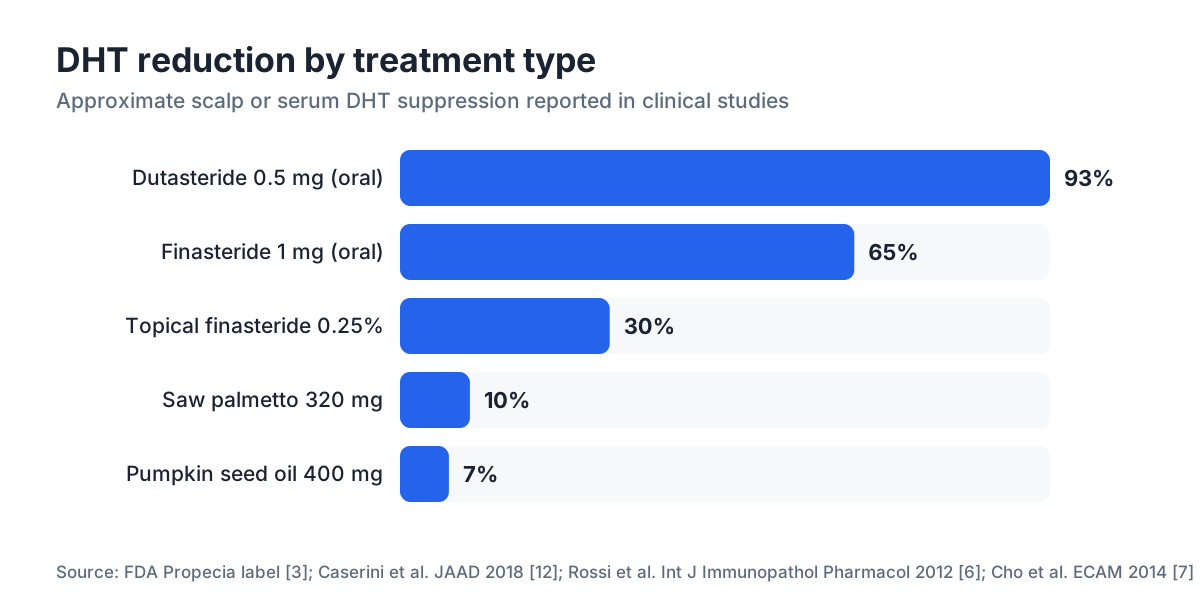
Finasteride (1 mg, brand name Propecia) inhibits the type II isoform of 5-alpha-reductase, the main isoform active in scalp follicles. The trials behind FDA approval found finasteride 1 mg daily maintained or increased hair count in about 90% of men at two years, and 48% showed visible improvement by physician assessment. [3] Scalp DHT falls by roughly 60 to 70% on this dose. [3]
Dutasteride (0.5 mg, brand name Avodart) blocks both the type I and type II isoforms, so it suppresses systemic DHT more completely, around 90 to 95%. The FDA approved it for benign prostatic hyperplasia (BPH), not hair loss, though dermatologists prescribe it off-label. A 2010 randomized controlled trial in the Journal of the American Academy of Dermatology found dutasteride 0.5 mg superior to finasteride 1 mg for hair count at 24 weeks. [4] It's more potent and lingers far longer (half-life near 5 weeks versus finasteride's 6 hours), so the side effect profile is similar but recovery after stopping is slower.
For a detailed breakdown, see our guide on finasteride and the combination approach in finasteride and minoxidil.
| Drug | DHT reduction | FDA-approved for hair loss | Half-life |
|---|---|---|---|
| Finasteride 1 mg | ~60-70% | Yes (Propecia) | ~6 hours |
| Dutasteride 0.5 mg | ~90-95% | No (off-label) | ~5 weeks |
| Saw palmetto (supplement) | Unknown, likely small | No | N/A |
| Ketoconazole shampoo | Topical, weak | No | N/A |
What are natural DHT blockers for men, and do they work?
Natural DHT blockers range from mildly plausible to pure marketing noise. A handful have real trials behind them. Most don't. Here's the honest breakdown.
Saw palmetto (Serenoa repens) is the most studied natural blocker. It appears to inhibit 5-alpha-reductase weakly and may have some androgen receptor activity. A 2002 randomized trial in the Journal of Alternative and Complementary Medicine found 60% of men taking 200 mg saw palmetto extract reported improvement, versus 11% on placebo. [5] That trial was tiny (26 men) and measured subjective outcomes. A 2012 randomized trial in the International Journal of Immunopathology and Pharmacology pitted saw palmetto (320 mg/day) against finasteride (1 mg/day) and found finasteride clearly outperformed it on hair count and hair diameter. [6] Saw palmetto is safe for most men and costs almost nothing. It's no replacement for finasteride, but if you can't take finasteride or won't, it's the best-evidenced natural option.
Pumpkin seed oil has one solid randomized controlled trial. A 2014 study in Evidence-Based Complementary and Alternative Medicine found men taking 400 mg/day had 40% more hair count at 24 weeks versus placebo, and the effect was statistically significant. [7] The mechanism isn't nailed down but likely involves some 5-alpha-reductase inhibition. The trial had 76 men, small but better than most supplement research. The effect was far milder than finasteride, but it's real data.
Rosemary oil (topical) deserves its own line because it has a genuine comparison trial. A 2015 randomized trial in SKINmed Journal found rosemary oil applied twice daily matched 2% minoxidil on hair count at 6 months, with less scalp itching. [8] The proposed mechanism is better scalp circulation, not DHT blockade. It's not a true DHT blocker, but it belongs in the conversation about non-drug options.
Ketoconazole shampoo (2%) is an antifungal with some evidence for mild androgen receptor blockade at the follicle. A 1998 study in Dermatology found alternating ketoconazole 2% shampoo with minoxidil produced hair density gains similar to minoxidil alone, though it wasn't compared directly to finasteride. [9] It's cheap, low-risk, and many dermatologists recommend it as an add-on.
Largely wishful thinking: biotin (only helps if you're deficient), stinging nettle extract (essentially no human hair trials), green tea EGCG (early lab data, no convincing human trials), zinc supplements (useful only for deficiency-driven loss). For a broader look, see hair loss supplements.
Which is the best DHT blocker for men overall?
Finasteride 1 mg daily is the best DHT blocker for men if you have pattern baldness and you're medically eligible. Nothing natural comes close in head-to-head trials. The evidence runs decades deep, FDA approval demanded large randomized controlled trials, and the mechanism is well understood. [3]
Dutasteride beats finasteride on DHT suppression and on at least some hair count measures, but it hits systemic DHT harder and washes out much slower. Most dermatologists start with finasteride and move to dutasteride only when results fall short.
Want the best natural route? Saw palmetto at 320 mg/day leads the evidence, with pumpkin seed oil at 400 mg/day a fair addition. Stack both, add ketoconazole shampoo two or three times a week, and you have the strongest natural combination available for men who won't or can't use finasteride. Just don't expect the same result. In the 2012 comparison trial, finasteride produced statistically significant gains in hair count and shaft diameter while saw palmetto did not reach significance on the same measures. [6]
Not sure where you land on the hair loss spectrum? A free AI scan at MyHairline reads your Norwood stage from a photo and shows which areas are most affected, which helps you decide if you're a candidate for aggressive treatment or can reasonably start lighter.
The honest summary: natural blockers beat nothing, and prescription blockers beat natural by a lot. The gap is wide.
What are the real side effects of DHT blockers?
The most common side effects of finasteride are sexual: decreased libido, erectile dysfunction, and reduced ejaculate volume. The FDA label reports these in about 3.8% of men in clinical trials versus 2.1% on placebo. [3] Those are low numbers, though online communities amplify the worst outcomes.
Most of these effects resolve after stopping the drug. The FDA added a label update in 2012 noting that some men report persistent sexual dysfunction after discontinuation, a condition some call post-finasteride syndrome. Whether persistent symptoms are real and how common they are is genuinely debated in the literature. What's clear is that it affects a minority of users and that the risk deserves honest disclosure from prescribers. [10]
Dutasteride carries a similar risk profile with one wrinkle: its long half-life means any side effects that appear may take longer to fade after you stop.
Finasteride also cuts PSA (prostate-specific antigen) levels by roughly half, which matters for prostate cancer screening. Any man on finasteride who gets a PSA test should tell his doctor so the result gets read correctly. [3]
Natural blockers are much cleaner. Saw palmetto is generally well-tolerated, with mild gastrointestinal upset the most common complaint. Pumpkin seed oil has no notable adverse effects in the clinical literature. Ketoconazole shampoo occasionally causes scalp irritation or dryness.
The decision to use finasteride is personal. The sexual side effect risk is real but statistically uncommon in trials, and many men take it for decades without trouble. The right call depends on how much the hair loss bothers you against your comfort with a hormonal drug.
How long does it take for DHT blockers to work?
Finasteride takes 3 to 6 months before you'll notice meaningful change, with the full effect building over 1 to 2 years. Expect a temporary bump in shedding in the first few months as DHT-damaged follicles reset their cycle. That's normal, not a sign the drug is failing.
The Propecia trials used 12 and 24-month endpoints for their primary outcomes, because hair grows slowly and the measurement window has to be long. At 24 months, men still on finasteride kept improving while the placebo group lost ground. [3]
Saw palmetto and pumpkin seed oil, if they work for you, run on a similar timeline since they act on the same pathway, just weaker. The 2014 pumpkin seed oil trial used a 24-week endpoint. [7]
Patience is the hard part. Most men who quit DHT blockers bail in the first 3 months, before any benefit shows. Start, then give it at least 6 months before you judge it.
Can you use DHT blockers with minoxidil?
Yes, and this pairing is the most evidence-backed approach in dermatology. Minoxidil and finasteride work through completely separate mechanisms. Minoxidil is a vasodilator that extends the anagen growth phase and boosts blood flow to follicles. It doesn't touch DHT. Using both attacks DHT-driven miniaturization (finasteride's job) and directly stimulates follicle activity (minoxidil's job).
A 2003 randomized trial found finasteride plus minoxidil beat either drug alone on vertex hair count. [11] Most dermatologists treat this combination as the standard first-line approach for men with moderate androgenetic alopecia.
For minoxidil on its own, read minoxidil for men. For the combination in depth, see finasteride and minoxidil. If minoxidil side effects worry you, minoxidil side effects covers those.
You can layer ketoconazole shampoo on top as an adjunct with no meaningful interaction. There's no proven benefit to piling natural supplements onto finasteride plus minoxidil, since finasteride already handles the DHT blocking far better than any supplement can.
Are topical DHT blockers like finasteride or saw palmetto shampoos effective?
Topical finasteride works and has real trial support. Saw palmetto shampoos don't. That's the short version. Compounding pharmacies formulate finasteride in solutions (often 0.25% or 0.1%) applied straight to the scalp. A 2018 randomized controlled trial in the Journal of the American Academy of Dermatology found topical finasteride 0.25% once daily cut scalp DHT similarly to oral finasteride 1 mg, with far less serum DHT reduction (meaning less systemic exposure). [12] Serum DHT fell about 2.7% with topical versus 60 to 70% with oral, which in theory means fewer systemic side effects. Hair count outcomes were similar.
Topical finasteride isn't FDA-approved in this form (it's compounded), so quality control varies by pharmacy. It also costs more than generic oral finasteride. For men worried about systemic side effects, though, it's a legitimate option to raise with a dermatologist.
Saw palmetto shampoos are a different animal. They're everywhere, but no clinical trial shows saw palmetto applied topically in a shampoo does anything for DHT. Shampoo rinses off in seconds, which isn't enough contact time for any active compound to reach follicles, and saw palmetto needs sustained tissue exposure to do anything. You'd be buying the label claim.
Ketoconazole shampoo is the exception. It's a medical-grade formulation built for scalp contact, and it sits on the scalp a few minutes before rinsing. The evidence for it is modest but real. [9]
Does creatine raise DHT and should you avoid it?
Creatine probably does raise DHT somewhat, but whether that meaningfully speeds hair loss is unknown. The concern traces to a 2009 randomized trial where college rugby players taking creatine for three weeks showed a 56% jump in DHT and a 40% rise in the DHT-to-testosterone ratio versus placebo. [13] Those aren't small numbers, and the study was peer-reviewed in the Clinical Journal of Sport Medicine.
The caveats matter. The study measured serum DHT, not scalp DHT. All values stayed within normal lab ranges. No hair loss was measured. The proposed mechanism has creatine helping convert testosterone to DHT more efficiently rather than raising testosterone itself. No follow-up trial has replicated it in a hair loss population or shown actual follicle effects.
So, the honest answer: if you're already on finasteride, that DHT rise would be largely blunted. If you're not on finasteride and you're shedding fast, it's reasonable to think hard about high-dose creatine. For much more, see does creatine cause hair loss.
When should a man consider a hair transplant instead of or alongside DHT blockers?
DHT blockers preserve what you have. They don't restore hair in areas that have been bald for years. That line determines when a transplant enters the picture.
Most hair restoration surgeons want patients on a DHT blocker (usually finasteride) for at least a year before surgery. Transplant into an unstabilized scalp and the native hair around your grafts keeps falling out, which shifts the cosmetic result in ways nobody can predict. Blockers and transplants aren't alternatives. They work best together.
If you're at a high Norwood stage with large bald zones, and you've run finasteride plus minoxidil for at least 12 months without holding enough hair, a transplant consultation makes sense. Early stages (Norwood I to III) rarely need one and can often be managed medically for years.
Transplant costs in the US typically run $4,000 to $15,000 depending on graft count and technique (FUE vs FUT). That's a real investment, and DHT blockers protect it by keeping the native hair around your grafts alive. See hair transplant for the full breakdown.
If you're unsure of your current stage or how fast you're progressing, MyHairline's free AI scan gives you a baseline Norwood assessment you can track over time. That's useful context before committing to any treatment.
Sources
- American Academy of Dermatology, Hair Loss clinical overview
- National Library of Medicine, MedlinePlus Genetics: Androgenetic Alopecia
- U.S. Food and Drug Administration, Propecia (finasteride) prescribing label
- Eun HC et al., Journal of the American Academy of Dermatology, 2010: dutasteride vs finasteride RCT
- Prager N et al., Journal of Alternative and Complementary Medicine, 2002: saw palmetto RCT
- Rossi A et al., International Journal of Immunopathology and Pharmacology, 2012: saw palmetto vs finasteride
- Cho YH et al., Evidence-Based Complementary and Alternative Medicine, 2014: pumpkin seed oil RCT
- Panahi Y et al., SKINmed Journal, 2015: rosemary oil vs minoxidil 2% RCT
- Pierard-Franchimont C et al., Dermatology, 1998: ketoconazole shampoo and hair density
- FDA Drug Safety and Availability: finasteride label update, 2012
- Whiting DA et al., Journal of the American Academy of Dermatology, 2003: finasteride plus minoxidil combination
- Caserini M et al., Journal of the American Academy of Dermatology, 2018: topical finasteride RCT