TL;DR: DHT blocker supplements like saw palmetto and pumpkin seed oil can modestly inhibit 5-alpha reductase, the enzyme that converts testosterone to DHT. They are far weaker than finasteride. Small trials show some benefit; no supplement has FDA approval for hair loss. Most men use them as low-risk add-ons, not replacements for proven treatments.
What does a DHT blocker supplement actually do?
DHT (dihydrotestosterone) is the androgen directly responsible for shrinking hair follicles in androgenetic alopecia. It binds to receptors in genetically sensitive follicles, progressively shortening the growth phase until the follicle stops producing visible hair. You can read a fuller breakdown of that mechanism on our what causes hair loss page.
A DHT blocker supplement targets the same enzyme that prescription drugs target: 5-alpha reductase (5-AR). This enzyme converts free testosterone into DHT inside the scalp's sebaceous glands, the liver, and other tissues. Finasteride blocks 5-AR type II; dutasteride blocks both type I and type II. Most supplements block neither isoform completely, but several plant compounds do show measurable 5-AR inhibition in laboratory assays and, in a smaller number of cases, in human trials.
Here's the honest framing. Supplements are pharmacologically weaker than drugs. That's not automatically a bad thing. Weaker action usually means fewer systemic side effects, and for someone at an early stage of thinning who isn't ready for a prescription, a supplement can slow progression without introducing sexual or mood side effects. The problem is that 'weaker' also means the gap between 'noticeable benefit' and 'no effect at all' is narrow, and the research quality sits far below what exists for finasteride or minoxidil. [1]
No supplement has FDA approval to treat or prevent hair loss. The FDA regulates supplements under the Dietary Supplement Health and Education Act (DSHEA) of 1994, which means manufacturers do not have to prove efficacy before selling their product. [2] That regulatory gap is why the market is full of products making vague structure-function claims ('supports healthy hair') that would never survive a drug approval process.
Which ingredients have actual human trial data?
Most DHT blocker formulas bundle four to eight ingredients together, which makes it nearly impossible to credit any single one with a result. Here's what the individual ingredient research actually shows.
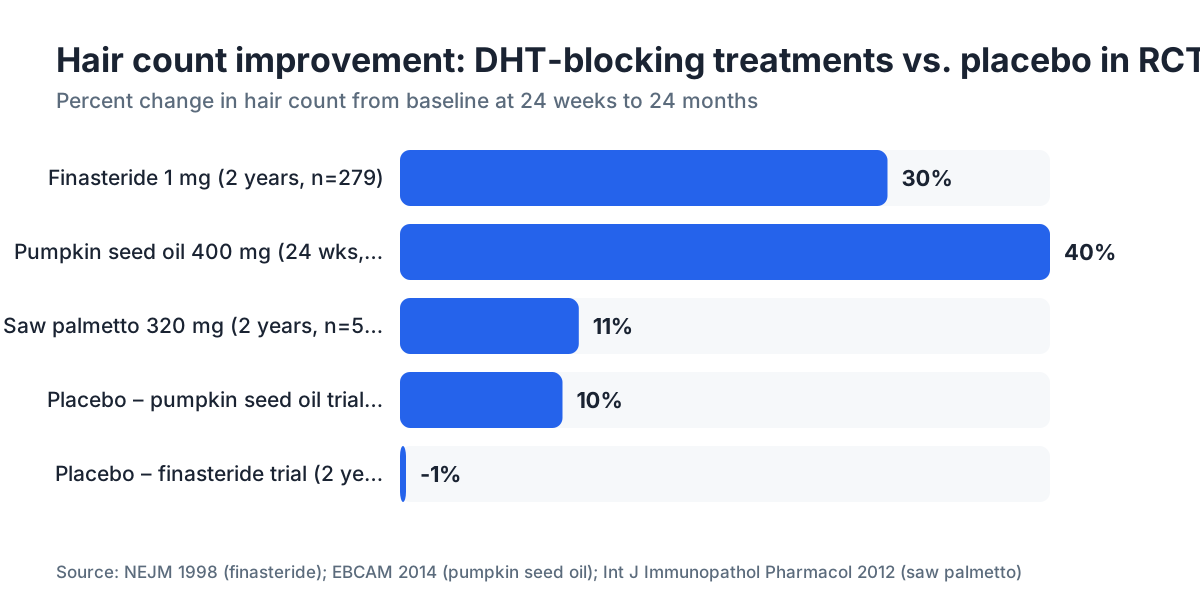
Saw palmetto (Serenoa repens) Saw palmetto is the most studied plant-based 5-AR inhibitor. A 2012 randomized trial published in the International Journal of Immunopathology and Pharmacology tested a saw palmetto extract (320 mg/day) against 1 mg finasteride over 24 months in 100 men with mild-to-moderate androgenetic alopecia. Finasteride increased hair count by 30 percent while saw palmetto increased it by roughly 11 percent [3]. That gap is real and worth knowing before you make a decision. A 2020 review in Dermatology and Therapy covering multiple saw palmetto trials concluded that the evidence supports 'a positive effect on hair loss' but characterized the effect as modest and called for larger, longer trials [4]. Saw palmetto's active compounds (fatty acids, phytosterols) appear to inhibit 5-AR type I more than type II, which is the reverse of finasteride. Read more on the dht blocker page.
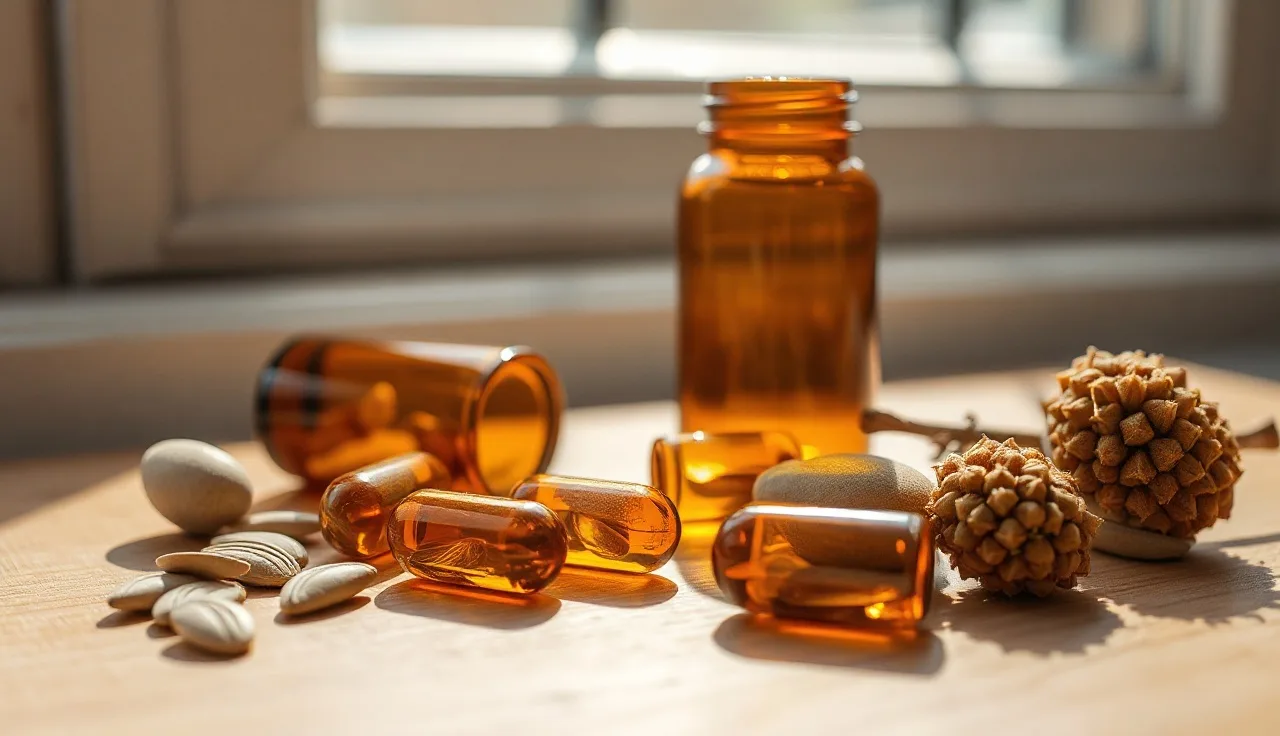
Pumpkin seed oil (Cucurbita pepo) A 2014 randomized, double-blind, placebo-controlled trial in Evidence-Based Complementary and Alternative Medicine gave 400 mg/day of pumpkin seed oil or placebo to 76 men with androgenetic alopecia for 24 weeks. The pumpkin seed oil group had a 40 percent increase in hair count from baseline compared to 10 percent in the placebo group [5]. That's a strong result for a single ingredient. The researchers proposed phytosterol-mediated 5-AR inhibition as the mechanism, but the trial was small and has not yet been replicated at scale.
Beta-sitosterol Beta-sitosterol is a phytosterol found in many plants and frequently included in hair supplement stacks. A small 1995 study in the Journal of Alternative and Complementary Medicine tested beta-sitosterol combined with saw palmetto extract in 19 men. Sixty percent of treated men reported improvement versus 11 percent on placebo, though the outcome was self-reported and the sample was tiny [6]. Beta-sitosterol is also the active comparator in many pumpkin seed oil studies, since pumpkin seed oil is rich in it.
Stinging nettle (Urtica dioica) Nettle root extract appears in many DHT blocker formulas because in vitro (cell culture) studies suggest it inhibits 5-AR. Human trial data for hair specifically is essentially absent. Its inclusion in most supplements rests on mechanism plausibility, not clinical proof.
Zinc Zinc deficiency is associated with hair loss, and zinc has shown some 5-AR inhibitory activity in vitro. But zinc supplementation only helps if you're actually deficient. Taking extra zinc when your levels are normal does nothing for DHT and can cause copper deficiency at high doses. [7]
Green tea extract (EGCG) Epigallocatechin-3-gallate (EGCG) inhibits 5-AR in laboratory models and has small supporting topical data in one 2005 mouse study. Human oral trial data for androgenetic alopecia is lacking.
The honest summary: saw palmetto and pumpkin seed oil have the most credible human data. Everything else is mostly mechanism theory or animal data dressed up as clinical evidence.
How do DHT blocker supplements compare to finasteride?
This comparison matters because most people researching supplements are really asking one thing: is this good enough to skip the prescription drug? The answer depends on your situation, but the efficacy gap is real.
| Treatment | Mechanism | DHT reduction | Hair count improvement (RCTs) | FDA approval for hair loss |
|---|---|---|---|---|
| Finasteride 1 mg/day | 5-AR type II inhibitor | ~70% scalp DHT reduction [1] | ~30% increase over placebo at 2 years | Yes (men) |
| Dutasteride 0.5 mg/day | 5-AR type I + II inhibitor | ~90% scalp DHT reduction | Superior to finasteride in trials | Yes (Korea, Japan; off-label US) |
| Saw palmetto 320 mg/day | Weak 5-AR type I inhibitor | Not well quantified | ~11% increase over baseline (one RCT) | No |
| Pumpkin seed oil 400 mg/day | Phytosterol-mediated 5-AR | Not well quantified | 40% increase over baseline (one small RCT) | No |
| Minoxidil 5% topical | Vasodilator, not a DHT blocker | None | ~15-20% increase in hair count | Yes |
Finasteride's 70 percent reduction in scalp DHT comes from the 2-year Merck trial reviewed in the New England Journal of Medicine. That's a hard ceiling supplements are not approaching.
For someone already on finasteride who wants to add a supplement as a belt-and-suspenders move, there's reasonable logic to it. The supplement targets 5-AR type I while finasteride targets type II; together they theoretically cover both isoforms more fully. That's a plausible rationale, but no published trial has tested the combination head-to-head against finasteride alone. If you're weighing the full prescription route, the finasteride article covers dosing, side effects, and what to expect.
Now the harder case. If you've been on a supplement for six to twelve months and your thinning is clearly progressing, the supplement alone is not working, and continuing to delay prescription treatment has a real cost. Hair follicle miniaturization is partly irreversible. Delay means fewer follicles left to save.
Are there any side effects from DHT blocker supplements?
One reason supplements appeal to people: finasteride carries a real (though debated) risk of persistent sexual side effects in a subset of men. Supplements carry risks too. They're just different and generally lower in frequency.
Saw palmetto: The most commonly reported side effects are gastrointestinal (nausea, stomach upset, diarrhea). A 2011 Cochrane review of saw palmetto for benign prostatic hyperplasia, which uses the same doses as hair formulas, found the herb was 'well tolerated' with side effects similar to placebo [8]. There are isolated case reports of hepatotoxicity (liver damage) with high-dose saw palmetto, but these are rare. Some men report mild sexual side effects, which makes sense given the mechanism, though systematic data on this is thin.
Pumpkin seed oil: Generally considered low risk. GI effects are the main complaint. No serious adverse events were reported in the 2014 RCT.
Zinc: Doses above 40 mg/day (the tolerable upper intake level set by the NIH Office of Dietary Supplements) can cause nausea and copper deficiency over time [7]. Many combination hair supplements stack zinc on top of a person's dietary intake, pushing them over this threshold.
Green tea extract: At high doses, EGCG has been associated with liver stress. The NIH LiverTox database lists green tea extract as a rare but documented cause of drug-induced liver injury at doses above 800 mg/day. [12]
Combination formulas: This is where safety tracking gets hard. When a product contains saw palmetto, nettle, zinc, EGCG, and biotin all in one capsule, pinning a side effect on any one ingredient becomes difficult. Single-ingredient products are easier to evaluate.
One firm rule. If you're pregnant or may become pregnant, avoid 5-AR inhibiting supplements entirely. Finasteride is Category X in pregnancy for exactly this reason (it can cause genital abnormalities in a male fetus), and plant-based 5-AR inhibitors carry a similar theoretical concern.
What is the best DHT blocker supplement backed by research?
No single answer fits everyone. But based purely on trial evidence, saw palmetto and pumpkin seed oil have the most data behind them among all natural DHT blocker supplements.
If you're picking one ingredient: pumpkin seed oil's 2014 RCT showed a 40 percent increase in hair count, the strongest single-ingredient result in this space, even accounting for the small sample size [5]. The dose used was 400 mg/day.
If you want the most-studied option with the longest track record: saw palmetto at 320 mg/day (standardized to 85-95 percent fatty acids) is the default choice. It has multiple trials, a reasonable safety profile, and decades of clinical use for prostate conditions, which gives it a broader safety dataset than most hair-specific ingredients.
For combination supplements: choose products that list actual doses per ingredient rather than hiding everything inside a 'proprietary blend.' A proprietary blend can legally contain 1 mg of saw palmetto and still call itself a saw palmetto supplement. Third-party certification (USP, NSF International, or ConsumerLab) confirms the product contains what the label says. That matters because analyses of botanical supplements have repeatedly found products that didn't contain the listed ingredients at labeled doses.
Biotin gets its own note because it's in nearly every hair supplement on the market. Biotin deficiency causes hair loss, but deficiency is rare in people eating a normal diet. Supplementing biotin when you're not deficient has no evidence behind it for hair growth in androgenetic alopecia. Biotin also interferes with thyroid and cardiac lab tests, which is a real concern your doctor should know about.
How long does a DHT blocker supplement take to work?
The hair growth cycle moves slowly regardless of what you're taking. Anagen (active growth) lasts two to seven years; telogen (resting/shedding) lasts about three months. Even if you completely stopped DHT today, you'd still shed hairs already in late telogen, and you'd need a full new anagen cycle to see the results.
In the pumpkin seed oil trial, the 40 percent improvement in hair count was measured at 24 weeks. In the saw palmetto vs. finasteride trial, results were assessed at 24 months. The honest answer: commit to at least six months before judging whether something is working, and a full year is a more reasonable window.
Some people notice reduced shedding earlier, sometimes within two to three months. That's plausible because a drop in DHT could push follicles out of the miniaturization spiral sooner. But if you're measuring success by visible density, six months is the floor.
Physically tracking your hair helps. Consistent photographs under the same lighting every 90 days reveal trends you won't notice day-to-day. People overestimate their response when hopeful and underestimate it when pessimistic. If you want an objective starting point, the free AI hair analysis at MyHairline can give you a baseline Norwood stage assessment before you start any new treatment.
If your hairline has continued receding visibly after 12 months on a supplement, that's signal. The supplement is not providing enough protection for your specific rate of loss and genetic sensitivity. That's when a conversation with a dermatologist about prescription options becomes worth having.
Can you take a DHT blocker supplement with finasteride or minoxidil?
This is one of the most common questions, and the honest answer is: probably fine for most people, with caveats.
Saw palmetto plus finasteride: both inhibit 5-AR, different isoforms. There are no published trials on the combination. The theoretical concern is additive DHT suppression, which could raise the risk of finasteride-type side effects. In practice, because saw palmetto is so much weaker, that concern is likely small. Doctors familiar with the question generally aren't alarmed by the combination but will note the lack of data.
Pumpkin seed oil or beta-sitosterol with finasteride: same logic applies. Additive 5-AR inhibition, no human combination trial data, likely low risk.
Saw palmetto with minoxidil: no pharmacological interaction concern. Minoxidil works through an entirely different mechanism (vasodilation and potassium channel opening at the follicle), so combining it with a 5-AR inhibiting supplement is not duplicative. Many men run this stack. The finasteride and minoxidil page covers combination therapy in more depth if you're thinking about stacking prescription treatments.
Zinc above 40 mg/day with any medication: tell your doctor. Zinc at high doses affects copper absorption and can interact with certain antibiotics and diuretics.
General rule: tell your prescribing doctor or dermatologist everything you're taking, including supplements. Supplements are not pharmacologically inert, and your doctor can't account for interactions they don't know about.
Do DHT blocker supplements work for women?
Female pattern hair loss (androgenetic alopecia in women) does involve DHT, but the hormonal picture is more complex than in men. Women also experience other forms of hair loss (telogen effluvium, alopecia areata, thyroid-related loss) that DHT-blocking does nothing for. Getting the right diagnosis before choosing a treatment matters more for women than for men. Our telogen effluvium article covers the type of shedding most commonly confused with genetic thinning.
Saw palmetto has been studied in women in a small number of trials. A 2021 randomized controlled trial published in JAMA Dermatology compared saw palmetto to minoxidil 2% in women with female pattern hair loss over 48 weeks. Minoxidil was significantly more effective. Saw palmetto did show some improvement over baseline [10]. So it's not zero effect, but it's weaker than the first-line option.
For women, finasteride is generally not recommended as a first-line treatment and is contraindicated in women of childbearing age. Minoxidil is FDA-approved for women. Spironolactone is an androgen-blocking prescription drug sometimes used in women with hormonal hair loss. A supplement fits into this picture only as an adjunct, not a primary strategy.
Pregnant women should avoid all 5-AR inhibitors, including plant-based ones, for the same reasons finasteride is Category X.
What should you look for on a supplement label?
Supplement labels are, politely put, confusing by design. Here's what actually matters.
Dose transparency: The effective saw palmetto dose in trials is 320 mg/day of a lipid extract standardized to 85-95 percent fatty acids. If a product lists 'saw palmetto extract' without a standardization percentage or buries it in a proprietary blend, you cannot verify you're getting a therapeutic dose.
Third-party testing: Look for a seal from USP (U.S. Pharmacopeia), NSF International, or ConsumerLab. These organizations verify that the supplement contains what the label says and doesn't carry heavy metals or contaminants at dangerous levels. The FDA does not test supplements before they go to market; third-party testing is the only real quality check available to consumers [2].
Health claims: Federal law allows supplements to make structure-function claims ('supports healthy hair') but not disease claims ('treats hair loss'). If a product says it treats, cures, or prevents hair loss, that violates FDA labeling regulations. It's also a signal the company may not be playing by the rules elsewhere.
Proprietary blends: These list the total weight of a blend but not individual ingredient doses. Avoid them if you want to verify you're getting anything close to the doses that showed up in trials.
Price is worth a look. Decent saw palmetto runs $15 to $30 a month for a standalone supplement at 320 mg/day. Combination 'hair growth' formulas often run $50 to $90 a month for the same core ingredients plus filler additions at sub-therapeutic doses. You're largely paying for packaging and marketing.
When should you skip supplements and go straight to prescription treatment?
Supplements make the most sense as a starting point for people at Norwood 1-2 with slow, early-stage thinning, or as add-ons for people already on prescription treatment who want to cover both 5-AR isoforms.
Skip supplements and see a dermatologist first if:
You're losing hair rapidly. Aggressive loss at Norwood 3 or above in your 20s means follicle miniaturization is moving fast. Months on a supplement that slows things marginally are months of irreversible follicle damage. Finasteride or dutasteride stop more DHT faster.
You've already been on a supplement for a year and your hair has kept thinning. That's the answer. The supplement is not strong enough for your degree of sensitivity.
You have a receding hairline at the temples with visible miniaturized hairs. This pattern responds to DHT blockade, but the window before those follicles die off is finite. Prescription-strength 5-AR inhibition is much more likely to preserve them.
Your hair loss is diffuse across the whole scalp rather than following a Norwood pattern. That suggests something other than DHT is driving it. Thyroid issues, iron deficiency, nutritional deficiencies, and stress-related shedding all cause diffuse loss. A supplement targeting DHT won't fix those. A blood panel will tell you more than any supplement could.
A hair loss specialist, ideally a board-certified dermatologist with a hair interest, can look at your scalp under a dermatoscope and tell you in five minutes whether your follicles are miniaturizing or doing something else. That information is worth more than any supplement purchase. If you want a preliminary read before that appointment, the free AI scan at MyHairline can help you understand your current pattern and stage.
What does the FDA say about supplements for hair loss?
The FDA does not approve dietary supplements for any specific indication before they reach the market. Under DSHEA (the Dietary Supplement Health and Education Act of 1994), manufacturers are responsible for ensuring safety before selling, but they do not need to prove efficacy [2]. The FDA can act after the fact if a product turns out to be unsafe or if a company makes drug claims.
For hair loss specifically, the only FDA-approved oral treatment is finasteride 1 mg (Propecia) for men. Minoxidil 2% and 5% topical are FDA-approved over-the-counter treatments for men and women. No supplement, including saw palmetto, pumpkin seed oil, or any multi-ingredient formula, has FDA approval to treat hair loss.
The American Academy of Dermatology (AAD) guidelines on androgenetic alopecia list minoxidil and finasteride as first-line treatments. The guidelines mention saw palmetto as an option with limited evidence and describe the overall quality of supplement evidence as low. The AAD does not recommend any specific supplement as a standard of care. [11]
The Federal Trade Commission (FTC) has taken action against companies marketing hair loss products with unsubstantiated efficacy claims. If a supplement's marketing reads more like a drug advertisement than a dietary supplement label, that's worth noting.
For anyone researching beyond supplements, the hair loss supplements article covers a broader set of nutritional approaches, and minoxidil for men covers the most widely used FDA-approved topical option in detail.
Sources
- New England Journal of Medicine, Kaufman et al. 1998, Finasteride in the treatment of men with androgenetic alopecia
- U.S. Food and Drug Administration, Dietary Supplements
- International Journal of Immunopathology and Pharmacology, Rossi et al. 2012, Comparative effectiveness of finasteride vs. Serenoa repens
- Dermatology and Therapy, Evron et al. 2020, Natural hair supplement: friend or foe? Saw palmetto, a systematic review
- Evidence-Based Complementary and Alternative Medicine, Cho et al. 2014, Effect of pumpkin seed oil on hair growth in men with androgenetic alopecia
- Journal of Alternative and Complementary Medicine, Prager et al. 2002, Randomized double-blind study with beta-sitosterol and saw palmetto
- NIH Office of Dietary Supplements, Zinc Fact Sheet for Health Professionals
- Cochrane Database of Systematic Reviews, Tacklind et al. 2011, Serenoa repens for benign prostatic hyperplasia
- JAMA Dermatology, Eom et al. 2021, Minoxidil 2% vs. saw palmetto for female pattern hair loss
- American Academy of Dermatology, Hair loss resources and guidance
- NIH LiverTox, Green Tea Extract