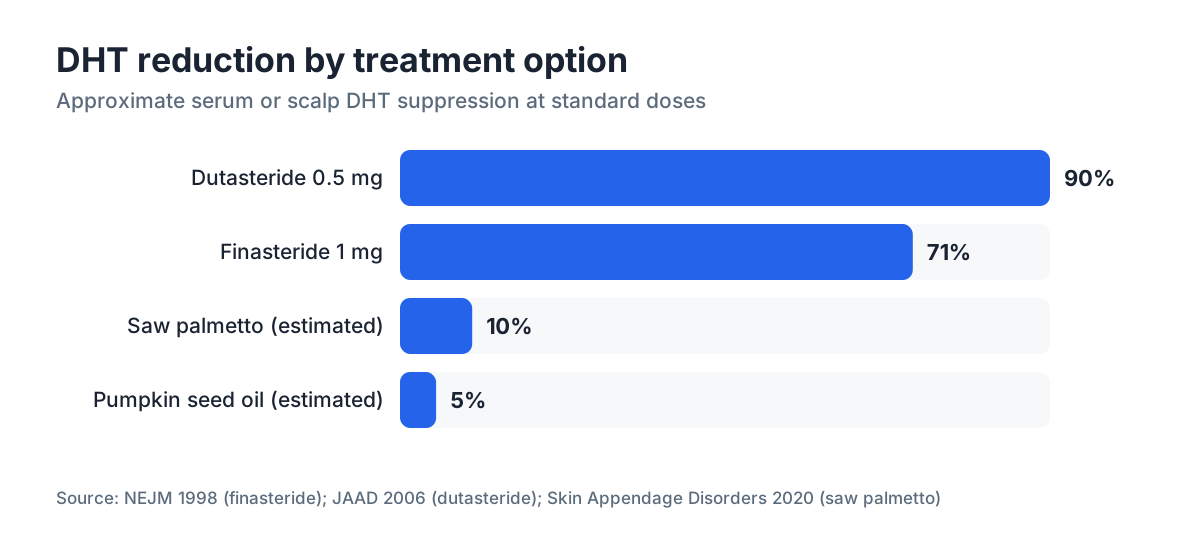
TL;DR: DHT blocker tablets work by reducing dihydrotestosterone, the androgen that shrinks hair follicles in male and female pattern hair loss. Finasteride (FDA-approved, prescription) cuts DHT by roughly 70%. Dutasteride cuts it by about 90%. Over-the-counter supplements sold as DHT blockers have almost no clinical evidence. Prescription options slow loss and modestly regrow hair in most users, but you have to take them indefinitely to hold the results.
What is DHT and why does it cause hair loss?
Dihydrotestosterone, almost always shortened to DHT, is an androgen hormone made when the enzyme 5-alpha-reductase converts testosterone. Your body makes it in the scalp, liver, prostate, and skin. In people with a genetic sensitivity to DHT, the hormone binds to receptors in hair follicles and slowly shrinks them over years. The follicle produces thinner, shorter hairs until it eventually stops producing visible hair at all. That process is called follicular miniaturization, and it's the core mechanism behind androgenetic alopecia, the most common form of hair loss in both men and women. [1]
The genetic sensitivity piece is key. Not everyone with high DHT loses hair. Your follicles have to carry the sensitivity, which is why two brothers with identical hormone levels can have completely different hairlines by 40. [1]
To understand what DHT blocker tablets actually do, see our explainer on what causes hair loss and the broader overview of dht blockers.
How do DHT blocker tablets actually work?
Every tablet sold as a DHT blocker is trying to do one of two things: inhibit the 5-alpha-reductase enzyme so less DHT gets made in the first place, or compete with DHT at the androgen receptor so the hormone can't bind as well. Prescription 5-alpha-reductase inhibitors (5ARIs) are the only class with solid clinical evidence for scalp hair. They are finasteride and dutasteride.
Finasteride selectively blocks the Type II isoform of 5-alpha-reductase. A large NEJM trial found it reduced serum DHT by 71.4% in men taking 1 mg daily. [2] Dutasteride blocks both the Type I and Type II isoforms, which is why it suppresses DHT deeper, roughly a 90% reduction in scalp DHT at the 0.5 mg dose. [3]
Over-the-counter tablets (saw palmetto, pumpkin seed oil capsules, zinc supplements) are classed as dietary supplements by the FDA, so they don't go through the same pre-market efficacy review as drugs. The usual claim is that they weakly inhibit 5-alpha-reductase, but the inhibition measured in the few small studies that exist sits far below what finasteride reaches. Nobody has good population-level data on whether that weak effect protects follicles at all.
Which DHT blocker tablets are FDA-approved for hair loss?
Finasteride 1 mg (brand name Propecia, plus many generics) is the only oral DHT blocker with full FDA approval for androgenetic alopecia in men. It was approved in 1997. [4] Women of childbearing potential cannot use it because of teratogenicity risk.
Dutasteride 0.5 mg (brand name Avodart) is FDA-approved for benign prostatic hyperplasia, not hair loss. Doctors prescribe it off-label for androgenetic alopecia. Some countries, including Japan and South Korea, have formally approved it for hair loss at 0.5 mg. In the US it's legal to prescribe off-label, and many hair loss specialists do. [3]
Finasteride 5 mg (brand name Proscar) is FDA-approved for BPH. Some men take a quarter tablet to approximate the 1.25 mg dose, which is common in practice because it's cheaper, but this is also off-label.
Nothing else in a tablet or capsule has FDA approval for hair loss. Those products are dietary supplements, not drugs, and they cannot legally claim to treat or prevent any disease. [5]
For a full breakdown of the evidence behind finasteride, we have a dedicated article.
How well do prescription DHT blocker tablets actually work?
The most-cited phase III trial of finasteride 1 mg followed 1,553 men aged 18 to 41 with mild to moderate vertex hair loss over two years. After 24 months, 83% of men on finasteride were rated as having no further hair loss, versus 28% in the placebo group. Hair count in a defined target area rose by an average of 107 hairs per cm2, against a loss of 50 hairs per cm2 in placebo. [2]
Dutasteride has gone head to head with finasteride in trials. A 24-week randomized study in the Journal of the American Academy of Dermatology found that 0.5 mg dutasteride produced statistically greater hair counts than 1 mg finasteride at 12 and 24 weeks. [3] The tradeoff is a much longer half-life (about 5 weeks versus about 6 hours for finasteride), which matters for how long side effects linger and for women who might consider pregnancy.
Manage your expectations here. These drugs slow loss and give most users modest regrowth. They will not rebuild a Norwood 5 scalp. The regrowth shows up mostly in the vertex (crown); finasteride's evidence at the hairline is weaker than at the crown. If hairline recession is your main worry, read more about receding hairline treatment options.
Results take time. Most prescribers say you need at least 12 months before judging whether a DHT blocker is working. Hair growth cycles run 3 to 6 months, and miniaturized follicles have to cycle through before you see the output.
What are the real side effects of DHT blocker tablets?
The FDA label for finasteride 1 mg lists sexual side effects in clinical trials at these rates: decreased libido 1.8% (versus 1.3% placebo), erectile dysfunction 1.3% (versus 0.7% placebo), decreased ejaculatory volume 0.8% (versus 0.4% placebo). [4] In most men who had these effects in trials, they resolved after stopping the drug.
Post-marketing reports describe a syndrome sometimes called post-finasteride syndrome (PFS), where sexual and cognitive side effects persist after stopping. The FDA updated the label in 2012 to note that sexual side effects "may continue after stopping." [4] The true prevalence of persistent PFS is genuinely uncertain. The closest systematic review estimates sit in the low single-digit percentages, but the data quality is poor and selection bias in PFS case series is real.
Dutasteride carries similar sexual side effect risks, since the same enzyme mechanism applies. Its very long half-life means side effects, if they show up, persist longer after stopping.
Gynecomastia (breast tissue growth) appears in post-marketing reports for both drugs but is considered uncommon.
Women who are pregnant or may become pregnant must not handle crushed finasteride or dutasteride tablets. The drugs can absorb through skin and may cause abnormalities in a male fetus. [4]
If you're weighing this against topical treatments, the minoxidil side effects article covers the comparison in detail.
What do DHT blocker tablets cost, and do you need a prescription?
Generic finasteride 1 mg is the cheapest prescription option. With a GoodRx-type coupon, 30 tablets often run $15 to $30 per month at major pharmacy chains, though prices vary by region and pharmacy. Without insurance or a coupon, cash prices can hit $60 to $80 per month for brand-name Propecia. Compounded finasteride (from a 503A pharmacy) may cost less but is not FDA-approved as a final product.
Generic dutasteride 0.5 mg runs roughly $20 to $50 per month with a coupon. It was brand-only until generic supply expanded, and current pricing is far more reachable than five years ago.
Both need a prescription from a licensed provider. Telehealth has made that easier. Many platforms can issue a prescription after an online intake and photo review, usually for a monthly platform fee of $15 to $25 on top of the pharmacy cost.
Over-the-counter DHT blocker tablets (saw palmetto standardized extract, pumpkin seed oil softgels, and so on) cost $15 to $40 per month with no prescription. The cost is low. So is the evidence.
| Product | FDA approval for hair loss | Monthly cost (approx) | Prescription needed |
|---|---|---|---|
| Finasteride 1 mg (generic) | Yes (men) | $15-$30 | Yes |
| Finasteride 1 mg (brand Propecia) | Yes (men) | $60-$80 | Yes |
| Dutasteride 0.5 mg (generic) | No (off-label in US) | $20-$50 | Yes |
| Saw palmetto extract | No | $15-$35 | No |
| Pumpkin seed oil capsules | No | $10-$25 | No |
Can women take DHT blocker tablets?
This is where it gets complicated. Finasteride is not FDA-approved for hair loss in women, and women of childbearing potential are specifically warned against it because of the teratogenicity risk. [4] Despite that, dermatologists do prescribe it off-label to postmenopausal women, and some case series and small trials show benefit in female pattern hair loss.
Dutasteride is similarly off-label for women.
Spironolactone is an aldosterone antagonist that also has anti-androgen effects at higher doses. Doctors use it off-label in women with androgenetic alopecia or polycystic ovary syndrome-related hair loss. It is not a 5ARI and works differently, blocking androgen receptors rather than cutting DHT synthesis. Evidence in women includes a retrospective study in the Journal of the American Academy of Dermatology showing hair density improvement in about 74% of women treated for at least 6 months. It's not technically a DHT blocker in the enzymatic sense, but it's in the same conversation.
If hormonal hair loss is your situation, the distinction between androgenetic alopecia and telogen effluvium matters a lot for which treatment actually applies.
Do over-the-counter DHT blocker tablets like saw palmetto actually work?
Saw palmetto (Serenoa repens) is the most studied OTC option. A 2020 systematic review of randomized controlled trials concluded that saw palmetto may have a modest positive effect on hair loss, but study quality was generally low, sample sizes were small, and the evidence does not support it as a substitute for finasteride. [6] One small RCT compared saw palmetto 200 mg twice daily to finasteride 1 mg and found finasteride produced meaningfully greater hair count gains after 24 months.
Pumpkin seed oil (PSO) has one oft-cited Korean RCT of 76 men showing higher hair count after 24 weeks of 400 mg per day. [7] That's one small study. Nobody has replicated it in a larger population.
Zinc shows up in a lot of hair supplement formulas with the claim that zinc deficiency drives hair loss. That link is real: documented zinc deficiency is associated with alopecia, and correcting it can help. [8] But zinc supplementation in someone who isn't deficient has not been shown to improve androgenetic alopecia.
Biotin gets enormous marketing spend. Hair loss from severe biotin deficiency is real, but biotin deficiency in otherwise healthy adults who eat a varied diet is rare. Supplementing biotin when you're not deficient does not appear to improve hair loss, and the FDA has warned that high-dose biotin can throw off lab test results. [5]
For a broader look at what supplements actually have evidence behind them, see hair loss supplements.
What happens if you stop taking DHT blocker tablets?
This is probably the most underplayed fact in the hair loss conversation. DHT blockers do not cure androgenetic alopecia. They suppress the hormonal trigger while you take them. Stop, and DHT returns to baseline within days to weeks for finasteride (6-hour half-life) or several months for dutasteride (5-week half-life).
When DHT comes back, follicular miniaturization resumes. Most people who quit finasteride return to their pre-treatment baseline within 9 to 12 months. Sometimes the loss after stopping feels accelerated, though that may be partly perceptual: you're losing ground you thought you had banked for good.
This isn't a reason to avoid the drug. It's a reason to go in with clear eyes. You're buying time, not a permanent fix. If the goal is permanent hair, a hair transplant is the only option that moves hair to stay, and even then transplants work best combined with ongoing medical therapy to protect your native hair.
Should you combine a DHT blocker tablet with minoxidil?
Most dermatologists who treat pattern hair loss recommend combination therapy as the standard of care for moderate to advanced androgenetic alopecia. The two drugs work through completely different mechanisms: finasteride hits the hormonal cause, minoxidil increases blood flow to follicles and stretches the growth phase. Used together, the effect is additive.
A systematic review and meta-analysis in the Journal of the European Academy of Dermatology and Venereology found that finasteride plus topical minoxidil outperformed either agent alone for both hair count and global photographic assessment. [9]
Oral minoxidil at low doses (1.25 mg or 2.5 mg daily) is an alternative to topical, with a different convenience and side effect profile. See oral minoxidil and minoxidil for men for the full picture, and finasteride and minoxidil for the combination evidence specifically.
If you're not sure where you fall on the loss spectrum before starting treatment, a free AI hair analysis at MyHairline can map your pattern against the Norwood scale from a photo, which helps you pick the approach that actually fits.
How long before DHT blocker tablets show results?
Give it at least 6 months before you draw any conclusions, and 12 months for a full read. This isn't marketing hedging. It reflects the biology of the hair growth cycle.
Hair follicles move through three phases: anagen (growth, 2 to 6 years), catagen (transition, about 2 weeks), and telogen (resting, 2 to 3 months). When DHT has miniaturized a follicle, removing the DHT signal doesn't instantly produce new hair. The follicle has to cycle through telogen, re-enter anagen, and then grow enough hair to be visible. That takes months.
Some users hit an initial shedding phase in the first 6 to 12 weeks, similar to the shed you see with minoxidil. It's thought to reflect follicles cycling into a new growth phase at once, not the drug making things worse. It usually resolves, but it's alarming if nobody warned you.
At 12 months, most clinical trials show the peak benefit from finasteride. Hair count gains creep up a bit from month 12 to 24, then tend to plateau. Past year 2, the drug holds the gains as long as you keep taking it. A 10-year open-label extension of finasteride trials found that men who took it continuously kept hair counts significantly above baseline, while those who stopped lost the benefit. [10]
Are there any newer or alternative DHT blocker tablets being developed?
Research here is active. Clascoterone (brand name Winlevi) is a topical androgen receptor antagonist the FDA approved in 2020 for acne, and it's being studied for androgenetic alopecia. It's not a tablet, but it targets the same androgen receptor pathway without systemic hormonal effects, which appeals to people worried about systemic side effects. Results from alopecia-specific trials have been modest so far. [11]
Bimiralisib and other signaling pathway inhibitors aimed at the Wnt/beta-catenin or JAK-STAT pathways are in various stages of investigation for hair loss, but these are not DHT blockers in the traditional sense and stay experimental for now.
For men who want to know whether lifestyle factors might amplify DHT-related loss, the evidence around does creatine cause hair loss is relevant: one small RCT found creatine supplementation raised the DHT-to-testosterone ratio, though long-term hair loss data doesn't exist.
For now, finasteride and dutasteride are the only oral options with substantial clinical backing. If you're weighing hair loss treatment in 2025 or 2026, don't wait on "coming soon" therapies that have no phase III data yet.
Sources
- American Academy of Dermatology Association, Hair Loss: Who Gets and Causes
- Kaufman KD et al., New England Journal of Medicine 1998, finasteride phase III trial
- Olsen EA et al., Journal of the American Academy of Dermatology 2006, dutasteride vs finasteride RCT
- Evron E et al., Skin Appendage Disorders 2020, saw palmetto systematic review
- Cho YH et al., Evidence-Based Complementary and Alternative Medicine 2014, pumpkin seed oil RCT
- Almohanna HM et al., Dermatology and Therapy 2019, vitamins, minerals and hair loss review
- Adil A & Godwin M, Journal of the American Academy of Dermatology 2017, meta-analysis of hair loss treatments
- Kaufman KD et al., European Journal of Dermatology 2002 to 10-year finasteride extension study
- US FDA, Propecia (finasteride) prescribing information
- US FDA, Dietary Supplements
- US FDA, Winlevi (clascoterone) approval information