TL;DR: The FDA-approved dosing for topical minoxidil is twice daily, and the trials that got it approved used that schedule. But at least two controlled trials show once-daily application produces roughly 70-80% of the hair count benefit. If twice daily causes scalp irritation or you can't stick to it, once daily still works, just somewhat less well.
What does the FDA label actually say about minoxidil dosing?
The FDA-approved labeling for Rogaine (minoxidil 5% topical solution and foam) tells men to apply 1 mL of solution or half a capful of foam to the scalp twice daily, every day. Women's formulations (2% solution, 5% foam) carry the same twice-daily instruction on the solution label, though the 5% foam is approved for once-daily use in women specifically. [1]
That distinction matters. The once-daily approval for women's 5% foam came from a separate clinical trial built around that schedule, which is why it sits on the label. For men's products, the twice-daily instruction traces back to the original approval trials. There is no approved once-daily labeling for men's minoxidil.
Once daily is not dangerous for men. It just means the FDA tested the twice-daily schedule for efficacy and that's what they stamped. Doctors prescribe off-label dosing all the time, and dermatologists frequently tell patients that once daily is fine if sticking to two doses is a problem.
What does the research say about once vs twice daily minoxidil?
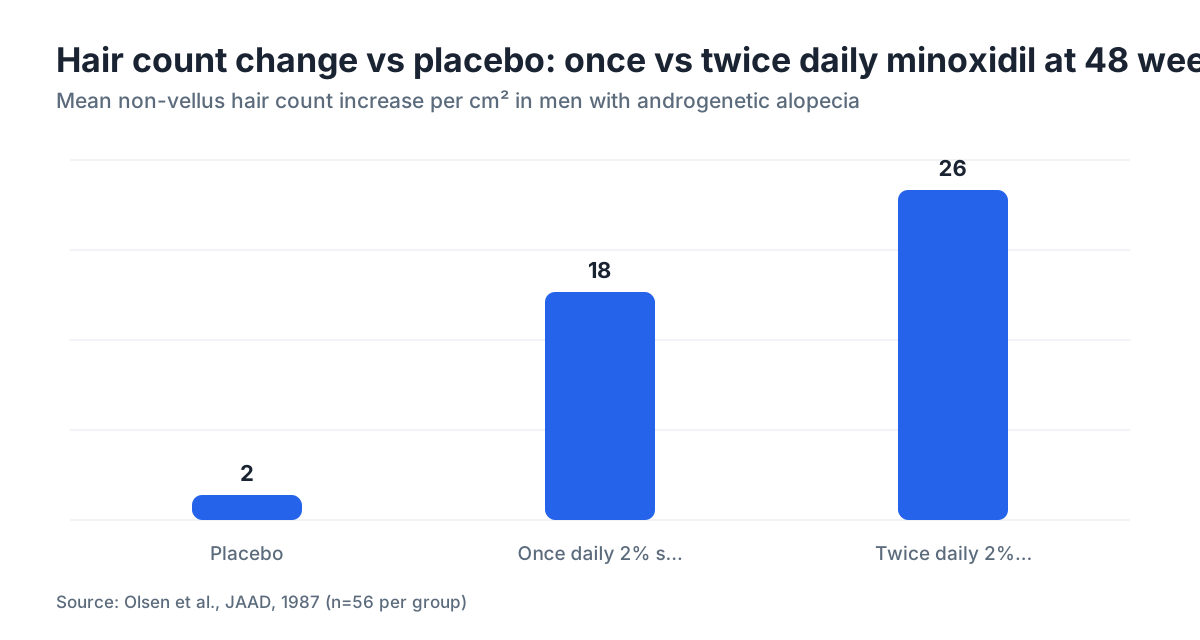
The most-cited head-to-head comparison is a 48-week randomized controlled trial published in the Journal of the American Academy of Dermatology in 1987. Olsen et al. compared 2% minoxidil solution applied once daily versus twice daily in men with androgenetic alopecia. The twice-daily group grew roughly 45% more terminal hairs than the once-daily group at 48 weeks, but both groups beat placebo by a wide margin. [2]
A later study on the 5% solution found the same pattern: twice daily was superior to once daily, but once daily was still meaningfully better than nothing. The dose-response relationship with minoxidil is real but not extreme. You don't lose half your results by going once daily.
For women using the 5% foam, Blume-Peytavi et al. (2011) published a randomized trial showing once-daily 5% foam was non-inferior to twice-daily 2% solution, which is what supported the once-daily label for that product. [3] That trial doesn't translate directly to men using 5% foam once daily, but it tells you something about the biology: peak scalp penetration from a single application lasts longer than 12 hours for many people.
Nobody has great long-term data comparing once versus twice daily over three to five years. The trials above run 48 weeks. The safest read of the whole literature: twice daily is the gold standard, once daily is a reasonable second choice, and missing doses entirely is where you lose most of your gains.
Why does frequency matter at all? How does minoxidil actually work?
Minoxidil is a potassium channel opener. Applied topically, it gets converted locally in the follicle to minoxidil sulfate by the enzyme sulfotransferase (SULT1A1). That sulfated form widens the small blood vessels around the follicle, extends the anagen (growth) phase, and may directly stimulate follicle stem cells. [4]
The pharmacokinetics explain the frequency question. After a single topical application, minoxidil concentration in the scalp drops fairly fast. Studies measuring percutaneous absorption find that peak scalp levels hit within about one hour and fall off significantly after 12 to 24 hours, depending on formulation and how quickly your skin metabolizes it. [5] That's why twice daily (every 12 hours) became the schedule: it keeps scalp concentrations reasonably elevated across the day.
But the clean pharmacokinetics story has a wrinkle. Some of the converted minoxidil sulfate is retained in scalp tissue, which acts as a reservoir. How big that reservoir is varies by person, and it's one reason results differ so much between individuals. People with naturally high SULT1A1 activity tend to respond better to minoxidil, and for them, a once-daily dose may hold good tissue concentrations.
This is also why some dermatologists say the gap between once and twice daily matters more for some patients than others. If you're a poor metabolizer or a strong responder, that gap widens or narrows accordingly.
Is once-a-day minoxidil ever actually recommended by doctors?
Yes, routinely. Many dermatologists and hair loss specialists tell patients that if twice daily is causing irritation, greasiness, or adherence problems, once daily is a real alternative. A 2020 survey published in JAMA Dermatology found that dosing flexibility is one of the most common topics in real-world prescribing discussions for topical minoxidil. [6]
There's also oral minoxidil, which reshapes this whole conversation. Oral minoxidil is typically dosed once daily at 1.25 to 5 mg, and emerging trial data suggests efficacy that rivals or beats topical twice-daily dosing for many patients. Oral absorption skips the variable skin penetration problem entirely. Switch formulations and the once-versus-twice question stops mattering.
For topical users who want the simplest honest recommendation: twice daily is the clinically supported standard. If you've been doing twice daily and tolerating it well, keep going. If you've been doing once daily and seeing results, your scalp tissue concentration may be sufficient and switching isn't urgent. If you've been doing once daily and see slow or no results after 6 months, adding a second daily application is the first thing to try before you conclude minoxidil doesn't work for you.
Does the solution vs foam formulation change how often you need to apply?
Somewhat, yes. The solution (both 2% and 5%) contains propylene glycol as a penetration enhancer. Foam does not. Propylene glycol increases how quickly and how deeply minoxidil penetrates the skin, which means the solution may deliver a larger dose per application but also causes more scalp irritation in people sensitive to it. [7]
The foam's slower, more surface-level penetration partly explains why the once-daily label was approved for women's 5% foam: a higher concentration applied once daily can match the tissue exposure of a lower concentration applied twice daily.
For men using the foam, the twice-daily instruction still sits on the label, but the biologically relevant question is whether your scalp is getting enough minoxidil per day. If you're using the 5% foam and applying it thoroughly once daily, you're probably getting a meaningful dose. If you're using the 2% solution once daily, the dose per application is lower to start with, so frequency matters more.
Honest answer: foam users probably lose less by going once daily than solution users do. But that's a quantitative claim where the comparative trial data is thin. The FDA label is still your safest guide.
What happens if you miss doses? Does it set you back?
Missing one or two doses occasionally doesn't cause noticeable regression. Hair follicles respond to minoxidil over weeks and months, not hours. A single skipped application is not the same as stopping the drug.
Stopping entirely is a different story. Minoxidil's effect is not permanent. When you quit, you lose any hair that grew because of it, typically within three to six months. [8] That shedding phase after stopping is called minoxidil-related telogen effluvium, and it's one of the more psychologically brutal parts of the drug. It feels like the treatment made your hair worse. What you're really seeing is the hair minoxidil was propping up cycling out.
So for the once-versus-twice question, consistency beats precision. Someone who does once daily every single day for two years will almost certainly outperform someone who does twice daily for three months and then quits. Missing the second daily dose now and then is not a failure. Going a week without any application because you left the bottle at home is the real problem.
If you tend to forget, pick a single consistent application time (say, right after a morning shower) and never miss it. That beats aiming for twice daily and regularly dropping one or both. The telogen effluvium that comes from stopping erratically can be harder to recover from psychologically than simply accepting the modest efficacy trade-off of once daily.
Does twice daily cause more side effects than once daily?
Yes. More total drug applied means more room for side effects. The most common ones with topical minoxidil are scalp dryness, itching, and contact dermatitis, and they show up more with twice-daily use because more product hits the scalp. [9]
Cardiovascular effects (palpitations, fluid retention, lowered blood pressure) from topical minoxidil are rare at standard doses, but twice daily does mean slightly higher systemic absorption than once daily. For most healthy adults this is a non-issue. For people with cardiovascular conditions, it's worth raising with a doctor.
One specific concern with foam and solution: apply minoxidil in the morning, then lie back down, and you transfer product to your pillow, which then touches your face and neck. That can grow unwanted facial hair, especially around the temples and hairline. Let the product dry completely before lying down (around 4 hours for solution, 2 to 4 hours for foam) and you cut that risk.
For the full picture of what to watch for, minoxidil side effects covers the complete list with frequency estimates from the labeling studies.
The tradeoff is simple. Twice daily gives you somewhat better efficacy and somewhat more side effect exposure. Once daily gives you less of both. Neither schedule is dangerous for most people.
Should you use minoxidil alone or add something else?
This is the bigger question than once versus twice daily. Adding a DHT blocker like finasteride to a minoxidil regimen consistently outperforms either drug alone. A 2015 randomized controlled trial published in Dermatologic Therapy found that oral finasteride plus topical minoxidil produced significantly greater hair count improvements at 12 months than minoxidil alone. [10]
The reason is simple. The two drugs work on different mechanisms. Minoxidil stimulates the follicle directly. Finasteride cuts the dihydrotestosterone (DHT) that's shrinking the follicle in the first place. Using both is like patching the hole and fixing the pipe that caused the leak.
If you're debating once versus twice daily minoxidil and you're not already on finasteride, adding finasteride (if it's appropriate for you and cleared with a doctor) will likely produce a bigger gain than doubling your minoxidil frequency. See the finasteride and minoxidil article for the clinical details on combination therapy.
For men with a receding hairline specifically, the combination holds the frontal zone better, which is exactly where minoxidil alone is weakest.
If you want to know where your hair loss stands before deciding on a treatment approach, the free AI hair scan at MyHairline.ai can map your Norwood stage and help you think through options before you spend money on products or consultations.
What's the honest bottom line on once vs twice daily minoxidil?
Twice daily is better. The data is consistent on that. The gap is real but not dramatic: somewhere in the range of 20-30% more hair count at one year, based on the existing trials. [2]
For most people, twice daily is the right default. Set a phone alarm for morning and evening, apply it to a dry scalp, let it dry fully before bed or before touching the area, and keep going for at least six months before drawing any conclusions.
Once daily is a legitimate option if twice daily causes persistent scalp irritation, if the greasiness or smell interferes with your life enough to threaten adherence, or if you're using oral minoxidil (which is one dose by design). The worst outcome is quitting the drug entirely because the twice-daily schedule felt like too much.
One more thing said plainly: minoxidil works better for some people than others, the frequency question is secondary to whether the drug fits your pattern of loss, and a dermatologist who sees your scalp is better placed to answer that than any article. The minoxidil for men overview covers who the best candidates are and what realistic outcomes look like.
If you want an objective starting point for that conversation, a hair analysis through MyHairline.ai's free scan can show you your current loss pattern and how it's likely to progress, which is the baseline information that makes any treatment decision more grounded.
How long does it take to see results regardless of dosing frequency?
Four to six months minimum before you see meaningful regrowth. That timeline holds for both once and twice daily. The first thing most people notice is reduced shedding, which starts around two to three months. New hair growth, if it comes, typically shows up between four and six months and keeps improving through twelve months. [8]
One warning worth repeating: many people go through an initial shed in the first four to eight weeks of starting minoxidil. This is normal. It reflects follicles being pushed from telogen into a new anagen cycle. It looks alarming. It is not a sign the drug is making things worse. Stop at week six because of shedding and you quit right before the treatment would have started working.
The twice-daily group in the Olsen trials showed a faster early response, with more noticeable improvement at 16 weeks than the once-daily group. By 48 weeks, both groups had made meaningful gains. [2] If you're impatient for results, twice daily may give you earlier reassurance. If your main concern is long-term maintenance, the final difference at one year is what counts.
Timeline expectations shift with how advanced your loss is. The chart below shows hair count outcomes from the FDA approval trial data at different timepoints.
Sources
- FDA, Rogaine 5% Minoxidil Topical Aerosol Drug Label
- Olsen EA et al., Journal of the American Academy of Dermatology, 1987 (PMID 3546807)
- Blume-Peytavi U et al., Journal of the American Academy of Dermatology, 2011 (PMID 21570152)
- Buhl AE et al., Journal of Investigative Dermatology, 1990 (PMID 2319377)
- Franz TJ, Journal of the American Academy of Dermatology, 1985 (PMID 3839636)
- Marks DH et al., JAMA Dermatology, 2020 (PMID 32936201)
- Kanti V et al., Journal of the European Academy of Dermatology and Venereology, 2014 (PMID 24164403)
- American Academy of Dermatology, Hair Loss: Who Gets and Causes
- MedlinePlus (NIH/NLM), Minoxidil Topical
- Hu R et al., Dermatologic Therapy, 2015 (PMID 25252685)
- FDA, Regaine/Rogaine Product Information, NDA 19-501
- Bernstein RM, Dermatologic Surgery, 2002 (PMID 11737136)