
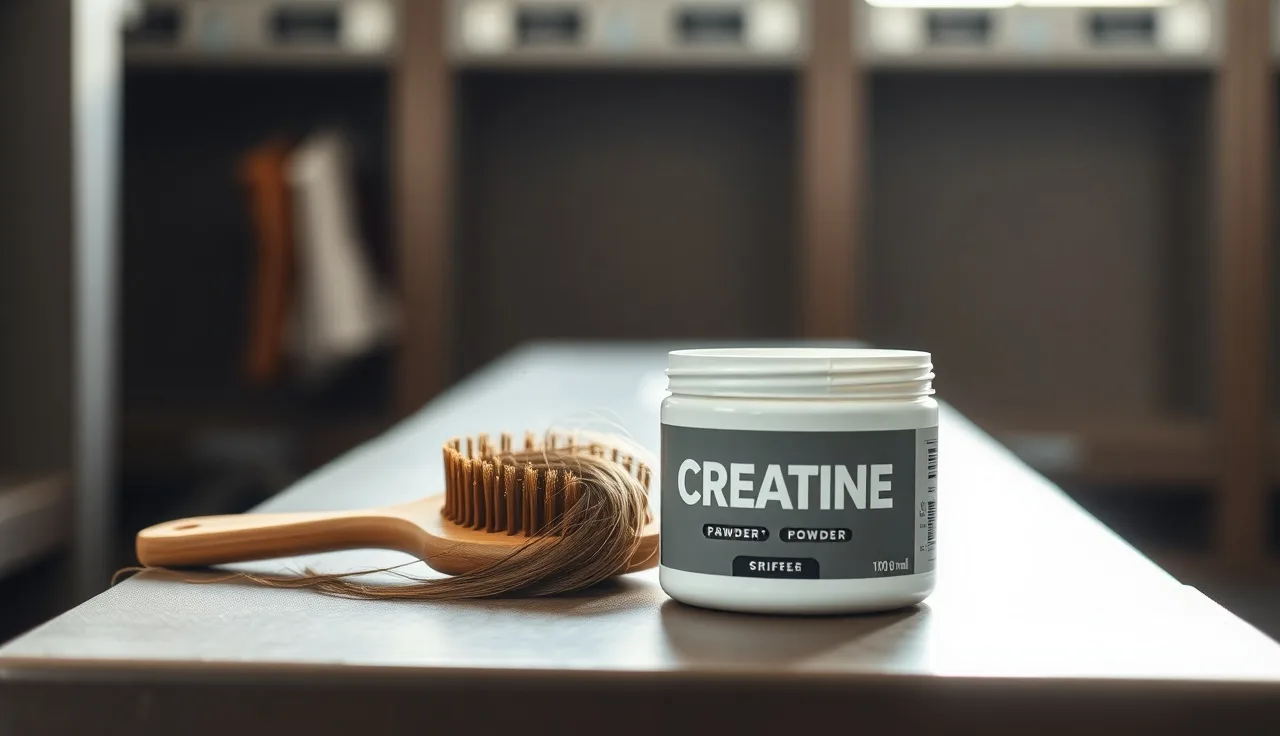
TL;DR: One small 2009 rugby study found creatine supplementation raised DHT levels by up to 56% over three weeks. No study has directly measured creatine causing hair loss. The DHT rise is real but short-term and only from one trial. If you're already genetically prone to male pattern baldness, there's a plausible but unproven mechanism worth knowing about.
What does the actual evidence say about creatine and DHT?
One study. That's the entire direct human evidence base connecting creatine to DHT elevation, and it's the honest place to start.
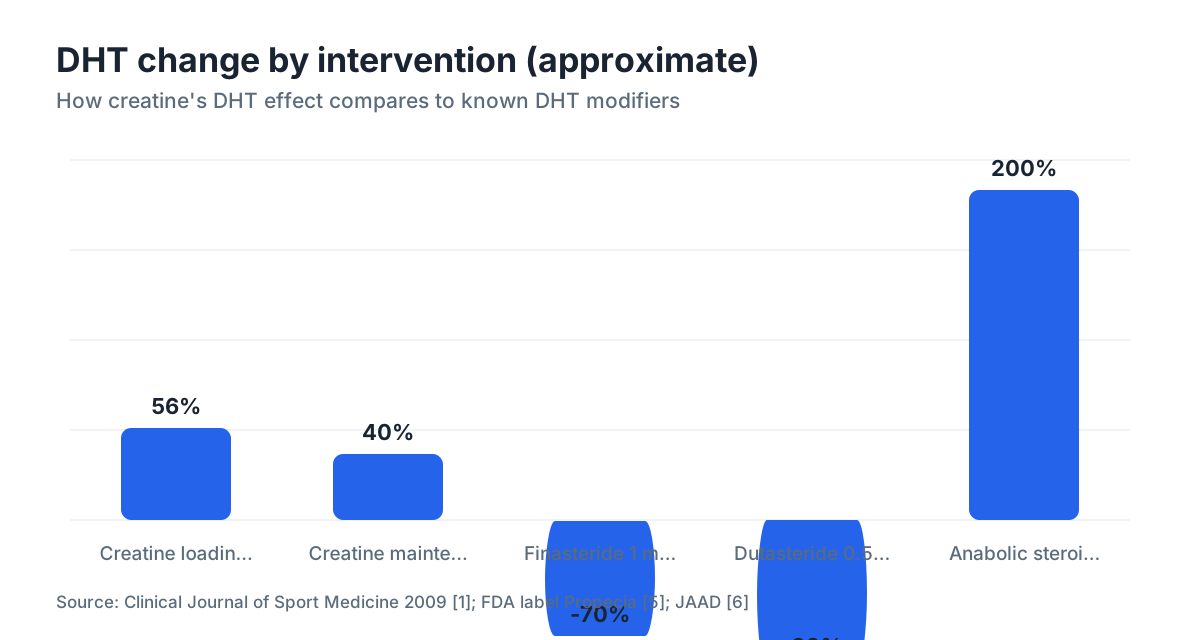
The study was published in 2009 in the Clinical Journal of Sport Medicine [1]. Researchers at Stellenbosch University in South Africa took 20 male college rugby players and split them into two groups. One group loaded creatine monohydrate for seven days (25 grams per day) then maintained at 5 grams per day for another 14 days. The other group took a dextrose placebo. After the loading phase, the creatine group's DHT had risen 56% above baseline. After the maintenance phase, DHT was still 40% above where it started. Testosterone didn't change significantly.
That's a real finding. It was peer-reviewed, it was placebo-controlled, and the DHT increase was statistically significant. But here's what it wasn't: a hair loss study. Nobody measured hair shedding, miniaturization, scalp DHT, or follicle health. The researchers measured serum DHT, which is blood DHT, not what's happening at the scalp.
No follow-up study has replicated this specific finding. A 2021 review in the Journal of the International Society of Sports Nutrition looked at creatine and hormone effects broadly and found the evidence base too thin for firm conclusions [2]. So you have one signal, no replication, and zero hair loss outcome data. That's not nothing. It's also nowhere near proof.
How does DHT actually cause male pattern hair loss?
DHT stands for dihydrotestosterone. It's made from testosterone by an enzyme called 5-alpha reductase, which shows up heavily in scalp follicles. In men (and some women) with genetic sensitivity to DHT, the hormone binds to androgen receptors in the follicle and triggers miniaturization: the follicle gradually shrinks, produces thinner and shorter hairs, and eventually stops producing terminal hair altogether.
This is the mechanism behind androgenetic alopecia, the medical name for male and female pattern hair loss. It's the most common form of hair loss, affecting roughly 50% of men by age 50 [3]. The genetic sensitivity piece is the part most people underestimate. Two men can have identical DHT levels and one goes bald while the other keeps a full head of hair. The difference is how sensitive their follicle androgen receptors are, which is mostly determined by genetics.
So the creatine-DHT link only matters for hair loss if you already carry the genetic predisposition. If you don't, higher DHT from any source is unlikely to trigger meaningful miniaturization. If you do carry the genes, anything that raises DHT is theoretically worth watching. Learn more about what causes hair loss.
For a deeper look at DHT blockers and how they work against this pathway, that's worth reading separately.
Why did creatine raise DHT in the first place?
The 2009 study's authors proposed that creatine might shift the ratio of testosterone to DHT by affecting 5-alpha reductase activity. Creatine boosts phosphocreatine in muscle, which helps regenerate ATP during high-intensity work. One theory is that higher training intensity combined with creatine increases androgen metabolism in peripheral tissues, nudging more testosterone down the 5-alpha reductase pathway toward DHT rather than toward other metabolites.
That's a hypothesis, not a confirmed mechanism. No study has directly shown creatine activates 5-alpha reductase. The ratio shift the rugby study saw (more DHT without more total testosterone) fits with increased conversion, but it could also reflect changes in DHT clearance, binding proteins, or plain measurement variability in a small sample.
The sample size problem is real. Twenty men. That's a group small enough that a few outliers can swing a percentage dramatically. Without replication in larger, more diverse populations, you genuinely can't know whether this is a reliable effect or a noisy one.
Has any study directly measured creatine causing hair loss?
No. As of mid-2026, no published clinical trial has directly measured hair shedding, hair density, follicle miniaturization, or any other hair loss endpoint in people taking creatine.
This is a genuine gap. The trial would be straightforward to design: give creatine to a group with androgenetic alopecia, give placebo to another, measure phototrichogram counts or hair pull tests at baseline and follow-up. Nobody has done it.
What does exist is a large literature showing creatine is safe at standard doses for kidneys, liver, and cardiovascular function in healthy adults [4]. The International Society of Sports Nutrition considers creatine monohydrate safe and effective for short and long-term use in healthy populations [2]. Their position paper doesn't list hair loss as an adverse effect, because no documented causal evidence supports it.
Anecdotally, plenty of men report more shedding after starting creatine, and plenty of others use it for years with no change. Anecdotes can't separate genetic predisposition from supplement effect, training changes, stress, diet shifts, and all the other variables that hit hair at the same time.
How does a 56% DHT increase compare to other factors that affect DHT?
Context helps. A 56% rise in serum DHT sounds large, but the numbers around it change the picture.
Finasteride (1 mg/day), the FDA-approved hair loss drug, suppresses serum DHT by roughly 70% [5]. That's the target, because cutting DHT hard and consistently over years is what slows or stops androgenetic alopecia. The creatine-linked DHT rise, if real and sustained, moves the dial the opposite way, but the size is still within ranges that many men without genetic sensitivity live with and never lose a hair.
Steroid use is the stronger known DHT driver. Anabolic steroids, particularly those that convert heavily to DHT (stanozolol, oxymetholone), are well-documented accelerants of androgenetic alopecia in predisposed men [6]. Next to that, creatine is a different category of concern.
Obesity also raises DHT through increased aromatase activity and androgen conversion in fat tissue. High-fat diets, chronic stress, and certain medications all shift the hormonal environment. Creatine's potential effect, if it replicates, would be modest against that backdrop.
| Factor | DHT change (approximate) | Evidence quality |
|---|---|---|
| Finasteride 1 mg/day | -70% | Multiple large RCTs [5] |
| Creatine (loading protocol) | +56% (one study) | Single small RCT [1] |
| Anabolic steroids (DHT-based) | +200% or more | Case reports, mechanism studies [6] |
| Dutasteride 0.5 mg/day | -90% | Multiple RCTs |
| Obesity | +15-30% (variable) | Observational data |
Should you stop taking creatine if you're worried about hair loss?
This depends almost entirely on your genetic situation and your priorities.
If you have no family history of androgenetic alopecia, no sign of a receding hairline, and no current thinning, the creatine-DHT concern is close to theoretical for you. The evidence doesn't support quitting a supplement with well-documented performance and recovery benefits over a single unreplicated study.
If you have a strong family history of male pattern baldness, are already showing early signs of a receding hairline, or are watching your temples closely, the math shifts. The mechanistic pathway is real even though the hair loss endpoint hasn't been directly studied. In that situation, some people choose to err toward caution, which is a reasonable personal call, not a medical mandate.
If you're already on finasteride or another DHT-blocking treatment, the creatine concern shrinks a lot. You're already suppressing DHT conversion hard. A modest possible increase from creatine on top of a 70% suppression from finasteride is unlikely to matter in practice.
If you're genuinely unsure whether your hair is thinning, a baseline assessment matters. MyHairline's free AI scan (/scan) gives you a starting picture of your hairline and density to track over time, which beats guessing.
What are the signs that your hair loss is DHT-related, not something else?
Male pattern hair loss follows a predictable geography: temples recede first, then the crown thins, and over years the two areas can merge. The Norwood scale classifies this from Type I (no recession) through Type VII (only a rim of hair around the sides and back). If your loss follows this pattern, DHT is almost certainly involved.
DHT-unrelated hair loss tends to look different. Telogen effluvium, which is diffuse shedding triggered by stress, illness, surgery, or rapid weight loss, drops hair evenly across the scalp rather than in the temple-and-crown pattern. Alopecia areata causes patchy, circular bald spots. Traction alopecia concentrates at the hairline where tension pulls.
A dermatologist can tell these apart with a pull test, dermoscopy, and sometimes bloodwork. If you're shedding heavily but your hairline and crown look unchanged, the cause is probably not DHT-driven androgenetic alopecia, and creatine is probably not the relevant variable.
Is creatine safe, aside from the DHT question?
Yes, with standard caveats. Creatine monohydrate is one of the most studied sports supplements in existence. A position paper from the International Society of Sports Nutrition calls creatine monohydrate "the most effective ergogenic nutritional supplement currently available to athletes" and notes that long-term supplementation is generally safe in healthy populations [2].
Kidney worries were common in earlier years because creatine raises serum creatinine, a kidney function marker. But creatinine elevation from creatine supplementation is a measurement artifact, not a sign of kidney damage, in people with healthy baseline kidney function [4]. People with pre-existing kidney disease should talk to a physician before supplementing.
Gastrointestinal discomfort, especially during high-dose loading phases (25 grams per day), is the most commonly reported side effect. Splitting doses through the day reduces it. Water retention in muscle tissue is real and is partly behind the early weight gain some users notice.
For most healthy adults, the risk profile is genuinely low. The hair loss concern is the murkiest part of the safety picture, because it's the least studied.
What treatments actually work if DHT is driving your hair loss?
If you've established that androgenetic alopecia is what you're dealing with, the treatments with real evidence are a short list.
Finasteride 1 mg/day is FDA-approved for male pattern hair loss and works by blocking 5-alpha reductase type II, cutting serum DHT by roughly 70% [5]. Multiple large trials show it slows progression and can regrow hair in a good share of men who take it consistently. It needs a prescription and carries a known side effect profile, including sexual side effects in a small percentage of users. Read more about finasteride here.
Minoxidil comes over the counter in 2% and 5% topical formulations and by prescription in oral form. It doesn't block DHT. Instead it appears to extend the anagen (growth) phase of the hair cycle and may improve scalp blood flow. It works as a standalone treatment but less well than paired with finasteride. Minoxidil for men and oral minoxidil are both worth understanding if you're comparing options.
Combining finasteride and minoxidil shows better outcomes in trials than either alone [7]. The finasteride and minoxidil combination is increasingly what dermatologists recommend for men who want to be aggressive about preservation.
Hair transplant surgery is a permanent option for men who have stabilized their loss but want to restore density. It doesn't stop future loss in untreated areas. Hair transplant is a separate conversation with its own criteria for candidacy.
If you're looking at the supplement angle specifically, hair loss supplements covers what has real evidence and what doesn't.
What should you actually do if you take creatine and are worried about your hair?
Start by being honest about your baseline. Do you have a family history of male pattern baldness? Are you already noticing changes at your temples or crown? If the answer to both is no, creatine is unlikely to be a meaningful concern.
If the answer to either is yes, you have a few reasonable paths. You can stop creatine and watch for change over three to six months, though the confound problem remains: hair changes are slow and multi-factorial, so pinning a change (or non-change) on creatine is hard. You can keep creatine and start a DHT-blocking treatment like finasteride, which essentially neutralizes the concern by suppressing DHT conversion far more than creatine can raise it. Or you can simply monitor your hairline with regular photos from consistent angles every few months.
See a dermatologist if you're genuinely concerned. A board-certified dermatologist or a physician who specializes in hair loss can run a proper assessment, look at your scalp with dermoscopy, and tell you whether what you're seeing is early androgenetic alopecia or something else. That's worth more than any amount of supplement speculation.
MyHairline's AI scan (/scan) can also help you set a baseline and track changes over time, which is the most practical first step before spending money on treatments or changing a supplement routine that's otherwise working for you.
Sources
- Journal of the International Society of Sports Nutrition, Kreider et al., 2017 ISSN position stand on creatine
- American Academy of Dermatology, Androgenetic Alopecia overview
- International Society of Sports Nutrition, creatine safety review
- Journal of the American Academy of Dermatology, Kanayama et al., anabolic steroids and hair loss
- JAMA Dermatology, Boyapati & Sinclair, combination finasteride and minoxidil trial
- National Institutes of Health, MedlinePlus, Creatine supplement overview
- American Academy of Dermatology, Hair loss types and causes
- FDA, finasteride approved uses and mechanism