
TL;DR: Hard water does not cause permanent hair loss. The calcium and magnesium in it coat the hair shaft and raise surface friction, which leads to breakage and dullness. A 2016 randomized controlled trial in the International Journal of Trichology found no significant difference in hair tensile strength between hard and distilled water. Real hair loss needs a different explanation, usually genetics and DHT.
What exactly is hard water and how common is it?
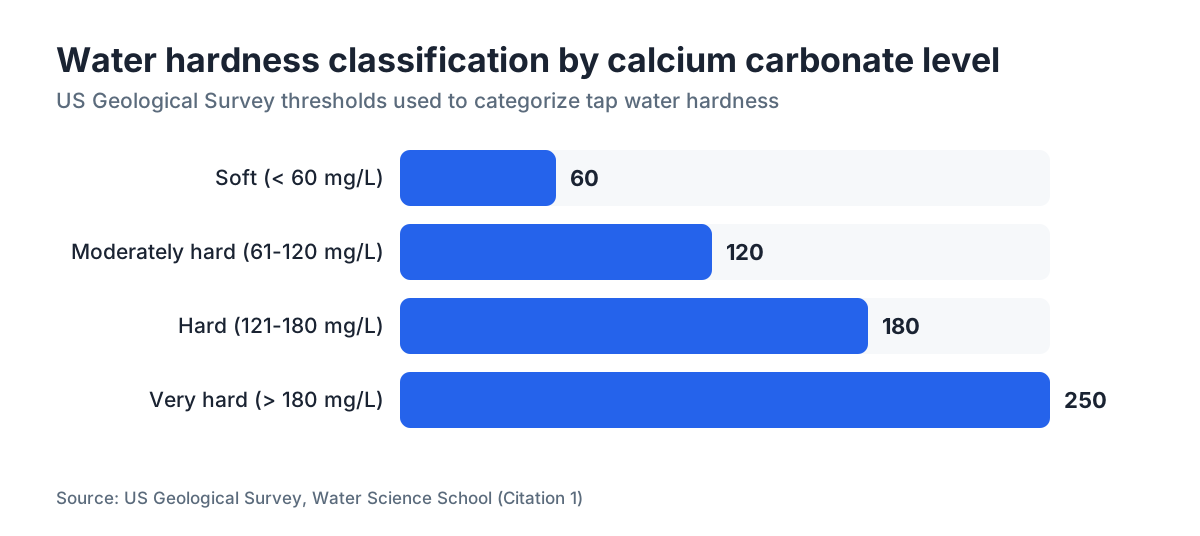
Hard water carries a high concentration of dissolved minerals, mainly calcium and magnesium ions, picked up as water moves through limestone and chalk. The US Geological Survey classifies hardness in milligrams per liter (mg/L) of calcium carbonate: soft is under 60 mg/L, moderately hard is 61-120 mg/L, hard is 121-180 mg/L, and very hard is above 180 mg/L [1].
About 85 percent of US households get hard water, according to the US Geological Survey [1]. If you live in the Southwest, the Great Plains, or the Midwest, your tap water is almost certainly in the hard or very hard range. Phoenix, Las Vegas, and Indianapolis regularly measure above 200 mg/L. Coastal cities and areas fed by mountain snowpack, like Seattle or Denver, tend to sit much lower.
You probably already know you have it. Scale on the faucets. Soap that won't lather. That film on the dishes and the squeaky drag your hair gets after a wash. None of it feels great. The question worth asking is whether it actually damages your follicles, or whether the damage stops at the hair shaft.
What does hard water actually do to your hair shaft?
When hard water dries on hair, calcium and magnesium ions bond to the negatively charged surface of the cuticle. The cuticle is the outermost layer, built from overlapping scales like roof shingles. Mineral deposits lift and roughen those scales, which raises friction, makes strands snag on each other, and leaves the hair feeling rough, dull, and harder to comb without breaking [2].
A 2013 study in the International Journal of Dermatology compared hair samples washed in hard water versus distilled water under scanning electron microscopy. The researchers found clear roughness on the cuticle surface of hard-water strands [2]. That roughness is real. It makes hair more likely to snap during brushing, heat styling, or a night spent grinding against a rough pillowcase.
Breakage and hair loss are not the same thing. Breakage happens mid-shaft. The follicle, the living structure under your scalp that produces hair, is untouched. When a hair leaves at the root, that is loss. When a strand snaps somewhere along its length, that is breakage. Hard water is a breakage story, not a follicle story.
The distinction matters because the fixes are completely different. Breakage responds to conditioning, chelating shampoos, and water softeners. Real hair loss, the kind that thins your density over time, means you need to understand what causes hair loss instead.
Is there any clinical evidence that hard water causes hair loss?
Yes, and it's mostly reassuring. The best-designed study on this question is a 2016 randomized controlled trial in the International Journal of Trichology by Srinivasan et al. [3]. Researchers took 70 male volunteers, split them into groups that washed with either hard water or distilled water over 30 days, and measured tensile strength (the force it takes to break a strand) at baseline and at the end.
The result: no statistically significant difference in tensile strength between the two groups [3]. The authors wrote, "There was no statistically significant difference in tensile strength of hair treated with hard water compared with control."
A separate 2016 study by Luqman et al. in the same journal compared hard versus soft water on hair elasticity and breaking strength and also found no meaningful structural damage [4].
Nobody has run a long-term population study tracking scalp follicle health across hard-water and soft-water regions while controlling for genetics, diet, and hormones. That study does not exist. So the honest answer: there's no good evidence hard water harms follicles, the one well-controlled tensile trial found no damage, and the ideal long-term trial still hasn't been done.
Can hard water irritate your scalp enough to trigger shedding?
This one is less settled. Scalp inflammation from any source, including contact dermatitis or flared-up seborrheic dermatitis, can disrupt the hair cycle and push follicles into early shedding, a process called telogen effluvium. If hard water dries out or irritates your scalp, in theory that could add to temporary shedding.
There's some biological logic here. Calcium in hard water can disrupt the skin barrier. A study in the Journal of Investigative Dermatology found calcium ions interfered with the ceramide-rich lipid barrier in eczema-prone skin [5]. Scalp skin is not identical to arm skin, but the mechanism could carry over.
In practice, most dermatologists treating hair loss patients in hard-water cities don't list water hardness as a meaningful driver of telogen effluvium. The usual suspects are iron-deficiency anemia, thyroid dysfunction, heavy caloric restriction, surgery, fever, and major psychological stress. Hard water barely registers.
If your scalp is visibly flaky, itchy, or red and you're in a hard-water area, treat the scalp condition itself instead of assuming the water is making you shed. Calming scalp inflammation is the right move no matter what caused it.
How do you tell if you have breakage versus actual hair loss?
Grab a strand from your brush or shower drain. Look at the end.
A small white or translucent bulb at the root end means that strand left the follicle naturally. That is a telogen hair, normal shedding. Losing 50 to 100 telogen hairs a day is within the typical range, according to the American Academy of Dermatology [6]. If you're consistently losing more, something is disrupting your hair cycle, and hard water is almost certainly not it.
A clean, sharp, or tapered break in the middle with no bulb is breakage. Hard-water damage almost always looks like this: short broken fragments in the brush, flyaways that aren't new growth, and hair that feels rough and tangles the moment you touch it.
The other cue is density. Breakage does not change your overall density at the scalp, because the follicle keeps producing. Real hair loss, driven by genetics, hormones, or systemic illness, does thin your density. You'll notice your part widening, your temples pulling back, or your scalp showing through under bright light. Once that starts, the hard-water conversation is beside the point, and you need to think about androgenetic alopecia, which has effective treatments in finasteride and minoxidil for men.
What does the water hardness research look like as a quick comparison?
Here are the main studies on this question side by side.
| Study | Year | Journal | N | Measure | Key finding |
|---|---|---|---|---|---|
| Srinivasan et al. | 2016 | Int'l Journal of Trichology | 70 men | Tensile strength | No significant difference, hard vs. distilled water [3] |
| Luqman et al. | 2016 | Int'l Journal of Trichology | 80 women | Breaking strength, elasticity | No significant difference in breaking strength [4] |
| Kaliyadan et al. | 2013 | Int'l Journal of Dermatology | N/A | SEM cuticle imaging | Visible cuticle roughness with hard water exposure [2] |
| Danby et al. | 2018 | Journal of Investigative Dermatology | Ex vivo | Skin barrier disruption | Calcium ions disrupted ceramide barrier in atopic skin [5] |
The pattern holds across all of it: hard water roughens the cuticle you can see under a microscope, but it does not measurably weaken the strand, and no controlled human trial shows follicle damage.
Does a water softener or filter actually help your hair?
For breakage, yes, probably. For hair loss, no evidence.
Ion-exchange softeners swap calcium and magnesium for sodium ions, which don't bond to hair the same way. Plenty of people who switch to softened water report hair that feels smoother, tangles less, and needs less conditioner. That tracks, because you've removed the ions that roughen the cuticle. The reports are consistent enough to trust the experience, even without a large randomized trial behind it.
One catch: soft water can leave hair feeling limp or greasy, since sodium doesn't strip the shaft as hard. Some people need to tweak their routine after switching, usually less conditioner or a volumizing shampoo.
Chelating shampoos are the cheaper first step. They use ingredients like EDTA (ethylenediaminetetraacetic acid) or citric acid that bind mineral ions and pull them off the hair. The bottles marketed as "clarifying" or "chelating" are aimed at exactly this. Used once or twice a week in a hard-water area, they cut mineral buildup without the cost of a whole-house softener, which usually runs $800 to $2,500 installed [8].
Vitamin C (ascorbic acid) rinses are a DIY option some people swear by. The acid lowers pH and helps dissolve mineral deposits. There's no peer-reviewed trial on this for hair specifically, so treat it as plausible but unproven.
What actually causes the hair loss people blame on hard water?
When someone in a hard-water city notices thinning and blames the tap, something else is usually running in parallel.
Androgenetic alopecia (male or female pattern hair loss) is far and away the most common cause of progressive thinning. It's driven by genetics and the hormone dihydrotestosterone (DHT), and it accounts for the majority of hair loss in men, according to the American Academy of Dermatology [6]. A receding hairline that tracks the Norwood scale is almost always pattern loss, not water quality.
Telogen effluvium is second most common. It's a temporary, diffuse shed triggered by a physical or emotional stressor three to six months earlier. Moving to a new city (and, by coincidence, a new water source) is itself a stressor that can set off a telogen effluvium. So someone moves to Phoenix, notices heavier shedding three months later, and reasonably but wrongly pins it on the famously hard Phoenix water.
Nutritional deficiency, especially low iron and ferritin, is another frequent culprit. Low ferritin is strongly linked to shedding in women, and a serum ferritin below 30 ng/mL is often cited as the threshold worth watching, though the evidence is observational [7]. Thyroid disorders, both underactive and overactive, can also drive diffuse shedding.
If you're seeing genuine thinning and density loss rather than more breakage, what causes hair loss is a better starting point than water quality.
Should you get a blood test if you think hard water is making your hair fall out?
Yes, but not to test your water. Test yourself.
If you're shedding more than 100 hairs a day for more than three months, a basic blood panel is a reasonable next step. Ask your doctor for thyroid-stimulating hormone (TSH), a complete blood count (CBC), serum ferritin, and, if relevant, androgen levels. These catch the medical causes of shedding that hard water can't explain.
A referral to a board-certified dermatologist or trichologist is worth it if the shedding runs past three to six months or you're seeing clear density loss. A pull test, dermoscopy, or scalp biopsy can separate scarring from non-scarring alopecia, and pattern loss from reactive shedding.
Skip the hair mineral analysis kits sold by wellness brands, the ones testing urine or hair samples. They have no validated clinical use for diagnosing hair loss. Keep your money.
If you want a starting point before your appointment, the free AI hair scan at MyHairline can help you describe what you're seeing, whether it looks more like breakage, a receding hairline, or diffuse thinning, so you walk in with clearer information.
What can you do right now if hard water is wrecking your hair quality?
Practical steps, in rough order of impact and cost.
Start with a chelating or clarifying shampoo once a week. Look for EDTA or citric acid on the label. It strips mineral buildup with zero plumbing involved. Cost: $10 to $25 a bottle.
Next, use a leave-in conditioner or a silicone-based serum after washing. It fills in the roughened cuticle and cuts friction while you comb. Not glamorous. It works.
Third, consider a showerhead filter. These use KDF media or vitamin C cartridges to reduce chlorine and some minerals. They run $20 to $100 and install in minutes. They won't soften water like an ion-exchange system, but they take the edge off the harshest mineral exposure.
Fourth, if you own your home and your water is very hard (above 180 mg/L), a whole-house ion-exchange softener is a legitimate option. Installation averages $800 to $2,500 depending on the unit and your plumbing [8].
Fifth, look at your habits. Hard water makes cuticle damage worse, but so does high-heat styling, tight hairstyles, and over-bleaching. Cutting mechanical and thermal stress helps no matter what your water looks like.
None of this grows back hair you've lost at the follicle. For that, treatments with real clinical evidence like finasteride and minoxidil are the tools. Hard water is a hair quality problem. Pattern hair loss is a separate problem with separate answers.
When should you stop worrying about water and start treating actual hair loss?
Stop blaming the water when you see any of these signs.
Your temples are receding in a defined pattern. Your part is visibly wider than it was two years ago. You can see scalp under direct light where you couldn't before. The thinning has crept along over months or years rather than spiking suddenly. You're a man over 25 with a family history of baldness.
Those signs point to androgenetic alopecia, and timing matters. Finasteride (a DHT blocker) and minoxidil are much better at holding the hair you still have than recovering hair you've already lost. Spending another year blaming the tap is a real cost.
The American Academy of Dermatology backs minoxidil and finasteride as first-line treatments for androgenetic alopecia [6], and the FDA has approved both for pattern hair loss [10]. If those don't do enough, a hair transplant is a surgical option worth understanding. Some people also explore hair loss supplements, though the evidence for most of them is thin next to finasteride and minoxidil.
MyHairline's free AI scan can give you a fast read on whether your hairline and density pattern looks like pattern loss, breakage, or something else, which helps you decide whether to see a dermatologist sooner rather than later.
Sources
- US Geological Survey, Water Science School (Water Hardness)
- Kaliyadan F et al., International Journal of Dermatology 2013, SEM study of hair cuticle in hard vs. distilled water
- Srinivasan G et al., International Journal of Trichology 2016, hard water vs. distilled water tensile strength RCT
- Luqman MW et al., International Journal of Trichology 2016, hard versus soft water effects on hair
- Danby SG et al., Journal of Investigative Dermatology 2018, calcium and skin barrier disruption
- American Academy of Dermatology, Hair Loss
- Rushton DH, Clinical and Experimental Dermatology 2002, nutritional factors and hair loss
- US Department of Energy, Energy Saver
- US Environmental Protection Agency, Consumer Confidence Reports
- FDA, Drugs (minoxidil and finasteride labeling)