

TL;DR: High testosterone does not automatically mean more hair loss. The real driver is how sensitive your hair follicles are to dihydrotestosterone (DHT), a byproduct of testosterone. Men with completely normal testosterone go bald. Some men with high testosterone keep every hair for life. Your genes decide follicle sensitivity, not how much testosterone you make.
What actually causes androgenetic alopecia (male pattern baldness)?
Male pattern baldness, the kind that gives you a receding hairline or a thinning crown, is called androgenetic alopecia. The name breaks down cleanly. "Andro" for androgens (male hormones), "genetic" for the inherited sensitivity that decides whether those hormones ever bother your follicles. Both parts have to be present. Hormones alone are not enough.
Here is the process. Testosterone circulates in your blood. An enzyme called 5-alpha reductase converts some of it into DHT, dihydrotestosterone. DHT binds to androgen receptors inside hair follicles. In genetically susceptible follicles, that binding sets off a slow process called miniaturization: the follicle makes progressively thinner, shorter hairs until it eventually stops making a visible hair at all [1].
The word that matters in that last sentence is "susceptible." Follicles on top of the scalp carry far more androgen receptors than follicles at the back and sides. That is why the back of your head almost always keeps its hair even in severe androgenetic alopecia. Every follicle on your scalp sees roughly the same hormone levels. The difference is how each follicle responds.
For the full picture of what causes hair loss, including causes that have nothing to do with androgens, it helps to know where androgenetic alopecia sits relative to other diagnoses like telogen effluvium.
Why is testosterone usually not the direct villain?
Testosterone gets blamed because it is the most famous male androgen, and androgenetic alopecia is obviously androgen-related. The leap feels logical. It is also wrong.
Testosterone binds weakly to androgen receptors in the scalp. DHT binds to those same receptors with roughly five times more affinity [2]. So even if your total testosterone runs high, most of the follicle-level damage runs through DHT, not through testosterone directly. This is why finasteride, which blocks the conversion of testosterone to DHT, slows hair loss without lowering your testosterone at all.
A study of men in the Dominican Republic born with a genetic 5-alpha reductase deficiency, published by Imperato-McGinley and colleagues, showed this plainly. These men had normal testosterone but very low DHT. They did not develop male pattern baldness [3]. This is probably the cleanest natural experiment we have that DHT, not testosterone, is the functional driver. Testosterone is the raw material. Whether it gets converted into the more potent DHT is the question that matters.
The enzyme side complicates things further. Two people with identical testosterone can make very different amounts of DHT, because they carry different levels of 5-alpha reductase activity. Your genes shape both how much enzyme you produce and how sensitive your follicle receptors are once DHT shows up. That layered genetics is why testosterone levels, on their own, tell you almost nothing about your hair.
Does having high testosterone increase DHT enough to matter?
This is the fairer, more careful version of the question. If more testosterone is circulating, does more DHT get made?
Yes, to a point. If testosterone climbs substantially (from anabolic steroid use, say, or high-dose testosterone replacement therapy), the absolute amount of DHT produced can rise, because there is more substrate for 5-alpha reductase to work with [4]. Men who use exogenous testosterone or anabolic steroids do report faster hair loss. But that is a pharmacological situation, not natural variation inside the normal range.
For men whose testosterone sits anywhere in the normal physiological range (roughly 300 to 1,000 ng/dL, per the American Urological Association) [5], the DHT swing tied to that normal-range variation is too small to change baldness outcomes for most people. Follicle sensitivity still runs the show.
Here is the plain version. A man at 900 ng/dL with genetically insensitive follicles may keep his hair. A man at 350 ng/dL with highly sensitive follicles may be bald by 30. Total testosterone within normal limits tells you almost nothing about how your hair will age.
Things change at supraphysiological levels. That is why accelerated hair loss is a known side effect of anabolic steroid use, and why anyone taking exogenous androgens ends up asking about DHT blockers as a countermeasure.
If not testosterone levels, what actually predicts your baldness risk?
Genetics wins by a wide margin. The androgen receptor gene sits on the X chromosome, which is why the old folk wisdom about inheriting baldness from your mother's father holds a grain of truth (though it oversimplifies, since many genes contribute) [6].
What your genes decide:
- How many androgen receptors your follicles express
- How sensitive those receptors are to DHT
- How much 5-alpha reductase you produce
- The baseline rate at which your follicles miniaturize once DHT exposure begins
Age matters too. DHT sensitivity compounds over decades of exposure. Men rarely see real loss before puberty, since androgens have to kick off the process, and the rate of loss often speeds up through the 30s, 40s, and 50s even though hormone levels drift down slightly with age. The accumulated exposure time is what pushes follicles further into miniaturization.
Scalp DHT does not track serum DHT perfectly, either. Research suggests scalp tissue can make DHT locally, so concentrations in the follicle microenvironment may diverge from what a blood test shows [7]. That is one reason a testosterone or DHT blood panel is a weak diagnostic tool for predicting or explaining one person's hair loss.
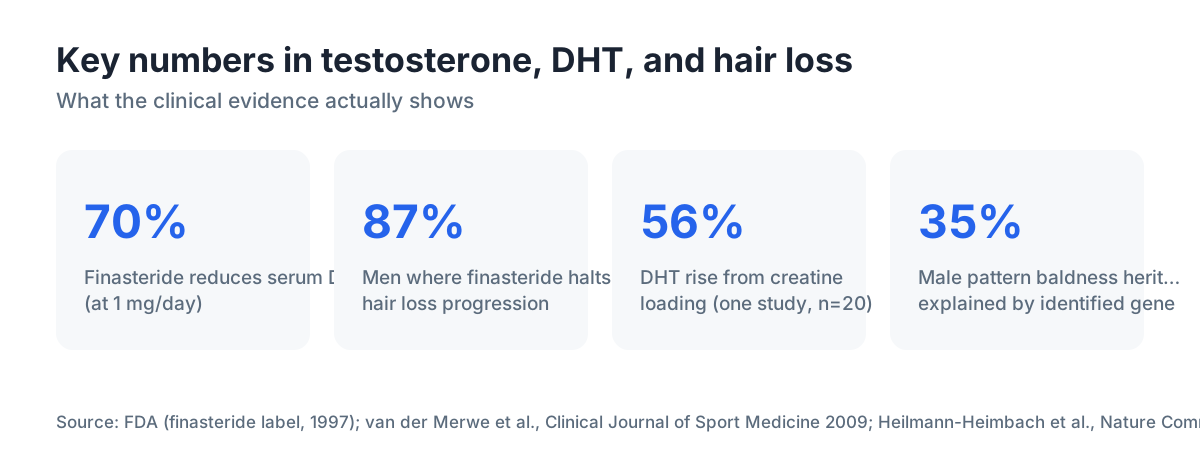
Nobody has clean numbers on exactly how much of baldness risk sits in the androgen receptor gene versus the dozen or so other loci. The current estimate from genome-wide association studies is that identified variants together explain somewhere around 30 to 40% of the heritability of male pattern baldness [6]. The rest is still unmapped.
What about women? Do high androgens cause female hair loss?
Women get androgenetic alopecia too, though the pattern differs. Women more often see diffuse thinning across the top of the scalp instead of a classic receding hairline at the temples. In women, androgen levels matter more directly than in men, because normal female androgen levels are much lower, so any real elevation has a proportionally bigger effect.
Conditions that raise androgens in women, including polycystic ovary syndrome (PCOS), congenital adrenal hyperplasia, and androgen-secreting tumors, are linked to faster female pattern hair loss [8]. For a woman with unexplained diffuse thinning, checking free testosterone and DHEA-S is standard practice and can turn up something you can actually treat.
Still, most women with androgenetic alopecia have entirely normal androgen levels, same as most men. The inherited follicle sensitivity drives the outcome. High androgens are more worth chasing in women than in men, because baseline levels are lower and because PCOS and related conditions are common and treatable. Normal androgen levels do not rule out androgenetic alopecia.
Telogen effluvium is a separate condition that more often hits women and has nothing to do with androgens. It gets triggered by physical stress, rapid weight loss, postpartum hormonal shifts, or nutritional deficiencies.
Does creatine or exercise raise DHT enough to cause hair loss?
This one comes up constantly, mostly because a 2009 study in Clinical Journal of Sport Medicine found that three weeks of creatine loading in college rugby players raised DHT by about 56% and the DHT-to-testosterone ratio by 36% [9]. That sounds alarming. Read the fine print.
The study had 20 participants. Replication has been thin. It never measured hair loss as an outcome; DHT rose in blood, but nobody tracked follicle behavior. And even if scalp DHT climbs on creatine, whether that turns into faster hair loss depends entirely on follicle sensitivity, the same variable that decides whether any DHT exposure causes miniaturization.
For someone with low genetic susceptibility, a short-lived DHT bump probably does nothing to their hair. For someone already losing hair fast, it is worth a thought. The honest answer: the creatine-hair-loss link is biologically plausible and unproven as a direct clinical outcome. Our full breakdown at does creatine cause hair loss goes deeper.
Heavy resistance training nudges testosterone up, and DHT with it, but the size of that change is small next to the variation from genetics. Regular exercise is not a meaningful driver of androgenetic alopecia in the evidence we have.
What do dermatologists actually use to diagnose and treat androgenetic alopecia?
Dermatologists diagnose androgenetic alopecia mostly by clinical pattern, often with dermoscopy to look at follicle miniaturization directly. Blood tests for testosterone and DHT are rarely part of the standard workup for a man with typical male pattern baldness, precisely because those levels carry low diagnostic value here [8].
For women, and for any patient with atypical features, a hormone panel is more likely. The point there is to rule out a secondary cause (PCOS, thyroid disease, high prolactin), not to read the hormone number as a direct explanation for the pattern.
Treatment targets the DHT pathway, not testosterone:
- Finasteride (Propecia, 1 mg) inhibits Type II 5-alpha reductase, cutting serum DHT by roughly 70% at the standard dose. The FDA approved it for male pattern hair loss in 1997 [10].
- Dutasteride inhibits both Type I and Type II 5-alpha reductase, cutting DHT more completely, but is approved for BPH rather than hair loss in the United States.
- Minoxidil for men works by a different mechanism, extending the anagen (growth) phase and improving follicle blood supply. It does not touch androgens or DHT.
- Combining finasteride and minoxidil is a common clinical approach, and the pair has more supporting evidence than either alone.
None of these erase the genetic susceptibility. They change the environment your follicles live in. Stop the medication, and the process picks back up.
If you want a baseline read on where your hairline stands today, MyHairline's free AI scan at /scan can map your current pattern against the Norwood scale before you see a dermatologist. That gives you something concrete to bring into the room.
Can you have low testosterone and still go bald?
Yes, easily. This is one of the clearest proofs that total testosterone is not the controlling variable.
Men with hypogonadism (clinically low testosterone) get androgenetic alopecia at rates that track genetic susceptibility, not testosterone levels. If a man carries the gene expression for sensitive follicles, even the low DHT produced from low testosterone can drive miniaturization over decades.
Testosterone replacement therapy in hypogonadal men does sometimes speed up hair loss, because raising testosterone from low to normal (or above) raises DHT production [4]. But the baseline low-testosterone state does not protect the hair long term if susceptibility genes are present.
Flip it around. Hypogonadal men who are not genetically susceptible will not develop androgenetic alopecia even on testosterone replacement, because their follicles do not respond to DHT in the miniaturizing way. The gene expression is the gate. The hormone is just the key, and some locks do not open no matter how many keys you try.
What is the relationship between scalp DHT and blood DHT levels?
Here is where the science gets genuinely messy, and where a lot of popular coverage flattens it.
Blood DHT (serum DHT) reflects systemic conversion of testosterone to DHT, mostly in the liver and skin. But hair follicles carry their own local 5-alpha reductase activity, so they can make DHT inside the follicle microenvironment regardless of what is happening systemically. Research has found that scalp DHT in balding areas can run higher than in non-balding areas of the same scalp, and that difference does not always map neatly to serum DHT [7].
That local production is one reason topical finasteride, which concentrates the drug at the scalp instead of spreading it systemically, has shown real efficacy in trials while suppressing systemic DHT less than oral finasteride does. A 2021 study in the Journal of the American Academy of Dermatology found that 0.25% topical finasteride solution cut scalp DHT meaningfully with substantially less reduction in serum DHT than 1 mg oral finasteride [11].
The practical takeaway for a patient: a blood test showing normal serum DHT does not mean your scalp is safe from DHT-driven miniaturization. The biology that matters is happening at the follicle, and blood tests do not capture it well enough to guide most hair loss diagnoses.
Should you get your testosterone or DHT tested if you're losing hair?
For most men with a standard male pattern baldness presentation (receding temples, thinning crown, family history of the same), testing testosterone and DHT is unlikely to change the plan or tell you anything useful. American Academy of Dermatology guidance does not recommend routine hormone testing for typical presentations in men [8].
Testing earns its keep in specific situations:
- Women with androgenetic alopecia, especially with other signs of androgen excess (irregular periods, acne, hirsutism)
- Men or women with rapid or atypical hair loss that does not fit the classic pattern
- Men considering testosterone replacement therapy who want a baseline before starting
- Anyone where a physician suspects a secondary hormonal cause
If you do test, the useful markers include total testosterone, free testosterone, DHEA-S, and in women, often prolactin and thyroid function too. A dermatologist or endocrinologist reads these in context. An out-of-range result on its own is rarely the whole story.
Do not spend money on hormone panels expecting them to explain your hair loss unless a clinician has a specific reason to suspect hormonal pathology. For most people losing hair in a classic pattern, the answer is already written in their genetics, not their blood work.
What is actually worth doing if you're worried about hair loss?
The treatments with real evidence behind them target DHT, follicle biology, or both. None of them require you to know your testosterone level.
For men in the early to mid stages (Norwood 1 through 4 or 5), finasteride is the most evidence-supported oral option. Clinical trials show it halts progression in roughly 83 to 90% of men and produces visible regrowth in about 66% over two years [10]. Minoxidil (topical or oral minoxidil) extends the growth phase and is available without a prescription. The two together beat either one alone.
For later-stage loss, hair transplant surgery moves DHT-resistant follicles from the back of the scalp into the areas where miniaturization has taken hold. Transplanted follicles keep the genetic programming of their origin site, which is why they keep growing after the move. It is also why donor hair from the back of the scalp is permanent: those follicles simply are not susceptible to DHT-driven miniaturization.
If you have a receding hairline and are not sure what stage you are at, mapping it against the Norwood scale is a good first step. MyHairline's AI scan at /scan does that in a few minutes from a photo and gives you a baseline to work from.
Hair loss supplements get a lot of marketing money. The evidence base for most of them is thin. Our honest review of hair loss supplements covers what actually has peer-reviewed backing versus what is mostly noise.
The one thing that genuinely does not help: worrying about your testosterone level. It is almost certainly not the variable that decides whether you keep your hair.
Sources
- American Academy of Dermatology, Hair loss types: Androgenetic alopecia
- Endocrine Society (endocrinology.org): androgen receptor affinity of DHT vs testosterone
- Imperato-McGinley J et al., New England Journal of Medicine: 5-alpha reductase deficiency study
- FDA Drug Information: Testosterone (androgen) products, prescribing information
- American Urological Association, Testosterone Deficiency Guideline 2018
- Heilmann-Heimbach S et al., Nature Communications 2017: GWAS of male-pattern baldness
- Schweikert HU & Wilson JD, Journal of Clinical Endocrinology & Metabolism: scalp DHT concentrations
- American Academy of Dermatology, Clinical guidance for androgenetic alopecia
- FDA Drug Label: Finasteride 1 mg (Propecia), approved 1997
- Piraccini BM et al., Journal of the American Academy of Dermatology 2021: topical finasteride trial
- NIH MedlinePlus: Dihydrotestosterone (DHT)