
TL;DR: Minoxidil has a real expiration date, usually 2 to 3 years from manufacture. Past that date, the active ingredient degrades and potency drops, so regrowth results can be weaker or absent. Use opened bottles within 12 months no matter what the printed date says. Toss any bottle that smells off, has changed color, or looks cloudy.
Does minoxidil actually expire, or is it just a legal formality?
Minoxidil expires for real. This isn't the throwaway date stamped on a box of salt to satisfy a lawyer. The FDA makes drug manufacturers run stability testing and guarantee potency only through the printed date [1]. After that, nobody is standing behind what's in the bottle.
The minoxidil molecule is vulnerable to oxidation and hydrolysis over time. Both reactions break it down into weaker or inert compounds. Degradation speeds up once the bottle is opened and air gets in, but it keeps going even in a sealed package sitting in your cabinet.
Here's the practical reality. An expired bottle might still hold most of its original concentration, or it might have lost a big chunk of it. You have no way to know at home. Lab work on dermatological topicals has shown that some products keep their potency well past the date while others drop below labeled concentration before the date even arrives [2]. The spread is wide enough that you can't assume you're fine.
Treat the expiration date on minoxidil as a real cutoff, not a suggestion.
What does the expiration date on minoxidil actually tell you?
The date on a minoxidil bottle, whether it reads 'EXP', 'USE BY', or 'EXPIRES', means the manufacturer guarantees the product sits at or above its labeled potency through that month and year, when stored correctly [1]. It does not mean the stuff turns poisonous the next morning.
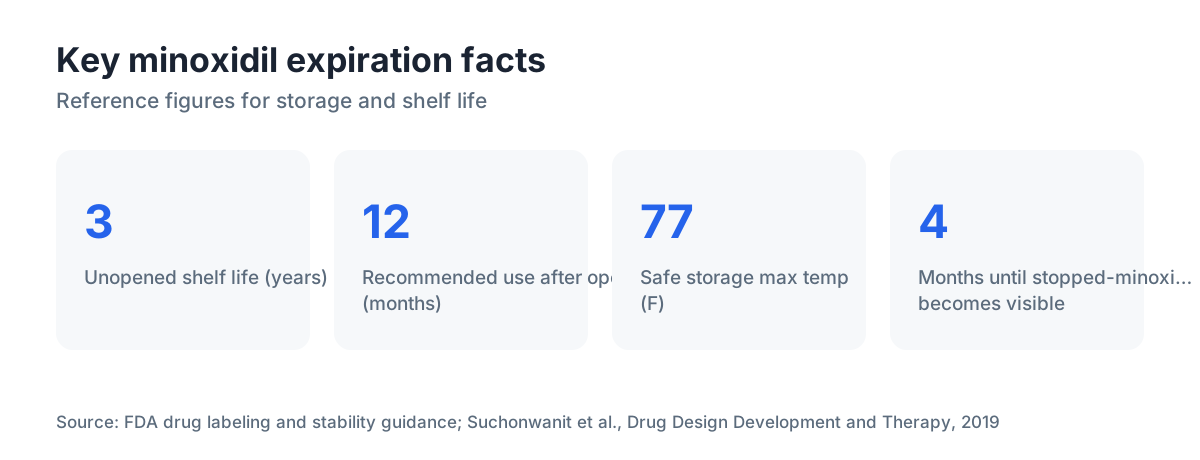
Most over-the-counter topical minoxidil (2% solution, 5% solution, 5% foam) carries a shelf life of 2 to 3 years from manufacture, and that manufacture usually happened months before the bottle reached the shelf [3]. So a bottle you buy today might have an expiration date 18 to 30 months out, not the full 3 years.
Opened bottles run on a faster clock. Minoxidil solution is mostly water and alcohol, and repeated air exposure speeds oxidation of the active compound. FDA guidance on topical stability supports using opened bottles within 12 months, even when the printed date sits further out [1].
Foam uses a propellant delivery system that limits air contact on each use. That gives foam a small edge over liquid on oxidation after opening. The difference is modest. The 12-month-after-opening rule is a sensible guideline for both.
How does minoxidil degrade, and does it become harmful?
Minoxidil breaks down mainly through oxidation and photodegradation. Oxidation is the same reaction that browns a cut apple. The molecule picks up oxygen atoms, its structure shifts, and it loses its ability to work as a potassium channel opener in the scalp [4]. Photodegradation is UV light driving that same breakdown, which is why most minoxidil bottles are opaque or dark-tinted.
The degradation products are generally considered non-toxic at the concentrations you'd find in an old bottle [4]. This isn't like tetracycline and a few other antibiotics, where breakdown products can actively hurt you. So an expired bottle of minoxidil is unlikely to damage your scalp. What it'll probably do is fail to help it, and that's the real cost.
Color tells you a lot. If your bottle has gone from clear or faintly yellow to deep yellow or brown, that's oxidation you can see. A sour or off smell is another sign. Liquid that looks cloudy or has floating particles goes straight in the trash. Each of these means the formulation has changed enough that you shouldn't put it on your head.
Expired minoxidil probably won't harm you. It may just burn your time and money by delivering less of the active ingredient your follicles need.
Does expired minoxidil still work for hair loss?
Maybe, but you're gambling. How much potency is left depends on storage, whether the bottle was opened, and how far past the date you are. A bottle that expired last month, lived in a cool dark drawer, and got opened recently might be close to full strength. A bottle that expired two years ago on a sunny bathroom shelf, opened and reclosed a hundred times, has almost certainly lost real potency.
Here's why that matters. Minoxidil's effect on hair growth tracks with concentration. The gap between 2% and 5% is real and documented in FDA-approved labeling [3]. A degraded 5% solution running at maybe 3% effective concentration acts like a weaker product. If you're already a borderline responder at full strength, that drop could be the line between keeping your hair and losing it.
Expired product is a false economy if you're serious about treatment. A two-month supply of OTC minoxidil runs about $20 to $40 depending on brand and format. That's nothing next to months of weak dosing while your follicles are still viable.
For how minoxidil fits into a full treatment plan, see our guide on minoxidil for men.
How should you store minoxidil to maximize its shelf life?
Minoxidil hates three things: heat, light, and air. Keep it away from all three and you get the shelf life you paid for.
FDA labeling and most product inserts call for controlled room temperature, defined as 68 to 77 degrees Fahrenheit (20 to 25 Celsius), with brief excursions allowed between 59 and 86 [1]. Your bathroom cabinet by the shower is one of the worst spots. Steam and the temperature swings from hot showers speed degradation. A bedroom drawer or a cabinet in a cooler room does the job better.
Direct sun through a window is a fast track to breakdown. Even diffuse countertop light drives photodegradation over months. Leave the bottle in its original container, which is built to block light, and don't decant it into a clear bottle just to see how much is left.
Foam needs its own care. Keep it away from heat sources and out of hot cars. The propellant in an aerosol can reacts to temperature in ways liquid doesn't, and high heat can degrade the minoxidil inside too.
Refrigeration comes up online a lot. The evidence that it meaningfully extends shelf life for minoxidil is thin, and cold can change the solution's viscosity in ways that mess with application. Unless the label says refrigerate, room temperature is the right call.
What is the shelf life of minoxidil foam vs. liquid vs. oral minoxidil?
Format changes the math.
| Formulation | Typical unopened shelf life | Recommended use after opening |
|---|---|---|
| Topical liquid (2% or 5%) | 2-3 years from manufacture | 12 months |
| Topical foam (5%) | 2-3 years from manufacture | 12 months |
| Oral minoxidil tablets | 2-3 years from manufacture | Per prescription label |
Oral minoxidil tablets, prescribed off-label more and more for androgenetic alopecia, are solid-dose forms and hold up better than liquids [5]. They still fall under the same FDA stability framework, and they still degrade in humid or hot conditions. Never keep tablets in a bathroom cabinet above the sink.
If you're weighing oral minoxidil against topical, know that it carries a different side effect profile and needs a prescription. Our explainer on oral minoxidil covers it.
One practical note. Generic minoxidil and brand-name versions (Rogaine is the best-known) use the same active compound and degrade at similar rates. The vehicle (the carrier ingredients) can differ a little between products, which changes how it feels going on, not how stable it is.
Can you use minoxidil past its expiration date safely?
Safety and efficacy are two different questions, and most people run them together.
On safety: there's no strong evidence that topical expired minoxidil irritates skin or causes systemic harm because of degradation. The breakdown products aren't known toxins at these concentrations [4]. So if you're asking whether using an expired bottle for one morning while your new supply is in transit will hurt your scalp, the answer is almost certainly no.
On efficacy: this is where an expired bottle costs you. You don't know the concentration you're actually applying, and steady concentration is everything with a treatment that needs months of daily use to show anything. A Cochrane review of minoxidil found its hair growth effects are concentration-dependent and need consistent daily application to hold [6]. Intermittent or weakened dosing ties to incomplete response or loss of whatever you gained.
My honest take. If the bottle expired in the last month or two, was stored well, and was opened recently, I'd use it while the replacement ships rather than stop cold (stopping minoxidil abruptly sheds the hairs it was holding). If it expired six months ago or more, or shows any color or smell change, toss it.
Still unsure about your hair loss pattern before you spend on treatment? The free AI hair analysis at MyHairline helps you see where you stand.
What happens if you stop minoxidil suddenly, even because your supply expired?
Nobody thinks about this until they're holding an empty or expired bottle with no backup.
Minoxidil doesn't cure hair loss. It manages it. Stop using it and the follicles it was supporting lose that stimulus and resume the path they'd have taken untreated. The shed from that reversal usually shows up within 3 to 4 months of stopping [6]. Many people land back where they'd have been without treatment within about a year.
So an expired bottle you don't replace fast is more than a skipped dose. It starts a countdown that reverses your progress. That's the argument for keeping a backup and reordering before you run out, not when the bottle's empty.
The shed after stopping is different from the shed some people get when they first start. That early one is telogen effluvium, where follicles cycle into a new growth phase at once. Our article on telogen effluvium walks through the difference.
Bottom line: if your only choice is an expired bottle or nothing, the expired bottle is probably the lesser harm, as long as it isn't visibly degraded.
How do you know if your minoxidil has gone bad before the expiration date?
The expiration date is the worst-case guarantee. Store a bottle badly and it can go off before that date. Here's what to check.
Color: Fresh topical minoxidil runs clear to faintly yellow. Turned noticeably yellow, amber, or brown means oxidation. This is the most reliable visual sign.
Smell: The liquid normally has a faint alcohol or mildly medicinal scent. Sour, acrid, or clearly different means chemical breakdown. Foam is harder to judge by smell because the propellant covers it, but an odd odor from foam is still a flag.
Clarity: Liquid minoxidil should be clear. Cloudiness or floating particles point to contamination or carrier ingredients dropping out of solution, which means the formula has broken down.
Foam texture: Good foam comes out light and white and melts fast on skin. Watery, separated, or liquid-out-of-the-can foam means the propellant system has failed.
Spot any of these and don't second-guess it. Throw it out. Using a compromised bottle doesn't save money. It wastes months of application time.
How does minoxidil fit into a broader hair loss treatment plan?
Minoxidil is well-studied and genuinely useful, but it works best as one piece of a plan for androgenetic alopecia. It stimulates follicles and stretches the growth phase, but it does nothing about the hormonal driver of pattern loss, which is DHT shrinking follicles over time [7].
For men with androgenetic alopecia, minoxidil plus finasteride (a DHT blocker) beats either one alone. A 2022 systematic review found combination therapy superior to monotherapy on hair count [8]. If you haven't read how the two work together, finasteride and minoxidil lays out the evidence. For the DHT mechanism itself, DHT blocker is worth a read.
For more advanced loss, minoxidil's ability to cover bald skin is limited. It works where follicles are miniaturized but still there, not where they're gone. If you're looking at heavy recession or a high Norwood stage, a hair transplant consult may be worth having alongside medical therapy.
Minoxidil also carries a real side effect profile worth knowing before you start, including the initial shed, scalp irritation, and the systemic absorption questions that come with higher strengths.
And because hair loss has causes beyond DHT, from nutritional gaps to stress to medications, understanding what causes hair loss helps you avoid chasing the wrong fix.
How should you dispose of expired minoxidil properly?
Don't pour it down the drain or flush it. Minoxidil is a pharmacologically active compound, and wastewater plants aren't built to strip pharmaceuticals out completely [9]. The FDA points to drug take-back programs as the first choice for getting rid of unused or expired medications [9].
The DEA's National Prescription Drug Take-Back Day runs twice a year, and many collection sites accept OTC products. Year-round drop-off spots show up through the DEA's Diversion Control Division locator [10]. Plenty of retail pharmacies also keep permanent collection kiosks.
No take-back option nearby? FDA household disposal guidance says to mix the medication with something unappealing like dirt or used coffee grounds, seal it in a container, and put it in the household trash. That cuts the chance of someone finding and misusing it [9].
Foam cans need one extra step. Empty the canister fully before it goes in regular recycling. A partly full aerosol can is a pressurized container and a fire hazard in some waste streams. Check your local rules on aerosol disposal.
Sources
- FDA, Drugs (drug products and stability guidance)
- Kommanaboyina S, Rhodes CT, Trends and Problems in the Drug Product Stability Testing, Drug Development and Industrial Pharmacy, 1999
- FDA, Drugs@FDA database (minoxidil 2% and 5% topical OTC labeling)
- Suchonwanit P, Thammarucha S, Leerunyakul K, Minoxidil and its use in hair disorders: a review, Drug Design Development and Therapy, 2019
- Randolph M, Tosti A, Oral minoxidil treatment for hair loss: A review of efficacy and safety, Journal of the American Academy of Dermatology, 2021
- van Zuuren EJ, Fedorowicz Z, Minoxidil for androgenetic alopecia in men and women, Cochrane Database of Systematic Reviews, 2016
- American Academy of Dermatology, Hair Loss
- Dhurat R et al, Combination therapy for androgenetic alopecia, Journal of the European Academy of Dermatology and Venereology, 2022
- FDA, Disposal of Unused Medicines
- DEA Diversion Control Division, Drug Disposal