
TL;DR: Yes, oral minoxidil works. At low doses (0.25-5 mg a day) clinical trials show real regrowth in roughly 70-80% of men and women with androgenetic alopecia. It beat topical minoxidil in a head-to-head trial in women. The trade-offs: fluid retention, body hair, and a prescription with ongoing blood pressure checks.
What is oral minoxidil and how does it differ from the topical version?
Oral minoxidil is the pill form of a drug the FDA first approved in 1979 for severe hypertension [1]. The topical version you know as Rogaine came later. It was built to keep the drug on the scalp and out of the bloodstream, because the full cardiovascular dose caused problems.
Same molecule. Different delivery and dose. Topical minoxidil (2% or 5% solution, 5% foam) leaves a small amount of drug on the scalp, where some absorbs into follicles and a little reaches your blood. The pill skips the scalp entirely. It absorbs through your gut, so 100% of what you swallow enters circulation before any of it gets near a follicle.
For hair loss, doctors prescribe far less than the blood pressure dose. The usual range is 0.25 mg to 5 mg a day, against the 10-40 mg a day used for hypertension. That gap is the whole reason the pill is tolerable for hair loss.
Minoxidil works by opening ATP-sensitive potassium channels in smooth muscle cells. In blood vessels that lowers pressure. In follicles it stretches the anagen (growth) phase and widens the follicle itself, so you grow thicker, longer hairs [9]. Neither form blocks DHT. That is why minoxidil and finasteride attack different parts of androgenetic alopecia.
Does oral minoxidil actually regrow hair? What do the trials show?
Yes, and the evidence is better than most people expect. Response rates for androgenetic alopecia run 70% to 80% across the published studies.
A 2022 systematic review in the Journal of the American Academy of Dermatology pooled 17 studies covering 634 patients on low-dose oral minoxidil. The authors concluded that "low-dose oral minoxidil is an effective and relatively well-tolerated treatment for various forms of alopecia" [2].
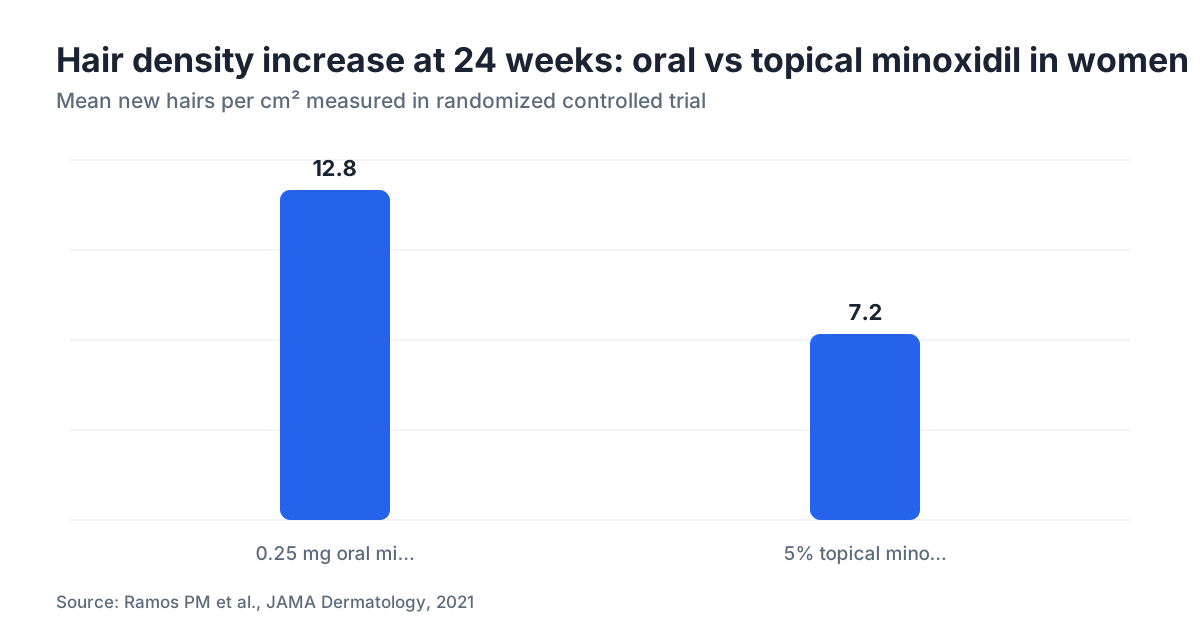
A randomized controlled trial in JAMA Dermatology in 2021 put 5% topical minoxidil once daily against 0.25 mg oral minoxidil once daily in women with female pattern hair loss. The pill won. Density rose by a mean of 12.8 hairs per cm² in the oral group versus 7.2 hairs per cm² on topical at 24 weeks [3]. That is nearly double.
For men, a 2020 study in Dermatology and Therapy followed 50 men with androgenetic alopecia on 5 mg oral minoxidil daily for 24 weeks. Hair count rose significantly and most participants improved on global photographic assessment [4].
Now the honest caveats. Most of these trials run 24 weeks, long enough to catch early response but not long enough to say what happens at year three. Populations are usually under 100 people. And many trials are open-label or single-blind, not the double-blind placebo-controlled design that makes evidence airtight. The data is genuinely encouraging. It is not yet as deep as the file behind finasteride.
Still, hair loss dermatologists have adopted low-dose oral minoxidil widely, and the American Academy of Dermatology lists it as an option for androgenetic alopecia in both sexes [5].
How does oral minoxidil compare to topical minoxidil?
The pill grows more hair and is easier to keep taking. The topical is safer to walk away from if something goes wrong. Here is the split by the numbers.
| Measure | Topical minoxidil (5%) | Oral minoxidil (0.25-5 mg) |
|---|---|---|
| FDA approval for hair loss | Yes (OTC) | No (off-label) |
| Prescription required | No | Yes |
| Hair density gain (24 wks, women) | ~7 hairs/cm² | ~13 hairs/cm² [3] |
| Adherence issues | Scalp residue, twice-daily dosing | Once-daily pill, simpler |
| Body hair growth risk | Low | Moderate |
| Fluid retention risk | Very low | Low to moderate |
| Cost (monthly, US) | $15-40 OTC | $20-60 with Rx |
Adherence carries real weight here. A large share of people on topical minoxidil quit inside the first year, partly because twice-daily application to a damp scalp is a chore and partly because the solution leaves residue [10]. A once-daily pill is far easier to stick with, and sticking with it is what produces results with any hair loss treatment.
Topical does have one structural edge. Get a side effect, stop applying, and systemic exposure drops fast. With a pill you wait for the drug to clear, which takes longer.
For topical-specific detail, see minoxidil for men.
Who is a good candidate for oral minoxidil?
The best candidate is someone with androgenetic alopecia and a healthy cardiovascular system who either couldn't stick with topical or didn't get enough from it. Dermatologists also use the pill off-label for alopecia areata, traction alopecia, and other diffuse shedding.
Good candidates usually:
Tried topical minoxidil and found it too messy or irritating to keep up. Ran topical for at least 6 months and found the results flat. Have normal blood pressure, or hypertension that is already controlled. Have no history of significant heart disease, pericardial effusion, or kidney disease that makes lowering blood pressure risky.
Go slow or avoid it if you have low baseline blood pressure (systolic under 100 mmHg), take other blood pressure medications, are pregnant or trying to conceive (minoxidil is teratogenic in animal studies and carries an FDA Pregnancy Category C label [8]), or have significant cardiovascular disease in your history.
Age matters less than heart health. Older adults can use it but need closer monitoring, since blood pressure swings more with age and fluid retention hits harder.
This drug interacts with others. NSAIDs like ibuprofen can blunt minoxidil's vasodilation and worsen fluid retention. Hand your prescriber the full list of everything you take, including things you buy off the shelf.
What are the side effects of oral minoxidil?
The side effects are real, most are dose-dependent, and lower doses cause fewer of them. Know them before you start.
Hypertrichosis, or unwanted body hair, is the most common cosmetic complaint. It shows up in 15% to 30% of users in published studies [2]. This is body hair, not scalp hair: legs, arms, and the face in women. It is worst above 2.5 mg and often eases when you drop the dose.
Fluid retention and ankle swelling happen because minoxidil dilates vessels and the body answers by holding onto sodium. At 0.25 to 1.25 mg it is usually mild. At 5 mg it is more common. Some prescribers add a low-dose diuretic like hydrochlorothiazide to manage it.
Blood pressure changes are the drug's original job. At hair-loss doses most people see minimal lowering, but some feel lightheaded standing up (orthostatic hypotension), especially in the first few weeks.
A faster heartbeat (reflex tachycardia) can follow the vasodilation. Dose-dependent, usually mild at these doses.
A shedding phase that looks like telogen effluvium often hits in the first 4-8 weeks. Same thing that happens with topical: the drug shoves resting follicles into an active phase, and old hairs fall before new ones arrive. It is temporary and it is alarming if nobody warned you. See telogen effluvium for why this happens.
For every minoxidil side effect across both forms, minoxidil side effects has the full picture.
Serious cardiac events (pericardial effusion, severe hypotension) are documented at high cardiovascular doses. At hair-loss doses they are very rare. They are also the reason this stays a supervised, prescribed treatment rather than something you order and forget.
What dose of oral minoxidil is used for hair loss?
There is no FDA-approved hair loss dose, so prescribers work from trial data and clinical experience. Women usually land between 0.25 mg and 2.5 mg once daily. Men usually land between 2.5 mg and 5 mg once daily.
Women: start at 0.25 mg or 0.5 mg, then increase based on response and tolerance. The trial that beat topical used just 0.25 mg [3].
Men: 2.5 mg to 5 mg once daily. Some men do fine lower, but the trials showing the strongest efficacy in men used 5 mg [4].
Start low and titrate up over 4-8 weeks. That window lets you catch blood pressure or fluid problems before they stack up. Starting at 5 mg on day one is asking for trouble.
Most prescribers dose it once in the morning. The vasodilation peaks in the first few hours, and feeling that while lying flat at night can make certain side effects worse.
How long does it take to see results from oral minoxidil?
Plan on 6 months to judge it and 12 months to see the real payoff. People quit far too early, usually right after the shedding scares them.
First 4-8 weeks: expect more shedding. Do not panic. This is the transition, not failure.
Months 3-4: some people notice early gains in density or texture. Most see nothing dramatic yet.
Month 6: this is where most trials measure outcomes and where responders start seeing real regrowth. The 2021 JAMA Dermatology trial used 24 weeks as its primary endpoint [3].
Month 12 and beyond: continued improvement. Follicles need full growth cycles to show visible change, so this is a slow build.
If you have seen nothing after 9-12 months on an adequate dose taken consistently, the drug probably isn't doing enough for you and you need a new plan. That might mean adding finasteride, looking at a DHT blocker, or talking hair transplant with a surgeon.
Does oral minoxidil work better when combined with finasteride?
Yes. This is the combination most hair loss specialists reach for in men with androgenetic alopecia.
The two drugs hit different targets. Minoxidil stretches the growth phase and widens follicles. Finasteride cuts DHT, the hormone that shrinks follicles in genetically susceptible people to begin with [1]. Run both and you cover more of the problem than either does alone.
A 2021 study in Dermatology and Therapy compared finasteride alone, minoxidil alone, and the two together in men with androgenetic alopecia. The combination beat both monotherapy arms on hair count at 24 weeks [6].
The oral-minoxidil-plus-finasteride pairing has fewer dedicated trials than topical-plus-finasteride, but the mechanism is the same and clinical experience backs it.
See finasteride and minoxidil for the full breakdown of how the combination works and the evidence behind it.
Is oral minoxidil safe for women?
Yes, at low doses and with a few rules specific to women. The best evidence for women comes from 0.25 mg to 1 mg daily.
The 2021 JAMA Dermatology randomized trial showed 0.25 mg outperformed 5% topical in women [3], and several observational studies confirm the benefit at these low doses.
Hypertrichosis matters more here for cosmetic reasons. At 0.25 mg it is mild and many women never notice. At 2.5 mg it gets more common and more visible on the face and forearms.
Pregnancy is the hard line. Minoxidil carries an FDA Pregnancy Category C label based on animal studies showing fetal harm [8]. Women of childbearing age who are not on reliable contraception should not take it. Any woman who becomes pregnant on oral minoxidil should stop right away and call her OB.
Breastfeeding is also off the table. Minoxidil passes into breast milk [8].
Outside those situations, oral minoxidil is one of the stronger options for women, a group that has historically had fewer studied treatments than men.
How much does oral minoxidil cost and how do you get it?
Expect $20 to $60 a month all in, and you will need a prescription. Oral minoxidil isn't FDA-approved for hair loss, so you can't buy it over the counter the way you can topical.
The drug itself is cheap. Generic tablets (2.5 mg and 10 mg strengths made for blood pressure) run about $10-25 a month at major US pharmacy chains with a GoodRx discount [7]. The catch: the exact hair-loss doses (0.25 mg, 0.5 mg, 1.25 mg) usually need a compounding pharmacy, which pushes cost to $30-60 a month depending on location and formulation.
The prescription is the other cost. A dermatology visit out of pocket runs $150-300 for the first consult. Telehealth platforms built around hair loss generally charge $20-50 a month including the prescription, which makes them the cheaper way in for many people.
Blood pressure monitoring is part of doing this right. Your prescriber should record a baseline before you start and recheck around 4-6 weeks. Buy a home cuff if you don't have one. They cost $25-40 and they earn it.
To understand your own pattern before you talk to a doctor, MyHairline's free AI scan (/scan) analyzes your hairline and shows where you sit on the loss spectrum.
What happens if you stop taking oral minoxidil?
You lose most of the regrown hair within 3-6 months. This is the part nobody enjoys hearing. Minoxidil, pill or topical, doesn't cure androgenetic alopecia. It holds the line while you take it.
Stop, and the follicles the drug was propping up return to the path they were on before. Some of that loss arrives in a burst that looks like a shedding episode.
This isn't the drug failing. It is the genetics reasserting themselves. DHT is still there, still miniaturizing susceptible follicles. Minoxidil was compensating, not correcting.
If you want a permanent result without lifelong medication, hair transplant is the only route that delivers it. Even then your untransplanted native hair keeps thinning, which is why many surgeons ask you to stay on medical therapy after surgery.
One upside of the pill: quitting is clean. There is no medical withdrawal. The cardiovascular effects clear in a few days. The hair effects take months to reverse.
Is oral minoxidil worth trying? An honest assessment
For most people with androgenetic alopecia who want something effective short of surgery, oral minoxidil is probably the most underused good option on the table.
The evidence holds up. The response rates are strong. The drug is cheap. And a once-daily pill is easier to maintain than topical twice a day, which matters because adherence decides whether any hair loss treatment works in real life.
The trade-offs are just as real. Body hair pushes some people to quit. Fluid retention is a genuine problem for a minority. And you need medical supervision, which adds friction.
Tried topical honestly for 6 months and came away unimpressed? Oral is a sensible next step to raise with a dermatologist. Starting from scratch and want the simplest effective regimen? For men, low-dose oral minoxidil plus finasteride has the best overall evidence for androgenetic alopecia short of surgery.
Read what causes hair loss for the full map of mechanisms and which treatments hit which target before you decide. To mark where you stand today, the MyHairline AI scan (/scan) gives you a free baseline.
Oral minoxidil is not a magic fix. Nothing in hair loss medicine is. But it works, the trials say so, and for a lot of people it works better than whatever they have been doing.
Sources
- FDA, Loniten (minoxidil) prescribing information
- Vano-Galvan S et al., Journal of the American Academy of Dermatology 2022, systematic review of low-dose oral minoxidil for alopecia
- Ramos PM et al., JAMA Dermatology 2021, oral vs topical minoxidil RCT in women
- Sinclair RD, Dermatology and Therapy 2020, oral minoxidil 5 mg in men with androgenetic alopecia
- American Academy of Dermatology, Clinical Guidelines: Androgenetic Alopecia
- Hu R et al., Dermatology and Therapy 2021, combination finasteride and minoxidil vs monotherapy in men
- GoodRx, minoxidil tablet pricing data
- FDA, Pregnancy and Lactation Labeling, minoxidil Category C classification
- Nestor MS et al., Journal of Cosmetic Dermatology 2021, review of minoxidil mechanisms and clinical use
- Olsen EA et al., Journal of the American Academy of Dermatology, topical minoxidil adherence data