TL;DR: Minoxidil does not block DHT. It works by widening blood vessels around follicles and extending the growth phase of hair, not by reducing the hormone that causes androgenetic alopecia. If DHT is driving your hair loss, you need a separate DHT-blocking drug like finasteride. Most men with pattern baldness benefit from using both.
What does minoxidil actually do in the scalp?
Minoxidil is a vasodilator. That's the whole story mechanically: it relaxes smooth muscle in blood vessel walls, which widens the vessels and increases blood flow to the area where you apply it. On the scalp, that improved circulation brings more oxygen and nutrients to hair follicles that have been starving.
The drug was originally developed in the 1970s as an oral medication for severe high blood pressure. Researchers noticed a conspicuous side effect: patients grew hair in unexpected places. That observation eventually led to the topical formulation that the FDA approved for androgenetic alopecia in 1988, first for men and later for women [1].
Beyond blood flow, minoxidil also shortens the telogen (resting) phase and extends the anagen (active growth) phase of the hair cycle. More follicles stay in growth at any given time, so the hair you see is denser. It may also open potassium channels in follicle cells, which appears to be part of how it prolongs anagen, though the exact molecular pathway is still being worked out [2].
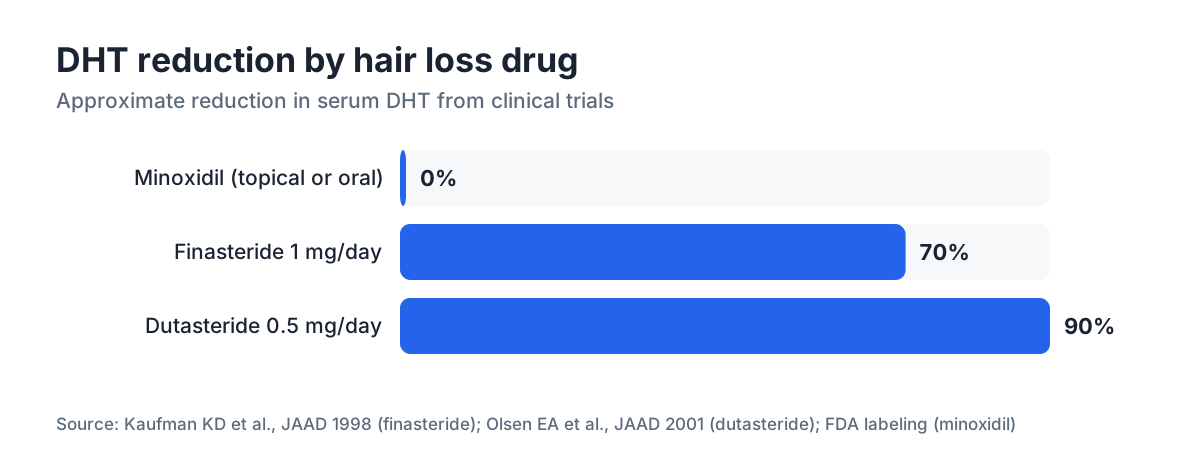
None of these mechanisms touch DHT. Minoxidil does not inhibit the enzyme that makes DHT, does not block androgen receptors in follicles, and does not lower serum or scalp DHT levels. If you're hoping minoxidil is quietly handling both jobs, it isn't.
What is DHT and why does it cause hair loss?
DHT stands for dihydrotestosterone. It's made when an enzyme called 5-alpha reductase converts testosterone into a more potent androgen. Scalp follicles in people with androgenetic alopecia (pattern baldness) carry a genetic sensitivity to DHT: when DHT binds to androgen receptors inside the follicle, it gradually miniaturizes the follicle over years. Hairs grow in shorter, finer, and lighter with each cycle until eventually the follicle stops producing a visible hair [3].
This process is the driver of pattern baldness in roughly 50 million men and 30 million women in the United States, according to the American Academy of Dermatology [4]. The progression follows predictable patterns, most commonly described using the Norwood scale for men and the Ludwig scale for women.
DHT isn't universally bad. It's necessary for normal male development and has functions throughout the body. The problem is the inherited sensitivity in certain follicles, not the hormone itself. That's why DHT blockers don't cause total body hair loss and why someone can have high DHT levels and still keep all their hair if they didn't inherit the sensitivity.
For a broader look at the other causes beyond DHT, see what causes hair loss.
Does minoxidil reduce DHT levels at all?
No. There is no published clinical evidence that topical or oral minoxidil reduces DHT levels in the blood or scalp. The drug has no known interaction with 5-alpha reductase enzymes, and it does not bind androgen receptors. This has been confirmed in pharmacological reviews and is consistent with how the drug was developed: it was engineered as a circulatory drug, not a hormonal one [2].
This matters practically. If your hair loss is entirely DHT-driven, minoxidil can slow the cosmetic appearance of thinning by keeping existing follicles in growth longer and improving follicle environment. But it cannot stop the underlying miniaturization process. You might hold ground for a while, but the DHT is still doing its damage in the follicle.
Some people try minoxidil alone, see modest improvement, and conclude it's handling the problem. What's actually happening is that minoxidil is compensating for the damage rather than preventing it. That distinction decides whether you should add a DHT blocker to your routine.
If you want to know more about drugs that actually do reduce DHT, the dht blocker article covers the evidence on finasteride, dutasteride, and topical options.
What drugs actually block DHT?
The two drugs with strong clinical evidence for DHT reduction are finasteride and dutasteride. Both work by inhibiting 5-alpha reductase, though they differ in which subtypes they block.
Finasteride (sold as Propecia for hair loss, Proscar for enlarged prostate) selectively inhibits type II 5-alpha reductase. In clinical trials it reduced scalp DHT by roughly 64% and serum DHT by about 70% [5]. The FDA approved it for male androgenetic alopecia in 1997. A 5-year trial published in the Journal of the American Academy of Dermatology found that 48% of men taking finasteride showed hair count improvement versus 7% on placebo, and 42% showed no further loss [5].
Dutasteride inhibits both type I and type II 5-alpha reductase, producing a more complete DHT suppression (roughly 90% reduction in serum DHT). It's approved in some countries for hair loss but only for benign prostatic hyperplasia in the US; off-label use for hair loss is common and supported by trial data.
Neither finasteride nor dutasteride has the vasodilating or anagen-extending effects of minoxidil. They work through a completely separate pathway. That's exactly why the combination often outperforms either drug alone.
For a detailed breakdown of how finasteride works, see finasteride.
| Drug | Mechanism | DHT reduction | FDA-approved for hair loss |
|---|---|---|---|
| Minoxidil (topical) | Vasodilation, anagen extension | None | Yes (men and women) |
| Minoxidil (oral) | Same, systemic | None | No (off-label) |
| Finasteride | 5-AR type II inhibitor | ~70% serum DHT | Yes (men only) |
| Dutasteride | 5-AR type I and II inhibitor | ~90% serum DHT | No (off-label in US) |
Does combining minoxidil and finasteride work better than either alone?
Yes, and the evidence for this is solid. A 2021 randomized controlled trial published in the Journal of the American Academy of Dermatology followed 450 men over 24 weeks and found that the combination of oral minoxidil 5 mg plus finasteride produced significantly greater hair count improvements than either drug alone [6]. The complementary mechanisms are the reason: finasteride slows or stops the follicle miniaturization process while minoxidil pushes follicles into active growth and improves their environment.
In practice, most dermatologists treating moderate-to-severe androgenetic alopecia recommend the combination. Minoxidil alone is a reasonable first step for mild loss or for people who want to avoid finasteride's side effect profile. But if you're trying to actually stop DHT-driven loss rather than just slow its visible effects, finasteride (or dutasteride) needs to be in the picture.
One honest caveat: response varies a lot between individuals. Some people see dramatic results from minoxidil alone. Others on the combination still lose ground. Nobody can predict your individual response before you try it.
The finasteride and minoxidil article goes deeper on the combination evidence if you want the trial details.
How well does minoxidil work for androgenetic alopecia?
Minoxidil's efficacy for pattern hair loss is real but modest compared to finasteride. The FDA approval for topical 5% minoxidil in men is based on clinical data showing that about 40% of men using it twice daily for a year had moderate to dense regrowth, compared to about 7% on placebo [1]. Maintenance of existing hair is more reliable than actual regrowth.
Women respond somewhat differently. The FDA-approved formulation for women is 2% topical, applied twice daily, or 5% foam once daily. Trial data showed statistically significant improvements in hair count and patient self-assessment versus placebo, though the effect sizes are generally smaller than in men [1].
Oral minoxidil (0.625 mg to 5 mg daily) has gained attention in recent years as an off-label option with data from several small trials. A 2020 retrospective analysis in the Journal of the American Academy of Dermatology found that low-dose oral minoxidil produced meaningful hair density improvements in women with various types of hair loss, including pattern loss and telogen effluvium [7]. The oral minoxidil article covers the dosing and side effect differences.
Minoxidil works best on the crown and mid-scalp. It's consistently less effective on a receding hairline, which is why hair at the temples often continues to recede even in people who respond well overall. This is also partly because frontal hairline loss tends to be driven more heavily by DHT miniaturization, which minoxidil doesn't address.
Who should use minoxidil, finasteride, or both?
This depends on where you are, how fast you're losing, and what risks you're comfortable with.
Minoxidil alone makes sense as a starting point for people with early or mild thinning, for women (who generally shouldn't take finasteride without specific medical guidance due to risks in pregnancy), and for anyone who wants an over-the-counter option with a well-established safety record.
Finasteride alone is used when someone wants to address the root hormonal cause but has trouble tolerating minoxidil (which is uncommon) or has scalp conditions that interfere with topical application. It's also appropriate for men focused on stopping progression rather than actively regrowing lost hair.
Both together is what most dermatologists recommend for men with Norwood stage 3 or higher who are motivated to halt progression and see some regrowth. The evidence supports better outcomes and the side effect profiles don't meaningfully overlap.
If you've already lost a significant amount of hair and the follicles appear to be permanently miniaturized or dormant, neither drug will restore them. At that point, a hair transplant consultation starts to make more sense, typically combined with medical therapy to protect the remaining native hair.
The minoxidil for men article covers product forms, doses, and application in detail.
Before spending money on a treatment plan, get a clear picture of what type of loss you actually have. A tool like the free AI scan at MyHairline (myhairline.ai/scan) can help you map your pattern and think through whether DHT blockade, minoxidil, or both make sense for your situation.
How long does minoxidil take to work and what does success look like?
Four to six months before you see anything cosmetically meaningful. That's the honest answer. And for the first six to eight weeks, many people actually see an increase in shedding, which is normal and has a name: minoxidil-induced telogen effluvium. The drug pushes hairs that were in resting phase into shedding so new anagen hairs can grow in their place. It looks worse before it looks better.
At four months, some people notice density improvement. At six months, results are clearer. At twelve months, you have a good read on whether it's working for you. Stopping minoxidil after it's been effective causes the hair it maintained to shed within three to six months, because you lose the anagen-extending effect and follicles return to their natural (shorter, slower) cycle [1].
Success for most people on minoxidil alone means holding what they have or gaining some density in the crown. Significant regrowth at the temples or along a receding frontal hairline is genuinely rare with minoxidil as the sole treatment.
If you shed a lot early and get discouraged, know that this is the mechanism working, not failing. If you see no change at all after twelve months, it likely isn't going to help you much. The drug has real non-responders, probably related to differences in how efficiently the scalp converts minoxidil to its active form, minoxidil sulfate [9].
Are there any DHT-blocking properties in topical minoxidil serums marketed as DHT blockers?
Some products marketed as DHT-blocking serums or shampoos contain minoxidil alongside other ingredients like saw palmetto, ketoconazole, or pumpkin seed oil. In these cases, any DHT-related activity comes from those other ingredients, not from the minoxidil.
Ketoconazole, an antifungal, has shown weak anti-androgenic activity in some studies and is the most evidence-backed topical addition. A small randomized trial found that 2% ketoconazole shampoo used every 2 to 4 days produced improvements in hair density comparable to 2% minoxidil in men with pattern loss, though the study was small and older [8]. It's not as strong as finasteride but has fewer systemic concerns.
Saw palmetto has very weak evidence for DHT inhibition when taken orally and essentially no solid clinical trial data for hair loss when applied topically. The same goes for pumpkin seed oil and most other botanical DHT blocker claims. If a product's DHT-blocking claim rests on these ingredients, the evidence is thin.
The hair loss supplements article covers what's genuinely supported by trial data and what's marketing.
The point: if a product contains both minoxidil and a real DHT blocker like a prescription finasteride spray (which does exist compounded), the DHT blocking is coming from the finasteride component, not the minoxidil.
What are the main side effects of minoxidil to know about?
Topical minoxidil's most common side effects are scalp irritation and contact dermatitis, which occur more often with the liquid formulation than the foam. The propylene glycol in many liquid formulations is the usual culprit. Switching to the foam version resolves this for most people.
Unwanted facial hair growth, especially on the forehead and cheeks, happens in some women and in men who get the solution on the face. This typically reverses when you stop or change how you apply it.
Oral minoxidil carries more systemic side effect risk because the drug gets absorbed throughout the body rather than mostly staying in the scalp. Fluid retention, heart palpitations, and the more pronounced body hair growth (hypertrichosis) are the main concerns. At the low doses used for hair loss (typically 0.625 to 2.5 mg for women, up to 5 mg for men), serious cardiovascular effects are rare but the drug shouldn't be used without medical supervision, particularly in people with heart conditions or low blood pressure.
The minoxidil side effects article has the full breakdown with the FDA label data.
Minoxidil has no sexual side effects. That's one of the practical reasons some men choose it over finasteride, which carries a small but real risk of sexual dysfunction (roughly 1.5 to 3.8% in placebo-controlled trials) [5].
Is minoxidil worth trying if DHT is causing your hair loss?
Yes, with appropriate expectations. Minoxidil won't stop DHT miniaturization, but it can meaningfully slow the visible progression of that process and help retain density in follicles that are thinning but not yet dormant. For many people, that's worth a lot.
Here's the honest calculation: if you're a man in your 20s or 30s with clear DHT-driven pattern loss and you want to do something real about it, minoxidil alone is probably not enough long-term. You're running the vasodilator engine while the DHT engine is still running in the other direction. You'll likely slow down the loss but not stop it.
If you add finasteride and tolerate it well, you're addressing both pathways. That's the combination most dermatologists and the evidence both point toward for people who want the best realistic chance at preserving hair over the next decade.
If you're someone who either can't take finasteride (pregnancy concern, side effect risk you're not willing to accept) or simply isn't ready to add a prescription drug, minoxidil is still worth using. It has a 35-plus year safety record, it's inexpensive, and something is better than nothing when DHT is slowly narrowing your options.
For people already at significant loss, medical therapy buys time and protects native hair while you think about whether a hair transplant makes sense. A transplant on an unprotected scalp without medical therapy is a plan that requires repeated procedures as loss continues.
If you're not sure what Norwood stage you're at or whether your loss pattern suggests DHT is the main driver versus something else, a baseline assessment helps. MyHairline's free AI scan (myhairline.ai/scan) can map your thinning pattern and give you a clearer starting point.
Sources
- FDA, Minoxidil Topical Solution labeling and drug approval history
- Suchonwanit P et al., International Journal of Molecular Sciences, 2019, Minoxidil mechanism of action review
- Kaufman KD, Journal of Investigative Dermatology, 2002, Androgens and alopecia
- American Academy of Dermatology, Hair loss types and causes
- Kaufman KD et al., Journal of the American Academy of Dermatology, 1998, Finasteride 5-year trial
- Hu R et al., Journal of the American Academy of Dermatology, 2021, Combination oral minoxidil and finasteride RCT
- Vañó-Galván S et al., Journal of the American Academy of Dermatology, 2021, Low-dose oral minoxidil retrospective analysis
- Piérard-Franchimont C et al., European Journal of Dermatology, 1998, Ketoconazole shampoo versus minoxidil trial
- van der Donk J et al., Journal of the American Academy of Dermatology, 1994, Minoxidil scalp bioavailability and sulfotransferase conversion
- van der Merwe J et al., Clinical Journal of Sport Medicine, 2009, Creatine and DHT study