TL;DR: Yes, minoxidil works for many women with androgenetic alopecia. The 2% topical formula is FDA-approved specifically for women, and clinical trials show 40 to 60% of users see meaningful regrowth or reduced shedding. It doesn't work for everyone, takes 4 to 6 months to show results, and must be used continuously. It isn't approved to treat hair loss from thyroid problems, postpartum shedding, or scarring.
What is minoxidil and how does it work in women?
Minoxidil started life as an oral blood pressure drug in the 1970s. Researchers noticed patients grew unexpected body hair, and the rest is dermatology history. The topical version reached the US market in 1988, and the FDA approved a 2% solution specifically for women in 1991 under the brand name Rogaine. [1]
How it actually works in the scalp is still not fully pinned down, but the leading explanation involves potassium channel opening. Minoxidil is a vasodilator. It widens blood vessels, which may improve blood flow and oxygen delivery to follicles. It also appears to shorten the telogen (resting) phase and extend the anagen (growth) phase of the hair cycle, so more follicles are actively growing at any given moment. [2]
For women, the main target condition is female pattern hair loss (FPHL), also called female androgenetic alopecia. This is the most common cause of hair loss in women worldwide, affecting roughly 40% of women by age 50. [3] It shows up differently than male pattern baldness: women typically see diffuse thinning across the top and crown of the scalp, with the hairline usually staying intact. That's the Ludwig pattern, and it's the presentation minoxidil is designed to address.
Minoxidil does not block DHT or alter hormones. It's a growth stimulant, not a hormonal treatment. That distinction matters for understanding both what it can do and what it can't.
What does the clinical evidence say about minoxidil for women?
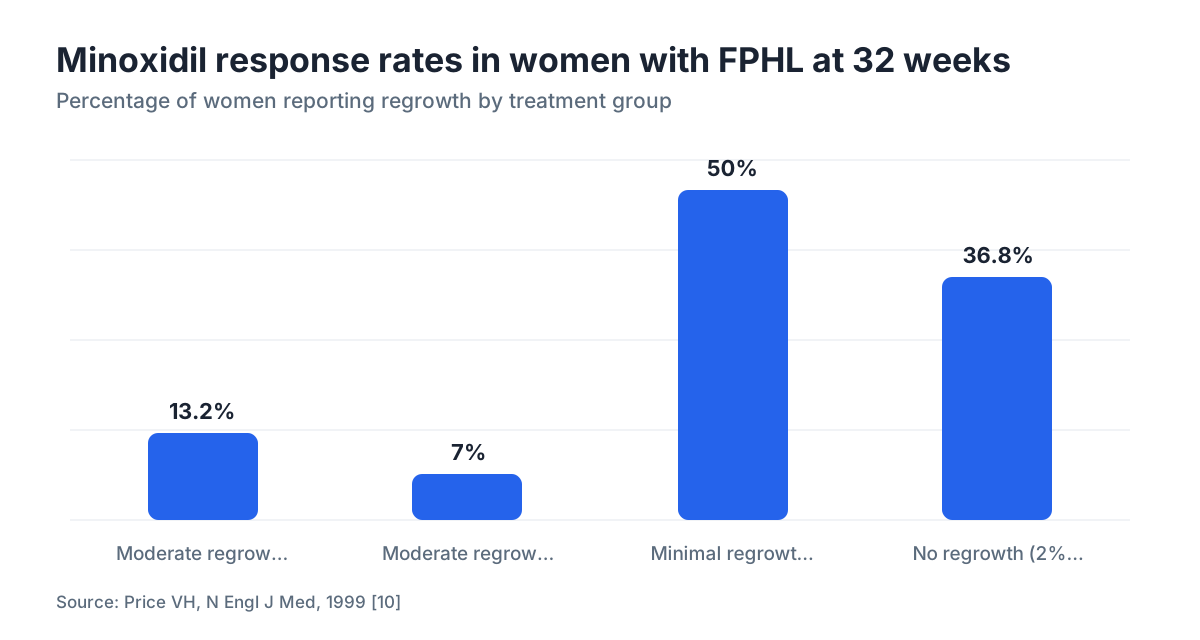
The FDA approval trials used the 2% solution. In one 32-week randomized controlled trial, 13.2% of women using 2% minoxidil reported moderate regrowth compared with 7% using placebo, and a further 50% reported minimal regrowth. [10] Hair count studies from the same era showed statistically significant increases in non-vellus hair counts on the vertex scalp versus placebo.
A 2004 meta-analysis published in the Journal of the American Academy of Dermatology, covering multiple controlled trials, confirmed that both 2% and 5% topical minoxidil produced significantly greater hair counts than placebo in women with FPHL, with the 5% concentration showing a modest edge. [4]
The 5% foam formulation got FDA approval for men in 2006 and was later studied in women. A 24-week trial published in the Journal of the American Academy of Dermatology in 2011 compared 5% minoxidil foam once daily against 2% minoxidil solution twice daily in women. The two regimens produced comparable regrowth, but women preferred the foam because it dried faster and felt less greasy. [5]
Oral minoxidil at low doses (0.25 mg to 2.5 mg daily) has drawn heavy interest since around 2020. Small randomized trials and retrospective studies suggest it performs at least as well as topical forms in women, sometimes better, with the convenience of a pill. [7] It isn't FDA-approved for hair loss in any form, but it is prescribed off-label. If you're curious about that option, the oral minoxidil overview covers the evidence in detail.
The honest summary: minoxidil works for a meaningful proportion of women with FPHL, but not all. Somewhere between 40% and 60% of users see noticeable benefit depending on how you define "benefit." It's not a cure. It slows or reverses thinning while you use it. Stop using it and you lose the gains within a few months.
How long does minoxidil take to work for women?
Expect nothing for the first two months. That's not pessimism, that's biology. The hair growth cycle runs on its own clock, and minoxidil has to shift follicles from resting into growth phase before any new shaft becomes visible above the scalp surface.
Most dermatologists draw a realistic timeline like this:
| Timeframe | What's happening |
|---|---|
| Weeks 1 to 8 | Possible increase in shedding ("minoxidil shed") as resting hairs are pushed out to make way for new growth |
| Months 2 to 4 | Fine vellus hairs may begin appearing; no cosmetically significant change yet |
| Months 4 to 6 | First real signs of regrowth visible; hair counts start to diverge from baseline |
| Months 6 to 12 | Peak response in most users; new hairs thicken from vellus to terminal |
| Month 12+ | Continued maintenance; some further improvement possible in the second year |
The shedding that can hit in the first 6 to 8 weeks scares many women off minoxidil before it has a chance to work. It's counterintuitive, but that early shed is often a sign the drug is working, not a reason to quit. [2] That said, if heavy shedding continues past three months, talk to a dermatologist to rule out other causes. Postpartum hair loss, for instance, is a different condition entirely, covered in the telogen effluvium article.
The clinical trials used 32 to 48 weeks as the evaluation window, which is the right expectation to set. Give it a full year before deciding it failed.
What concentration should women use, 2% or 5%?
The FDA-approved formulation for women is 2% topical solution, applied twice daily. The 5% foam, while approved for men, is widely used off-label in women and studied directly in female populations. [5]
Most dermatologists today start women on 5% foam once daily. The evidence points to similar results as 2% solution twice daily, and the once-daily routine is easier to stick with. Adherence matters enormously with any chronic treatment. A product you'll actually use consistently beats a theoretically better one you skip.
Why wasn't 5% approved for women originally? The earlier studies showed a higher rate of facial hypertrichosis (unwanted facial hair growth) with 5% solution in women. The foam formulation appears to lower that risk because it dries faster and is less likely to drip onto the face and neck. [5]
For reference, the minoxidil for men approach to concentration runs a little different: men typically start at 5% because higher concentrations seem to be both more effective and better tolerated for male pattern baldness. Women's follicular biology and distribution of loss differ enough that starting conservative makes sense.
If topical minoxidil causes scalp irritation, it's often the propylene glycol carrier in the solution, not the minoxidil itself. Switching to the foam (which is alcohol-based) usually resolves this.
Does minoxidil work for all types of hair loss in women?
No. This is probably the most important thing to understand before spending money on it.
Minoxidil has the strongest evidence for female androgenetic alopecia (FPHL), the hereditary thinning pattern that affects the top of the scalp. That's the condition it's approved for and the one it was studied in. [1]
For other causes of hair loss, the picture is much murkier:
Telogen effluvium (diffuse shedding triggered by stress, illness, crash diets, surgery, or childbirth) tends to resolve on its own once the trigger is removed. Minoxidil may shorten the recovery period in some cases, but there's no strong trial data, and using it for a self-limiting condition that would resolve anyway is hard to justify. Read more about telogen effluvium to understand whether your shedding pattern fits.
Alopecia areata (patchy loss caused by autoimmune attack on follicles) does not respond reliably to minoxidil. The FDA has approved baricitinib and ritlecitinib for moderate-to-severe alopecia areata, which are genuinely different drugs with different mechanisms.
Scarring alopecias (lichen planopilaris, frontal fibrosing alopecia, central centrifugal cicatricial alopecia) destroy the follicle permanently. Minoxidil cannot regenerate a follicle that's been replaced by scar tissue. [9]
Traction alopecia from tight hairstyles responds mainly to changing styling habits and stopping the mechanical stress, not to minoxidil, though the drug may help preserve follicles that are damaged but not yet dead.
The first step before starting minoxidil is getting the correct diagnosis. A dermatologist can usually tell FPHL from other types with a physical exam, dermoscopy, and sometimes bloodwork to check thyroid function, ferritin, and androgens. Understanding what causes hair loss can help you walk into that appointment with better questions.
What are the side effects of minoxidil that women specifically experience?
Minoxidil is considered safe for most healthy adult women, but side effects exist and a few are more relevant for women than for men.
Facial hypertrichosis is the most commonly reported complaint in women. Unwanted hair growth on the forehead, temples, cheeks, and upper lip affects somewhere between 3% and 7% of women using 5% solution and fewer using the 2% concentration or 5% foam. [4] It's caused by drug absorption and spread beyond the scalp. Applying minoxidil at bedtime and washing your hands and forehead afterward substantially reduces the risk.
Scalp irritation, dryness, and contact dermatitis are more common with the solution formulation than the foam, largely because of propylene glycol. Switching formulations often fixes this.
The systemic cardiovascular risks from topical minoxidil are generally low in healthy adults because systemic absorption is minimal at recommended doses. Oral minoxidil carries higher systemic exposure and can cause fluid retention, palpitations, and peripheral edema at doses used for hypertension; at the low doses used for hair loss (0.25 to 2.5 mg), these effects are reported but uncommon. [7] Women with cardiovascular disease or who are pregnant or breastfeeding should not use any form of minoxidil without a physician's direct guidance.
Pregnancy is a hard contraindication. The FDA label for Rogaine warns against use during pregnancy and breastfeeding. [1] There is animal evidence of fetal harm, and while the topical dose is much lower than oral doses, the risk isn't worth taking.
For a full breakdown of what to watch for, the minoxidil side effects article covers both topical and oral forms in depth.
How should women apply minoxidil correctly?
Application errors are one of the most common reasons women don't see results. The drug has to reach the scalp, more than coat the hair.
For 2% solution: Part your hair to expose the thinning areas. Use the dropper to apply 1 mL directly to the scalp (not the hair) in the affected area. Spread with your fingertips and let it dry. Do this twice daily, about 12 hours apart. Wash your hands immediately after.
For 5% foam: Dispense half a capful onto your fingertips, not your scalp directly. Part your hair, then press the foam into the scalp where you want coverage. It melts quickly on contact with skin. Let it dry for at least two hours before bed or before washing your hair.
Don't shampoo within four hours of application. Let it absorb. Styling products, blow dryers, and wet hair don't void the effect, but applying to a clean dry scalp before styling gives the best absorption.
You can wash your hair normally while using minoxidil. There's no evidence that any specific shampoo amplifies the drug's effect, despite what you'll read on the packaging of countless "minoxidil-friendly" shampoos. Save your money.
Missing occasional doses won't tank your results, but missing weeks at a time will. This is a chronic treatment. Treat it like a skincare routine, not a medication you take only when you remember.
Can women combine minoxidil with other hair loss treatments?
Yes, and for many women the best outcomes come from combining approaches rather than relying on any single one.
The most common combination is minoxidil with a low-androgen oral contraceptive or spironolactone, particularly for women who have elevated androgens or FPHL with a hormonal component. Spironolactone is an anti-androgen that blocks androgen receptors in the scalp and reduces DHT's effect on follicles. It's used off-label for FPHL in women who have signs of hormonal involvement. A dermatologist needs to evaluate whether this is appropriate, because spironolactone can affect potassium levels and blood pressure.
Finasteride, the 5-alpha reductase inhibitor approved for men, is used off-label in postmenopausal women with FPHL. Evidence is mixed and the drug is absolutely contraindicated in women who could become pregnant due to risk of feminization of a male fetus. The finasteride article explains the mechanism and the evidence. If you've seen advertisements for DHT blockers, most of the legitimate ones in this category work through similar pathways.
Minoxidil combined with finasteride has been studied in men extensively, with better results than either alone. See the finasteride and minoxidil comparison here. The combination evidence in women is thinner, but clinically it's common practice for postmenopausal women with moderate FPHL.
For women considering supplements, the honest take is that the evidence for most hair loss supplements is weak. Biotin deficiency is rare. Iron deficiency and ferritin levels below 30 ng/mL may impair hair growth, and correcting a true deficiency is worth doing, but no supplement replaces minoxidil's track record.
Hair transplant surgery is an option for women with stable, well-defined FPHL who haven't responded adequately to medical treatment. The catch is that diffuse thinning makes donor selection harder than in men. Read the hair transplant overview if you're exploring that path.
What happens if you stop using minoxidil?
The gains are not permanent. That's the honest reality of minoxidil and the part most marketing underplays.
Minoxidil doesn't cure hair loss. It supports follicle activity while you use it. Stop using it and within about 3 to 6 months, the follicles return to their previous trajectory, and the hair you regrew or maintained will shed. This is called "discontinuation shedding" and it's documented in both clinical observation and in the package labeling. [1]
Some women try using it for a defined period, then tapering. This doesn't reliably preserve gains. The drug needs to be present for the effect to continue.
This is worth knowing upfront because it changes the decision calculus. You're not buying a 6-month course of treatment. You're potentially committing to a long-term habit, possibly indefinitely. For some women that's fine. For others, especially younger women who may be managing minoxidil around future pregnancies, it takes real planning.
If you need to stop temporarily (for pregnancy, for surgery, for whatever reason), discuss it with your doctor. Some dermatologists will recommend restarting immediately after delivery or clearance from the surgeon. The science on ideal restart timing is thin, but clinical consensus generally favors restarting as soon as it's safe.
How much does minoxidil cost for women and where can you get it?
Minoxidil is available over the counter without a prescription in both 2% and 5% concentrations. The price has dropped substantially since the branded Rogaine patents expired.
Generic topical minoxidil 2% solution (60 mL, roughly a one-month supply) costs around $10 to 20 at major pharmacies. The 5% foam runs about $20 to 35 per month for the name brand (Rogaine Women's) and roughly $15 to 25 for generics.
Oral minoxidil requires a prescription because it's being used off-label for hair loss. Compounding pharmacies offer it at lower doses specifically for this use, typically for $20 to 50 per month depending on dose and provider.
Telehealth services and dermatology practices can prescribe oral minoxidil via video visit, which is often easier to arrange than an in-person appointment for the initial evaluation. The American Academy of Dermatology maintains a "Find a Dermatologist" locator if you want an in-person evaluation. [6]
If you want to understand your pattern of loss before committing to a treatment, the free AI hair scan at MyHairline (myhairline.ai/scan) can help identify whether your thinning looks consistent with FPHL or another pattern worth discussing with a doctor.
Generic topical minoxidil is one of the cheapest evidence-based hair loss treatments that exists. The barrier isn't price. It's patience and consistency.
When should women see a dermatologist instead of just buying minoxidil over the counter?
Self-treating with OTC minoxidil is reasonable if your hair loss pattern looks like classic FPHL: gradual diffuse thinning on the top and crown, no scalp symptoms, no sudden onset, and no obvious trigger. If you're unsure of any of those, see a dermatologist first.
Get a professional evaluation if:
- Hair loss is patchy, asymmetric, or accompanied by itching, burning, or scalp pain
- Loss started suddenly or progressed rapidly over a few months
- You also have irregular periods, acne, or excess facial or body hair (these can signal elevated androgens or PCOS)
- You've been losing hair since childbirth and it's been more than a year with no improvement
- You're under 18
- You're pregnant, trying to become pregnant, or breastfeeding
- You have a personal or family history of autoimmune disease
- You've tried minoxidil for 12 months without any change
A dermatologist can do a scalp biopsy if needed, run bloodwork (thyroid, iron studies, hormones), and prescribe treatments beyond OTC options. A correct diagnosis changes everything. Treating androgenetic alopecia with minoxidil when the real cause is iron-deficiency anemia or hypothyroidism will get you nowhere.
Is minoxidil worth it for women? An honest assessment
For women with confirmed female androgenetic alopecia, yes, minoxidil is worth trying. It has the strongest evidence of any OTC hair loss treatment for women, it's inexpensive, and the side effect profile is manageable for most people. The American Academy of Dermatology lists topical minoxidil as a first-line recommendation for FPHL. [6]
Here's the realistic frame. Most women who respond to minoxidil don't go from significantly thinned hair back to the density they had at 25. They slow further loss, regrow some finer hairs in the most affected areas, and see their part look less wide over time. That's meaningful. It's not magic.
The women who get the most out of minoxidil start relatively early (before extensive follicle miniaturization), stay consistent with application, and hold realistic expectations. The women who end up most disappointed expected a dramatic transformation by month 3.
If you want to understand where your loss currently stands before deciding, MyHairline's AI hair analysis at myhairline.ai/scan is a free starting point that can flag whether your pattern looks like FPHL and give you something concrete to discuss with a dermatologist.
Minoxidil isn't the answer for everyone. But for the right woman with the right diagnosis and the willingness to commit, it's one of the few hair loss treatments with legitimate evidence behind it.
Sources
- FDA, Rogaine (minoxidil) 2% Solution Prescribing Information / Label
- Suchonwanit P et al. Minoxidil and its use in hair disorders: a review. Drug Design, Development and Therapy 2019;13:2777-2786. Dove Press.
- American Academy of Dermatology, Hair Loss Types and Causes
- Olsen EA et al. J Am Acad Dermatol (5% minoxidil foam trial and FPHL reviews).
- Blume-Peytavi U et al. A randomized, single-blind trial of 5% minoxidil foam once daily versus 2% minoxidil solution twice daily in the treatment of androgenetic alopecia in women. J Am Acad Dermatol 2011;65(6):1126-1134.
- American Academy of Dermatology, Hair Loss: Diagnosis and Treatment
- Suchonwanit P et al. Minoxidil and its use in hair disorders: a review. Drug Design, Development and Therapy 2019;13:2777-2786. Dove Press.
- Vañó-Galván S et al. Frontal fibrosing alopecia: A multicenter review of 355 patients. J Am Acad Dermatol 2014;70(4):670-678.
- Price VH. Treatment of hair loss. N Engl J Med 1999;341(13):964-973.
- FDA, Drug Approvals and Databases (Drugs@FDA)