TL;DR: Minoxidil can help a receding hairline, but it works better in some spots than others. The temples are stubborn. Studies show real regrowth at the crown and mid-scalp; the frontal hairline responds less reliably. Starting early matters more than anything else. It is not a cure, and results reverse when you stop.
What does minoxidil actually do to your hair follicles?
Minoxidil is a vasodilator. It started as a blood pressure pill, and researchers noticed an awkward side effect: patients grew more hair. That observation eventually turned into the topical product most people know as Rogaine.
The mechanism isn't perfectly understood, but the leading explanation is that minoxidil opens potassium channels in smooth muscle cells around the follicle, which widens nearby blood vessels and increases blood and oxygen delivery to the hair root [1]. It also appears to extend the anagen (active growth) phase of the hair cycle and shorten the resting phase, so more follicles are actively growing at any given time.
What it does not do is block dihydrotestosterone (DHT), the hormone behind the genetic miniaturization that causes male and female pattern hair loss. That's the fundamental limit of minoxidil. It works on the environment around the follicle, not the hormonal signal attacking it. If DHT miniaturization has gone far enough to kill a follicle permanently, minoxidil can't bring it back.
The FDA approved topical 2% minoxidil for women in 1991 and topical 5% for men in 1997, both for androgenetic alopecia [2]. That approval language matters. The trials that earned it were focused on the vertex (crown), not the frontal hairline.
Does minoxidil work on a receding hairline, or just the crown?
It can work at the hairline, but the honest answer is that it depends on how far the recession has gone and how long it's been happening. Minoxidil helps most where follicles are still alive and only partly shrunk.
The FDA approval trials for 5% topical minoxidil focused on the vertex scalp, not the temples or frontal hairline [2]. That's why Rogaine packaging says it's indicated for the top of the head. The company isn't being modest. That's where the trial data lives.
The frontal scalp and temples are more sensitive to DHT than the vertex. Follicles there tend to miniaturize faster and reach the point of no return sooner. Minoxidil can still help at the hairline, but the response rate is lower and the regrowth is usually thinner than what you'd get at the crown.
A 2017 review in the Journal of the American Academy of Dermatology reported that topical minoxidil produces "a significant increase in total hair count" across the scalp, while noting the evidence base for the frontal zone is thinner than for the vertex [3]. Smaller studies and clinical observations suggest men who start minoxidil early, when the hairline is just starting to recede, see the most frontal benefit.
So yes, minoxidil can work on a receding hairline. It's not guaranteed, and it won't work as dramatically or as predictably as it does at the crown. Useless for the hairline, though, it is not.
If you want the full picture of what's driving your recession, receding hairline breaks down the different patterns and what they mean for treatment.
How well does rogaine work on a receding hairline compared to the crown?
Here are the actual numbers. The 48-week trial that supported FDA approval of 5% minoxidil foam in men found a mean increase of 12.4% in non-vellus hair count in the vertex versus placebo [2]. That's the controlled trial data. Frontal hairline data from equally rigorous head-to-head trials is sparse.
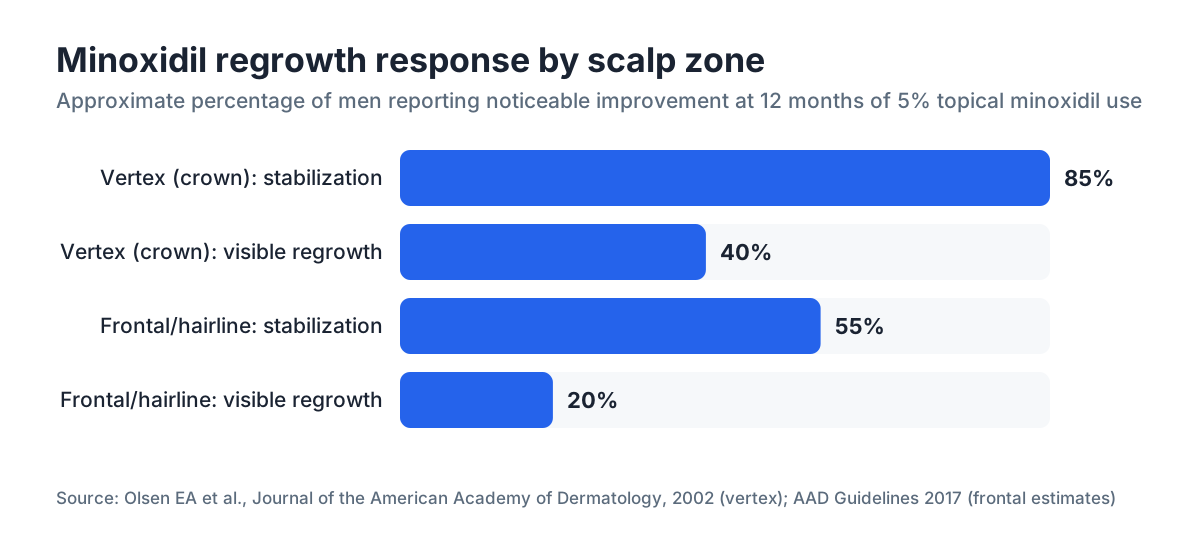
For the crown, roughly 40% of men using 5% topical minoxidil report noticeable regrowth at 12 months, and around 85% report that their loss at least stabilized [4]. Those numbers drop considerably for the frontal zone.
Think of it this way. The frontal hairline is the leading edge of recession. It's losing ground to DHT in real time. Minoxidil is trying to push against that current without cutting off the source. At the crown, DHT damage is also happening, but the vertex is slightly less sensitive in many men, and those follicles have often been miniaturizing for less time by the time you notice them.
Age and Norwood stage matter too. A man at Norwood stage II or III who starts minoxidil in his mid-20s has a better shot at hairline preservation than a man at stage V who starts at 45. By stage V, much of the frontal hairline has likely gone through irreversible follicle death.
Oral minoxidil is a different story worth mentioning. Oral minoxidil at low doses (0.625mg to 5mg) has shown real frontal regrowth in several recent trials, possibly because systemic delivery reaches follicles that topical application misses. That's a conversation to have with a dermatologist, not a self-prescription.
What the regrowth timeline actually looks like
People quit minoxidil at 8 weeks because "it's not working." That's the most common mistake.
The first thing that often happens is shedding. Minoxidil pushes dormant follicles into an active growth phase, which can eject existing hairs first. This usually starts around weeks 2 to 8 and lasts 4 to 6 weeks. It's alarming if you don't expect it, and it's also a sign the drug is doing something [1].
Actual visible regrowth takes longer. Most dermatologists tell patients to judge results at 6 months minimum, with 12 months giving a more honest picture. The AAD states that hair regrowth from minoxidil is typically visible "after at least 4 months of consistent use" [5].
For the hairline specifically, expect slower and more modest results than at the crown. Fine, unpigmented vellus hairs often show up first. Over months, some mature into terminal hairs. Many don't. That gradual process is why patience is genuinely necessary here, not a throwaway line.
Consistency matters more than most people realize. Missing doses regularly blunts the effect. Twice-daily application of topical minoxidil (the labeled frequency) keeps steadier tissue levels than once-daily, though some once-daily foam formulations have supporting data.
| Phase | Typical timeframe | What to expect |
|---|---|---|
| Initial shedding | Weeks 2 to 8 | Temporary increase in hair fall |
| Early regrowth | Months 3 to 4 | Fine, light vellus hairs |
| Visible result | Months 6 to 12 | Thicker, pigmented terminal hairs (if response occurs) |
| Peak effect | Month 12 to 18 | Maximum benefit for most users |
| Maintenance | Indefinitely | Must continue or gains reverse within 3 to 6 months |
Does the formulation matter: foam vs liquid, 2% vs 5%?
It does, though maybe not as much as marketers would have you believe.
The 5% concentration is more effective than 2% for men. A randomized comparison found that 5% topical minoxidil produced significantly greater hair regrowth than 2% in men with androgenetic alopecia [4]. For women, the FDA-approved concentration is 2%, though 5% foam is used off-label with appropriate caution about side effects like facial hair growth.
Foam vs liquid is mostly a question of application and scalp tolerance. Liquid contains propylene glycol, which can cause contact dermatitis in some people. Foam doesn't, which is why it tends to be better tolerated. For the hairline, foam is easier to apply precisely near the temples without running into your face.
Generic minoxidil contains the same active ingredient as Rogaine at a fraction of the cost, usually $10 to $20 per month versus $30 to $50 for branded products. The FDA requires bioequivalence, so there's no meaningful difference in the drug itself [2].
For a full breakdown of formulations and dosing options for men, minoxidil for men covers the practical details.
Why does the hairline respond less than the crown?
A few things make the frontal zone harder to treat.
First, DHT sensitivity varies across the scalp. Frontal and temporal follicles tend to have higher concentrations of 5-alpha reductase, the enzyme that converts testosterone to DHT, plus more androgen receptors. They're simply more vulnerable to the hormonal signal causing the loss [6].
Second, by the time most men notice a receding hairline, those follicles have often been miniaturizing for years. Miniaturization is a spectrum. A follicle that's 70% miniaturized can potentially be rescued. One that's fully atrophied can't. The temporal peaks and the very front of the hairline often cross that irreversible line before the crown does.
Third, topical application at the hairline is less consistent than on the scalp. Hair at the front deflects the product. Technique matters, and many people undertreat the temple area.
One thing worth knowing: some doctors prescribe finasteride and minoxidil together because they target different parts of the problem. Finasteride blocks DHT at the source. Minoxidil improves the follicle environment. The combination has better evidence for hairline preservation than either drug alone [7]. That combination is covered in detail at finasteride and minoxidil.
Who is most likely to see results at the hairline?
Be honest with yourself about where you are before expecting miracles.
Minoxidil at the hairline works best for people who started losing within the last 5 years, are Norwood II or early III, still have miniaturized (but not dead) follicles in the recession zone, and are willing to use it consistently for at least a year.
It works less well for people who have had significant recession for a decade or more, are Norwood IV and above with a clearly defined frontal bald area, or followed an aggressive loss pattern in their 20s that points to strong genetic DHT sensitivity.
Younger patients often assume early treatment is pointless because "it's not that bad yet." The opposite is true. The follicle that's 30% miniaturized today is far more recoverable than the same follicle at 80% three years from now. Starting early is the single biggest variable you control.
Women with diffuse thinning along the frontal part line, common in female pattern hair loss, generally respond better to minoxidil than men with defined temple recession. The pattern of loss matters.
If you're trying to figure out exactly what your pattern looks like, the free AI hair scan at MyHairline can map your recession and give you a clearer baseline before you start any treatment.
What happens when you stop using minoxidil?
This is the part most people don't want to hear.
Minoxidil is not a cure. It's maintenance. When you stop, the environmental advantage it was providing disappears, and the follicles slide back to their natural DHT-driven miniaturization. Most people lose the ground they gained within 3 to 6 months of stopping [1].
That means if you regrow hair at your hairline with minoxidil and then quit, that hair falls out. Not all at once, but progressively. You'll roughly end up where you would have been without treatment, often within a year of stopping.
This is why some people call minoxidil "not worth it." They try it, see results, stop for whatever reason, and lose it all. The drug didn't fail them. They stopped a maintenance treatment that needs indefinite use.
If you're going to use it, plan to use it for years, not months. That changes the cost math. At $10 to $20 a month for generic topical, it's manageable for most people. At $30 to $50 for branded, it adds up.
Are there side effects you should know about before applying it near your face?
Applying minoxidil near the temples and hairline puts it closer to your forehead and face than crown applications do. That brings a few practical risks.
The most common topical side effect is scalp irritation: dryness, itching, and flaking. This often comes from the propylene glycol in liquid formulations. Foam tends to cause less of it [1].
More relevant for hairline use: minoxidil that runs or transfers to the face can cause facial hypertrichosis, meaning unwanted hair growth on the forehead, cheeks, or temples. It's dose-dependent and reversible when you stop or cut back, but it's genuinely annoying. Applying at night and washing your hands and face after application lowers the risk.
Systemic side effects from topical minoxidil at standard doses are uncommon but include fluid retention, headache, and in rare cases cardiovascular effects (it is a vasodilator). People with existing cardiovascular conditions should talk to a doctor before starting [2].
For the complete picture of what to watch for, minoxidil side effects has the full breakdown.
Facial hair growth in women using 5% foam near the hairline is a real concern. Some dermatologists advise women to use 2% liquid at the hairline for this reason, applied with a dropper for precision.
Is a hair transplant better than minoxidil for the hairline?
Different tools for different situations.
A hair transplant physically moves DHT-resistant follicles from the back and sides of your scalp to the hairline. Those transplanted hairs are genetically set to be permanent. They don't care about DHT the way frontal follicles do. For advanced recession, a transplant can restore a hairline that minoxidil can't touch [8].
But transplants cost between $4,000 and $15,000 or more depending on graft count and clinic location. They involve real surgery, recovery time, and results that swing heavily on surgeon skill. They also require a stable donor area, which young men with aggressively progressing loss often don't have yet.
Minoxidil costs $120 to $240 per year for generic topical. It's non-invasive. The right move for someone at Norwood II is almost certainly to try minoxidil (and possibly finasteride) first, not spend five figures on surgery.
For someone at Norwood V or VI with a decade of advanced recession, minoxidil is unlikely to produce meaningful hairline restoration. Surgery might be the realistic option, with minoxidil used afterward to preserve existing hair.
More on the surgical route at hair transplant.
What does the evidence say about combining minoxidil with other treatments?
Minoxidil combined with finasteride is the most studied combination for androgenetic alopecia. A 2015 randomized controlled trial found the combination produced significantly greater hair counts than either drug alone in men with pattern hair loss [7]. For the hairline, the logic is clean: finasteride reduces DHT, which slows the attack on frontal follicles, while minoxidil supports the growth environment. They're not redundant. They work differently.
Dermarolling (microneedling) combined with minoxidil has growing evidence behind it. A 2013 randomized trial in the International Journal of Trichology found that minoxidil plus a 1.5mm dermaroller produced significantly more hair growth than minoxidil alone in men with androgenetic alopecia, with 82% of the dermaroller group showing a greater-than-50% improvement versus 4.5% in the minoxidil-only group [9]. The mechanism seems to involve increased skin permeability and growth factor release. That's a striking number from one small trial, so treat it as promising rather than settled.
Ketoconazole shampoo (2%, prescription) has some evidence of modest anti-androgenic effects at the scalp level and may complement minoxidil, though the evidence is weaker than for finasteride.
If you're exploring other treatment angles, DHT blocker covers the range of anti-androgen options, and hair loss supplements gives an honest read on what the over-the-counter options actually deliver.
MyHairline's free AI hair analysis can help you track whether a combined regimen is actually moving the needle over time, which is genuinely hard to judge in the mirror month to month.
Sources
- FDA, Drugs@FDA Approval History for Minoxidil Topical
- American Academy of Dermatology, Guidelines of care for androgenetic alopecia, Journal of the American Academy of Dermatology, 2017
- Olsen EA et al., A randomized clinical trial of 5% topical minoxidil versus 2% topical minoxidil and placebo in the treatment of androgenetic alopecia in men, Journal of the American Academy of Dermatology, 2002
- American Academy of Dermatology, Hair loss: Tips for managing
- Kaufman KD, Androgen metabolism as it affects hair growth in androgenetic alopecia, Dermatologic Clinics, 1996
- Kanti V et al., Evidence-based (S3) guideline for the treatment of androgenetic alopecia in women and in men, Journal of the European Academy of Dermatology and Venereology, 2018 (citing Hu R et al. 2015 RCT)
- International Society of Hair Restoration Surgery, Practice Census Results 2022
- Dhurat R et al., A randomized evaluator blinded study of effect of microneedling in androgenetic alopecia: a pilot study, International Journal of Trichology, 2013