TL;DR: Pumpkin seed oil contains beta-sitosterol and other phytosterols that appear to partially inhibit 5-alpha reductase, the enzyme that turns testosterone into DHT. One small randomized trial found 40% more hair count in men after 24 weeks. That's promising, not proven. It won't replace finasteride or minoxidil, but it's one of the safer things you can try early.
What is DHT and why does it cause hair loss?
DHT stands for dihydrotestosterone. It's a strong androgen your body makes by converting testosterone with an enzyme called 5-alpha reductase (5AR). In scalp follicles that are genetically sensitive to it, DHT binds to androgen receptors and slowly miniaturizes the follicle over years. The hairs get thinner, shorter, and lighter until eventually nothing grows there at all. This process is androgenetic alopecia, and it's the most common cause of hair loss in both men and women. [1]
Genetics decide which follicles are sensitive. DHT doesn't wreck every follicle, which is why the back and sides of the scalp usually keep their hair. Those follicles carry fewer androgen receptors. That single fact explains why anything that lowers DHT or blocks it at the receptor can, in theory, slow or stop the loss.
Want the full picture on what drives this? The what causes hair loss explainer covers genetics, age, and the factors beyond hormones.
Two prescription drugs already work this biology hard. Finasteride blocks 5AR directly and drops serum DHT by roughly 70%. [2] Minoxidil does something else entirely, widening blood vessels near follicles and never touching DHT. Pumpkin seed oil is aiming at the same target as finasteride, but with far less punch and no prescription.
What's actually in pumpkin seed oil that might block DHT?
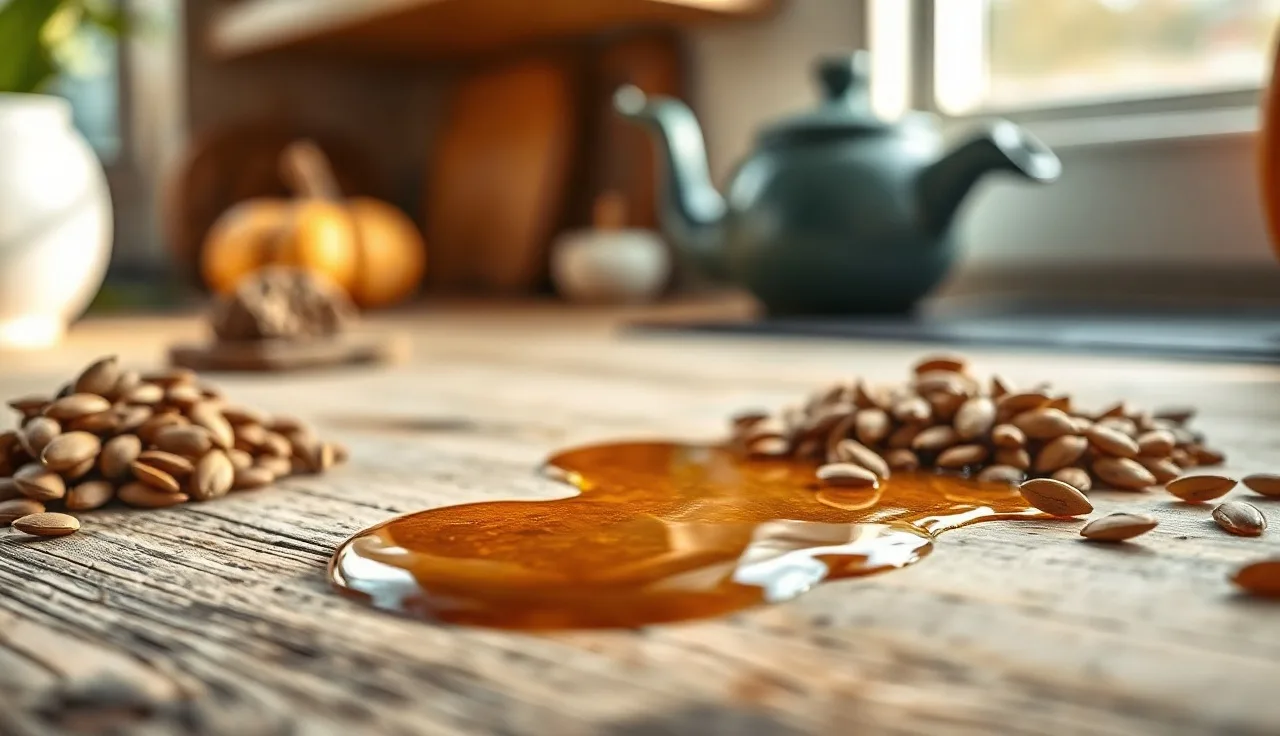
Pumpkin seed oil (PSO) is pressed from the seeds of Cucurbita pepo, the common pumpkin. It's loaded with several compounds that have real biological activity around DHT.
The main suspect is beta-sitosterol, a plant sterol built a lot like cholesterol. Lab studies show beta-sitosterol slows 5-alpha reductase activity. It's also one of the active compounds in saw palmetto, the better-studied botanical DHT blocker. [3] PSO carries beta-sitosterol along with delta-7-sterols (unusual in most plant oils), linoleic acid, oleic acid, and tocopherols (the vitamin E family).
Delta-7-sterols are the interesting part. Some researchers think they compete with testosterone for the 5AR enzyme, which would slow the conversion to DHT. Most of that evidence is mechanistic, meaning it comes from lab dishes and animal models, not big human trials. Nobody has cleanly pinned down which compound in PSO does what inside a living human scalp.
PSO also calms inflammation, and there's a theory that scalp inflammation speeds up follicle miniaturization on its own, apart from DHT. Whether soothing that inflammation with an oil translates to hair you can actually see and keep is genuinely unknown. The honest read: PSO probably runs several weak mechanisms at once, none strong alone. That's either encouraging (they add up) or underwhelming (still not enough), depending on where the clinical data lands.
What does the best human study on pumpkin seed oil and hair loss actually show?
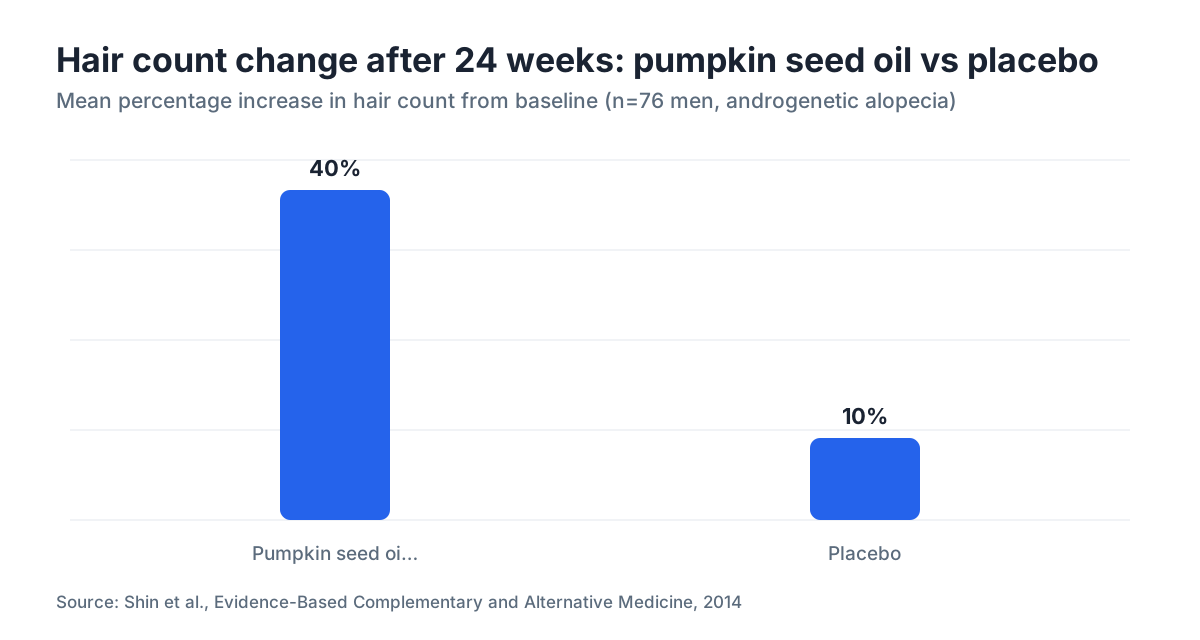
The most-cited trial is a 2014 randomized, double-blind, placebo-controlled study in Evidence-Based Complementary and Alternative Medicine. Researchers at Pusan National University in South Korea randomized 76 men with mild to moderate androgenetic alopecia to either 400 mg/day of pumpkin seed oil or a placebo for 24 weeks. [4]
The result: the PSO group showed a mean hair count increase of 40% from baseline versus 10% in the placebo group at 24 weeks. Self-assessment scores and investigator assessments both favored PSO. No serious adverse events turned up.
That 40% number gets quoted everywhere, and it's real. Read the fine print before you get too excited. Seventy-six men is a small sample. The study had ties to a PSO supplier, a conflict of interest worth flagging even though the design was otherwise solid. The primary endpoint was a standardized photographic count at a fixed scalp spot, a legitimate method that still carries variability. And there's been no large independent replication. The 2014 paper is still the only placebo-controlled human trial on PSO for androgenetic alopecia as of this writing.
Plainly: one good small study with a funding conflict beats no study, but it's nowhere near the evidence behind finasteride, which has decades of trials and FDA approval. [2] The PSO finding is a signal to take seriously, not a settled fact.
How does pumpkin seed oil compare to finasteride and minoxidil?
This is where honest comparison earns its keep.
| Treatment | Mechanism | Evidence level | Hair count change (typical) | Prescription needed |
|---|---|---|---|---|
| Finasteride 1mg/day | Blocks 5AR, reduces DHT ~70% | FDA-approved, multiple large RCTs | +15-20% hair count vs placebo at 12 months [2] | Yes |
| Minoxidil 5% topical | Vasodilator, full mechanism unclear | FDA-approved, many RCTs | +20-25% vs placebo at 48 weeks [9] | No (OTC) |
| Pumpkin seed oil 400mg/day | Partial 5AR inhibition (proposed) | 1 small RCT (n=76) | +40% vs placebo at 24 weeks [4] | No |
| Saw palmetto | Partial 5AR inhibition | A few small RCTs | Modest, inconsistent | No |
The PSO number looks better than finasteride at first glance. That comparison is misleading. The finasteride studies used tighter methods, bigger samples, longer follow-up, and multiple independent replications. The PSO figure came from one small trial. You can't line up percentages across trials with different designs, patients, and measurement methods and call it a fair race.
Here's the fair statement: PSO probably won't match finasteride for most people with real androgenetic alopecia. If your loss is early and you'd rather avoid prescription drugs and their side effects, PSO is a sensible low-risk thing to try. If your loss is moving fast, the evidence points hard at prescription options. Plenty of people run both at once, and that isn't crazy. Finasteride and minoxidil together is the most effective non-transplant combination the evidence supports.
For the wider DHT blocker landscape, prescription and OTC alike, that guide lays out the full spectrum.
Is pumpkin seed oil a real DHT blocker or just marketing?
Both, in a way. It's not pure marketing. There's plausible biochemistry and one legitimate human trial. It's also not the proven DHT blocker that finasteride is.
Supplement marketing uses 'DHT blocker' loosely, to mean anything that might cut DHT production, keep DHT off receptors, or dampen its downstream effects. PSO probably does a version of the first one at the 5AR enzyme level, based on its beta-sitosterol and delta-7-sterol content. A 2006 study in the Journal of Medicinal Food found that Cucurbita pepo seed extract inhibited 5AR activity in rat prostate tissue, which is mechanistically relevant but not the same as human scalp evidence. [5]
The FDA has approved pumpkin seed oil for exactly zero hair loss indications. The FTC would frown on any supplement company claiming PSO cures or treats hair loss. What's fair: PSO seems to have mild 5AR-inhibiting properties, and the one human trial showed a meaningful response in men with early androgenetic alopecia. That's real. It's also a single small study, and real clinical practice needs more than that before anyone makes confident promises.
If someone tells you PSO is as good as finasteride, they're overselling. If someone tells you it's all hype with zero evidence, they haven't read the 2014 trial.
Does it matter whether you eat pumpkin seeds or take the oil?
This comes up constantly. Do you need the concentrated oil supplement, or do plain pumpkin seeds block DHT on their own?
The 2014 RCT used 400 mg/day of encapsulated pumpkin seed oil, not whole seeds. Whether eating whole seeds delivers a clinically useful dose of beta-sitosterol and delta-7-sterols to the right tissues the same way is unknown. Seeds carry fiber, protein, and other compounds that can change how the active phytosterols get absorbed.
A 100-gram serving of pumpkin seeds holds roughly 100 to 130 mg of total phytosterols per USDA nutrition data, with beta-sitosterol making up part of that. [6] You'd need a heavy quantity of seeds to reach the 400 mg oil dose the trial used, and that assumes the bioavailability even matches. Eating a handful of pumpkin seeds a day is healthy and no bad thing. Calling it equivalent to the studied intervention oversimplifies.
Topical PSO is another popular route. There's basically no controlled human data on topical PSO for hair loss. Some animal work suggests topical phytosterols reach dermal tissue, but how that plays out in human scalp follicles is guesswork. If you're going to try PSO seriously based on the evidence, the oral capsule at roughly 400 mg/day is what the one meaningful trial actually tested.
How long does pumpkin seed oil take to work for hair loss?
The 2014 RCT measured outcomes at 24 weeks, six months. That fits how hair growth trials run: the hair cycle is slow, so changes take months to show up in measurable counts. [10]
Hair grows about 1 cm per month on average. [10] A follicle that was shrinking and starts to recover still needs time to push out a hair long enough to count and see. Most legitimate hair loss treatments show nothing meaningful before three to four months. The 24-week mark in the PSO trial is a reasonable place to judge results.
Judge PSO at six or eight weeks and you haven't given it a fair test. Sit at nine to twelve months with no change in your photos and you probably have your answer. The same patience rules minoxidil for men and every other treatment. Early shedding is common as the cycle resets, and results come in slow.
One practical tip. Take photos in the same light, same angle, same spot on your scalp every four weeks from day one. Your memory of what your hair looked like six months ago is not reliable. Photos are.
Are there side effects from pumpkin seed oil?
PSO has a friendly safety profile next to prescription DHT blockers. The 2014 RCT reported no serious adverse events in the PSO group. [4] That matters, though a 76-person trial over six months can't catch rare side effects.
Finasteride's side effect list includes sexual dysfunction (lower libido, erectile trouble, ejaculation issues) in a minority of users, plus an ongoing debate about whether some of those persist after stopping the drug. [2] PSO has no documented pattern of sexual side effects, which is exactly why some men who can't tolerate finasteride reach for botanical alternatives.
Stomach upset is the most commonly reported problem with high-dose PSO supplements, especially past 400 mg. Allergic reactions are possible with any food-derived supplement, more so in people with seed allergies.
If you're pregnant or trying to conceive, there's not enough data to call PSO safe in that setting, and a hormone-modulating supplement isn't something to take without asking a doctor first. Same logic for anyone on other medications that affect hormone levels.
For how this stacks against minoxidil side effects, that's a different risk profile entirely, mostly cardiovascular and scalp-related rather than hormonal.
Can women use pumpkin seed oil to block DHT and stop hair loss?
The 2014 RCT enrolled only men. There's no comparable human trial in women with androgenetic alopecia or other DHT-driven hair loss. The evidence gap is real.
Still, androgenetic alopecia in women does involve DHT sensitivity in vulnerable follicles, though the pattern differs (diffuse thinning rather than a receding hairline, usually). [1] The biochemistry of 5AR inhibition is the same regardless of sex, so there's no obvious reason PSO would be biologically inert in women.
Finasteride isn't FDA-approved for women and is specifically contraindicated in women of childbearing age because of the risk of feminizing a male fetus. [2] PSO doesn't carry that specific risk at typical supplement doses, but it also hasn't been studied in women carefully enough for confident claims.
If you're a woman with thinning hair and you're weighing PSO, it's a low-risk supplement to raise with a dermatologist. It shouldn't replace a proper diagnosis. Hair loss in women has plenty of causes beyond DHT, including telogen effluvium, thyroid conditions, and iron deficiency, none of which PSO touches.
What's a reasonable way to use pumpkin seed oil if you want to try it?
If you decide to try PSO based on what the evidence supports, here's a sane approach.
Dose: 400 mg/day of pumpkin seed oil in capsule form. That's what the one human trial used. Culinary-grade PSO (the kind you drizzle on salads) is the same oil, but the dose is uncontrolled and purity swings around. Capsules give you consistency.
Duration: commit to at least six months before you judge results. Take photos from day one.
Context: PSO probably won't stop fast-moving hair loss by itself. Treat it as an add-on, not a standalone fix. If your loss is moving quickly, this alone isn't enough. The hair loss supplements overview lines PSO up against other OTC options like saw palmetto, biotin, and zinc.
Before you spend money on supplements, get an objective read on where your hairline actually stands. MyHairline's free AI hair analysis (/scan) can assess your loss pattern against the Norwood scale from a photo and help you see whether you're dealing with early androgenetic alopecia or something else. Knowing your baseline matters before you pick any treatment.
If PSO alone doesn't hold the line after six months, the next call is whether to add or switch to a prescription option. A dermatologist who works in hair loss can review your photos, run a hormonal panel if it's relevant, and give you a real diagnosis instead of a supplement recommendation built on one small trial.
What does the research still need to figure out?
The gaps in the PSO evidence base deserve to be named clearly.
One, replication. The 2014 Shin et al. trial needs independent replication with bigger samples, longer follow-up, and no financial conflicts before pumpkin seed oil earns a confident nod from dermatology societies. The American Academy of Dermatology's guidance on androgenetic alopecia does not currently list PSO among proven treatments. [7]
Two, dose-response. Nobody knows whether 400 mg/day is optimal, too little, or more than you need. The 2014 trial tested one dose.
Three, topical versus oral. The topical form sells widely and sits completely unstudied in controlled hair loss trials.
Four, women. There's no RCT in women.
Five, mechanism confirmation in humans. The 5AR inhibition story rests on lab and animal data. A human trial measuring serum DHT before and after PSO, head to head with finasteride, would answer a lot. That trial hasn't happened.
For now PSO sits alongside saw palmetto and other botanicals: a plausible mechanism, thin but not zero human evidence, a mild safety profile, and a fair role as an add-on or early move while the research catches up. If you're tracking whether your hairline is shifting during a trial, the receding hairline guide explains what to watch and how to measure change objectively.
Should you try pumpkin seed oil for hair loss?
Here's my actual take after reading what's available.
If you're in your 20s or 30s, seeing some early diffuse thinning or a slightly higher hairline, and you're not ready for a prescription, PSO at 400 mg/day is worth a six-month trial. It's cheap (most capsule products run $15 to $30 a month), the safety profile is mild, and the one trial we have showed real results. You're not risking much.
If you're watching rapid recession or serious thinning in photos, PSO alone probably won't cut it. The math doesn't favor a botanical with one small supporting trial against follicles actively shrinking under strong genetic pressure. That's where finasteride and minoxidil for men have decades of evidence behind them.
PSO also makes sense as an add-on if you're already on finasteride or minoxidil. There's no known interaction, and the mild extra 5AR effect might be a small bonus. Nobody has studied that combination directly, so treat it as a reasonable assumption, not proven fact.
What PSO is not: a cure, a proven replacement for FDA-approved treatments, or something backed by the kind of evidence that should make you skip a doctor for serious hair loss. The 2014 trial is a starting point for research, not the last word.
Want to understand your current loss pattern first? MyHairline offers a free AI hair analysis at /scan that takes a photo and maps your hairline to the Norwood scale. It's a solid way to get an objective baseline before you commit to any approach.
Sources
- American Academy of Dermatology, Hair loss types: androgenetic alopecia
- FDA, Drugs@FDA database (Propecia/finasteride 1mg prescribing information)
- Prager N et al., Journal of Alternative and Complementary Medicine, 2002. Saw palmetto and beta-sitosterol for androgenetic alopecia
- Shin HS et al., Evidence-Based Complementary and Alternative Medicine, 2014. Pumpkin seed oil RCT for androgenetic alopecia
- Gossell-Williams M et al., Journal of Medicinal Food, 2006. Cucurbita pepo seed extract and 5-alpha reductase inhibition
- USDA FoodData Central, Pumpkin and squash seeds, whole, roasted
- American Academy of Dermatology, Hair loss resource center
- National Center for Biotechnology Information, PubMed (5-alpha reductase inhibitors in androgenetic alopecia)
- FDA, Drugs@FDA database (minoxidil topical OTC approval history)
- Kwon OS et al., Journal of Korean Medical Science, 2007. Hair cycle and growth rate measurements