
TL;DR: Seborrheic dermatitis can trigger temporary hair shedding, mainly through scalp inflammation and scratch-related damage, but it does not directly destroy hair follicles. Most shedding reverses once the flare is controlled. Permanent loss is rare and usually involves a second condition like androgenetic alopecia. Treating the dermatitis early is the best way to keep the two from compounding.
What is seborrheic dermatitis and what does it do to the scalp?
Seborrheic dermatitis is a chronic inflammatory skin condition that hits the oily areas of the body, and the scalp gets it worse than anywhere else. It shows up as greasy, yellowish scales, redness, and itching. The American Academy of Dermatology estimates it affects up to 5% of the general population, with higher rates in people who are immunocompromised or have Parkinson's disease [1].
The condition is driven by an overgrowth of a yeast called Malassezia (previously Pityrosporum), which normally lives on everyone's scalp. When it proliferates, the skin's immune response kicks in, producing inflammation, faster skin cell turnover, and those flakes. That inflammation is the part that matters most for hair.
The scalp inflammation disrupts the local environment around hair follicles. Cytokines released during the immune response can push follicles into the shedding phase of the hair cycle earlier than they should. It doesn't burn out the follicle permanently the way scarring alopecias do, but it stresses the follicle enough to cause noticeable shedding during a bad flare.
Does seborrheic dermatitis cause hair loss?
Yes, seborrheic dermatitis can cause hair loss, but the mechanism and severity matter a lot. The hair loss is almost always inflammatory or mechanical, not follicle-destructive. That distinction changes everything about your odds of recovery.
Inflammatory pathway: The cytokine soup generated by a chronic seborrheic dermatitis flare creates a hostile environment at the follicle level. Several studies have detected elevated inflammatory markers in scalp biopsies from people with both seborrheic dermatitis and alopecia. A 2015 study published in the Journal of Dermatology found a statistically significant association between seborrheic dermatitis severity and increased telogen (resting phase) hairs on trichoscopy, suggesting the inflammation nudges follicles out of active growth [2].
Mechanical pathway: Scratching is underrated as a cause of hair damage. Repeated trauma to the follicle opening, especially with nails, can cause enough physical injury to produce localized breakage and, in severe long-term cases, superficial scarring around the follicle.
Here is the honest answer. Seborrheic dermatitis causes temporary, diffuse shedding in most people, and that shedding reverses when the inflammation is controlled. Permanent follicle loss from seborrheic dermatitis alone is uncommon, and most dermatologists treat it as a secondary possibility rather than a primary outcome. What makes the story messy is that seborrheic dermatitis frequently rides alongside androgenetic alopecia, and the two together thin your hair faster than either does alone.
If you're already dealing with a receding hairline or diffuse thinning and you also have a scaly, itchy scalp, treating the dermatitis belongs in your hair loss plan, not on the side of it.
Can seborrheic dermatitis lead to permanent hair loss?
This is the question people are actually scared to ask. The short answer: rarely, but not never.
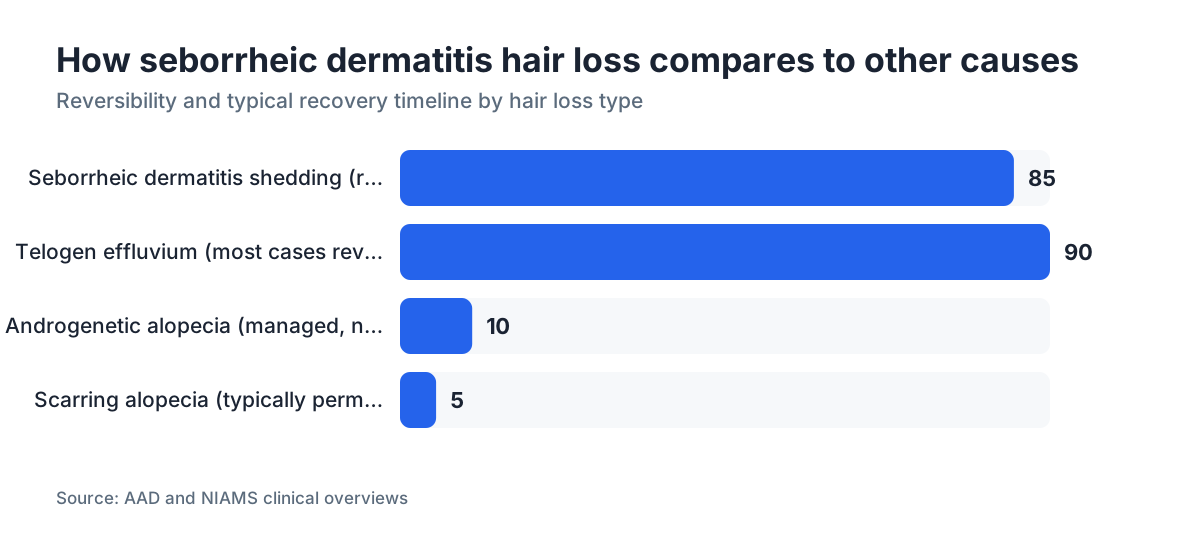
For most people, the hair loss from seborrheic dermatitis is a form of telogen effluvium, a diffuse shedding where follicles prematurely enter the resting phase. Telogen effluvium is reversible. Once the trigger (here, scalp inflammation) is removed or reduced, follicles cycle back into the growth phase and density returns, usually over three to six months.
Permanent loss becomes a real risk in two scenarios. First, if seborrheic dermatitis goes untreated for years and the chronic inflammation is severe enough, there's some evidence from animal models and biopsy studies that perifollicular fibrosis can develop, though the human data is thin and mostly drawn from extreme cases. Second, and far more common, seborrheic dermatitis can speed up androgenetic alopecia. Androgenetic alopecia is permanent by nature. DHT-driven miniaturization of the follicle is a separate and additive process, and scalp inflammation appears to accelerate it. The co-occurrence rate isn't perfectly quantified, but both conditions peak in the same crowd: adult men, especially those genetically predisposed to thinning.
The move is simple. Treat seborrheic dermatitis early and keep treating it. If you suspect androgenetic alopecia is also in play, the proven interventions are minoxidil and finasteride, not antifungal shampoo alone.
How much hair loss does seborrheic dermatitis actually cause?
No clean randomized trial quantifies average hair loss per seborrheic dermatitis flare, so be skeptical of anyone who hands you a precise number. The honest range from the literature: people with active, untreated seborrheic dermatitis can shed noticeably more than the normal 50 to 100 hairs per day, but the excess shedding is diffuse rather than patterned.
A 2020 review in Skin Appendage Disorders noted that scalp inflammation from any cause, including seborrheic dermatitis, is a recognized contributor to diffuse hair thinning, though the authors admitted controlled quantification studies are lacking [3]. The review did report that in studies using trichoscopy (a noninvasive scalp imaging technique), patients with both seborrheic dermatitis and alopecia had higher rates of follicular miniaturization than patients with alopecia alone.
The practical takeaway: the hair loss is real and measurable with trichoscopy, but it's generally modest next to the shedding you see in severe androgenetic alopecia. Most people who get their seborrheic dermatitis under control say their hair feels thicker and their shedding calms down within a few months.
What does the scalp inflammation from seborrheic dermatitis actually do to follicles?
Understanding the biology explains why treatment works and why delays cost you.
Malassezia yeast produces lipases that break sebum down into free fatty acids. Those fatty acids irritate the stratum corneum and set off an innate immune response, releasing interleukins (particularly IL-1, IL-4, IL-5) and tumor necrosis factor-alpha. These cytokines drive local keratinocyte proliferation (hence the flaking) and create oxidative stress around the follicle bulb.
The follicle sits in a relatively immune-privileged spot, but that privilege breaks down under sustained inflammation. When it does, the follicle's growth phase shortens. The result is shorter, finer hairs and a higher share of hairs sitting in the telogen (resting) phase at any given time, which is exactly what trichoscopy studies confirm.
Malassezia also triggers the Th2 inflammatory pathway in some people, which is tied to eczema and heightened scalp sensitivity. That immune skew may be one reason seborrheic dermatitis patients who also have atopic tendencies seem to shed more, though this is still an area of active research.
What does not happen in typical seborrheic dermatitis is direct follicle destruction. That's the hallmark of scarring alopecias like lichen planopilaris or discoid lupus. Seborrheic dermatitis is not a scarring condition. The follicle is stressed, not destroyed, which is why the odds of recovery with treatment are genuinely good.
How do you tell seborrheic dermatitis hair loss apart from other causes?
This matters because the treatment changes completely depending on the cause, and getting it wrong costs you time and money.
Seborrheic dermatitis hair loss tends to be diffuse, meaning spread across the scalp rather than concentrated at the temples or crown. It comes with visible scalp signs: flaking (which may look greasy rather than dry), redness, and itching. The shedding often tracks with flare-ups and eases when the flare calms down.
Androgenetic alopecia follows a pattern. In men, it tracks the Norwood scale, hitting temples and crown first. In women, it widens the central part. There's no itching or flaking unless a second condition is present.
Alopecia areata shows up as smooth, round patches of sudden hair loss with no scaling. The skin inside the patch looks normal.
Contact dermatitis from shampoos or dyes can mimic seborrheic dermatitis closely, but it tends to be acute rather than chronic and clears when you drop the offending product.
Telogen effluvium (diffuse shedding triggered by systemic stress like illness, crash dieting, or surgery) looks a lot like seborrheic-dermatitis-driven shedding on the surface. A dermatologist can separate them with a scalp biopsy or trichoscopy. The timeline helps too: telogen effluvium typically peaks two to three months after the triggering event, while seborrheic-dermatitis shedding tracks with active flares.
If you want a starting point before seeing a doctor, the free AI hair analysis at MyHairline can flag whether your shedding pattern looks inflammatory or patterned, though nothing replaces a board-certified dermatologist for a real diagnosis.
Here's a simple comparison:
| Feature | Seborrheic Dermatitis Hair Loss | Androgenetic Alopecia | Telogen Effluvium |
|---|---|---|---|
| Pattern | Diffuse | Patterned (temples, crown) | Diffuse |
| Scalp signs | Flakes, redness, itch | Usually none | Usually none |
| Reversible? | Yes, with treatment | No (managed, not reversed) | Usually yes |
| Trigger | Malassezia flare | DHT + genetics | Systemic stressor |
| Typical onset | Gradual | Gradual | 2-3 months post-trigger |
What treatments actually work for seborrheic dermatitis and its hair effects?
The FDA has approved several antifungal agents for seborrheic dermatitis, and they do work. The goal is to cut the Malassezia load and calm the inflammatory response.
Ketoconazole 2% shampoo (prescription in the US, though a 1% version sells over the counter as Nizoral) is one of the best-studied options. A double-blind randomized trial published in the International Journal of Dermatology found ketoconazole 2% shampoo significantly reduced scalp scaling and inflammation compared to placebo [4]. There's also separate evidence, including a controlled trial by Pierard et al., that ketoconazole 1% shampoo used long-term increased hair density in men with androgenetic alopecia compared to a nonmedicated shampoo, though this is not an FDA-approved use and should not replace proven hair loss medications [5].
Other effective antifungals include selenium sulfide (2.5% prescription, 1% OTC), ciclopirox, and zinc pyrithione. These are all reasonable first-line options. Ciclopirox is especially useful for people who don't respond to azole antifungals.
For inflammation that won't yield to antifungals alone, short-course topical corticosteroids (like clobetasol or betamethasone) can calm acute flares. They're not for long-term scalp use because of atrophy risk, but they're good at breaking a bad cycle.
Calcineurin inhibitors like tacrolimus and pimecrolimus are sometimes used for facial seborrheic dermatitis and are steroid-sparing, but the scalp data is thinner.
For the hair loss piece specifically: treating the seborrheic dermatitis is the primary move. If androgenetic alopecia is also present, finasteride and minoxidil for men are the standard of care [6]. Both should be discussed with a dermatologist. Using finasteride and minoxidil together is often more effective than either alone, per the evidence. DHT blockers are the mechanism by which finasteride works, and that mechanism is independent of seborrheic dermatitis treatment, which means you may need both.
Does treating seborrheic dermatitis actually reverse the hair loss?
For the seborrheic-dermatitis-specific shedding, the answer is generally yes, and the timeline is measurable.
Most people see shedding normalize within six to eight weeks of starting effective antifungal treatment. Noticeable regrowth, meaning new hairs filling in areas that thinned during a long flare, usually takes three to six months. That matches the normal hair growth cycle: it takes roughly three months for a follicle to move from telogen back into anagen and push out a visible shaft.
The catch: if you've had active, untreated seborrheic dermatitis for years alongside androgenetic alopecia, the alopecia-driven permanent miniaturization won't reverse with antifungal treatment. That's why it pays to see a dermatologist who can assess both conditions and give you a realistic picture. Treating one and ignoring the other is a common and expensive mistake.
Maintenance matters too. Seborrheic dermatitis is chronic, not a one-and-done infection. Most people need ongoing maintenance with an antifungal shampoo used one to two times per week to prevent relapse. Stop treatment entirely after a flare resolves and the flare usually comes back, dragging renewed shedding stress along with it.
If you've been managing seborrheic dermatitis and you're still seeing thinning after several months of good scalp control, that's a strong signal androgenetic alopecia or another cause is involved. At that point, reading up on what causes hair loss more broadly, or looking into evidence-based interventions like minoxidil, becomes the right next step.
Are some people at higher risk of hair loss from seborrheic dermatitis?
Yes, and the risk factors are pretty easy to spot.
Men get seborrheic dermatitis more often, and they're also the group most likely to carry co-occurring androgenetic alopecia. The combination is brutal. Seborrheic dermatitis prevalence peaks between ages 30 and 60 in men, which is exactly when androgenetic alopecia is also accelerating [1].
People with HIV or other immunocompromising conditions develop more severe seborrheic dermatitis, and their hair loss risk rises with it. The AAD notes that up to 83% of people with HIV develop some form of seborrheic dermatitis, often severe.
Genetic predisposition to androgenetic alopecia raises the stakes a lot. If your father or maternal grandfather had significant hair loss, the inflammatory load from seborrheic dermatitis is landing on follicles that are already biologically vulnerable.
Scratch habit and product use matter too. People who habitually scratch cause repeated mechanical trauma. Those who use thick, occlusive styling products (pomades, heavy waxes) can worsen Malassezia overgrowth by feeding the yeast a fatty substrate.
Neurological conditions tied to seborrheic dermatitis, especially Parkinson's disease, tend to produce severe chronic forms that are harder to manage, which raises the risk of prolonged inflammatory stress on follicles.
And stress. Seborrheic dermatitis is notoriously stress-reactive. Psychological stress suppresses immune regulation in the skin and bumps up sebum production, both of which favor Malassezia. If your scalp gets worse during high-stress stretches, you're not imagining it.
When should you see a doctor about seborrheic dermatitis and hair loss?
Most mild seborrheic dermatitis (light flaking, minimal itch, no hair loss) can be managed with OTC antifungal shampoos like 1% ketoconazole or zinc pyrithione. Give them eight weeks of consistent use before calling them a failure.
See a dermatologist if any of these apply: you have visible thinning or bald patches, the flaking is heavy and the redness is spreading past the scalp hairline, OTC treatments aren't working after two months, the itching is bad enough to wreck your sleep or make you scratch until the skin breaks, or you're not sure whether you're dealing with seborrheic dermatitis, psoriasis, or something else (they look similar and the treatments diverge).
A dermatologist can run trichoscopy or a scalp biopsy to separate inflammatory shedding from androgenetic miniaturization, which is genuinely useful. It tells you whether you're fighting one battle or two.
Don't wait years. Chronic untreated scalp inflammation is bad for follicles even when it doesn't cause scarring. The window to recover shedding-related loss is far better than the window to reverse years of androgenetic miniaturization. Early action pays off.
For a free starting point on pattern and severity before your appointment, the AI scan at MyHairline can help you frame what you're seeing and structure your questions for a dermatologist.
What lifestyle and product changes help prevent seborrheic dermatitis flares?
Seborrheic dermatitis is chronic, so the goal is fewer and milder flares, not a permanent cure.
Wash frequency matters. Many people with seborrheic dermatitis do better washing the scalp more often, not less, because washing strips the sebum and dead skin Malassezia feeds on. If your hair type or texture makes frequent washing impractical, a targeted medicated shampoo worked into the scalp (rather than lathered through the ends) can stand in.
Product choice matters. Skip heavy, oil-based styling products on the scalp. They build the lipid-rich environment Malassezia loves. Water-based and alcohol-based products are safer bets for people prone to flares.
Diet probably has a modest effect, but the evidence is weak. A few small studies suggest a high-sugar, high-refined-carbohydrate diet worsens seborrheic dermatitis by feeding yeast systemically, but no well-powered randomized trials confirm it. Cutting sugar isn't a bad idea for general health, but don't expect it to replace medical treatment.
Stress management is legitimate. There's solid mechanistic evidence that stress worsens seborrheic dermatitis through cortisol's effect on sebum production and skin immune function. The practical tools (sleep, exercise, less alcohol) are good for hair in other ways too.
Sun exposure in moderate amounts may help, because UV light has mild antifungal and anti-inflammatory effects on the skin. That's why seborrheic dermatitis often improves in summer. Don't take this as a reason to skip sunscreen on your face, but a bit of natural light on the scalp isn't harmful.
Alcohol appears to worsen seborrheic dermatitis in some people, possibly through immune modulation. If your flares track with heavy drinking stretches, that's worth noting.
And biotin supplements, despite their popularity for hair, do essentially nothing for seborrheic dermatitis and have very limited evidence for hair growth in people who aren't biotin-deficient. If you're looking at hair loss supplements, be skeptical of broad claims and stick to ingredients with real trial data.
Sources
- American Academy of Dermatology, Seborrheic Dermatitis Overview
- Journal of Dermatology, Seborrheic Dermatitis and Telogen Hair Increase (2015)
- Skin Appendage Disorders, Scalp Inflammation and Hair Loss Review (2020)
- International Journal of Dermatology, Ketoconazole 2% Shampoo RCT
- Dermatology (journal), Pierard et al., Ketoconazole and Hair Density
- FDA, Finasteride (Propecia) Drug Label
- National Institute of Arthritis and Musculoskeletal and Skin Diseases (NIAMS), Seborrheic Dermatitis Information
- DermNet NZ, Seborrhoeic Dermatitis
- American Hair Loss Association, Causes of Hair Loss
- National Alopecia Areata Foundation, Hair Loss Overview