
TL;DR: Spironolactone doesn't stop your body from making DHT. It blocks the androgen receptors in hair follicles so DHT can't bind and trigger miniaturization, and it lowers circulating testosterone and DHT by cutting androgen production. Studies show 44 to 88 percent of women with androgenetic alopecia see stabilization or regrowth. It isn't used in men because it causes feminizing side effects.
What does spironolactone actually do to DHT?
Spironolactone works differently than most people assume. It doesn't block the enzyme (5-alpha reductase) that turns testosterone into DHT. That's finasteride's job. Spironolactone instead competes with DHT for the binding sites on the androgen receptor inside the hair follicle cell [1]. When spironolactone sits on that receptor, DHT can't dock, and the miniaturization signal never fires.
A second mechanism runs alongside it. Spironolactone interferes with androgen production in the adrenal glands, so your body makes less testosterone and DHT to begin with [9]. Two hits from two directions: less DHT made, and less of whatever remains reaching the receptor.
That dual action is why dermatologists call it an "antiandrogen" rather than a plain DHT blocker. The receptor antagonism is the stronger and faster of the two effects. Picture a bodyguard standing in front of the lock so DHT can't get in, while also cutting the number of keys being cut.
Before you go further, the piece on what causes hair loss covers how DHT drives follicle miniaturization in the first place.
How is this different from finasteride or dutasteride?
The mechanism split has real consequences. Finasteride blocks the 5-alpha reductase type II enzyme and cuts serum DHT by roughly 70 percent [3]. Dutasteride blocks both type I and type II and cuts DHT by around 90 percent [4]. Neither touches the androgen receptor directly.
Spironolactone leaves the enzyme alone. DHT is still being made, just a bit less of it, and the receptor blockade does most of the work. Here's how the four options line up.
| Drug | Blocks 5-AR enzyme | Blocks androgen receptor | DHT reduction (serum) | Approved for hair loss |
|---|---|---|---|---|
| Finasteride | Yes (type II) | No | ~70% [3] | Yes (men, FDA-approved) |
| Dutasteride | Yes (type I + II) | No | ~90% [4] | No (off-label) |
| Spironolactone | No | Yes | Moderate (variable) | No (off-label) |
| Bicalutamide | No | Yes (stronger) | None directly | No (off-label) |
Why does this matter? Side effects. Finasteride is generally well-tolerated in men. Spironolactone causes feminizing effects (gynecomastia, sexual dysfunction, breast tenderness) because blocking androgen receptors body-wide shifts the testosterone-to-estrogen ratio in a female direction. That's why spironolactone for hair loss goes almost exclusively to women.
For how finasteride works and the trial data behind it, that article has the detail. If you're weighing options, finasteride and minoxidil together is worth a look too.
What does the clinical evidence say about spironolactone for hair loss?
The evidence is real but imperfect. Most trials are in women with androgenetic alopecia (female-pattern hair loss), and the studies are smaller than what finasteride has in men.
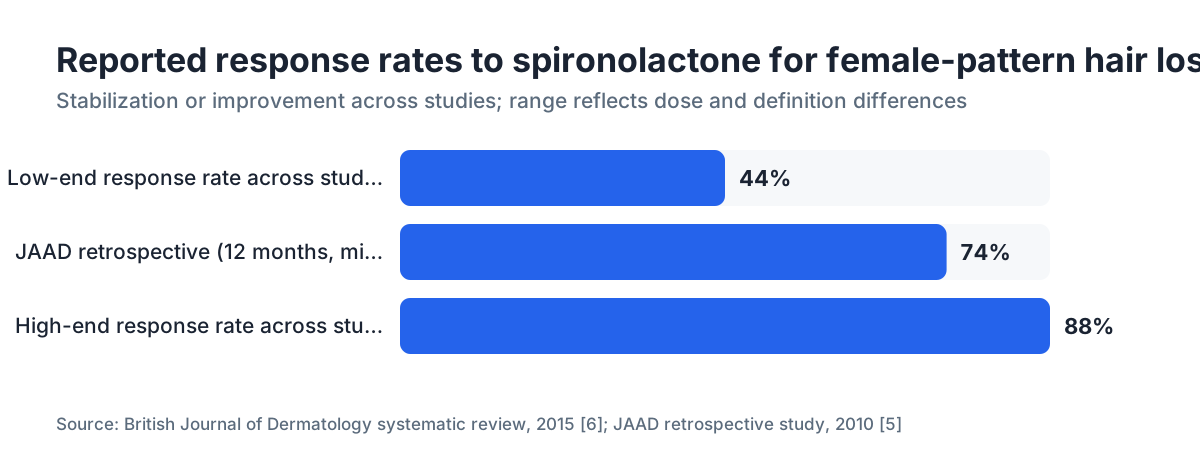
A 2010 retrospective study in the Journal of the American Academy of Dermatology followed women on spironolactone for female-pattern hair loss. About 74 percent reported stabilization or improvement after 12 months [5]. That's meaningful, though retrospective work carries the usual baggage: recall bias and no placebo group.
A 2015 systematic review in the British Journal of Dermatology pooled the available studies and found response rates from 44 to 88 percent, depending on dose, duration, and how each study defined "response" [6]. That wide range is the honest picture of messy data. Doses ran from 25 mg to 200 mg daily, and longer treatment plus higher doses generally tracked with better results.
One randomized trial compared spironolactone 200 mg against topical minoxidil 5% in women and found similar efficacy at 12 months, with roughly equal proportions showing meaningful density gains [7]. It was small (n=40), so read the parity finding as suggestive, not settled.
Here's the plain version. Spironolactone works for most women with androgen-driven hair loss, the effect takes months, and the data isn't as strong as finasteride's record in men. Nobody has run a large placebo-controlled trial in hundreds of women yet. That gap is genuine.
What doses are typically used for hair loss?
Doses for hair loss in women usually start at 50 to 100 mg daily and climb to 150 or 200 mg if the lower dose does nothing after three to six months [5]. Some prescribers begin at 25 mg to check tolerance and titrate up from there.
The 25 mg starting dose rarely moves the needle on its own. Think of it as a tolerance test. The evidence for real regrowth sits in the 100 to 200 mg range. Most prescribers cited in the literature land near 100 mg as a target, going higher only if it's tolerated and needed.
Spironolactone is an oral pill, taken every day. There's no topical version with meaningful penetration data for hair loss (a few compounded topicals are being studied, but the evidence is thin as of 2025). Plan on staying on it. Most prescribers expect treatment to continue indefinitely, because stopping usually means the loss comes back within months.
Who is a good candidate for spironolactone for hair loss?
Women with androgenetic alopecia (female-pattern hair loss) are the main candidates. It's especially useful for women showing signs of elevated androgens: polycystic ovary syndrome (PCOS), high serum testosterone, or hirsutism alongside thinning [6]. Normal labs don't rule it out either, since the receptor-blocking effect can still slow miniaturization even when androgen levels read normal.
Premenopausal women on spironolactone are usually told to use reliable contraception. The drug can feminize a male fetus, and irregular periods are common [2]. Postmenopausal women are simpler to manage: no contraception worry, no cycle to disrupt.
Men are almost never prescribed it for hair loss. Gynecomastia (breast tissue growth), erectile dysfunction, and loss of libido show up often enough at effective doses that the math doesn't work. Finasteride or dutasteride is the practical oral route for men.
Anyone with kidney disease or meaningfully reduced kidney function needs a careful look first. Spironolactone started life as a diuretic and changes how the body handles potassium [2].
What are the real side effects and risks?
Spironolactone has a genuine side effect profile, and patients deserve the honest version rather than the softened one some sites run.
Hyperkalemia (high blood potassium) is the most serious risk. Spironolactone is a potassium-sparing diuretic, and if potassium climbs too high it can throw off heart rhythm. In healthy young women without kidney disease, clinically meaningful hyperkalemia is uncommon, but most prescribers check potassium at baseline and recheck it periodically, especially at higher doses [2].
Menstrual irregularities are common. Some women get lighter periods, others get more irregular cycles, and spotting shows up especially in the first few months.
Breast tenderness and increased urination are both frequent and dose-dependent. Manageable for most women, but real.
Dizziness and low blood pressure can happen, particularly in women who already run low or who take other blood pressure meds. Taking the pill at night helps.
An early shed sometimes scares people. It's a documented adjustment period: the drug's shift in the hair cycle briefly pushes more hairs into telogen. It usually passes. For the biology behind it, the article on telogen effluvium lays it out plainly.
Long-term safety in women taking it for years looks reassuring given decades of use as an antihypertensive, though it was never originally studied for hair loss.
Does spironolactone work as well as minoxidil for women?
Roughly, yes, based on the one head-to-head trial we have. Minoxidil is the other main option most women get offered, and the two work in completely different ways. Minoxidil is a vasodilator that stretches out the anagen (growth) phase of the hair cycle and does nothing to androgens [7]. Spironolactone attacks the androgen signaling causing the miniaturization in the first place.
That single randomized trial found them roughly equal on response rate at 12 months [7]. Given how small it was, the fair reading is that they sit in a similar tier for androgenetic alopecia in women, not that either one wins.
Plenty of dermatologists combine them. The logic holds up: block the androgenic cause with spironolactone while stimulating follicles with minoxidil. There's no strong RCT on the combination for hair loss specifically, but the pharmacology backs it and the practice is common.
For what topical minoxidil does, see minoxidil side effects. If oral minoxidil is on your radar as an alternative or add-on, oral minoxidil covers how it differs.
Does spironolactone cause hair loss at first?
Yes, temporarily, in some users. An initial shed in the first four to twelve weeks is documented with spironolactone, much like minoxidil and finasteride at startup. The cause is the abrupt shift in androgen signaling, which pushes a batch of follicles into the telogen shedding phase at once.
It's alarming if nobody warned you. The shed usually clears by three to four months, and most prescribers mention it upfront. If it's severe, drags past four months, or comes with other systemic symptoms, that's a call to the prescribing doctor, not something to ride out alone.
The harder truth: telling an expected adjustment shed from an adverse reaction takes clinical judgment. Simple monthly photos (same lighting, same spot) starting from day one make that call far easier and give you something objective to track.
How long does spironolactone take to work for hair loss?
Three to six months is the earliest you'll see anything. Hair follicle cycles are long, roughly two to six years for the anagen growth phase, so the drug has to work through multiple cycles before density visibly changes.
Most studies that show clear improvement measure at 12 months [5]. By six months you might see shedding calm down and some early density gain. Twelve months is when before-and-after comparisons in studies start hitting statistically meaningful differences.
If you've held an adequate dose (at least 100 mg) for 12 months with no change at all, that's the point to reassess with your prescriber. Some women respond late, at 18 to 24 months. Others just don't respond, and a different approach or a combination may suit them better.
Track it systematically. MyHairline's free AI hair scan (/scan) can document your current pattern before you start or while you're on treatment, so you have a real baseline to compare against later.
Is spironolactone FDA-approved for hair loss?
No. Spironolactone is FDA-approved for hypertension, edema tied to heart failure and liver cirrhosis, and primary hyperaldosteronism [2]. It's not approved for androgenetic alopecia or any hair loss.
Prescribing it for hair loss is off-label, which is legal and routine. The FDA lets physicians prescribe approved drugs for non-approved uses based on clinical judgment. Off-label isn't the same as unapproved or unsafe. Spironolactone has decades of real-world safety data from its use as an antihypertensive [10].
The American Academy of Dermatology's practice guidance for female-pattern hair loss lists spironolactone as an option, noting the off-label status while acknowledging the supporting evidence. That backing from a major specialty society counts in practice even without a hair-loss-specific FDA label.
The missing approval mostly reflects economics. No drug company has funded the large, expensive randomized trial that formal approval demands, because spironolactone is generic and off-patent. That's a money problem, not a sign the drug fails.
Can spironolactone be used alongside other hair loss treatments?
Yes, and combinations are increasingly common in dermatology.
Spironolactone plus topical or oral minoxidil is the most frequent pairing for women. The mechanisms don't overlap, so there's no pharmacological reason to avoid stacking them, and the practice is widespread even though large RCTs on the combination are missing.
Spironolactone is sometimes paired with low-dose combined oral contraceptives in premenopausal women. The estrogen in combined OCs has some hair-protective effect, and it also covers the contraception recommended while on spironolactone. OCs with less androgenic progestins (like norgestimate or desogestrel) are preferred over more androgenic ones.
Combining spironolactone with finasteride in women happens occasionally but isn't standard. The evidence for that specific pairing is thin.
For women who don't respond to medication, a hair transplant is an option, though usually only after medical management has been tried and the loss has stabilized. Transplanting into zones where follicles are still miniaturizing, without settling the androgen signaling, gives you better-looking transplanted hair while the native hair around it keeps thinning.
If you want the DHT angle across all treatments, the dht blocker overview compares the main options and their evidence side by side.
What should you discuss with your doctor before starting spironolactone?
A handful of things genuinely need sorting before you start.
Kidney function and potassium. A basic metabolic panel before starting is standard, and most prescribers recheck potassium a few months in, especially above 100 mg.
Contraception if you're premenopausal. Spironolactone can feminize a male fetus [2]. That's not an abstract warning. Most dermatologists want confirmation you're using reliable contraception, or not sexually active with a male partner, before they'll prescribe.
Your blood pressure baseline. Spironolactone lowers blood pressure. If you already run low, even 50 mg daily can bring dizziness, especially standing up fast. That shapes your dose and timing.
Other medications. It interacts with other potassium-sparing drugs, ACE inhibitors, angiotensin receptor blockers, and potassium supplements. Your prescriber needs the full list.
Realistic timeline. If your doctor isn't saying "expect to wait 6 to 12 months before judging results," that's a red flag. Patients who expect three-week results quit too early and miss the window where the drug actually works.
For women with receding hairlines or diffuse thinning who haven't pinned the cause yet, get bloodwork to rule out thyroid problems and iron deficiency before blaming androgens for everything. Spironolactone won't fix hair loss driven by thyroid disease or a nutritional gap.
Sources
- Journal of Clinical Endocrinology and Metabolism (via NIH PubMed Central) - Spironolactone as androgen receptor antagonist mechanism
- FDA, Spironolactone (Aldactone) prescribing information
- New England Journal of Medicine - Finasteride in male-pattern baldness (Kaufman et al., 1998)
- Journal of the American Academy of Dermatology - Dutasteride for androgenetic alopecia review
- Journal of the American Academy of Dermatology - Rathnayake & Sinclair retrospective study of spironolactone in female-pattern hair loss (2010)
- British Journal of Dermatology systematic review of treatments for female androgenetic alopecia (via NIH PubMed Central, 2015)
- Journal of the European Academy of Dermatology and Venereology - RCT of spironolactone vs minoxidil 5% in women with hair loss (via NIH PubMed)
- American Academy of Dermatology
- National Institutes of Health, StatPearls - Spironolactone pharmacology (Bookshelf)
- MedlinePlus (U.S. National Library of Medicine) - Spironolactone drug information