
TL;DR: Sleeping position does not cause androgenetic alopecia or permanent hair loss. Scalp blood flow adjusts automatically when you lie down, so no position starves follicles of oxygen. Friction from pillowcases can break hair shafts, and prolonged pressure on one spot may flatten hair texture. If you're losing hair, the cause is almost certainly hormonal, genetic, or nutritional.
What actually causes hair loss, and is sleep on that list?
The honest answer: sleep position is not a recognized cause of hair loss in any major clinical guideline. The American Academy of Dermatology lists the leading causes as androgenetic alopecia (male and female pattern hair loss), telogen effluvium triggered by physical or emotional stress, thyroid dysfunction, nutritional deficiencies, and autoimmune conditions like alopecia areata [1]. Sleep posture is not in any of those categories.
That does not mean what happens overnight is irrelevant to your hair. You need to separate two different things. One is hair loss, where follicles stop producing hair permanently or semi-permanently. The other is hair breakage, where the shaft snaps or frays, making hair look thinner without any follicle involvement. Sleeping position has a real, documented relationship with the second. It has essentially no proven relationship with the first.
If you're worried about thinning, the question to answer is why follicles are miniaturizing. For most people under 50, the answer is dihydrotestosterone (DHT) sensitivity, which is genetic. No pillow swap changes that. You can read the full picture at what causes hair loss.
Does blood flow to the scalp change while you sleep?
Yes, scalp circulation changes overnight, but not in any way that harms follicles. When you lie down, hydrostatic pressure in the head and neck vessels shifts compared to standing, and the heart no longer has to fight gravity to push blood upward. Studies of cerebral blood flow during sleep show modest changes between sleep stages, with slow-wave (deep) sleep generally associated with lower cerebrovascular resistance [2]. The scalp surface vessels behave similarly.
Follicles get oxygen and nutrients from the dermal papilla, the tiny cluster of blood vessels at the base of each follicle. Those vessels are small enough that autoregulation keeps them perfused across almost any body position. No peer-reviewed study has documented follicle hypoxia caused by a standard sleeping posture in healthy adults.
The one scenario where blood flow genuinely matters is sustained external pressure. Sleep with your arm pinned under your head for hours and your hand goes numb. That is pressure-induced ischemia. Something similar could in theory happen to scalp tissue if pressure were extreme and prolonged, but a normal pillow does not generate that load. Hair follicles sit roughly 3 to 4 mm below the skin surface [3], and capillary perfusion pressure far exceeds what a foam or fiber pillow exerts.
Lying down does not deprive your follicles of blood. If someone is selling you a pillow or a scalp massager by claiming it "restores circulation lost during sleep," that claim has no evidence behind it.
Can a pillow cause hair breakage or damage overnight?
This is where sleeping position actually matters, and the evidence is clearer. Friction is the mechanism. When your hair rubs against a cotton pillowcase for seven or eight hours, the cuticle, the outer protective layer of each shaft, abrades. Repeat that hundreds of nights and you get split ends, shaft thinning, and breakage that mimics diffuse thinning to the naked eye [4].
A 2019 study in the Journal of Cosmetic Dermatology examined the surface morphology of hair strands after simulated friction against different textile surfaces and found significantly less cuticle damage on silk and satin than on cotton [4]. The study did not measure hair growth rates or follicle health, only shaft integrity. That distinction matters: damaged shafts look like hair loss, but the follicles are fine and will produce new growth.
Who is most affected? People with:
- Chemically processed, bleached, or color-treated hair (cuticle already compromised)
- Fine hair (less structural mass to resist abrasion)
- Dry or low-porosity hair
- Natural or tightly coiled textures, which have more surface contact with fabric when compressed
If you see short, broken hairs around your hairline each morning, friction breakage is a plausible explanation. Switching to a satin or silk pillowcase, or sleeping with hair loosely wrapped in a satin bonnet, is cheap, low-risk, and has reasonable mechanistic support. It will not regrow hair lost to follicle miniaturization, but it can cut cosmetic breakage.
Satin bonnets are common in Black hair care for exactly this reason, and the AAD's patient resources treat friction reduction as a legitimate protective measure [1].
Does sleeping on one side cause a receding hairline or thinning temples?
No good evidence supports this. The hairline and temples are the areas hit hardest by androgenetic alopecia, especially in men moving through the Norwood scale. When people notice temple recession worsening on the side they sleep on, the likely explanation is coincidence or selection bias: they look harder at the side they press into a pillow and notice thinning that is happening symmetrically or slightly asymmetrically for hormonal reasons.
Traction alopecia does cause hairline recession, but it comes from sustained mechanical tension on the hair root, not pressure on the skin surface. Tight braids, weaves, and ponytails held at tension for months are the classic causes. A pillow does not pull the root. It compresses the shaft against the skin. Different forces, different biology.
If your hairline is receding, see a dermatologist. The cause is almost certainly DHT-related, and there are proven treatments. Finasteride, which blocks the conversion of testosterone to DHT, is FDA-approved for male pattern hair loss [5]. Minoxidil is FDA-approved in both topical and oral forms to slow loss and promote regrowth [6]. Changing your sleep side addresses neither mechanism. More on this at receding hairline.
Is there any sleeping position that is better for hair health?
Not in terms of follicle biology. But some habits do reduce mechanical damage.
Back sleeping spreads scalp contact across the back of the head more evenly than side sleeping, which concentrates pressure on one temporal region. If you already have thinning there, this might reduce visible flattening of the hair you still have, though it does nothing for follicle function.
Side sleeping on a silk or satin pillowcase is probably just as fine in practice. The variable that counts is fabric friction, not the angle of your neck.
Stomach sleeping is harder on the neck and upper spine, and it presses the face and forehead into the pillow, which some dermatologists note can aggravate facial skin. For hair, the forehead hairline gets more friction in this position, but the follicles themselves are not harmed.
The single most evidence-backed nighttime move for hair integrity is fabric choice, not position. If you want to optimize: satin pillowcase, loose hair (not tied in a tight band that creates hairline traction), and hair that is not soaking wet when you lie down. Wet hair is more elastic and more prone to mechanical damage [7].
Nobody should lose sleep, literally, over this. Position is a minor variable inside a minor category. If you have real hair loss, the lever that matters is the underlying cause.
What about scalp massage during sleep or before bed? Does it help growth?
Scalp massage before bed is the most plausible mechanical intervention for hair growth, and it has one small but real study behind it. A 2016 study in ePlasty had nine Japanese men perform a standardized four-minute scalp massage daily for 24 weeks [8]. Hair thickness (measured by phototrichogram) increased, though total hair count did not change significantly. The proposed mechanism is that mechanical stretching of dermal papilla cells switches on genes involved in hair follicle elongation.
Interesting, not conclusive. Nine participants, no control group, industry-funded context, short duration. The fair reading: scalp massage is unlikely to hurt and might help marginally with shaft diameter. It is not a treatment for androgenetic alopecia.
A brief scalp massage before bed as a wind-down habit is fine. Just do not expect it to reverse genetic hair loss. For that you need treatments that address DHT or stimulate the follicle at a cellular level, like finasteride or minoxidil for men.
If you want a quick baseline on whether your pattern suggests a treatable cause or something structural, the free AI scan at MyHairline (/scan) analyzes your hairline against Norwood and Ludwig staging criteria in seconds.
Can stress from poor sleep cause hair loss?
Yes, and this is the one indirect link between sleep and hair loss with real biological grounding. Chronic sleep deprivation elevates cortisol, and sustained high cortisol is associated with telogen effluvium, a condition where a large share of hairs shift from the anagen (growth) phase to the telogen (resting and shedding) phase at once [9].
Telogen effluvium usually shows up as diffuse shedding across the scalp, often two to four months after the trigger. The good news: it is almost always reversible once the stressor, including chronic poor sleep, resolves. Full breakdown at telogen effluvium.
The distinction matters. Poor sleep quality causes hair loss indirectly through the HPA axis stress response. Sleeping on your side rather than your back does not. Two very different claims. When someone says their sleep position is why they're losing hair, they're collapsing a real mechanism (stress hormones from sleep deprivation) into a non-mechanism (positional effects on scalp circulation).
A 2021 review in the International Journal of Environmental Research and Public Health noted that sleep disorders, including insomnia and sleep apnea, are associated with elevated inflammatory cytokines, which may also disrupt hair follicle cycling [9]. Sleep quality matters. Sleep angle does not.
Does wearing a sleep cap or bonnet protect hair?
Yes, with caveats. A satin or silk bonnet reduces friction between hair and pillowcase and helps hold moisture, especially in textured, coiled, or chemically processed hair. Dermatologists and trichologists routinely recommend them for protective styling [1].
What they do not do: stimulate follicles, prevent androgenetic hair loss, or improve scalp circulation. They are a hair integrity tool, not a hair loss treatment.
One thing to watch. If the bonnet has a tight elastic band that sits on the hairline for eight hours every night, it could, over months, cause mild traction at that margin. Minor and reversible for most people, but if you notice hairline irritation or miniaturization right at the bonnet line, take note.
For anyone with a history of traction alopecia, avoid anything that adds tension to the hairline, even a slightly tight bonnet elastic. Loose satin scarves tied gently are a lower-risk option.
What signs at night actually suggest a real hair loss problem?
Waking up to hair on your pillow is not automatically a crisis. The average person sheds 50 to 100 hairs per day, and many of those fall during sleep [10]. A few hairs on a pillowcase is normal telogen shedding.
Signs that warrant a dermatologist visit:
- Consistently large clumps (more than a small handful) on the pillow morning after morning
- Visible scalp through the part or crown when you look in the mirror after waking
- Shedding markedly higher than your personal baseline for more than two months
- Bald patches appearing (could be alopecia areata)
- Hairline recession visible in photos over a six-month period
None of these come from sleep position. They signal a systemic, hormonal, or autoimmune process that needs actual diagnosis. A dermatologist will likely run bloodwork (thyroid, ferritin, CBC, hormone levels) and may examine the scalp under dermoscopy. That information decides whether the next step is finasteride and minoxidil combination therapy, nutritional support, or something else.
The worst move: spending months optimizing your sleep angle while genetic hair loss advances untreated.
Comparison: what actually affects hair loss vs. what does not
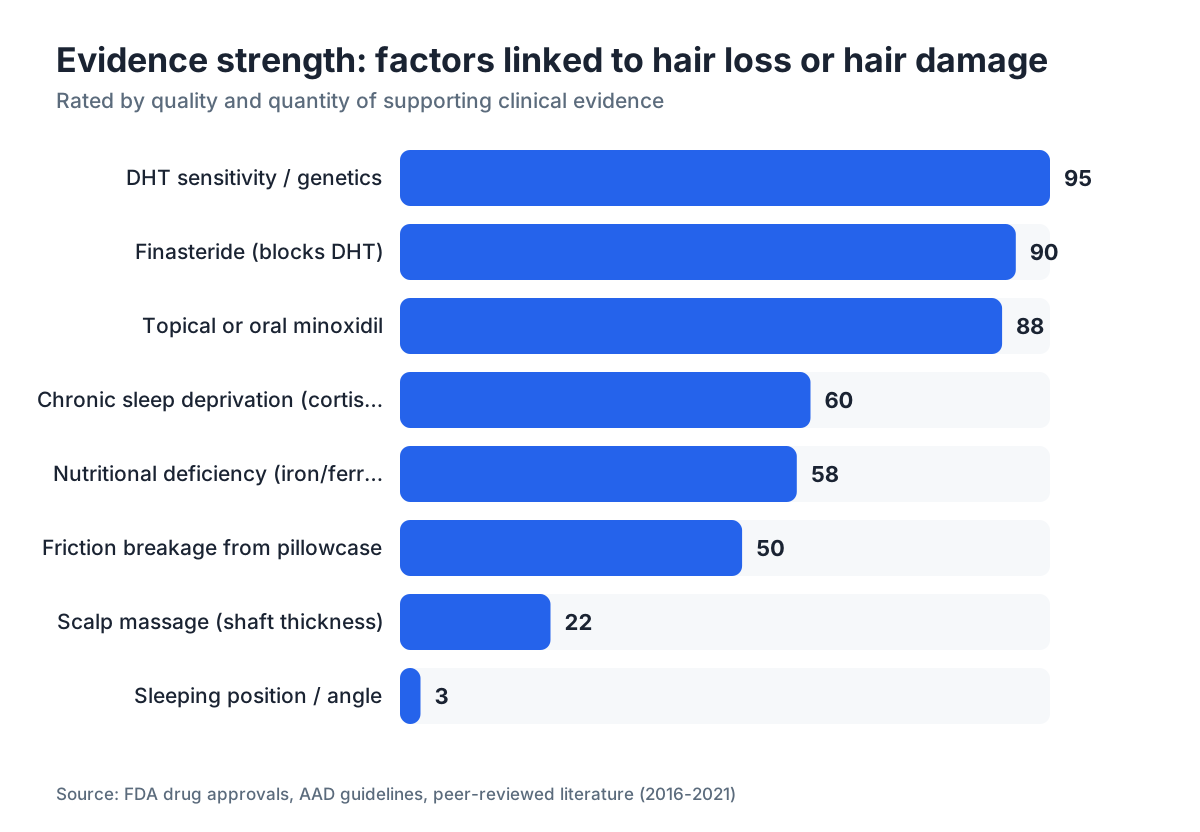
Here's a straight breakdown of factors and the quality of evidence linking them to hair loss:
| Factor | Effect on hair loss | Evidence quality |
|---|---|---|
| DHT sensitivity (genetics) | Strong causal role in androgenetic alopecia | High, FDA-recognized [5] |
| Finasteride (DHT blocker) | Proven to slow loss and maintain hair | High, multiple RCTs [5] |
| Topical/oral minoxidil | Proven to stimulate growth | High, FDA-approved [6] |
| Chronic sleep deprivation (cortisol) | Indirect link via telogen effluvium | Moderate [9] |
| Nutritional deficiency (iron, ferritin) | Documented in telogen effluvium | Moderate [10] |
| Friction breakage from pillowcase | Real, but affects shaft not follicle | Moderate [4] |
| Scalp massage | Very small possible effect on shaft diameter | Low (single small study) [8] |
| Sleeping position (angle/side) | No demonstrated effect on follicles or growth | No supporting evidence |
| Pillow type (foam vs. latex vs. spring) | No demonstrated effect | No supporting evidence |
This table makes the hierarchy clear. If you're spending time researching sleep positions and zero time on DHT management or nutritional assessment, you have the priorities inverted. A DHT blocker like finasteride does something real. Switching to your back does not.
For personalized context, MyHairline's free AI scan (/scan) reads your hairline photo and tells you where you fall on the Norwood or Ludwig scale before you spend money on treatments.
What should you actually do tonight to protect your hair?
Practical steps ranked by evidence strength:
First, if you have actual hair loss (more than breakage), treat it medically. That means a dermatologist, a proper diagnosis, and considering FDA-approved treatments. Sleep hygiene will not arrest androgenetic alopecia.
For hair integrity and breakage: switch to a satin or silk pillowcase. A decent one costs $15 to $40 and cuts cuticle friction with reasonable mechanistic support [4]. If your hair is textured or processed, add a satin bonnet with a loose band.
Do not sleep with wet hair if you can help it. Wet hair stretches more than dry hair under load, so shafts snap more easily [7].
Get adequate sleep. The CDC cites 7 to 9 hours a night for adults [10], enough to keep chronic cortisol elevation in check. This is the actual sleep-hair connection with biology behind it.
Do not pull hair tight before bed. A loose braid or loose bun is fine. A tight ponytail with a rubber band at the hairline, worn nightly for months, can trigger traction alopecia at those margins.
If you're eyeing supplements as part of a broader plan, the evidence is thin for most of them. See what the data actually shows at hair loss supplements before you buy.
Sources
- American Academy of Dermatology, Hair Loss Overview
- NIH National Library of Medicine, Sleep and Cerebrovascular Regulation
- NIH National Library of Medicine, Hair Follicle Anatomy Review
- Journal of Cosmetic Dermatology, Textile Friction and Hair Cuticle Damage Study (2019)
- FDA, Propecia (finasteride) Label and Approval Information
- FDA, Minoxidil Drug Approvals and Safety Information
- International Journal of Trichology, Wet Hair Mechanical Properties
- ePlasty, Standardized Scalp Massage Study (2016)
- International Journal of Environmental Research and Public Health, Sleep Disorders and Hair Cycling Review (2021)
- CDC, How Much Sleep Do I Need?