

TL;DR: Stress-related hair loss is almost always reversible once the trigger is gone. The main culprit is telogen effluvium, where hairs shed in bulk 2-3 months after a stressful event, then regrow within 6-12 months. Permanent loss from stress alone is rare. But chronic stress can accelerate underlying genetic hair loss, and that part may not fully come back.
What actually happens to your hair when you're under stress?
Stress does not attack your hair directly. It hijacks the growth cycle. Each follicle runs through an active growth phase called anagen (lasting 2-6 years), a short transition phase called catagen, and a resting phase called telogen, after which the hair falls out and the cycle restarts. At any moment, roughly 85-90% of your scalp hairs are in anagen and 10-15% are in telogen. [1]
Stress throws this balance off. It shoves a large batch of follicles out of anagen and into telogen all at once. This is called telogen effluvium. You lose more hairs than you grow during the shedding window, and it can feel alarming when handfuls come out in the shower. The follicle itself survives. It is sitting there dormant, waiting to restart anagen.
There is also a less common stress-linked condition called alopecia areata, an autoimmune disease where the immune system attacks the follicle directly. Psychological stress is a trigger or aggravating factor here, not the sole cause, but it shows up in many patients' histories right before a flare. [2] In severe, long-running cases, alopecia areata can occasionally scar follicles. That is one of the few scenarios where stress-adjacent hair loss edges toward permanent.
The third mechanism is trichotillomania, a body-focused repetitive behavior tied to stress or anxiety, where people pull their own hair out over and over. Years of that trauma can scar follicles and leave permanent bald patches. [3] It is a behavioral disorder, not a physiological stress response, but it belongs on this list because the hair loss can look similar.
For the vast majority of people who notice heavy shedding after a rough stretch of life, the mechanism is telogen effluvium, and the follicles are intact.
Is stress-related hair loss permanent or will it grow back?
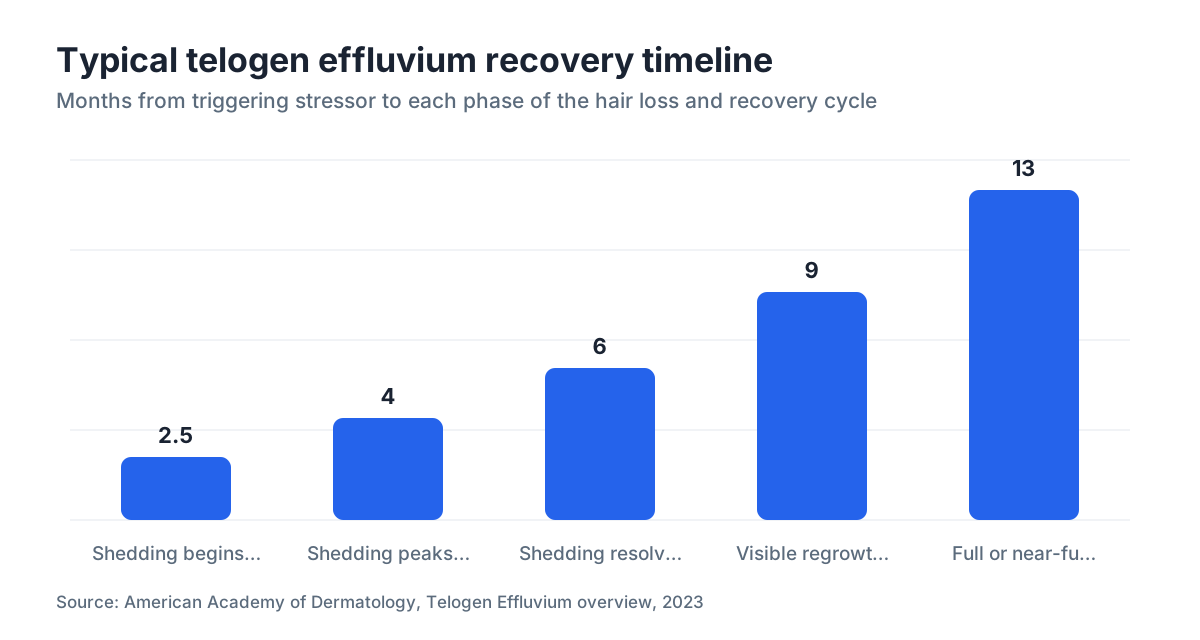
For acute telogen effluvium, the answer is almost always the same: it grows back. Guidance from the American Academy of Dermatology says telogen effluvium typically resolves within six months of the stressor being removed, with full or near-full regrowth by 12 months. [4] The follicles were never destroyed. Once the trigger is gone, they cycle back into anagen.
Chronic telogen effluvium is different. This is diffuse shedding that lasts more than six months, often with no single trigger you can point to. It tends to hit women 30-60 years old and can drag on for years. Most cases still do not cause permanent follicle damage, but the constant shedding can knock down overall density in a way you can see. Dermatologists still argue about whether some chronic cases leave lasting thinning even after they resolve. [5] The honest answer: most people recover, but a subset never get back to exactly their pre-shedding density, probably because aging and other factors pile on.
Where stress starts touching permanent loss is through androgenetic alopecia (pattern baldness). If you are genetically predisposed, chronic high cortisol appears to speed up the DHT-driven miniaturization of follicles, pulling the timeline forward. [6] Stress did not cause that permanent loss on its own. It may have moved it earlier than it would have arrived. That hair, unlike telogen shed, may not come back.
Here is the practical rule. If shedding started within 2-4 months of a stressful event and you have no personal or family history of pattern baldness, it is very likely reversible. If you have been watching a receding hairline or thinning crown for years, stress is probably compounding something that will not fully reverse without treatment.
How long does it take for stress hair loss to grow back?
There are two built-in delays that throw almost everyone off.
First, the gap between the stressor and the shedding. Telogen effluvium usually shows up 2-3 months after the trigger because that is how long a follicle pushed into telogen takes to reach the shedding phase. [4] So if you had surgery, a serious illness, or a brutal stretch in January, you might not notice the shed until March or April. Most people never link the two.
Second, the gap between shedding stopping and new hair looking like anything. Regrowth comes in as short, fine hairs that need several months to reach a length that adds back visible thickness. Realistically, you will not see a clear cosmetic difference until 6-12 months after the stressor resolves.
Here is a rough timeline pulled from the research and clinical guidance:
| Phase | Approximate timing |
|---|---|
| Stressor occurs | Month 0 |
| Follicles shift to telogen | Month 0-1 |
| Heavy shedding begins | Month 2-3 |
| Shedding peaks and slows | Month 3-6 |
| New growth (anagen) restarts | Month 3-6 |
| Visible density improvement | Month 6-12 |
| Full or near-full recovery | 9-18 months |
If shedding has not slowed at all after six months, or if you are seeing recession and thinning at the temples and crown instead of diffuse shedding everywhere, that pattern points to something beyond telogen effluvium and warrants a dermatologist visit. You can also get a baseline read on your current shedding pattern using a free AI hair scan at MyHairline before that appointment.
What are the signs that your hair loss is from stress versus something else?
Stress-related telogen effluvium has a fairly distinct look. The shedding is diffuse, coming from all over the scalp rather than clustering at the temples, crown, or hairline. Run your hands through your hair and many strands come loose at once. The classic pull test shows more than five or six hairs per 60-hair cluster. [12] The shed hairs have a white bulb (the telogen club root) at the base, not a broken shaft.
Pattern baldness (androgenetic alopecia) looks nothing like that. It recedes from the temples and crown in a predictable shape. The hairs that stay behind in the affected zones get finer and shorter over time as the follicles miniaturize. A family history on either side raises your odds a lot. [6] There is more on how this progresses in our guide to receding hairlines.
Alopecia areata shows up as smooth, round patches of total hair loss on the scalp or elsewhere on the body. The edges are often sharply defined. Nails may show pitting. [2] It affects about 2% of the population at some point.
Nutritional shortfalls (iron, ferritin, zinc, vitamin D) and thyroid disease both cause diffuse shedding that looks identical to stress-related telogen effluvium on the surface. That is exactly why blood work is worth doing if shedding does not resolve. A dermatologist can run a scalp biopsy to separate scarring from non-scarring causes when the diagnosis is genuinely murky.
The short version: intact hairline plus diffuse shedding points to stress or nutrition. Thinning hairline and crown with miniaturized hairs means pattern hair loss is in play, no matter what your stress level is right now.
Can chronic stress speed up genetic hair loss permanently?
This is the question that matters most for younger men and women with a family history, and the answer is a qualified yes. Chronic stress can move the clock forward on hair loss that your genes already had scheduled.
Cortisol, the main stress hormone, has documented effects on the follicle. A 2021 study in Nature found that chronic stress raised corticosterone (the rodent version of cortisol) in mice and suppressed a follicle stem cell activator called Gas6, which sharply delayed follicle cycling and cut hair growth. [7] The researchers described stress hormones keeping follicles stuck in a prolonged resting state.
In humans the causal link is harder to prove, but the evidence lines up. Elevated cortisol is tied to more sebaceous gland activity and inflammation at the follicle. In people with androgenetic alopecia, DHT already miniaturizes follicles step by step. Chronic inflammation from long-term stress appears to speed that up. [6] The follicle does not scar and die the way it does in scarring alopecias, but a follicle that miniaturizes past a certain point may never recover, even after the stressor is gone and even with treatment.
So here is the real concern. If your genetics have started a clock on pattern hair loss, years of high stress can push that clock ahead by months or years. DHT-driven miniaturization stacks up and does not fully reverse. Finasteride and minoxidil can slow or partly reverse miniaturization, but they work best early, before follicles are fully shrunk. Wait until the loss is visually advanced and you lower the ceiling on what any treatment can bring back.
To see how DHT-blocking treatments fit in, read our guide to DHT blockers. For men weighing finasteride specifically, our finasteride overview covers the evidence on how early treatment changes long-term outcomes.
Are there types of stress hair loss that cannot be reversed?
Yes, though they are less common.
Scarring alopecias are the clearest case. Conditions like lichen planopilaris and frontal fibrosing alopecia involve inflammation that destroys the follicle for good. Stress may set off flares in susceptible people, but it is not the main driver. Once a follicle scars, no treatment on the market restores it. [8] Hair transplants can fill some of the area, but only by moving in follicles that were never affected.
Severe, long-running alopecia areata can, in rare cases, progress to alopecia totalis (full scalp loss) or alopecia universalis (full body loss). In cases that go on for years, the follicle may lose its ability to regrow even if the immune attack finally stops. The American Academy of Dermatology notes that the prognosis worsens a lot with extensive loss lasting over a year. [2]
Repeated mechanical trauma from trichotillomania, mentioned earlier, can scar follicles in patches. Once follicle tissue turns to scar tissue, hair will not return in those specific spots.
For most people reading this, none of these apply. Stress-triggered diffuse shedding with intact follicles is the common picture, and it is reversible. But if you have had unexplained bald patches for over a year, or shedding comes with scalp inflammation, burning, or itching, see a board-certified dermatologist instead of waiting it out.
What treatments actually help while waiting for stress hair to grow back?
Remove or reduce the stressor if you can. Obvious advice, but it is the only thing that hits the root cause. Nothing topical or oral speeds recovery as reliably as taking away the trigger.
Past that, here is what the evidence actually supports.
Minoxidil shortens the telogen phase and stretches out anagen. It does not touch the stress itself, but it can modestly speed the regrowth phase and shrink the window of visible thinning. [9] Over-the-counter 5% minoxidil foam is the standard for men. Women use the 2% or 5% solution or foam. For a full breakdown of the evidence and side effects, see our guide to minoxidil for men, or check the minoxidil side effects before you start.
Nutrition matters more than most people admit. Iron deficiency, specifically low serum ferritin, is one of the most common things aggravating telogen effluvium. Aim for ferritin above 70 ng/mL when you are managing hair shedding, a threshold cited in the dermatology literature. [5] Vitamin D and zinc deficiency are also worth ruling out with a basic blood panel. Our breakdown of hair loss supplements covers what has evidence and what does not.
If your stress shedding seems to be compounding underlying pattern baldness, the math changes. Waiting and hoping for regrowth while DHT keeps miniaturizing follicles means losing ground you cannot get back. In that situation, finasteride plus minoxidil together has stronger evidence than either one alone. [10] Our article on finasteride and minoxidil combined covers the trial data.
Platelet-rich plasma (PRP) and low-level laser therapy have some trial evidence for telogen effluvium and alopecia areata, but both cost real money and the evidence quality is modest. Nobody has good long-term data comparing them to simply letting telogen effluvium run its course.
Steroid injections (intralesional triamcinolone) are the first-line treatment for alopecia areata and can work well on localized patches. They need a dermatologist. [2]
How much shedding is normal versus a sign of a real problem?
The average person sheds 50-100 hairs a day as part of normal follicle cycling. [1] In telogen effluvium that can spike to 300 or more a day during the peak, which feels catastrophic but is still usually reversible.
The number that actually matters is not your daily shed count. It is whether overall density is visibly dropping over months. Someone shedding 200 hairs a day whose follicles are cycling straight back into anagen may hold thickness better than someone shedding 80 a day from slowly miniaturizing follicles.
A simple home test is the 60-second hair count described in some clinical literature. Part your hair in four places, count the hairs shed in the shower over two washes, average them. More than 100 per wash consistently is worth an evaluation. This is a rough guide, not a diagnostic tool.
The features that should send you to a dermatologist instead of just waiting:
- Shedding that has not eased after six months.
- A receding hairline, widening part, or thinning crown (not diffuse shedding).
- Smooth bald patches.
- Scalp pain, burning, itching, or visible redness.
- Hair loss in eyebrows, lashes, or body hair.
If any of those apply, diffuse stress shedding is probably not the whole story, and a scalp exam plus a blood panel will save you months of guessing.
Does everyone's hair grow back after stress, or do some people not recover?
Most people with acute telogen effluvium recover fully or close to it. The literature says so consistently. One review in the Journal of Clinical and Aesthetic Dermatology reported that the prognosis for acute telogen effluvium is generally excellent, with most patients reaching full recovery once the precipitating event resolves. [5]
But most is not all. Three things push toward incomplete recovery.
Age is the first. Follicle cycling slows as you get older, so recovery in a 55-year-old takes longer and may not land at exactly the same endpoint it would have at 30.
Concurrent androgenetic alopecia is the second. If pattern loss is already underway, the follicles telogen effluvium would shed overlap with follicles already being miniaturized. The telogen effluvium part recovers, but the miniaturized follicles do not bounce back with it, leaving a net drop in density that feels like an incomplete recovery from stress.
Nutritional status is the third. Chronic iron deficiency in particular is tied to poor recovery from telogen effluvium. Someone who resolves the stress but keeps eating a diet low in bioavailable iron may find regrowth sluggish or incomplete until ferritin is corrected. [5]
If you are young, nutritionally replete, have no family history of pattern baldness, and the stressor was a single defined event (surgery, illness, bereavement, a major life disruption), your odds of full recovery are very high. If any of those pieces is missing, the picture gets more complicated and is worth discussing with a clinician instead of just waiting.
MyHairline's free AI hair scan gives you a baseline read on your current density and pattern, which is handy for tracking progress across the 6-12 month recovery window.
What does the research actually say about stress hormones and the hair follicle?
The research is clearer in animals than in humans, but the human data points the same direction.
The 2021 Nature study by Choi et al. showed that chronic stress, through elevated corticosterone, suppressed Gas6, a protein made by dermal papilla cells that normally tells hair follicle stem cells to re-enter the growth phase. [7] The study stated directly: "We discovered that the stress hormone corticosterone inhibits hair follicle stem cell activation by suppressing dermal papilla Gas6 expression." That is one of the cleanest molecular explanations of how stress keeps follicles dormant.
Cortisol also raises production of substance P, a neuropeptide released from sensory nerve fibers near the follicle during stress. High substance P is linked to premature catagen (early exit from growth), mast cell degranulation around the follicle, and local inflammation. [11]
In human studies, the link between major stressors (physical illness, surgery, childbirth, psychological trauma) and diffuse shedding 2-4 months later is well established. Postpartum telogen effluvium, which affects roughly 40-50% of new mothers thanks to the hormonal and physical stress of pregnancy and delivery, is one of the best-studied models. [4] Most cases resolve by 12 months postpartum with no intervention.
The picture for purely psychological stress (work, anxiety, relationships) rests on clinical observation and the cortisol-Gas6 mechanism. Controlled human trials that isolate psychological stress as the only variable are hard to run for obvious reasons. The biology is plausible and the clinical patterns are consistent. Whether cutting psychological stress alone reverses early miniaturization is genuinely unknown. Nobody has good data on that specific question.
When should you see a dermatologist about stress-related hair loss?
Earlier than most people do. That is the honest answer.
Most people spend 6-12 months hoping telogen effluvium resolves on its own before they ask for help, which is reasonable for acute shedding after a clear trigger. But wait 18-24 months before seeing anyone and you can burn the treatment window for androgenetic alopecia if that turns out to be part of the story.
See a dermatologist now, not later, if:
- You cannot pin down a specific stressor 2-3 months before the shedding started.
- The hairline or crown is changing, more than overall density.
- Shedding started more than six months ago and has not clearly improved.
- You have a first-degree relative (parent or sibling) with significant hair loss.
- The hair loss is patchy rather than diffuse.
- You have other symptoms (fatigue, weight changes, irregular periods) that hint at thyroid or hormonal issues.
A dermatologist will usually order TSH, free T4, CBC, serum ferritin, and sometimes a hormonal panel. Some will do dermoscopy or a scalp biopsy. The workup is not expensive and it tells you whether you are dealing with reversible shedding or something that needs treatment before it progresses.
If pattern hair loss does turn out to be involved, the earlier you start treatment, the better the outcome. Follicles that are thinning but not yet gone can often be preserved. Follicles that have fully miniaturized cannot be recovered with medication, only possibly replaced with a hair transplant. The cost and complexity of that option make early medical management a far better first move. For the bigger picture on what does and does not cause hair loss, our guide to what causes hair loss is worth reading.
Sources
- American Academy of Dermatology, Hair loss types: Telogen effluvium overview
- American Academy of Dermatology, Alopecia areata: overview and treatment
- National Institute of Mental Health, mental health information
- American Academy of Dermatology, Hair loss: Telogen effluvium overview and postpartum shedding guidance
- Journal of Clinical and Aesthetic Dermatology, Telogen Effluvium: A Review (Malkud, 2015)
- StatPearls (NCBI Bookshelf), Androgenetic Alopecia
- Nature, Choi et al. 2021 - Corticosterone inhibits GAS6 to govern hair follicle stem cell quiescence
- StatPearls (NCBI Bookshelf), Cicatricial (scarring) Alopecia
- StatPearls (NCBI Bookshelf), Minoxidil
- JAMA Dermatology, finasteride and minoxidil for androgenetic alopecia
- PLOS ONE / NCBI, substance P and the stressed hair follicle
- StatPearls (NCBI Bookshelf), Telogen Effluvium