TL;DR: Equate is Walmart's store-brand minoxidil, sold as a 2% solution for women, a 5% solution for men, and a 5% foam. Same FDA-approved active ingredient as Rogaine at roughly a third of the price. The drug works identically no matter whose label is on the bottle. What changes is the inactive ingredients, the feel on your scalp, and the cost.
What is Equate minoxidil and how does it compare to Rogaine?
Equate is Walmart's private-label brand, and its minoxidil line covers the exact formulations the FDA first approved for Rogaine: a 5% solution for men, a 2% solution for women, and a 5% foam. Active ingredient, concentration, and approved use are identical across all three.[1]
Rogaine got there first. The FDA cleared the 2% solution for OTC hair regrowth in 1996, and the 5% men's extra-strength solution followed in 2006.[1] Once those patents expired, any manufacturer could make a bioequivalent copy. Equate is one of dozens. It's just one of the easiest to buy, because there's a Walmart in almost every town.
The price gap is real and it holds up. A three-month supply of Equate 5% solution runs $15 to $20 at Walmart. The same size Rogaine box costs $45 to $65 at most stores. You're not buying better minoxidil. You're buying the name on the front.
Does Equate minoxidil actually work the same as Rogaine?
Yes, as far as the active ingredient goes. Minoxidil doesn't behave differently depending on who filled the bottle. It stretches out the anagen (growth) phase of the hair cycle and increases blood flow to the follicle by opening potassium channels.[2] The 5% dose does that whether the label reads Rogaine, Equate, Kirkland, or a pharmacy house brand.
The FDA holds every OTC generic to the same standard: it has to be pharmaceutically equivalent to the reference drug. Same active ingredient, same strength, same dosage form, same route.[3] Equate clears that bar or it doesn't ship.
Where brands split off is the inactive ingredients: propylene glycol, alcohol content, the emulsifiers in a foam. None of that changes whether the drug works. It changes how the stuff feels going on, how fast it dries, and how much your scalp complains. High propylene glycol content is the usual culprit behind flaking and redness. If one brand bothers your scalp, a slightly different formulation sometimes fixes it, and the foams generally carry less propylene glycol than the liquids.[4]
The original evidence base comes from the Rogaine trials, but a 2017 systematic review in the Journal of the American Academy of Dermatology pooled 47 randomized controlled trials and found topical 5% minoxidil beat placebo for hair regrowth and outperformed 2% in men.[2] The drug is the drug.
What are the different Equate minoxidil products and which one should you use?
Equate makes three products worth knowing.
5% solution (men): The original extra-strength liquid. You apply 1 mL twice a day with the dropper or spreader. Higher propylene glycol, slower to dry, and it can leave a film if you put it on before bed.
5% foam (men): Half a capful twice a day. No propylene glycol, so it's gentler on a touchy scalp and dries faster. Easier to work into the crown without it running down onto your forehead.
2% solution (women): The FDA-approved strength for women, applied twice daily. The label says women should not use the 5% product; it's cleared for men only.[1] Some dermatologists do prescribe 5% off-label for women, but that's a talk to have with a clinician, not a reason to grab the men's box off the shelf.
Most men find the foam easier to live with day after day. Women should stick with the on-label 2% solution. If your scalp runs dry or reacts easily, the foam's lower propylene glycol is worth the few extra dollars over the solution.[4]
If you want to know whether minoxidil for men is even the right first move for your pattern, that article covers dosing, realistic expectations, and who tends to respond best.
How much does Equate minoxidil cost, and is it actually cheaper long-term?
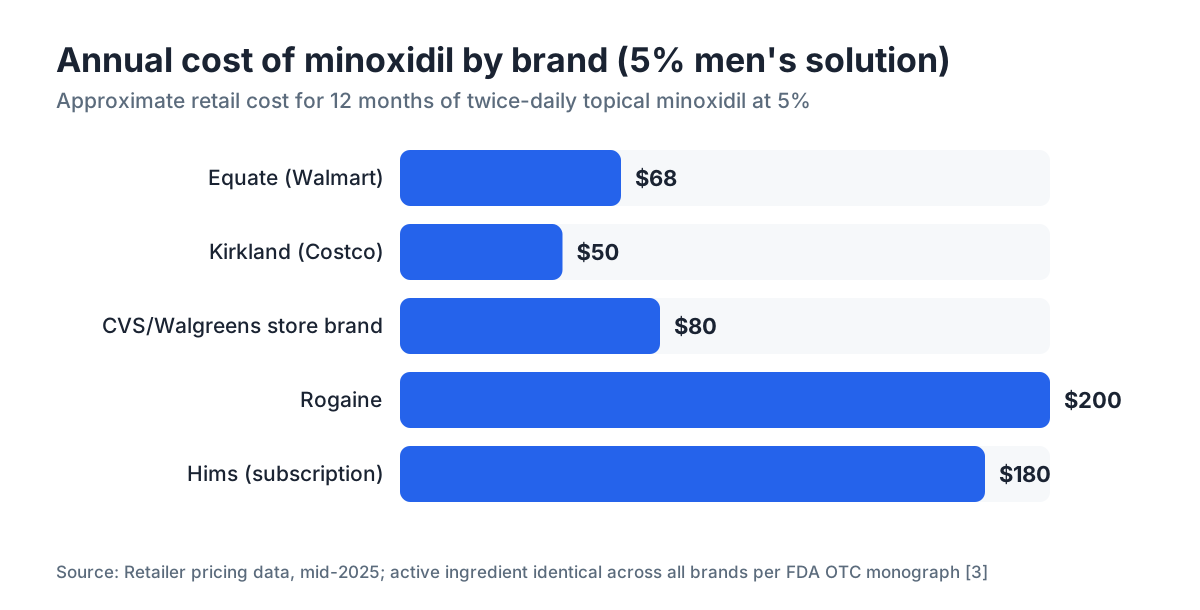
Minoxidil only works while you use it. Stop, and the regrowth sheds out within three to six months.[2] That makes annual cost the honest number to look at, not the price on the box.
| Product | Equate (approx.) | Rogaine (approx.) | Annual Equate cost | Annual Rogaine cost |
|---|---|---|---|---|
| 5% Solution, 3-month supply | $17 | $50 | $68 | $200 |
| 5% Foam, 3-month supply | $20 | $60 | $80 | $240 |
| 2% Solution (women), 3-month supply | $16 | $45 | $64 | $180 |
Prices are approximate as of mid-2025, based on Walmart and major retail listings, and they move around with promotions and supply. Over five years of steady use, choosing Equate over Rogaine saves somewhere between $600 and $900 depending on the formulation. Same drug doing the work, several hundred dollars less.
Kirkland Signature (Costco) and other generics land in the same price range as Equate. Picking between them mostly comes down to which inactive-ingredient profile your scalp puts up with.
What results can you realistically expect from Equate minoxidil?
Minoxidil won't grow a full head of hair on a bald scalp. Set that expectation before you spend a dollar.
The original FDA-reviewed trials for 5% minoxidil found that after 48 weeks, about 40% of men reported moderate to dense regrowth.[1] Most of the rest held onto what they had or saw minimal new growth. Roughly 1 in 10 got nothing. Those numbers apply to Equate exactly as they do to Rogaine, because the molecule is identical.
The best responders catch things early, usually with a smaller thinning patch at the crown. Minoxidil does less on a fully slick vertex or a hairline that's already pulled back. If your receding hairline has moved well past the early stage, pairing minoxidil with finasteride gives you better odds than minoxidil on its own.[5]
Timing trips people up. The first couple of months often bring a shedding phase where more hair than usual comes out. That's normal. Follicles are cycling into a new growth phase. Don't quit. Most people see no real new growth before month four, and peak results show up closer to twelve months of steady twice-daily use.
A baseline photo helps you judge whether it's working instead of guessing in the mirror. MyHairline's free AI scan at /scan reads your hairline and density from a photo, so you have an objective starting point before you commit to months of daily application.
What are the side effects of Equate minoxidil?
The side effects match any topical minoxidil, because the active ingredient is the same.[1]
Scalp irritation is the common one: itching, flaking, dryness, redness. It shows up more with the propylene glycol solution than the foam. If your scalp is reacting hard, switching from solution to foam is the first thing to try before you give up on treatment entirely.
Unwanted facial hair is possible, especially if the product drips down onto your forehead. Apply it carefully and wash your hands right after. Women get bothered by this more often than men.
Systemic absorption from a topical is low, but not zero. Rarely, people report dizziness, a racing heartbeat, or fluid retention. Those matter more with oral minoxidil, but if you have a history of heart disease or low blood pressure, talk to a doctor before you start anything with minoxidil in it.[2] The FDA label is blunt: "For external use only. Do not use if you have heart disease."[1]
For a full rundown of what's likely, what's rare, and what to do about each, see minoxidil side effects.
Is Equate minoxidil FDA-approved?
Topical minoxidil for OTC hair regrowth is FDA-approved, and Equate is a generic that has to comply with the FDA's OTC drug rules, including the monograph system for topical hair-loss products.[1][3]
Under the OTC monograph framework, a manufacturer doesn't file a new drug application for a formula that matches an approved set of conditions. It has to meet the manufacturing standards, labeling rules, and concentration limits the monograph spells out. Equate's 5% men's and 2% women's products sit inside those limits.
The FDA doesn't test every store-brand batch before it reaches the shelf. It does hold manufacturers to standards and it has enforcement power when they fall short. The track record for generic minoxidil, store brands included, has been clean. There's no documented case of widespread quality failure with a major retail generic like Equate.
Want to check a product's status yourself? The FDA's OTC drug monograph pages and DailyMed are the tools for it.[3]
Can women use Equate minoxidil?
Women should use Equate's 2% solution, which is labeled and FDA-approved for female pattern hair loss. The 5% men's product is not approved for women, and the label tells women not to use it.[1]
Off-label 5% use in women does happen, and some dermatologists recommend it, usually for women with significant androgenetic alopecia who didn't respond to 2%. A 2011 randomized controlled trial in the Journal of the American Academy of Dermatology found 5% foam once daily worked at least as well as 2% solution twice daily in women, and better on some measures.[6] That's still a clinical decision, not a self-medication one.
For women, what causes hair loss is often a knottier question than it is for men. Thyroid problems, iron deficiency, and hormonal shifts all show up, and treating the root cause can matter as much as the minoxidil you put on top.
One more thing: women who are pregnant or trying to conceive should not use minoxidil at all. Animal studies show fetal harm, and while the human data is thin, the risk is enough to skip it entirely during pregnancy.[9]
Should you combine Equate minoxidil with finasteride or other treatments?
For men with androgenetic alopecia, topical minoxidil plus finasteride is the best-supported pairing you can put together. A 2015 randomized controlled trial in Dermatologic Therapy found 5% minoxidil plus 1 mg finasteride daily produced a bigger hair-count improvement at 12 months than either drug by itself.[5]
The reason is simple. They hit different targets. Minoxidil pushes follicle growth directly. Finasteride blocks DHT, the hormone that shrinks follicles in genetically prone men.[7] Equate minoxidil is the cheap, easy half of that combo. Finasteride needs a prescription and carries its own side-effect profile you should understand before starting.
Read more about finasteride and how the two work together at finasteride and minoxidil. If you're weighing the DHT side of things more broadly, dht blocker covers the full range, prescription and OTC.
Not ready for finasteride? Equate minoxidil on its own is a fair starting point. Low cost, low barrier, and the standalone evidence for early to moderate loss holds up. It won't stop DHT from driving more loss, though, so keep your expectations honest.
What happens if you stop using Equate minoxidil?
The hair minoxidil kept or regrew will shed, usually within three to six months of quitting.[2] Understand that before you start. You're not curing anything. You're managing a process that keeps going.
Some people are fine with that. They run minoxidil for a while, get the regrowth, then stop and accept the slide back to baseline. Others find that discouraging and want to know upfront that this is a long-term habit.
Stopping and restarting doesn't seem to do permanent damage. The follicles settle back to their pre-treatment state. But you'll probably lose ground during each break, and the hair you get back on a second run may not reach the density of the first.
If cost is the reason you're thinking about quitting, run the numbers again. At about $68 a year for Equate 5% solution, staying on it is cheaper than most people assume.
How does Equate minoxidil compare to Kirkland and other generics?
Kirkland Signature (Costco), Hims, Keeps, and the pharmacy house brands all sell topical minoxidil at the same concentrations. Same active ingredient across the board. The differences that actually matter:
Kirkland 5% solution: One of the cheapest options for years, often $20 to $25 for a six-month supply. High propylene glycol. A longtime favorite in hair-loss forums. No foam.
Equate: Priced like Kirkland, sold without a Costco membership, and now available as a foam.
Hims / Keeps: Subscription services that bundle minoxidil (sometimes with finasteride) and layer on telehealth. More expensive per unit of minoxidil, but handy if you also want prescription finasteride managed in one place.
Pharmacy brands (CVS, Walgreens, Target Up&Up): Same price tier as Equate, same formulations. Comes down to where you already shop.
If your scalp handles propylene glycol without complaint, Kirkland solution is historically the best pure value. If you want foam or you'd rather skip a Costco membership, Equate is a straight swap. Neither one is a mistake.
Are there any quality or safety concerns with Equate specifically?
No large-scale quality or safety problems with Equate minoxidil show up in FDA enforcement records or peer-reviewed literature. The FDA's MedWatch system collects reports on OTC products across the board, but Equate minoxidil isn't tied to a pattern that points to a manufacturing issue.[8]
The complaint users bring up most is foam texture varying between production batches. Some report the foam dispenses a little differently from one can to the next. That doesn't touch the minoxidil concentration, but it can make application easier or harder on a given day. Cosmetic annoyance, not a safety flag.
If you notice something off (color change, separation, an odd smell), the FDA wants to hear about it through MedWatch. That reporting loop is how quality problems in generics get caught.
Worth flagging: if your hair is coming out in a pattern that looks sudden or unusual, look into that separately. Telogen effluvium is a common cause of sudden diffuse shedding, often kicked off by stress, illness, or a nutritional gap, and minoxidil won't touch the underlying trigger.
Sources
- FDA, DailyMed: Minoxidil 5% Topical Solution OTC label
- Adil A, Godwin M. Journal of the American Academy of Dermatology, 2017: The effectiveness of treatments for androgenetic alopecia
- FDA, Generic Drug Facts
- NIH National Library of Medicine, DailyMed: Minoxidil topical foam and solution labels
- Khandpur S et al. Dermatologic Therapy, 2015: Combination of finasteride and 5% topical minoxidil vs monotherapy in men
- Blume-Peytavi U et al. Journal of the American Academy of Dermatology, 2011: 5% minoxidil foam once daily vs 2% solution twice daily in women
- Rossi A et al. Dermatologic Therapy, 2016: Minoxidil mechanism of action review
- FDA MedWatch, voluntary reporting for OTC drugs
- NIH National Library of Medicine, DailyMed: Minoxidil 2% solution label (women)