

TL;DR: The Norwood scale was built for male-pattern baldness and describes women's hair loss poorly. Dermatologists use the Ludwig scale or Sinclair scale for women instead. Female hair loss usually causes diffuse thinning across the crown with a preserved hairline, not deep temple recession. Treatments differ too: topical minoxidil is FDA-approved for women, finasteride is not.
Why the Norwood scale doesn't really work for women
The Norwood scale, formally the Hamilton-Norwood scale, was published in its modern form by O'Tar Norwood in 1975, based almost entirely on men [1]. It maps hair loss as a march through seven stages of hairline recession and crown thinning, ending in the horseshoe of hair around the sides and back. That pattern comes from dihydrotestosterone (DHT) sensitivity in the frontal and crown follicles, a process called androgenetic alopecia.
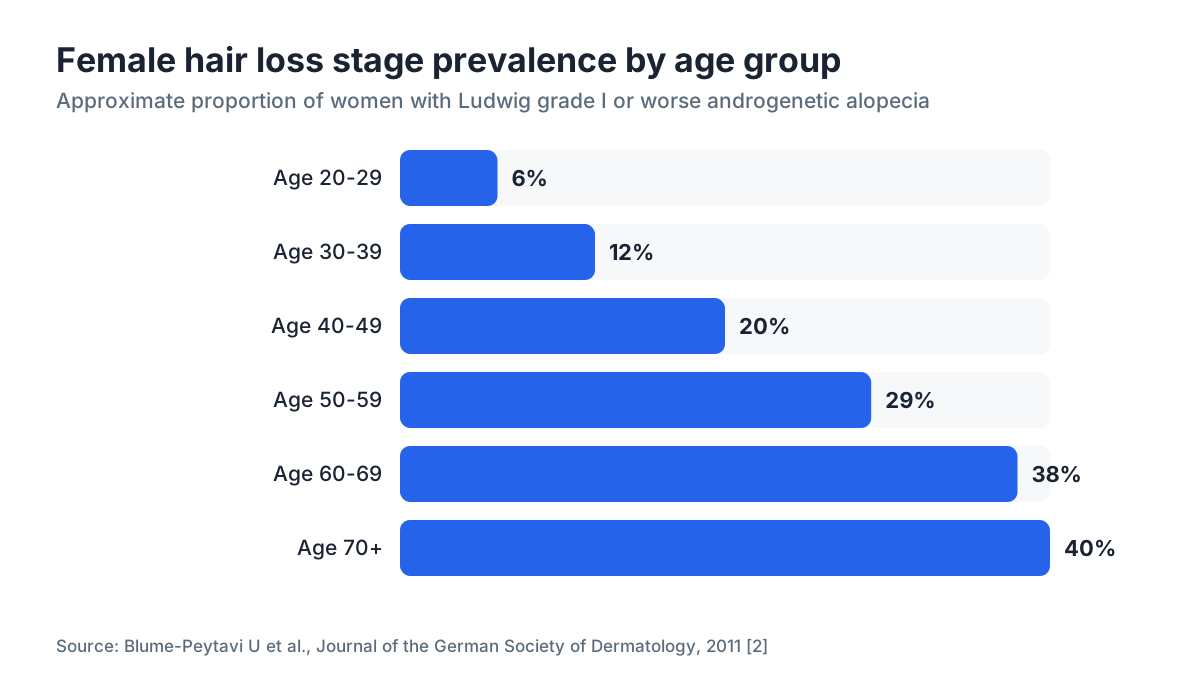
Women get androgenetic alopecia too. Roughly 40 percent of women show it by age 70 [2]. But the pattern is different in most cases. Women rarely develop the deep temple recession that defines Norwood stages II through IV, and a true Norwood VII in a woman is uncommon. What happens instead: density fades across the top and crown while the front hairline stays mostly intact. The biology overlaps with men's. The picture on the scalp does not, and forcing a seven-stage male chart onto it confuses more than it clarifies.
Dermatologists sometimes still write "Norwood stage III" in shorthand for a woman, and the phrase "norwood scale female" turns up in clinical notes. What they usually mean is that this particular woman's pattern looks more like that Norwood stage than anything else. It's a rough approximation, and most specialists know it.
So if you're a woman trying to read your own hair loss, the Norwood scale hands you a vague direction, not an accurate map. The scales built for women do a far better job.
Which hair loss scales actually apply to women?
Three systems get real clinical use for female hair loss: the Ludwig scale, the Sinclair scale, and the BASP (Basic and Specific) classification. Each was built to describe the diffuse crown thinning that defines most female pattern loss.
Ludwig scale (1977) [3]: The oldest and most cited scale for women. Ludwig split female androgenetic alopecia into three grades by how much thinning shows over the central scalp.
| Ludwig Grade | What you see |
|---|---|
| I | Mild thinning on the crown; the part looks slightly wider than before; hairline intact |
| II | Clearly visible thinning on crown; scalp visible through the part; hairline still mostly intact |
| III | Severe thinning; scalp easily visible across the crown; hairline may show some retreat |
Sinclair scale (2004) [4]: Built around a single overhead photograph of a central part. It runs from grade 1 (normal) to grade 5 (severe diffuse thinning). Many dermatologists reach for it during serial photography because one fixed reference point makes change over time easy to measure. The 2004 European Journal of Dermatology paper that introduced it validated the scale against Ludwig and found strong correlation.
BASP classification: Covers both the basic pattern (hairline type) and specific patterns (density loss in the frontal and vertex regions). It handles the overlap between male-pattern and female-pattern presentation, which helps for women who do show some frontal recession.
For most women, a Ludwig grade paired with a scalp photo is the standard your dermatologist uses to track how treatment is working.
What does female androgenetic alopecia actually look like by stage?
Reading the stages of female hair loss beats trying to force-fit a Norwood number. Here is what each Ludwig grade looks like in the mirror.
Early-stage (Ludwig I): The part looks a bit wider. You notice more hair on the pillow or in the shower drain. The front hairline hasn't moved. Most women here are half-convinced they're imagining it, and dermatologists sometimes can't confirm it without trichoscopy or a pull test.
Mid-stage (Ludwig II): The scalp shows through the hair on top under overhead light or when you bend forward. The Christmas-tree pattern, where density thins in a triangle spreading down from the part, becomes clear. The ponytail is noticeably thinner around.
Late-stage (Ludwig III): Widespread thinning across the crown. Some women here also start to see recession near the temples, which is where the overlap with Norwood shows up. Without treatment, progression can continue, though the rate varies enormously from one person to the next.
A small group of women, especially those with polycystic ovary syndrome (PCOS) or higher androgen levels, develop a pattern closer to Norwood II-III, with visible temple recession. In those cases a dermatologist might reasonably use Norwood language.
If you want a clearer read on where your own hairline and density sit right now, myhairline.ai's free AI scan gives you a baseline you can track over time before your first dermatologist visit.
What causes hair loss in women at each stage?
Androgenetic alopecia is the most common cause at every Ludwig stage, but it's far from the only one. This matters because the treatment changes depending on the cause.
Telogen effluvium causes diffuse shedding that can mimic Ludwig I-II. It's triggered by physical stress: childbirth, surgery, crash dieting, thyroid disruption, or a severe illness. The shedding usually starts two to three months after the trigger and clears within six to nine months once the trigger is gone. Women in the middle of a telogen effluvium episode sometimes think they're staging into Ludwig II when they're actually dealing with a temporary shed.
Iron deficiency is another common overlap. A 2003 study in the Journal of Investigative Dermatology found that low serum ferritin is associated with hair loss in women, though whether it causes female pattern loss is still debated [5].
Thyroid disorders, hypothyroid or hyperthyroid, cause diffuse thinning that again looks like early Ludwig staging. A basic blood panel (TSH, ferritin, CBC) before any treatment is reasonable.
For a broader look at root causes, see what causes hair loss.
The practical upshot: if you're a woman seeing thinning across the crown, a dermatologist will often order bloodwork before assuming androgenetic alopecia, because treating the wrong thing burns time and money.
How is female hair loss diagnosed?
Diagnosis for women takes more steps than for men, because the differential (the list of things it might be) is longer. A thorough workup usually means a physical exam, scalp imaging, and blood tests.
A dermatologist will do a pull test, grasping 40 to 60 hairs and pulling gently; shedding more than 6 hairs counts as abnormal [6]. They'll examine the scalp under a dermatoscope or trichoscope to check follicle density, miniaturization (smaller, thinner hairs replacing normal ones), and inflammation around the follicle. If the pattern is unclear, they may take a 4mm punch biopsy.
Blood tests vary by practice but commonly cover ferritin, thyroid-stimulating hormone (TSH), free and total testosterone, DHEA-S, prolactin, and a full blood count.
Photos matter a lot. The scalp gets shot from standardized angles, usually a top-down view through a central part, and again at follow-up. That's why the Sinclair scale, built around that overhead photo, sees so much clinical use.
The whole process can run across a few appointments over several weeks, which is maddening when you want answers now. Getting bloodwork done before your first dermatology visit, if your GP will order it, moves things along.
Does the Norwood scale predict hair loss in women the same way it does in men?
No, and this is one of the more important things to grasp. In men, the Norwood stage at a given age predicts future progression reasonably well, partly because the genetics and the DHT-driven mechanism stay fairly consistent. A man at Norwood III at 30 has a high chance of reaching Norwood V or beyond without treatment.
In women, prediction is harder. Female androgenetic alopecia tends to move more slowly than the male version [7]. Hormonal shifts, especially the estrogen drop at menopause, often speed thinning, so some women see little change for decades and then notice faster loss in their fifties. Menopause-linked androgenetic alopecia can look more Norwood-like than premenopausal female hair loss does.
Because female hair loss doesn't follow one consistent track, staging is better for recording current status and treatment response than for predicting where things land in ten years. Still, earlier treatment generally produces better outcomes. Waiting to "see if it gets worse" is usually the wrong move once thinning is confirmed.
What treatments work for women with pattern hair loss?
The evidence base for female hair loss is thinner than for men, partly because many early trials shut women out. Here's what has real data behind it.
Topical minoxidil (2% or 5%): The FDA approved 2% topical minoxidil for women in 1991 for androgenetic alopecia. The 5% foam, first approved for men, now sees wide off-label use in women and beats 2% in head-to-head trials. A 2002 randomized trial in the Journal of the American Academy of Dermatology found 5% minoxidil outperformed 2% in women at 48 weeks, with 45 percent versus 30 percent rating regrowth as moderate or better [12]. Common minoxidil side effects in women include a temporary shed in weeks 2 to 8 and facial hypertrichosis (unwanted facial hair), which shows up more with 5% than 2%.
Oral minoxidil (low-dose): Oral minoxidil at 0.25 to 1 mg daily has growing evidence in women, with low doses showing meaningful density improvement in retrospective series. It's not FDA-approved for hair loss, so it's used off-label.
Spironolactone: An anti-androgen used off-label for female androgenetic alopecia, especially in women with elevated androgens. Standard doses run 50 to 200 mg daily and require monitoring for electrolyte problems [13]. It's a DHT blocker approach that makes biological sense, though large randomized trials are lacking.
Finasteride: FDA-approved for men, not for women [9]. It's teratogenic in pregnancy, which rules it out for premenopausal women who might conceive. Some dermatologists prescribe it off-label to postmenopausal women. See the detailed finasteride breakdown for mechanism and risk.
Hair transplant: Women are candidates for hair transplant surgery, but the bar is higher. Women need stable donor density, a confirmed androgenetic alopecia diagnosis (not diffuse alopecia areata or scarring alopecia), and realistic expectations. Results hinge on whether the donor area stays stable.
Hair loss supplements: Biotin, saw palmetto, and similar products get heavy marketing. The evidence is weak for most. If you're low on iron, zinc, or vitamin D, fixing that deficiency may help. Supplementing without a confirmed deficiency has almost nothing behind it.
Can women use finasteride for hair loss?
This comes up constantly, so here's a direct answer. Finasteride is not FDA-approved for women [9], and premenopausal women should not take it because of birth-defect risk.
The FDA label states that finasteride tablets should not be handled by women who are pregnant or may become pregnant, because of the risk of birth defects (specifically ambiguous genitalia in male fetuses). A 1997 controlled trial failed to show benefit for finasteride 1 mg in postmenopausal women with androgenetic alopecia, which is part of why it never earned an approved indication for women.
That said, some dermatologists prescribe it off-label to postmenopausal women, at doses of 1 to 5 mg. Some studies report benefit at 5 mg in postmenopausal women. If you're postmenopausal and want to weigh this, a dermatologist or endocrinologist who knows female hair loss is the person to have that conversation with.
For premenopausal women, the teratogenicity risk is considered prohibitive unless you're certain you won't become pregnant and are using reliable contraception. Most prescribers won't go there.
Dutasteride (a stronger 5-alpha reductase inhibitor) has even less evidence in women and carries the same pregnancy risk.
How does female pattern hair loss compare to male pattern hair loss?
A side-by-side is the clearest way to see why one scale can't cover both.
| Feature | Male pattern (AGA) | Female pattern (AGA) |
|---|---|---|
| Primary scale | Norwood I-VII | Ludwig I-III / Sinclair 1-5 |
| Hairline recession | Common; starts at temples | Rare; hairline mostly preserved |
| Crown involvement | Yes, often severe | Yes, usually the primary site |
| Frontal thinning | Yes | Christmas-tree pattern common |
| Complete baldness | Possible (Norwood VII) | Extremely rare |
| Onset | Often 20s-30s | Often 40s-50s; menopause accelerates |
| DHT sensitivity | High | Present but usually lower than men |
| First-line FDA treatment | Minoxidil, finasteride | Minoxidil (2% approved) |
| Prevalence by age 70 | ~80% some loss | ~40% some loss [2] |
Female hair loss is almost always less severe in absolute terms, moves more slowly, and carries a different emotional weight because cultural expectations around women's hair run higher. Complete baldness in women is extremely rare. That's the real difference the numbers don't show.
When should a woman see a dermatologist about hair loss?
The honest answer: earlier than most women go. Women typically wait three to five years after first noticing thinning before seeking care, and that delay costs them.
Minoxidil and other treatments work better on miniaturizing follicles than on follicles that have already quit producing hair. Every year of waiting shrinks the pool of follicles you can still save.
See a dermatologist promptly if:
You notice sudden heavy shedding (more than 150 to 200 hairs a day, easily visible in the shower or on a brush). Sudden shedding can signal a triggering condition that needs its own treatment, more than hair-focused care.
Your part is visibly wider than it was a year ago. Progression to Ludwig II is already underway.
You have other symptoms alongside hair loss: irregular periods, acne, unexpected facial hair, or weight changes. These point toward a hormonal cause worth evaluating, possibly PCOS or a thyroid issue.
You're under 30 and losing hair. Early-onset androgenetic alopecia can move fast, and early treatment makes a real difference.
A GP can order initial bloodwork, but a board-certified dermatologist or a trichologist is the right specialist for ongoing management. The American Academy of Dermatology has a find-a-dermatologist tool on its website [6].
If you want to document what you're seeing before that appointment, an AI-based baseline gives you a consistent starting point. The myhairline.ai free AI scan is one option for pre-appointment documentation.
Is there a way to slow or stop female pattern hair loss?
Slow it, yes. Stop it completely, unlikely without ongoing treatment. Reverse it fully, rare, though partial reversal happens with consistent treatment.
Minoxidil works by stretching the anagen (growth) phase of the hair cycle and increasing blood flow to the follicle. It doesn't cure the underlying androgen sensitivity; it manages the symptom. That's why stopping minoxidil usually brings shedding back within three to six months.
Spironolactone tackles the androgen side more directly, which is why some dermatologists pair it with topical minoxidil for women with documented high androgens or those who didn't respond to minoxidil alone.
Low-level laser therapy (LLLT), sold as FDA-cleared at-home devices, has some evidence for modest improvement. A 2014 randomized sham-device controlled trial in Lasers in Surgery and Medicine found statistically significant hair count improvement with an LLLT device in women [11]. The effect is smaller than minoxidil's, but the side effects are minimal.
Lifestyle factors have modest effects. Enough dietary protein, correcting iron or vitamin D deficiency, and managing chronic stress can cut the telogen effluvium that piles on top of androgenetic alopecia. None of that reverses genetic pattern thinning on its own.
The realistic expectation from treatment is stabilization plus modest regrowth, not full restoration. Setting that up front saves a lot of frustration.
Sources
- Norwood OT. Male pattern baldness: classification and incidence. Southern Medical Journal, 1975
- Blume-Peytavi U et al. S1 guideline: diagnosis and treatment of female pattern hair loss. Journal of the German Society of Dermatology, 2011
- Ludwig E. Classification of the types of androgenetic alopecia occurring in the female sex. British Journal of Dermatology, 1977
- Sinclair R et al. A new scale for measuring female pattern hair loss after the menopause. European Journal of Dermatology, 2004
- Kantor J et al. Decreased serum ferritin is associated with alopecia in women. Journal of Investigative Dermatology, 2003
- American Academy of Dermatology. Hair loss: diagnosis and treatment
- Dinh QQ, Sinclair R. Female pattern hair loss: current treatment concepts. Clinical Interventions in Aging, 2007
- U.S. Food and Drug Administration. Finasteride (Propecia) prescribing information
- Lanzafame RJ et al. The growth of human scalp hair in females using visible red light laser and LED sources. Lasers in Surgery and Medicine, 2014
- Olsen EA et al. A randomized clinical trial of 5% topical minoxidil versus 2% topical minoxidil and placebo in the treatment of androgenetic alopecia in men and women. Journal of the American Academy of Dermatology, 2002
- Sinclair R et al. Treatment of female pattern hair loss with oral antiandrogens. British Journal of Dermatology, 2005