
TL;DR: Generic finasteride (1 mg) costs roughly $10 to $30 per month at a pharmacy with a GoodRx coupon or discount card. Brand-name Propecia runs $85 to $110 for the same 30 pills. Telehealth subscriptions bundle the prescription and land at $20 to $50 per month. Insurance rarely covers it for hair loss but usually covers 5 mg finasteride for BPH.
What does finasteride cost without insurance?
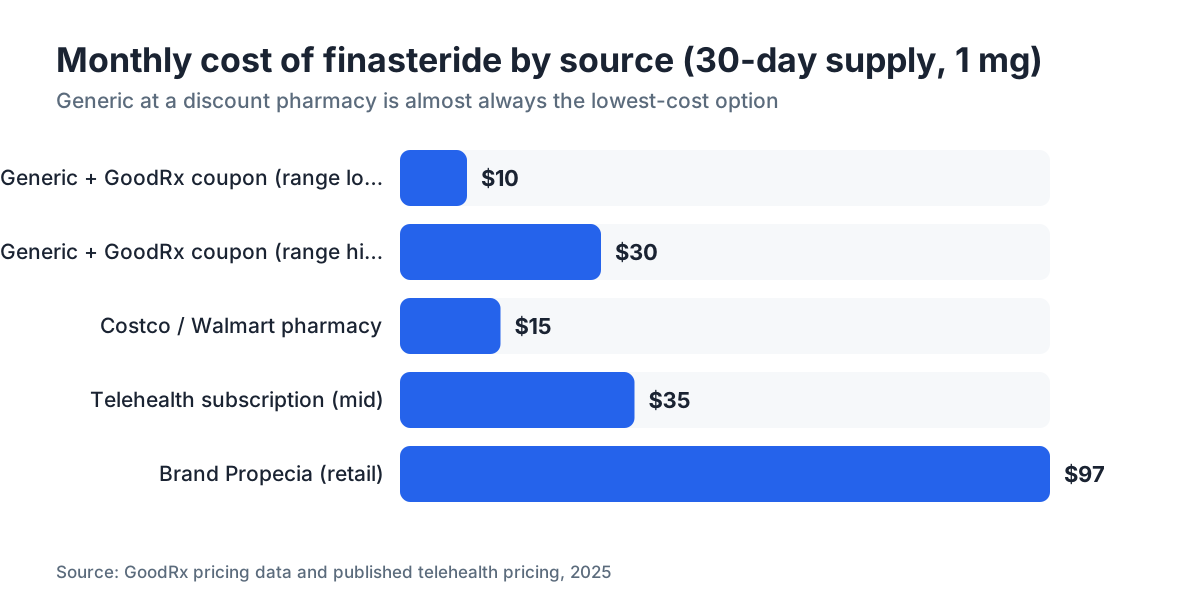
Generic finasteride 1 mg is one of the cheapest long-term medications you can take. Full retail at a chain pharmacy runs $50 to $70 for 30 tablets. Add a free GoodRx or RxSaver coupon and that number falls hard. In most U.S. markets, a 30-day supply of generic finasteride 1 mg lands between $10 and $30 with a discount card [1].
Where you fill it matters. Costco, Walmart, and Sam's Club pharmacies tend to be the cheapest. CVS and Walgreens retail prices sit higher, but coupon sites close the gap. A 90-day supply usually shaves another 10 to 20% off the per-pill cost at most chains.
Brand-name Propecia, made by Organon (formerly Merck), lists at roughly $85 to $110 for 30 tablets at U.S. retail [2]. The active ingredient is identical to the generic at the same dose. No published study shows Propecia beating a good generic on hair outcomes. I'd skip it.
Finasteride 5 mg tablets, approved for benign prostatic hyperplasia (BPH), get prescribed off-label for hair loss and then split into halves or quarters. The 5 mg tablets often cost the same or less per pill than the 1 mg version, which is why splitting is a common way to cut the bill. Talk to your prescriber before you split. The dose math has to be right, and the tablet has to be scoreable.
How much does finasteride cost through telehealth services?
Telehealth reset the price ceiling on finasteride. Hims, Keeps, Roman, and similar services roll the online consultation, prescription, and monthly supply into one subscription. Most land between $20 and $50 per month, with introductory offers sometimes lower [3].
Read the fine print. Some platforms tack on a one-time consultation fee of $5 to $20. Some lock you into a 3- or 6-month prepayment. A few dispense compounded formulations, which means the product is not an FDA-approved generic. Compounded finasteride sits in a different regulatory category from an approved generic, and the FDA has flagged concerns about the consistency of compounded drugs [4].
For most people, telehealth costs about the same as, or a little more than, a generic at a discount pharmacy. The extra dollars buy convenience: no in-person visit, no waiting room, refills renewed automatically. That convenience is real. For some people it's the difference between starting treatment and never getting around to it. Just confirm the pharmacy filling your script is state-licensed or NABP-accredited.
Already have a primary care doctor or a dermatologist? Ask them for the script. Generic finasteride at Costco with a GoodRx code is often the cheapest path there is.
Does insurance cover finasteride for hair loss?
Usually no. Most commercial plans, including Medicare Part D, treat finasteride for androgenetic alopecia (male pattern hair loss) as cosmetic and exclude it [5]. That's the honest answer, and it surprises people.
There's an exception worth knowing. Finasteride 5 mg for BPH is a different animal. Plans and Medicare Part D commonly cover it because BPH is a medical diagnosis, not a cosmetic one. Some physicians prescribe 5 mg tablets and have the patient split them. If your doctor writes the script for BPH and you also happen to have hair loss, the coverage picture changes. That's a conversation to have with your doctor, not something to engineer on your own.
An HSA or FSA changes the math too. Prescription finasteride is a qualified medical expense under IRS rules, even for hair loss [6]. You're paying with pre-tax dollars, which cuts the real cost by your marginal tax rate. On a 22% bracket, a $30/month prescription costs closer to $23 after tax. Not dramatic. Still real.
Employer drug discount programs run through PBMs sometimes cover generic finasteride at a $5 to $10 copay even when the formulary technically excludes it as cosmetic. Check your plan's drug lookup tool before you assume you'll pay full retail.
Finasteride price comparison: generic vs. brand vs. telehealth
The table below pulls real price ranges from pharmacy data and published telehealth pricing. Prices reflect a 30-day supply of 1 mg finasteride as of mid-2025. Actual prices move by location and change often, so read these as directional, not firm quotes [1][2][3].
| Source | 30-day cost (est.) | Notes |
|---|---|---|
| Retail pharmacy, no discount | $50, $70 | CVS, Walgreens full price |
| Retail pharmacy + GoodRx coupon | $10, $30 | Varies by chain and ZIP code |
| Costco / Walmart pharmacy | $10, $20 | Often cheapest without coupon |
| Telehealth (Hims, Keeps, Roman) | $20, $50 | Includes consult; some lock-ins |
| Brand Propecia (no coupon) | $85, $110 | Same active ingredient as generic |
| Compounded finasteride | $25, $60 | Not FDA-approved drug; varies by compounder |
The pattern is clean. Generic at a discount pharmacy or big-box store wins on price almost every time. Telehealth adds convenience but rarely beats a Costco run on dollars. Propecia is the same molecule at roughly four times the cost.
What's the total cost of finasteride over a year, 5 years, or longer?
This matters because finasteride is not a short course. The American Academy of Dermatology says treatment takes at least 12 months to show meaningful results, and stopping it causes the hair you kept to shed within 6 to 12 months [7]. Most men who respond stay on it indefinitely.
At $20/month, a year costs $240. Five years, $1,200. Ten years, $2,400. Those aren't scary figures for an ongoing medication, but they stack up when you're paying out of pocket.
At the telehealth median of $35/month, a 10-year run costs about $4,200. At brand Propecia ($100/month), you'd spend $12,000 over 10 years for the same outcome. The case for generic makes itself.
For perspective, a hair transplant, the fallback if medication stops working, runs $4,000 to $15,000 as a one-time procedure [8]. Some men do the math and treat finasteride as cheap insurance against a bigger bill later. That framing is fair, though it's no guarantee, since finasteride doesn't work for everyone. See our finasteride overview for response-rate data.
If cost ever becomes a barrier, ask your prescriber about 5 mg tablets and pill splitting. Same drug. Plenty of dermatologists recommend it without hesitation.
Can you get finasteride cheaper outside the U.S.?
Yes, a lot cheaper in many countries. In Canada, the UK (through the NHS or a private prescription), India, and much of Europe, generic finasteride runs the equivalent of $3 to $10 per month. That gap is the whole reason medical tourism and cross-border pharmacy buying exist.
Importing prescription drugs from foreign pharmacies is technically illegal under federal law for individuals, though the FDA's personal-use policy has historically let customs use discretion for small quantities (under a 90-day supply) meant for personal use [4]. The FDA does not affirmatively authorize this and can seize shipments. Enforcement against individuals has been light historically, but it isn't zero, and the quality of unvetted foreign pharmacies varies wildly.
If cost is a genuine hardship, the better move is a GoodRx-style coupon at a U.S. licensed pharmacy, or 5 mg tablets to split. Both are legal, simple, and usually get you under $15/month.
Don't order from random online pharmacies flashing a U.S. address. The FDA's BeSafeRx program has documented counterfeit medications in the supply chain from unlicensed online sellers [4].
Does combining finasteride with minoxidil cost more, and is it worth it?
Adding minoxidil for men to a finasteride regimen is the combination dermatologists reach for most in androgenetic alopecia. Topical minoxidil 5% (generic Rogaine) adds roughly $15 to $25/month. Oral minoxidil, an off-label option that's grown popular, runs $10 to $30/month at a discount pharmacy [9].
So a finasteride plus minoxidil stack runs $25 to $60 per month total for generics, depending on the minoxidil form and where you buy it.
A 2021 network meta-analysis in JAMA Dermatology found the finasteride-plus-minoxidil combination beat either drug alone on hair count [10]. Whether that extra gain justifies doubling your monthly spend depends on how you're responding to a single drug and how much the added improvement matters to you. See finasteride and minoxidil for a side-by-side breakdown.
For oral minoxidil specifically, the cost tracks topical but the convenience is higher (a pill instead of a daily scalp application). For some people that convenience is what keeps them consistent, and consistency matters more than which formulation you pick.
Are there any hidden costs or fees to watch for?
A few things catch people off guard.
Consultation fees are the most common. An in-person dermatologist visit can cost $100 to $300 out of pocket without good insurance, and that's before you fill anything. Most people don't need a specialist. A primary care physician can prescribe finasteride for hair loss and usually costs less to see.
Telehealth platforms sometimes advertise a low monthly price and then charge a separate platform or membership fee. Read what you're actually signing up for before you enter a card number.
Lab work sometimes comes into play, particularly a PSA (prostate-specific antigen) test in men over 40. Finasteride lowers PSA by roughly 50% [2], which changes how prostate cancer screening gets read. Your doctor needs your baseline. A PSA test is usually covered at standard screening age, but out of pocket it can run $30 to $80.
One more thing. Using myhairline.ai's free AI hair analysis scan to track your response over time costs nothing. What costs money is what comes after: a scan that reveals a pattern pushing you toward a hair transplant consultation. Knowing where you stand before you spend is the whole point.
How does finasteride cost compare to other hair loss treatments?
Finasteride is one of only two FDA-approved drug treatments for male pattern hair loss. The other is minoxidil [11]. Everything else (PRP, laser caps, hair loss supplements, DHT shampoos) is either unapproved or backed by weaker evidence.
Here's how the costs stack up:
| Treatment | Monthly cost (est.) | FDA approval (hair loss) |
|---|---|---|
| Finasteride 1 mg (generic) | $10, $30 | Yes (men) |
| Minoxidil topical 5% (generic) | $15, $25 | Yes (men and women) |
| Oral minoxidil (off-label) | $10, $30 | No (off-label use) |
| Low-level laser therapy cap | $20, $50 (amortized) | FDA-cleared device, not drug |
| PRP injections | $300, $700 per session | No |
| Hair transplant | $4,000, $15,000 (one-time) | Surgical, not drug |
| Ketoconazole shampoo | $10, $20 | No (dandruff only) |
Finasteride is the cheapest evidence-backed medical treatment on the board. The dht blocker mechanism is well documented: it inhibits type II 5-alpha-reductase and cuts scalp DHT by roughly 60 to 70% [2]. No supplement or shampoo gets anywhere near that pharmacological effect.
Before spending on any of these, confirm the diagnosis. If you're not sure whether this is pattern loss or something like telogen effluvium, find out first. Finasteride won't help hair shedding from a nutritional deficiency or a thyroid problem.
What affects whether finasteride is worth the cost for you?
Cost is only one input.
Finasteride works best started early. Men with Norwood II or III pattern loss who begin in their 20s or 30s have the most to gain. The drug preserves existing hair better than it regrows what's gone. The further along the receding hairline progression, the less it can do, though it still slows further loss at later stages.
Response rates vary. The original Merck trials showed roughly 85 to 90% of men had no further progression over 2 years, and about 65% saw some regrowth [2]. Those aren't universal outcomes. Some men see dramatic regrowth. Some get stabilization only. A small share don't respond much at all.
Side effects are real but less common than forums suggest. The FDA-approved Propecia label lists sexual side effects (decreased libido, erectile dysfunction, ejaculation disorder) in 3.8% of patients in trials versus 2.1% on placebo [2]. The gap exists. It's narrower than most people expect. See what causes hair loss to figure out whether your specific pattern is likely to respond.
On the fence about starting? myhairline.ai's free AI scan gives you an objective read on your current hairline and stage, which helps you decide whether finasteride makes sense before you sign up for an ongoing monthly expense.
Sources
- GoodRx, finasteride pricing tool
- FDA, Propecia (finasteride) prescribing information
- Hims, finasteride subscription pricing page
- FDA, BeSafeRx safe online pharmacy program
- Medicare.gov, prescription drug coverage overview
- IRS Publication 502, Medical and Dental Expenses
- American Academy of Dermatology, hair loss treatment guidance
- American Society of Plastic Surgeons, hair transplant cost data
- GoodRx, minoxidil oral pricing tool
- JAMA Dermatology, 2021 network meta-analysis on androgenetic alopecia treatments
- FDA, approved drug products for androgenetic alopecia